The Hero
Perseus comes from Greek mythology, part of the story of Andromeda, where he rescues the maiden from being sacrificed to Cetus the sea monster, returning from slaying Medusa. In the sky he’s depicted wielding his sword and holding the head of the Gorgon. In Babylonia he’s the constellation of the “Old Man”.
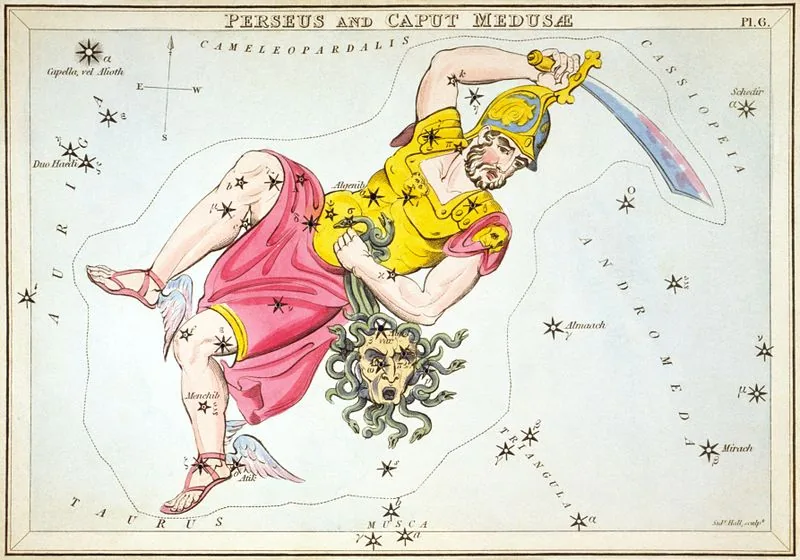
Astronomically, the constellation is almost overhead in the late Fall, lying in the plane of the Milky Way. Therefore, it’s rich in deep-sky objects associated with the Galaxy: open star clusters and nebulae, plus a few extra-galactic objects (though mostly very faint, requiring telescopes of moderate aperture to enjoy them. One very large cluster, centered around α Persei (Mirfak) is a young (50-70 Myr old); Mirfak is the brightest star - a yellow supergiant; several other bright members (incl. δ, ε, and ψ Persei) are all hot, blue, B-type stars, all over 10 times the mass of the Sun, and with lifetimes of only a few million years. Another special star, β Persei is “Algol” the Demon star, representing the eye of Medusa, is one of the first variable stars recorded, officially in 1667, though anecdotally it may have been noticed before then.
The Perseid meteor show is a summer highlight in mid-August, associated with the comet Swift-Tuttle and have been observed for two millennia (at least).
Map of Perseus
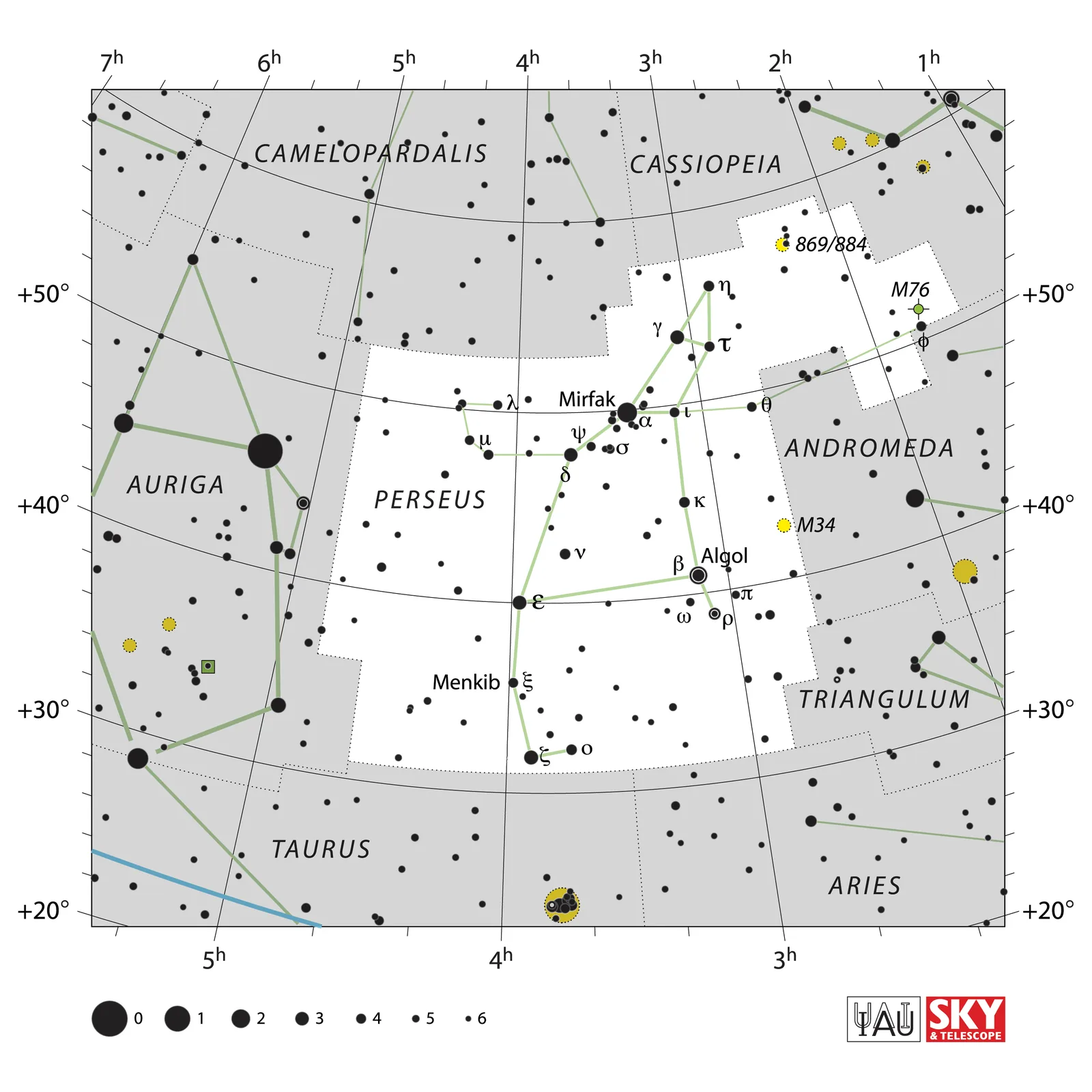
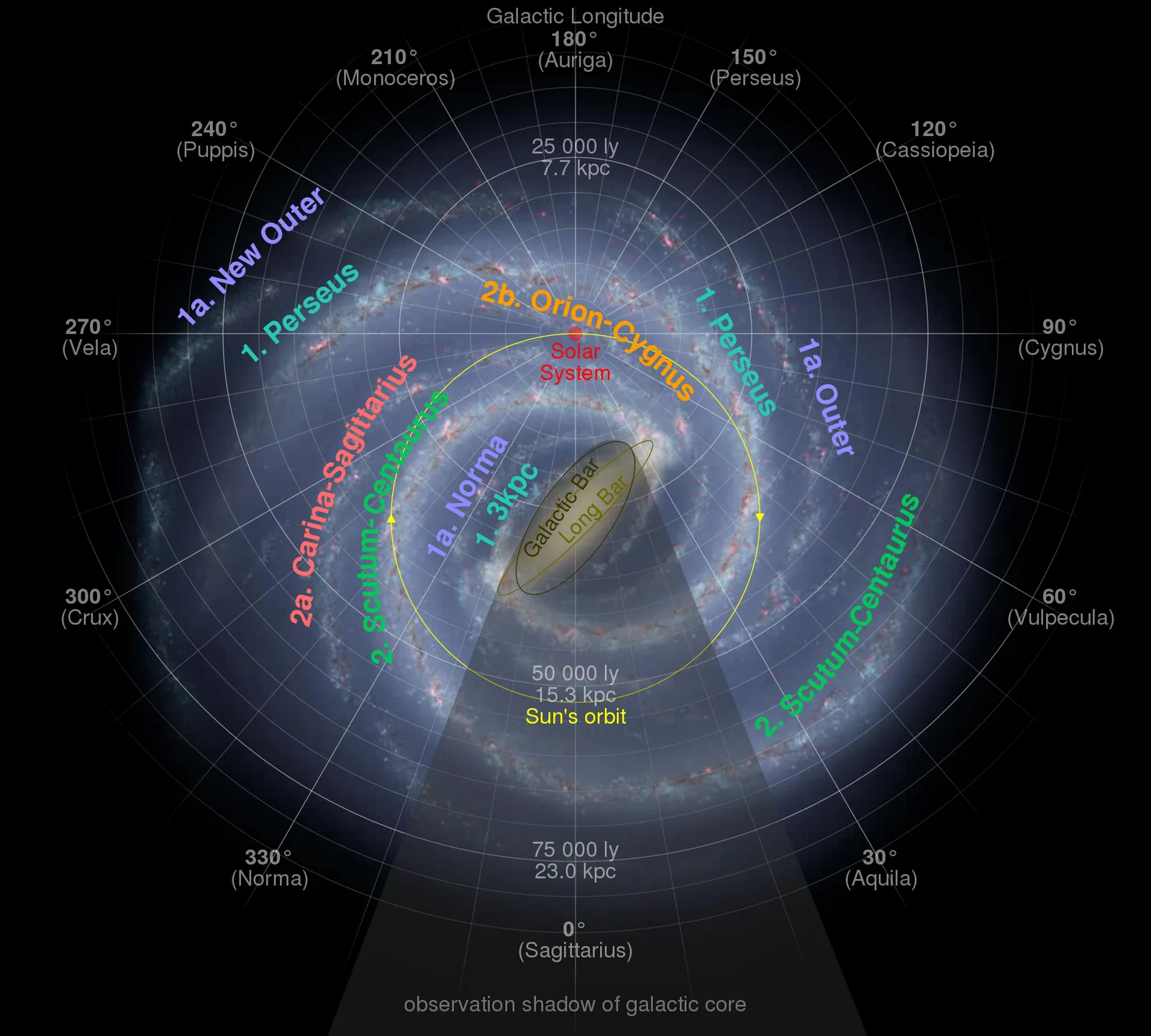
Perseus’ stars form two long trails of moderately bright stars, traced outward from Mirfak: the “head” points to the W of Cassiopeia, and down towards the Pleiades to the south; the second line of stars including Algol towards Triangulum and Aries. The Milky Way is present, although fainter and more diffuse because we’re looking mostly away from the center of the Galaxy (in Sagittarius); the anti-center is in nearby Auriga.
Things to See in Perseus
Quick Reference: Objects of Interest
| Object | Type | Equipment |
|---|---|---|
| χ and h Persei - the "Double Cluster" | Open Clusters | Binoculars, Small Telescope |
| M 76 | Planetary Nebula | Small/Medium Telescope |
| NGC 1245 - the "Starfish Cluster" | Open Cluster | Binoculars, Small Telescope |
| NGC 1499 - the "California Nebula" | Emission Nebula | Telescopes and Imagers |
| C 24 (NGC 1275) - Perseus A | Galaxy Cluster | Medium/Imaging Telescopes |
| β Per - Algol | Eclipsing Variable | Naked Eye/Binoculars |
The Double Cluster
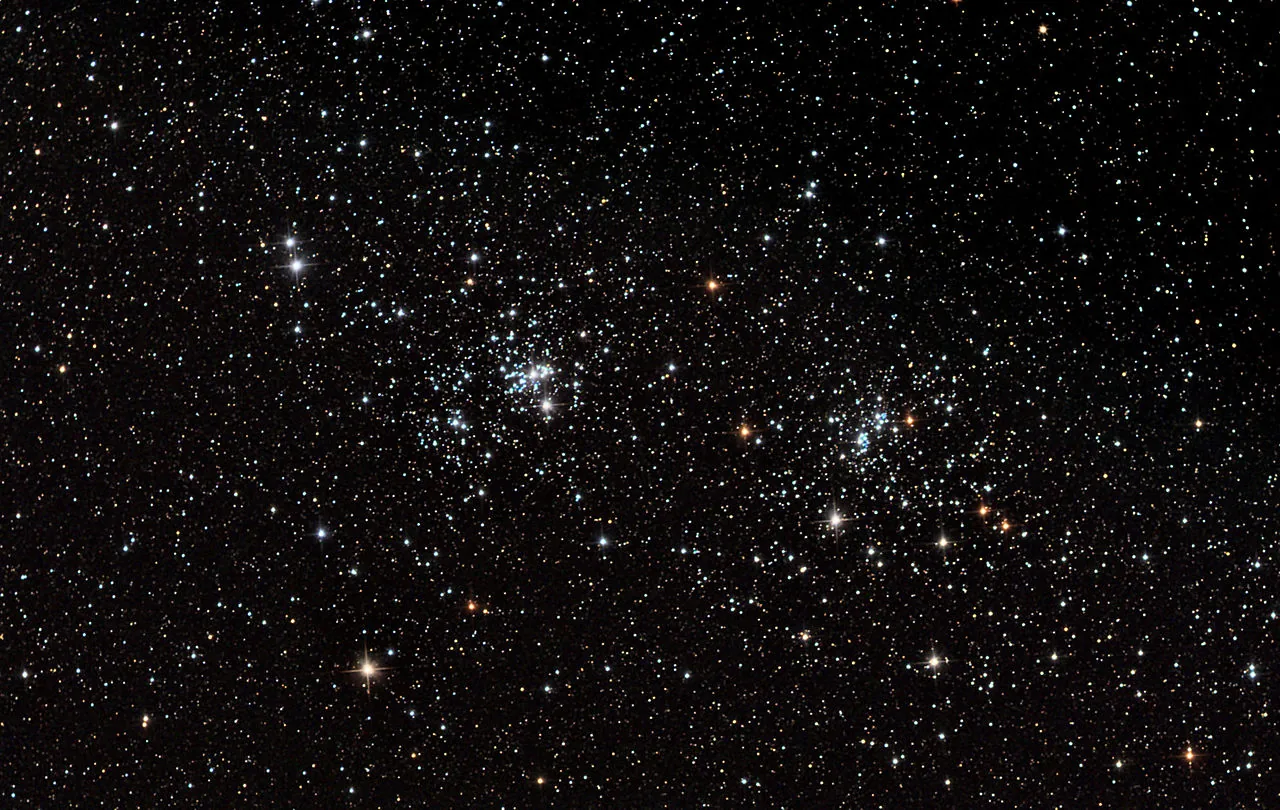
The most famous deep-sky object in Perseus, it is two young (14 Myr old) clusters that actually are close together (only about 200 light years apart), and because they’re so young contain many hot blue stars, with several blue and a few red supergiant stars. It’s easily found between the body of Perseus and the W of Cassiopeia by eye or with binoculars.
The Little Dumbbell Nebula
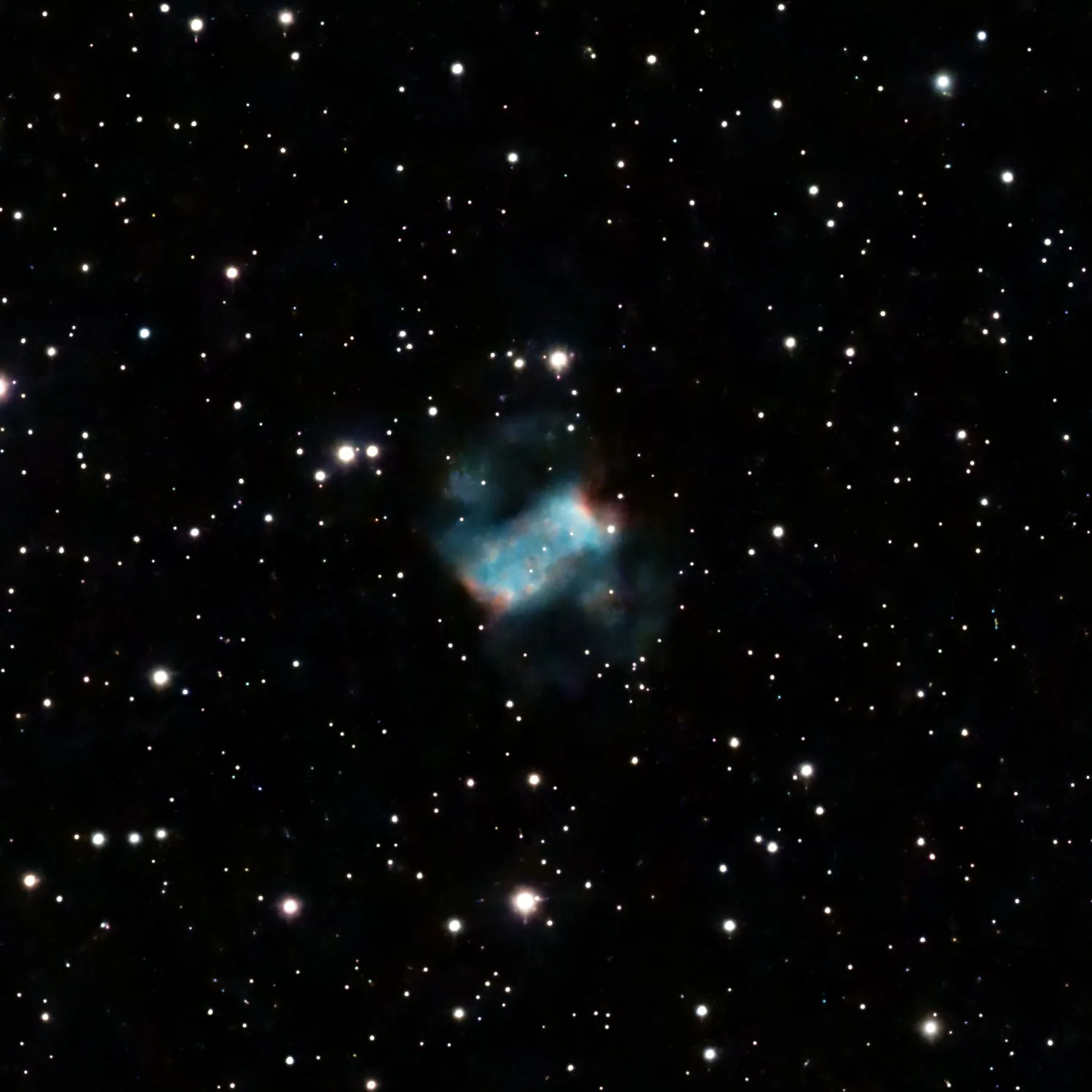
Discovered in 1780 by Méchain, and included by Messier in his catalog, this 10th magnitude object is 2500 light years away, and about 1.2 light years across. It’s overall faintness makes it one of the more challenging Messier objects. The bipolar nature of this planetary (as compared to the Ring Nebula) which could be due to the central star being part of a binary system.
A Starfish of Stars
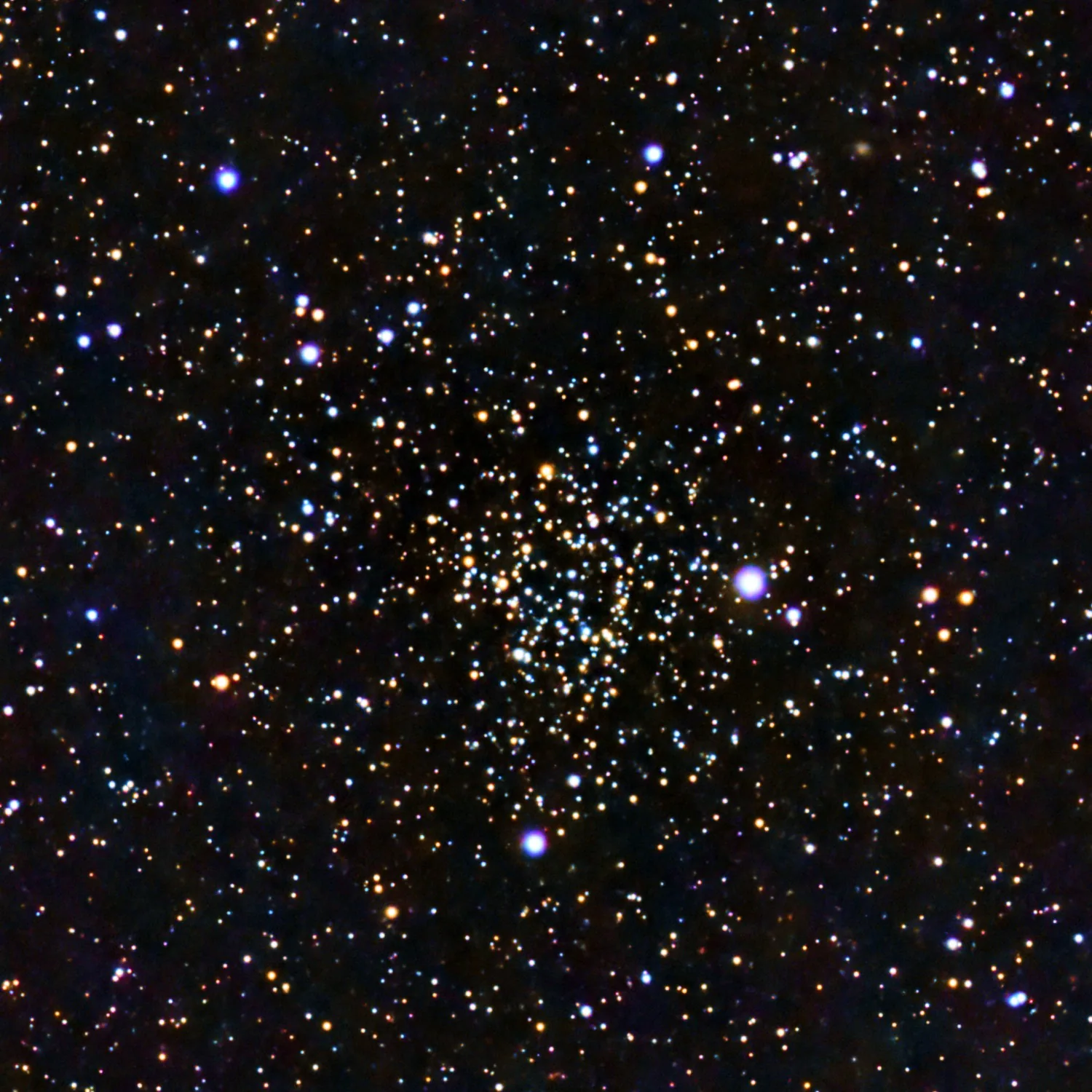
Nestled in the center of Perseus is an open cluster that isn’t well- known. What makes the cluster notable is its shape: a five-pointed star with a central concentration of fainter stars. This cluster is comparatively old - about 1 Gyr and distant (over 9,000 light years), making it a bit of an oddity.
The California Nebula
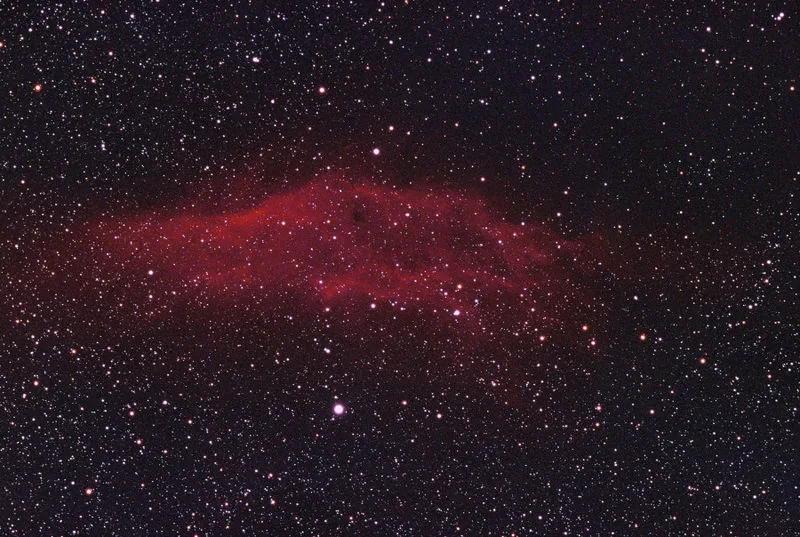
The large (2.5-degrees) nebula is 1,000 light years from Earth. named because its shape is similar to the state outline of California. It’s a challenging target visually because of its low surface brightness, but it is possible to see under extremely dark skies. Typically hydrogen filters and a wide-field telescope in good conditions can show some structure. Its glow comes from the very hot O-type star ξ (Xi) Persei exciting the hydrogen atoms in the nebula.
A Cluster of Galaxies
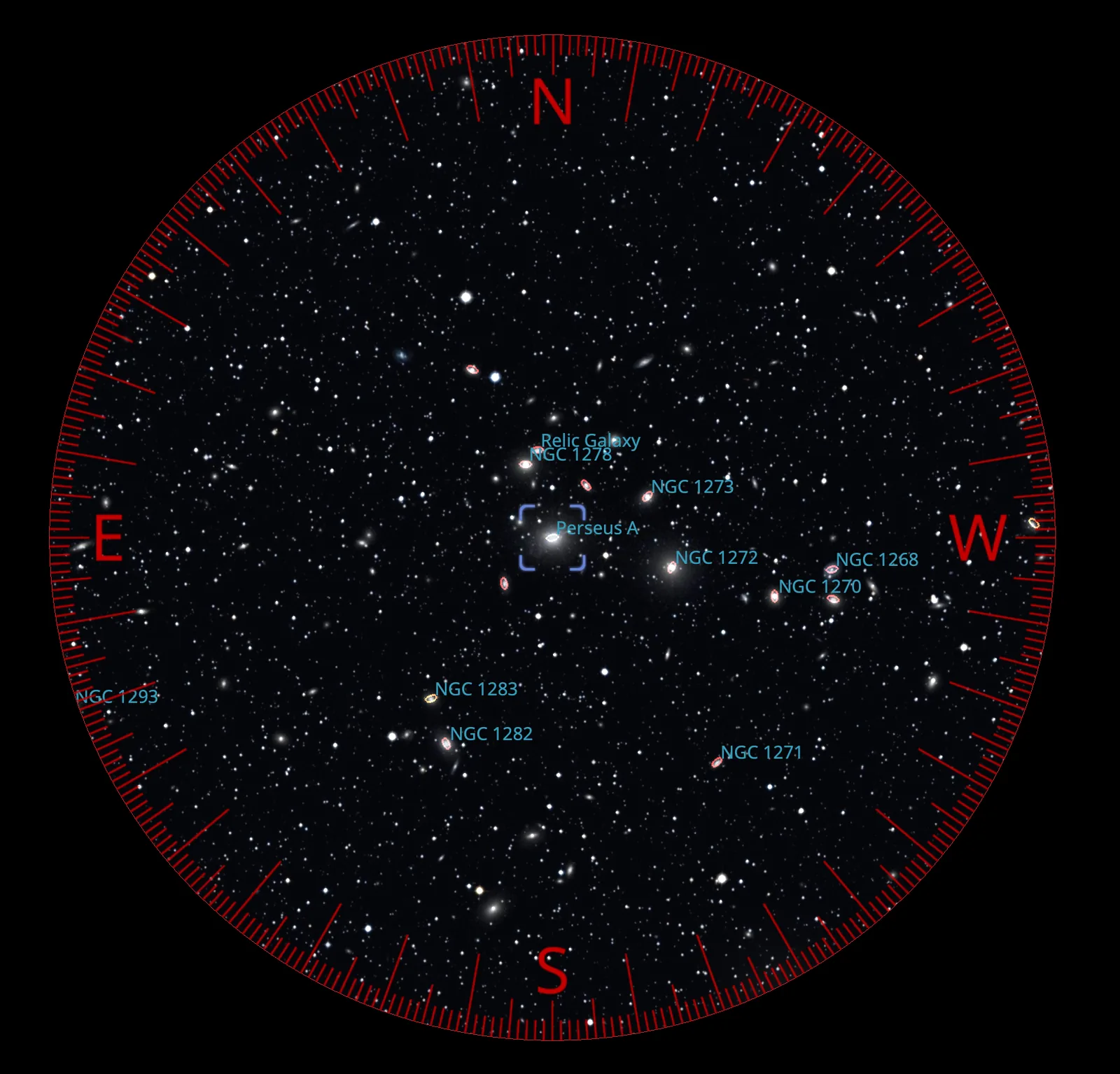
Just 2° NE of Algol, is Caldwell 24/NGC 1275 = “Perseus A”, a huge galaxy at the center of an entire cluster of galaxies, probably formed from cannibalizing the surrounding members of the cluster. While they’re generally not interesting to look at, what’s interesting here is that in a smallish field-of-view (1/2°) you can see well over a dozen cluster member galaxies around 13th-14th magnitude with a moderate-sized telescope. The image shows a simulated field with a 5” telescope and 17mm eyepiece.
The “Demon” Star
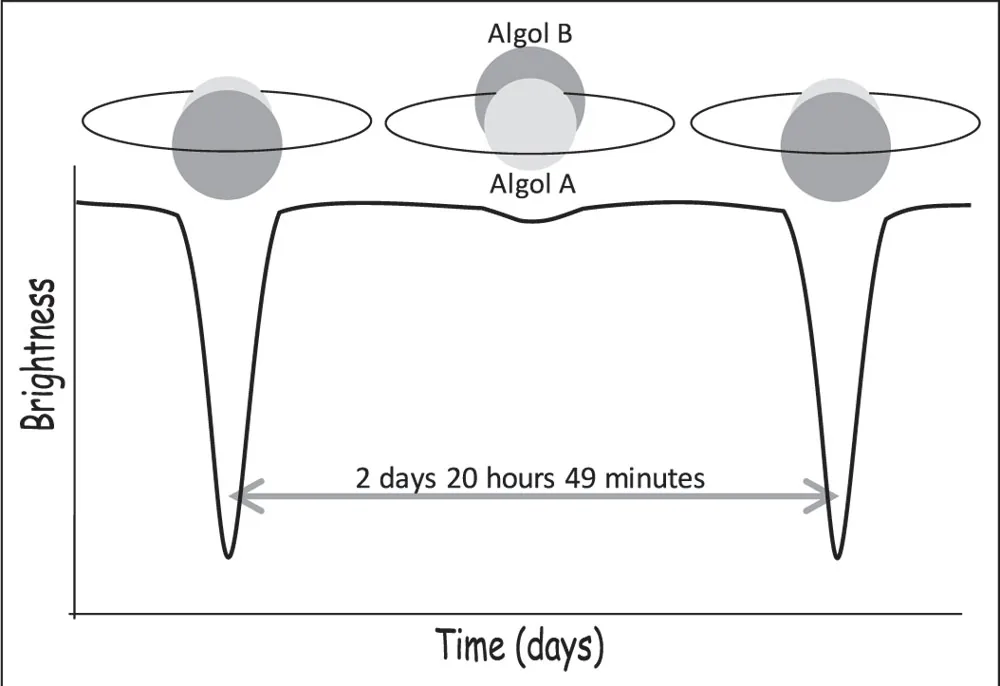
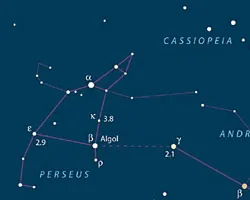
Finally, a variable star. Algol is an eclipsing binary star, with a hot blue star eclipsed by a cooler K sub giant every 2.867 days. Because the orbit is in our line of sight, this causes a dip in brightness from magnitude 2.1 to 3.4, with the (partial) eclipses lasting 10 hours. You can track this visually by comparing Algol to Gamma Andromedae (also mag 2.1), Epsilon Per (2.9) and Kappa Per (3.8).
Algol is just under 100 light years from the Sun, however it passed with 10 light years of the solar system about 7 million years ago which would make it as bright as Jupiter.