Hercules
… is the mythological hero, one of the 48 constellations listed by the 2nd century astronomer Ptolemy. He is based on the Greek Heracles the son of Zeus and Alcmene, He is featured in the epic poem “The Twelve Labors of Heracles” from the 6th-7th century BC. He’s also the half-brother of Perseus (since Zeus fathered both), also a Fall constellation.
On his way back to Mycenae from Iberia having obtained the Cattle of Geryon (the 10th labour), Heracles came to Liguria where he engaged with two giants. The opponents were strong; Hercules was in a difficult position so he prayed to his father Zeus for help. With the aegis of Zeus, Heracles won the battle. It was this kneeling position of Heracles when prayed to his father Zeus that gave the name “the Kneeler”.
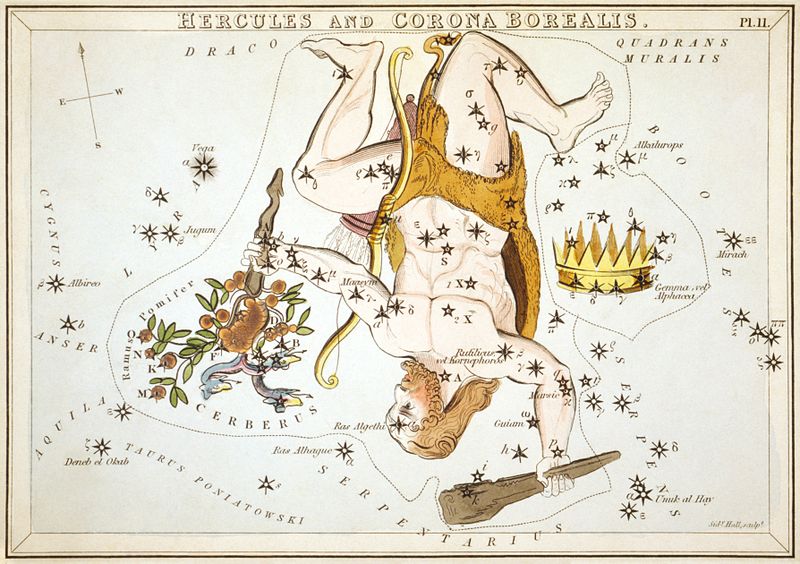
The traditional visualization imagines α Herculis as Hercules’s head; its name, Rasalgethi, literally means “head of the kneeling one”. Hercules’s left hand then points toward Lyra from his shoulder (δ Herculis), and β Herculis, or Kornephoros (“club-bearer”) forms his other shoulder. His narrow waist is formed by ε Herculis and ζ Herculis. Finally, his left leg (with θ Herculis as the knee and ι Herculis the foot) is stepping on Draco’s head, the dragon/snake who Hercules has vanquished and perpetually gloats over for eternities.
None of the stars are among the brightest in the sky, though the constellation is large (ranking 5th out of 88), and is overhead in the late Spring.
The four stars Pi (π), Eta (η), Zeta (ζ), and Epsilon (ε) which outline Hercules’ torso form a quadrangle-shaped asterism known as “The Keystone”. The bright globular cluster Messier 13 lies between ζ and η.
Map of Hercules
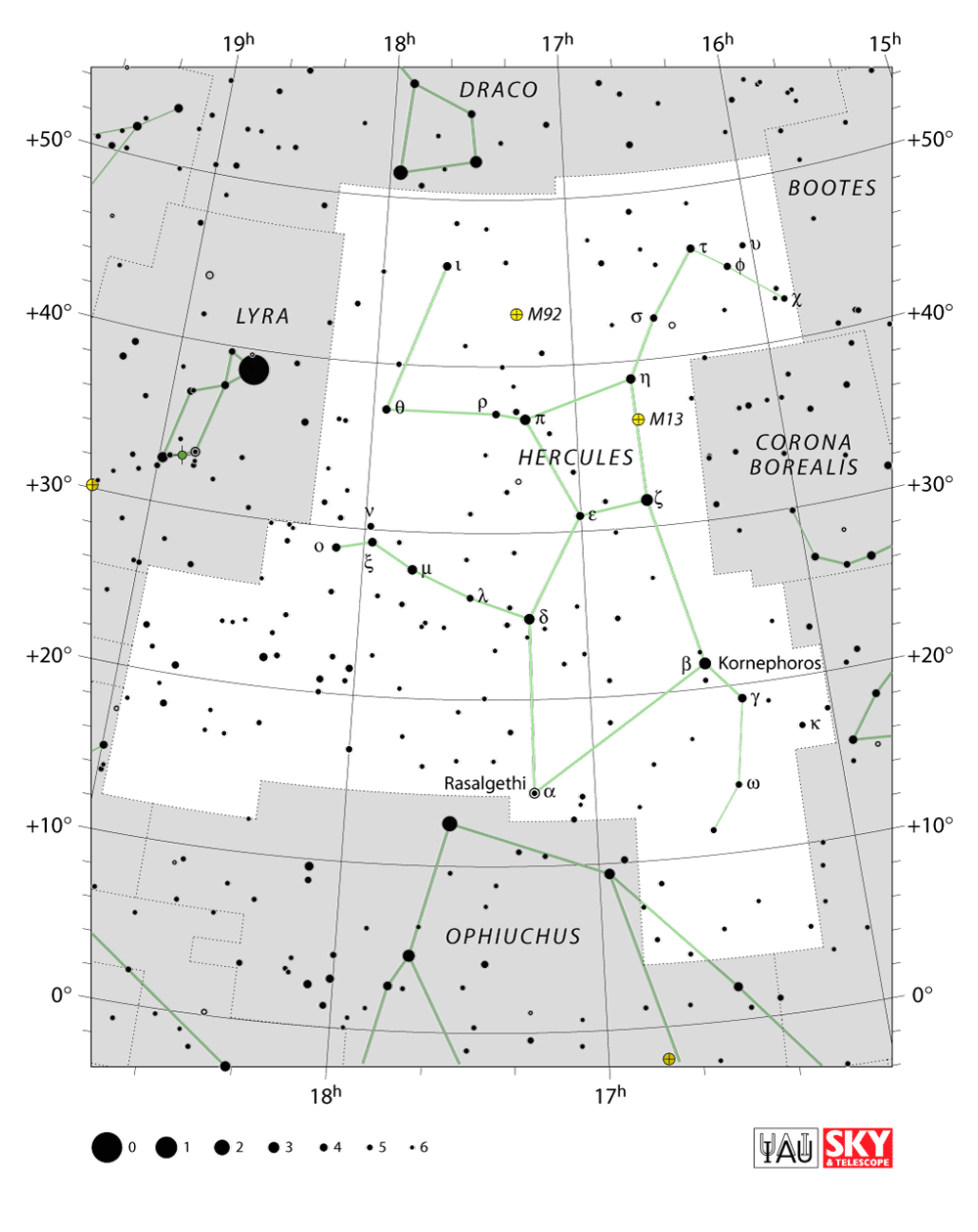
Hercules is easily found just going West from the bright star Vega and South of the head of Draco.
At the border of Hercules and Lyra, just after the “arm” stars of Omicron (ο) and Nu (ν) is the “Solar Apex” - the direction to which the solar system is with respect to the local standard of rest (LSR; about 13.4 km/s or 30,000 mph). This is different than the motion of the Sun around the Milky Way; one way to think of it is different cars on a highway traveling at slightly different speeds: the overall motion of the cars as a whole is their “local standard of rest”. The motion of the LSR around the Milky Way is about 255 km/s (about 570k mph).
Because we’re inching closer to the Milky Way in the sky, the range of deep-sky object types is a little more varied than the field of galaxies to the West.
Things to See in Hercules
Quick Reference: Objects of Interest
| Object | Type | Equipment |
|---|---|---|
| Messier 13 | Globular Cluster | Naked Eye/Small Telescope |
| NGC 6207 | Spiral Galaxy | Medium/Imaging Telescope |
| Messier 92 | Globular Cluster | Small Telescope |
| Abell 2151 | Galaxy Cluster | Imaging Telescope |
| Abell 39 | Planetary Nebula | Imaging Telescope |
| Alpha (α) Herculis | Double Star | Small Telescope |
The Great Hercules Cluster
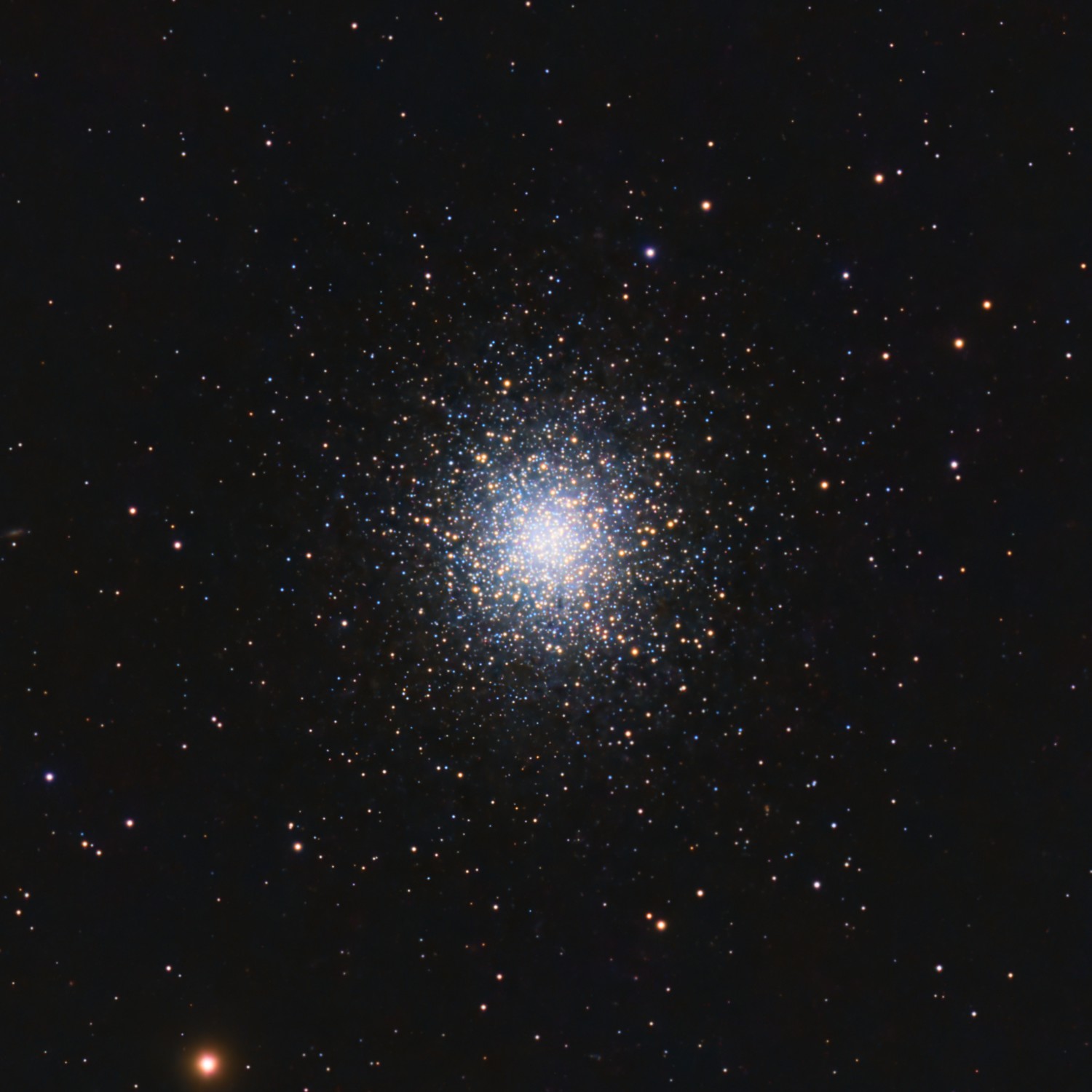
The Great Hercules Cluster is the most famous globular cluster to northern hemisphere observers. It can be dimly seen when overhead with the naked eye as a faint patch between Eta (η) and Zeta (ζ) Herculis in the “keystone” asterism, and is very easy to detect with binoculars.
In a telescope, it exploded with a half-million stars all packed into a space that’s less than 145 ly across. At that density, the average distance between stars in the cluster is under a light year!
NGC 6207
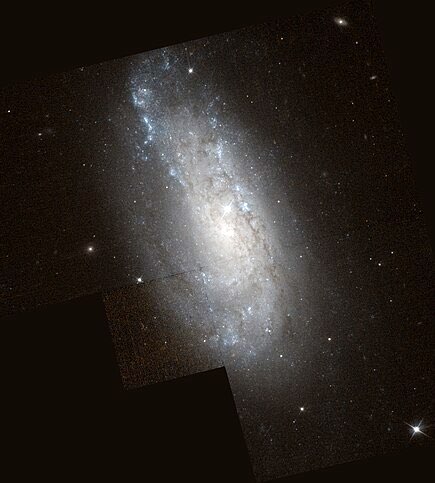
Frequently overlooked, because it’s only 1/2° away from the famous M 13, this small galaxy might be more famous if it were elsewhere in the sky. Overall it’s “flocculent” with traces of spiral arms, and is 30 Mly away.
Not So Ugly Step-Sister
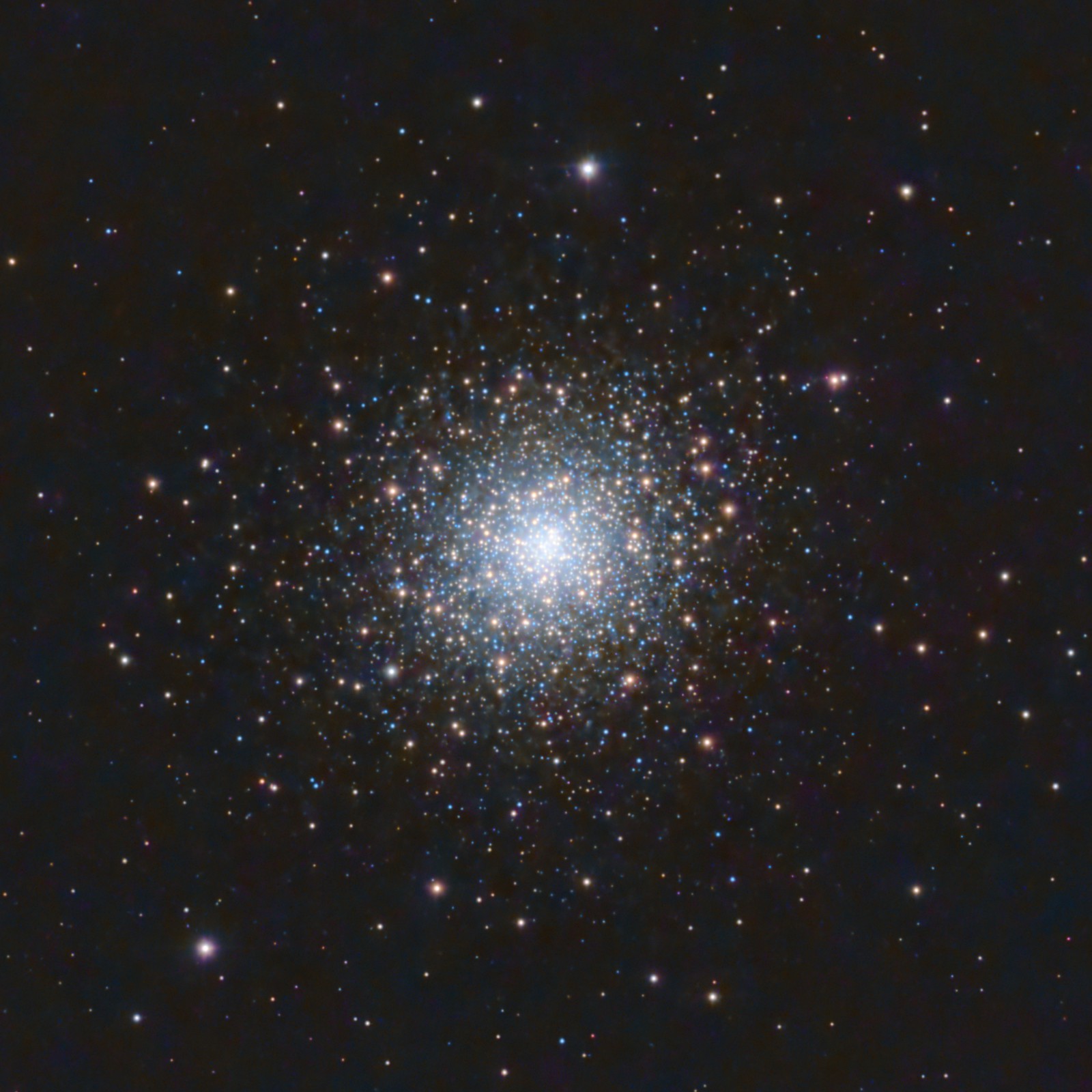
Sometimes it feels like “all globular clusters look the same”, but looking more closely (esp. when you can see them side-by-side) differences are apparent. Comparing the two globulars M 13 and M 92, while both have compact cores, M 92 seems a little more disperse.
Hercules Galaxy Cluster
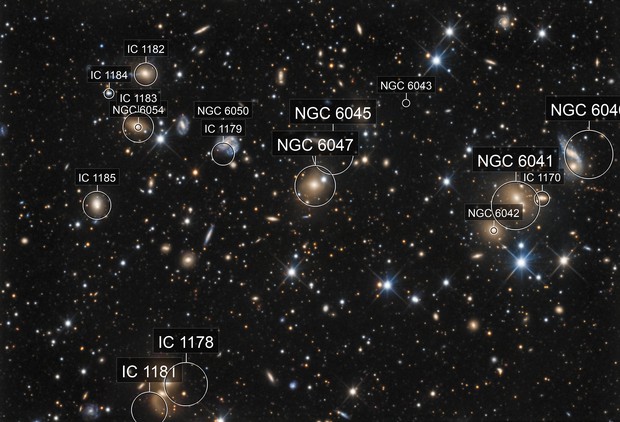
Half a billion light years away, this cluster of over 200 galaxies is faint (the brightest member - NGC 6047 - is only magnitude 13). Unlike the Virgo Cluster, many of the larger/brighter members are spiral galaxies (instead of ellipticals/lenticulars), some of whom are interacting with each other.
Spooky Soap Bubble
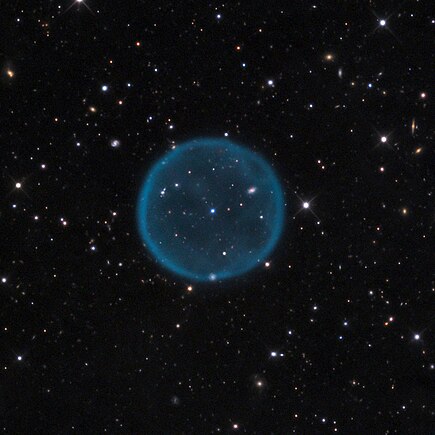
There are two Abell catalogs: one is for galaxy clusters (like the Hercules cluster above), and one for planetary nebulae. In the latter catalog, entry number 39 is striking in how uniformly spherical it is, 1.4 light years across (and 3800 light years distant). The explosion that created it happened about 11,000 years ago.
It angular size is larger than most planetary nebula (but about 2/3 the size of the Ring Nebula), but it has a very low surface brightness, so it’s a true challenge to detect visually.
Color Contrasted Double Star
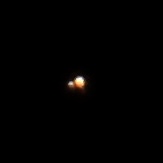
Rasalgethi is one of the cases where the star marked α (alpha) in a constellation is not the brightest star in that constellation (Sagittarius is another), this triple star system has a red-giant primary and a spectroscopic binary (so they’re too close together to be each seen visually) secondary. The red giant is so large, if placed in our solar system would extend past Mars and almost reach the asteroid belt!
Rasalgethi means “head of the kneeler”: on maps Hercules was depicted upside down (as seen on the other page)!