
Prepping for Summer
The Summer Solstice happens on June 20th - with the shortest nights for observing (only just over 4 hours for full darkness) which means we have to cram in observations as we can.
This month, let’s highlight two objects that are in the June skies that are of particular interest this year.
Incoming Comet
Though comet C/2023 A3 (Tsuchinshan-ATLAS) is still almost 2 AU away is speeding towards the Sun from the Oort Cloud, and will make its closest approach to Earth in October.
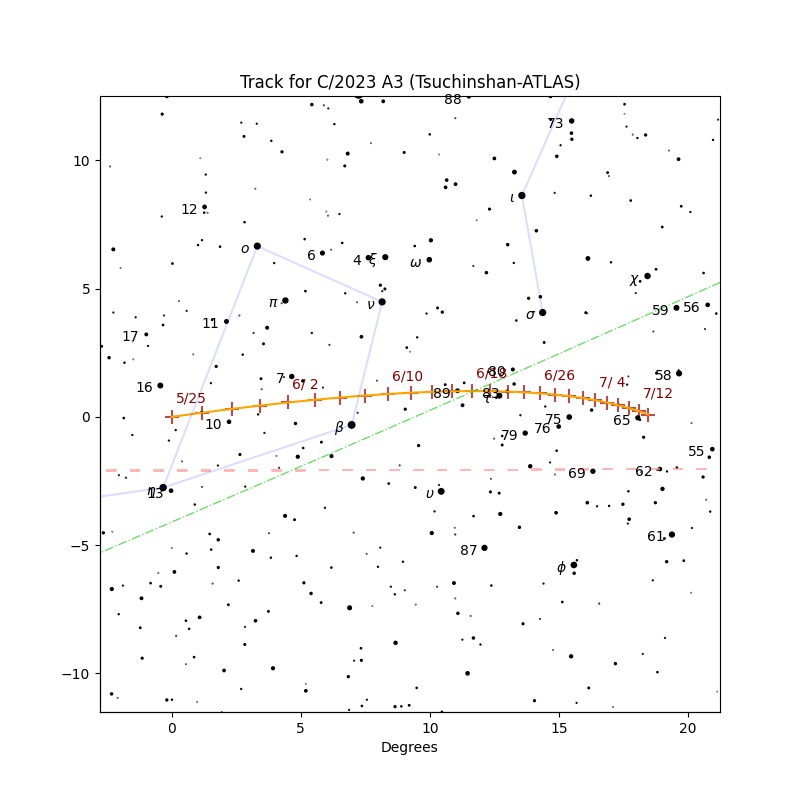
It has the potential of being a spectacular comet, easily visible to the naked eye, but you can catch it now at 9-10th magnitude in the West as it skims the celestial Equator from Virgo into Leo over the month of June.
Its orbit is nearly hyperbolic, and there’s the chance that it won’t remain bound to the Sun after this encounter: as it’s being tugged upon by the planets, it could find itself ejected from the solar system. Even if it does manage to “stay with us”, the orbit is so extended that it won’t return for upwards of a few million years.
Recurrent Nova T Coronae Borealis
The “Blaze Star” T CrB is a binary system, 3,000 light years away consisting of a red giant and a white dwarf. As the red giant loses mass, it’s transferred to an accretion disc surrounding the white dwarf.
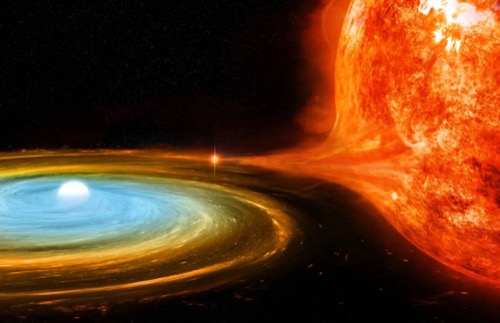
About every 80 years, this causes the white dwarf to heat up, causing an explosion which brightens the system from its normal visual magnitude of ~10 to as bright as +2 - about the brightness of the North Star - for a few weeks, after which it’ll return to its quiescent phase for another 80 yr.
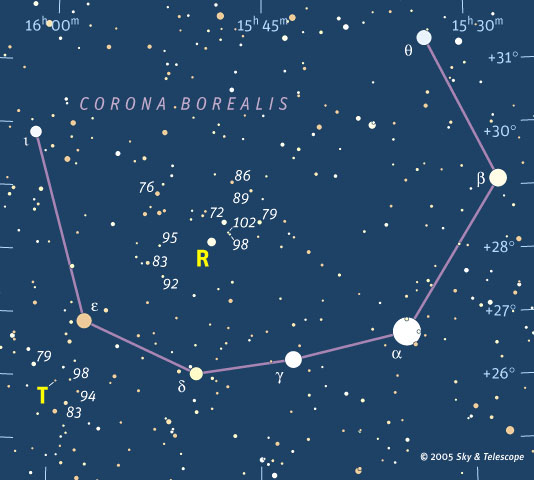
To find T CrB, first find the semi-circle of stars that is the Northern Crown (Corona Borealis) just “left” of Boötes with the bright star Arcturus. It’s placed just a few degrees from the SE part of the crown. When the outburst occurs, it will shine as bright as Alphecca - the brighter star in the bottom of the crown. When not in outburst, with a telescope the star should appear noticeably red compared to the stars nearby.
This Month’s Image
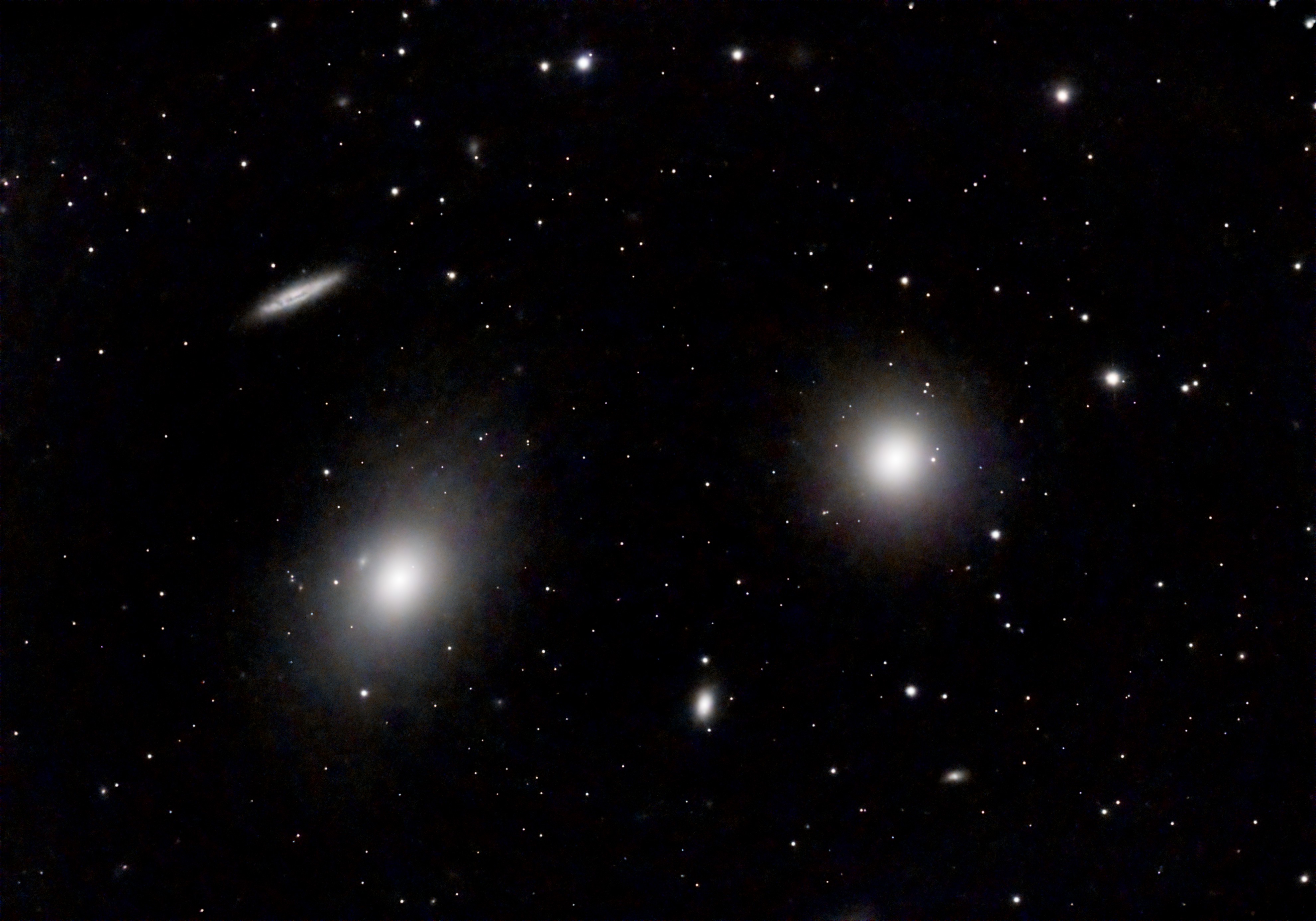
M 84 and M 86 are part of Markarian’s Chain - a string of 8 primary galaxies that extends for 1 1/2° in Virgo. The small edge- on galaxy in the upper left is NGC 4402; tiny NGC 4387 is center-bottom. Most of the galaxies in the chain are 60 Mly away; the Chain is just one part of the Virgo Cluster.