
Prepping for Summer
The warm (but short) nights means speeding through skies filled with interesting objects! The Summer Milky Way is teeming with star clusters and nebulae.
The Summer Triangle
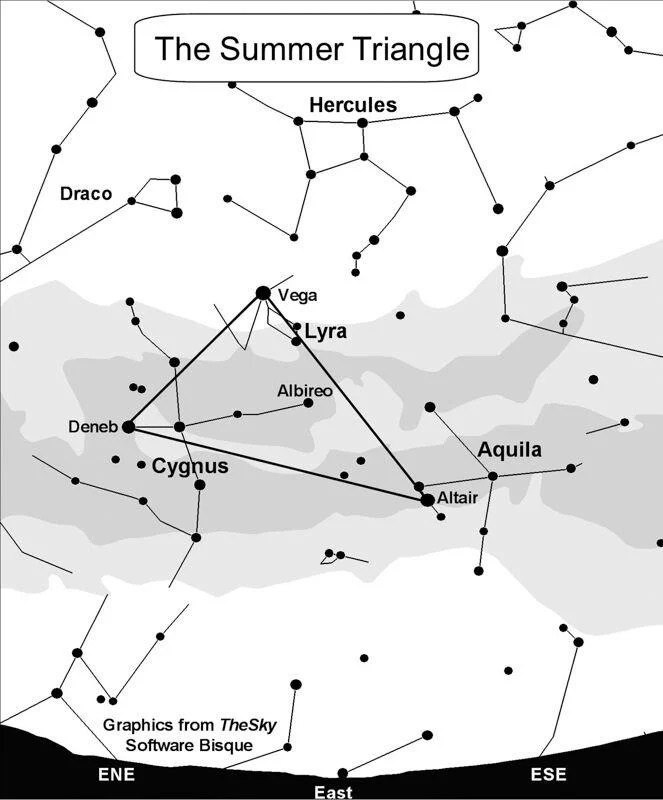
The three bright stars of Summer!
Vega is the 3rd brightest star in the sky (mag 0.0 - it’s the standard for the modern magnitude system), and is 25 ly away. It’s a young star (450 Myr - about half way through its lifetime) and rapidly-rotating (P = 16.3h; which makes it egg-shaped).
Altair is the 12th brightest star over, all and slightly closer to us than Vega (17 ly), younger (100 Myr) rotating even faster (7.8h) and even more flattened.
Deneb - although almost as bright (19th in rank), is the true outlier - over 2600 ly distant! This is because it’s a supergiant: if it were as close to us as the other two stars, it’d almost be as bright as the Full Moon, and would definitely cast a shadow!
Cascading through Cygnus into Aquila, the Milky Way shines, and in dark skies, you can see the Great Rift splitting it into two lanes. This is the same sort of dust feature visible in many edge- on Galaxies (e.g., the Sombrero, and NGC 891).
Following an Eclipsing Variable - β Lyrae
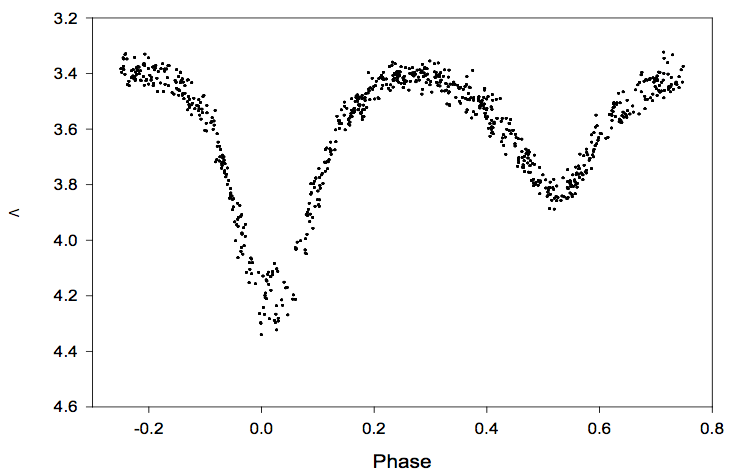
This bright star, at the SW corner of the parallelogram group of stars in Lyra, is a binary star whose brightness varies between mag +3.2 and +4.4 over a period of just under 13 days. The two stars have had a complicated relationship in their 23 million year existence: as the originally more-massive star component evolved, it transferred mass to the companion which now has most of the mass of the system, surrounded by a thick accretion disk.
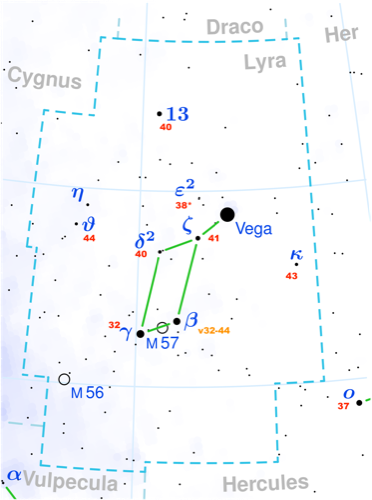
Because their mutual orbit is in the line of sight viewed from Earth it’s an eclipsing binary: the total light dims when one star is “in front of” the other star from our point of view. You can easily tell if it’s in eclipse by comparing its brightness to Gamma (γ) Lyrae just to the East (“left”) - which has a magnitude of +3.2. When the two stars appear equally bright, then β is not in eclipse. If β appears fainter, then an eclipse is happening! (Note the famous Ring Nebula, M 57, lies between them.)
On the chart, the red numbers are the magnitudes of surrounding stars (with the decimal point removed, so “40” = +4.0). You can use it to monitor the variations of β Lyrae over time.
This Month’s Image
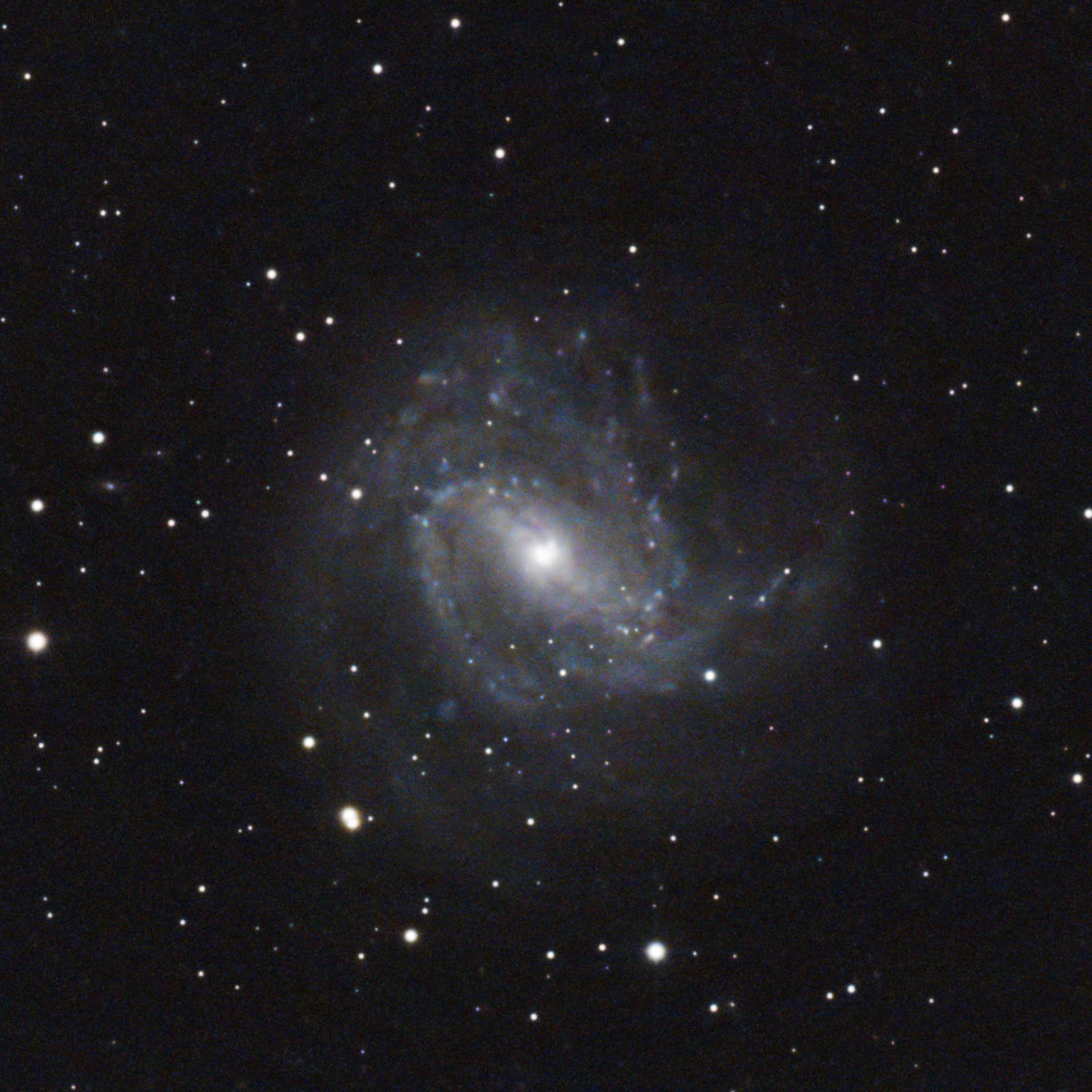
M 83 in Hydra is one of the furthest south of all Messier objects, but bright enough to be seen with small telescopes and worth the challenge. This image was taken close to meridian, but only 17° above the horizon!