The Archer
Sagittarius is commonly represented as a centaur pulling back a bow, and is one of the original 48 constellations by Ptolemy. His arrow points to the star Antares: the archer is poised to attack the scorpion from stinging Hercules, or to avenge the slaying of Orion.
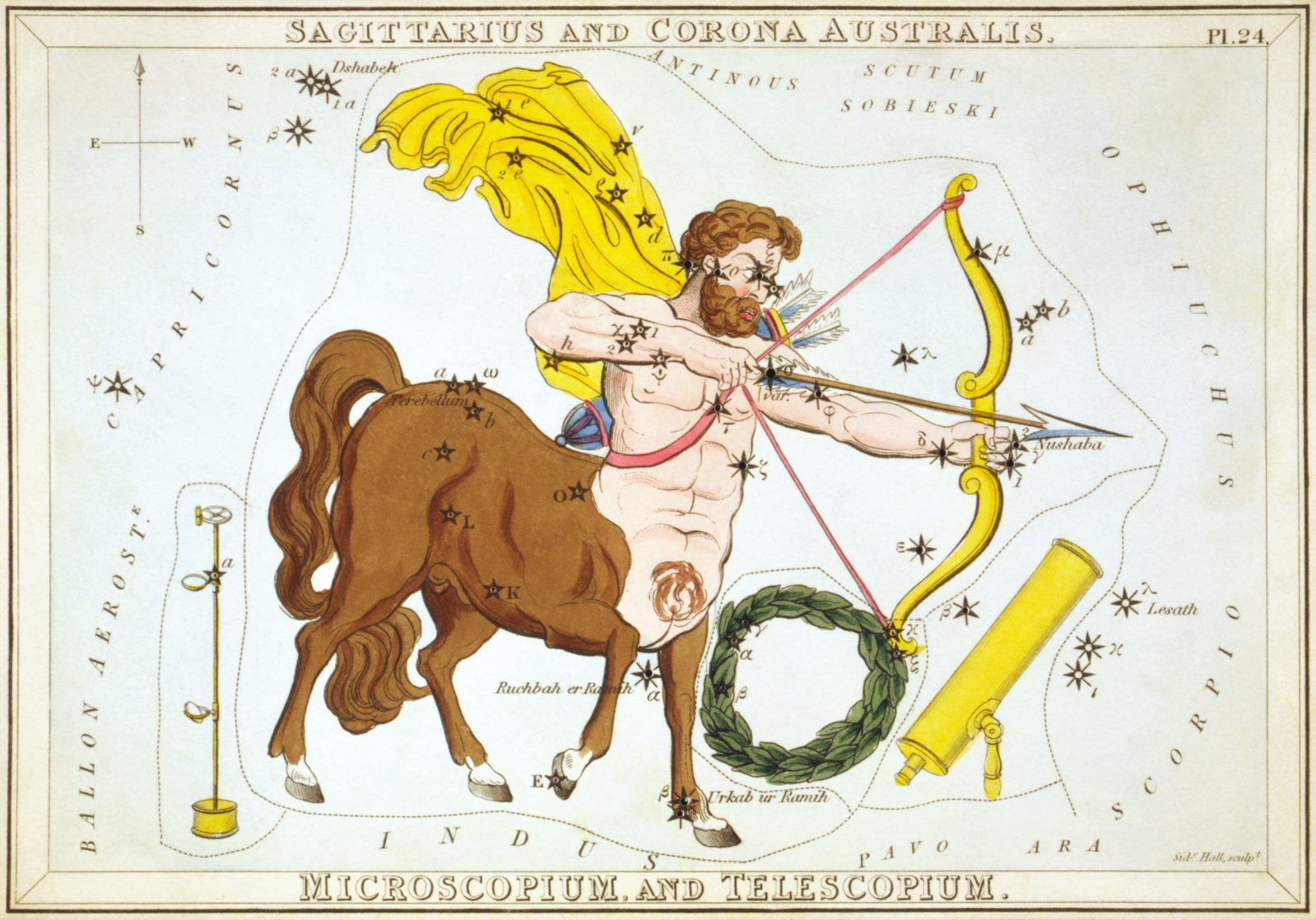
In Greek mythology, Sagittarius is usually identified as a centaur: half human, half horse. Some identify Sagittarius as the centaur Chiron, the son of Philyra and Cronus, tutor to Jason. As there are two centaurs in the sky, some identify Chiron with the other constellation, known as Centaurus. Or, as an alternative tradition holds, that Chiron devised the constellations Sagittarius and Centaurus to help guide the Argonauts in their quest for the Golden Fleece. Eratosthenes identified the Archer as the satyr Crotus, son of Pan, who is credited with the invention of archery.
There are several asterisms connecting the stars of Sagittarius: the most popular is the “Teapot” which here forms the bow and outstretched arm. The “Elbow” stars are east of the Teapot. Further East is a small, fainter cross called “Terrebellum”. “Ballon Aeroste” is an obsolete constellation shown in other atlases of the time as “Globus Aerostaticus” - the hot air balloon.
Map of Sagittarius
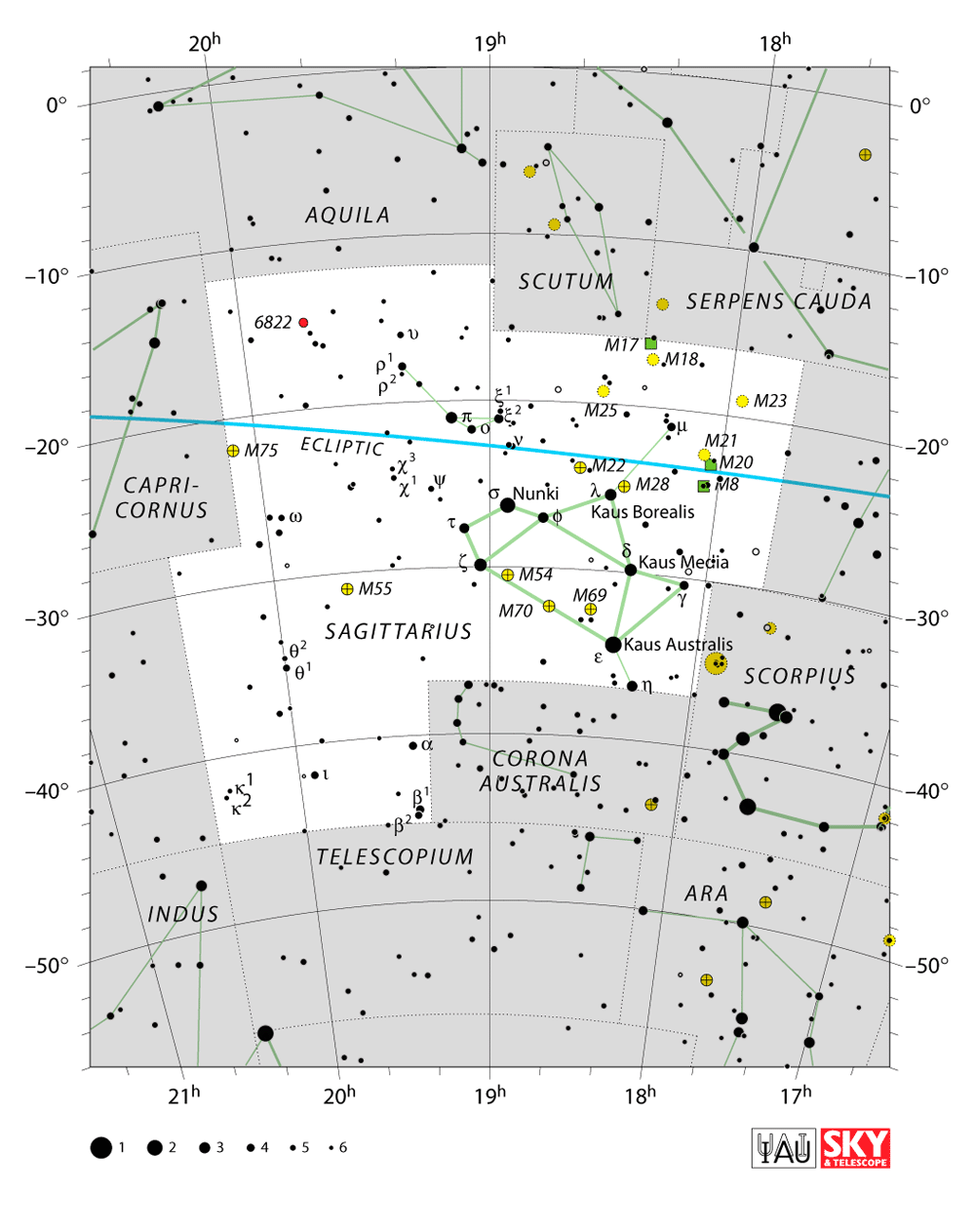
Sagittarius is the southernmost constellation of the Zodiac, rising briefly over the horizon from northern latitudes. That’s unfortunate because it’s in this direction where we’re looking to the center of the Galaxy, just west of the Teapot in the corner of the constellation bordering Scorpius. Thus, there are many deep-sky objects in the vicinity: open clusters M18, M21, and M 25; globular clusters M22 and M 28, the “Great Star Cloud” of M 24 and of course the bright nebulae M 8 (the Lagoon), M 17 (the Swan - upside-down from northern latitudes) and the combination emission/ reflection nebula M 20 (the Trifid).
But aside from the more-famous objects, there are some other surprises! Messier 54 - despite its proximity to the Galactic Center in the sky, wasn’t born here! It started out as part of the Sagittarius Dwarf Galaxy which is slowly being torn apart by the Milky Way over billions of years. These interactions have caused star formation, and might have influenced the spiral structure of the Galaxy.
Things to See in Sagittarius
Quick Reference: Objects of Interest
| Object | Type | Equipment |
|---|---|---|
| Messier 17 | Emission Nebula | Binoculars/Small Telescope |
| Messier 20 | Emission/Reflection Nebula | Binoculars/Small Telescope |
| Messier 22 | Globular Cluster | Naked Eye/Binoculars |
| Caldwell 57 (NGC 6822) | Dwarf Galaxy | Medium/Imaging Telescopes |
| Messier 21 | Open Cluster | Binoculars |
| Sgr A | Galactic Center | Naked Eye/Binoculars |
Upside-Down Swan
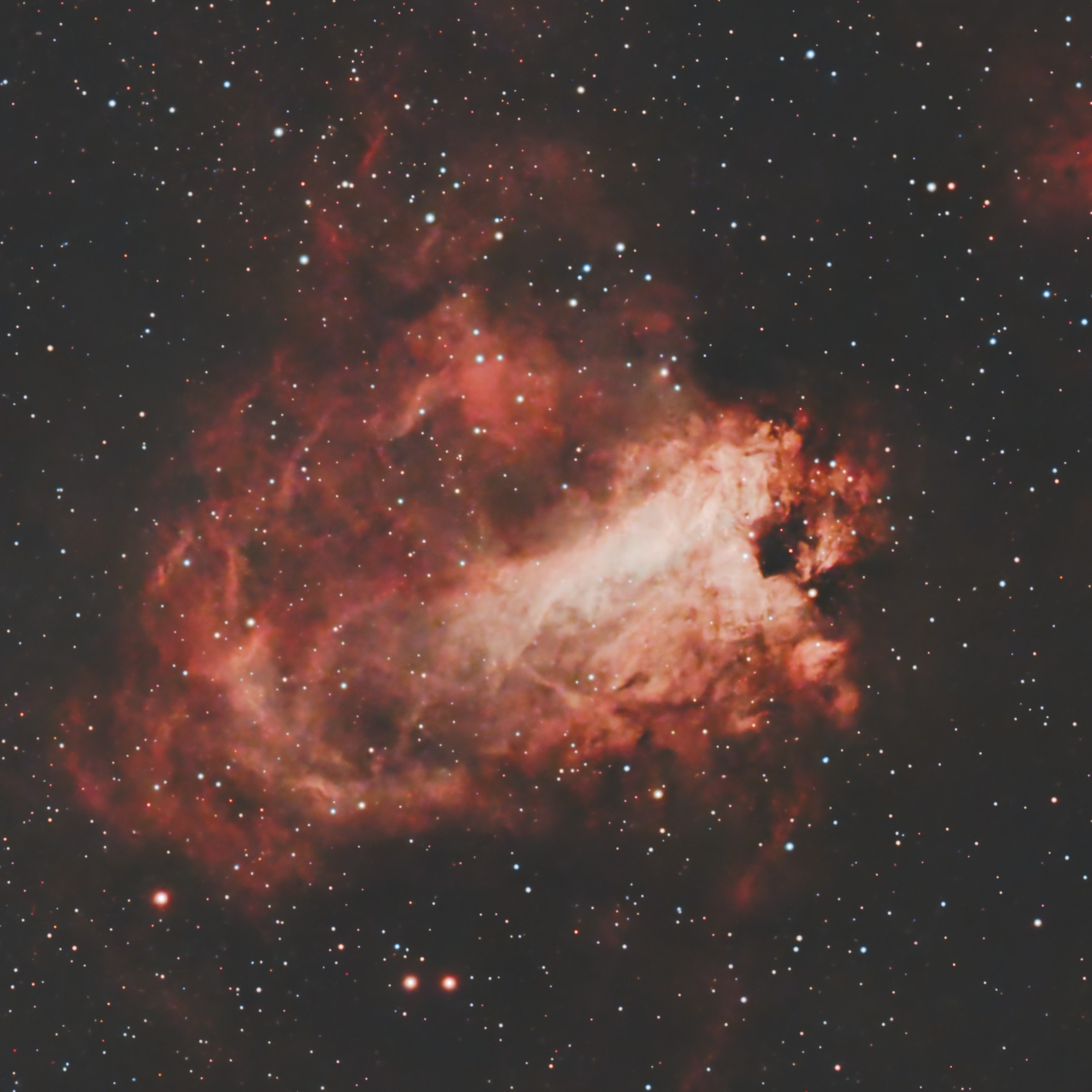
Also known as the “Omega” Nebula, is a star forming region about 5500 light years away. Most of the several hundred hot young (~1 Myr) stars are obscured by dust. light years. The entire cloud of interstellar matter spans 40 light years.
Colorful Trifid
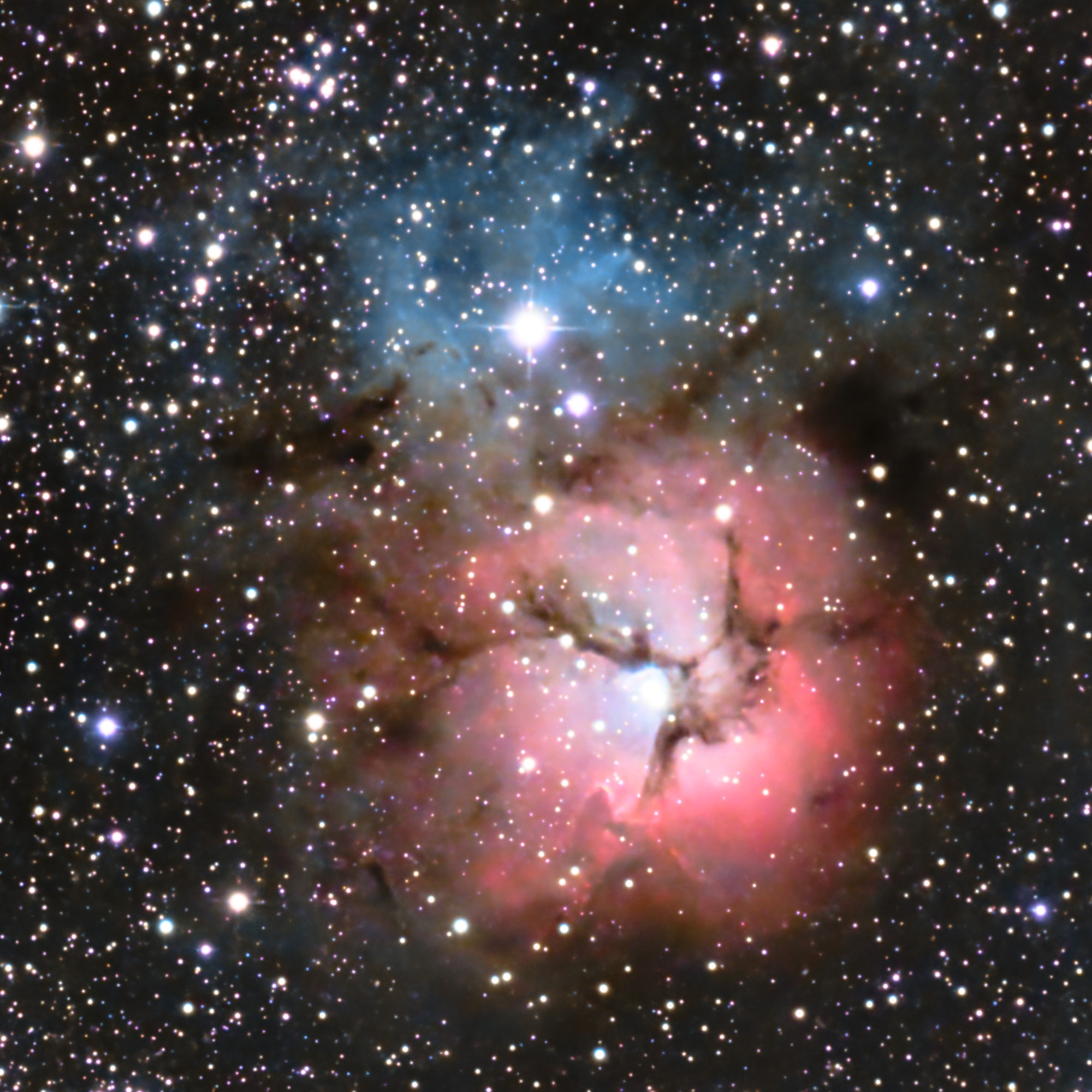
This nebula has everything: a bright “three-lobed” (hence the name) emission nebula with lanes of dark nebula superimposed (itself designated as Barnard 85) plus a reflection nebula at the northern edge. It’s about 4100 light years from Earth, 21 light years across, and is extremely young: only about 300 kyr. The reflection nebula doesn’t glow on its own: the light comes from the hot nearby stars, scattered by grains of dust.
Crackerjack Cluster
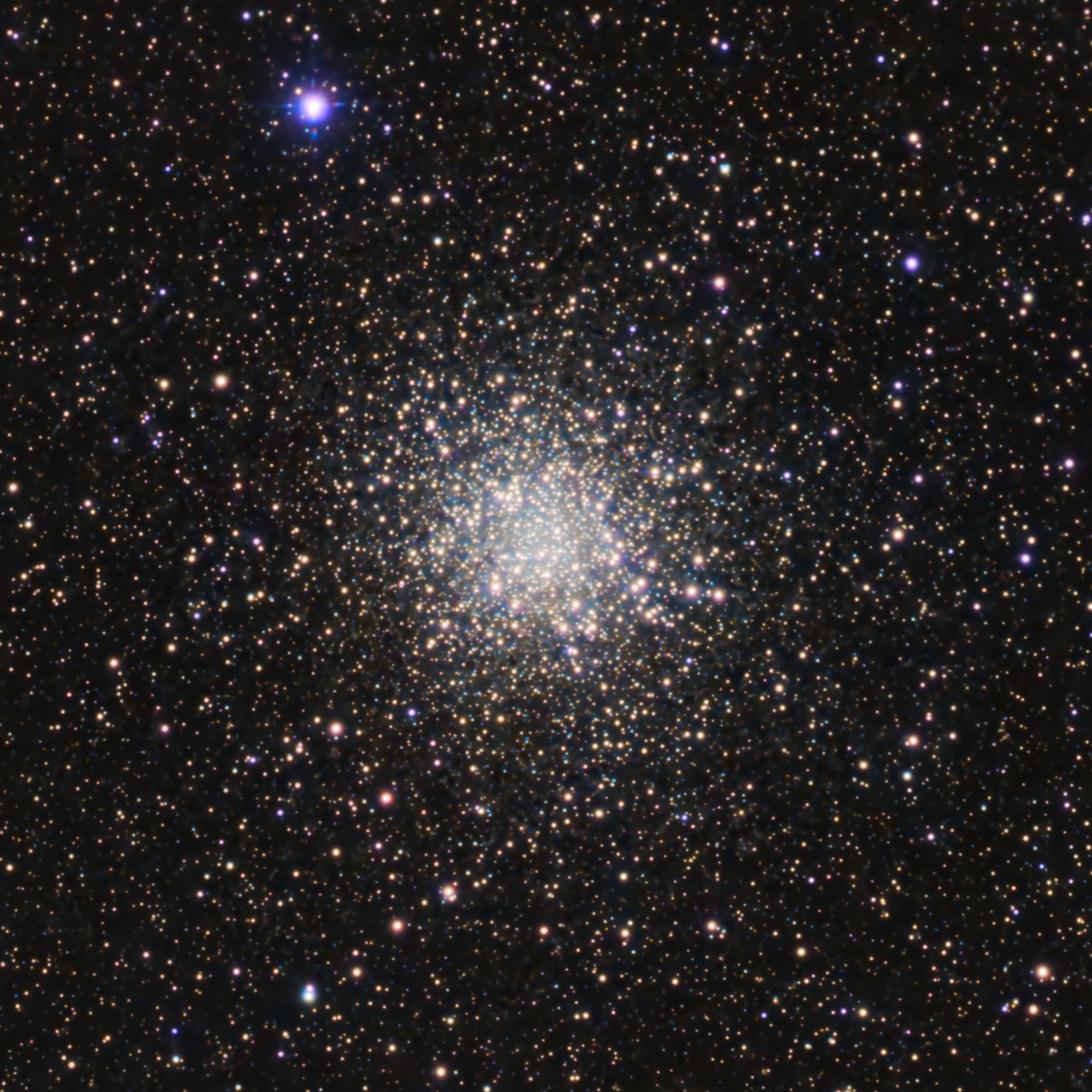
100 ly across, this bright globular cluster is one of the closest to us, 10.6 kly distant. Like M 15, it contains a planetary nebula - one of only four globulars known to do so.
Barnard’s Galaxy
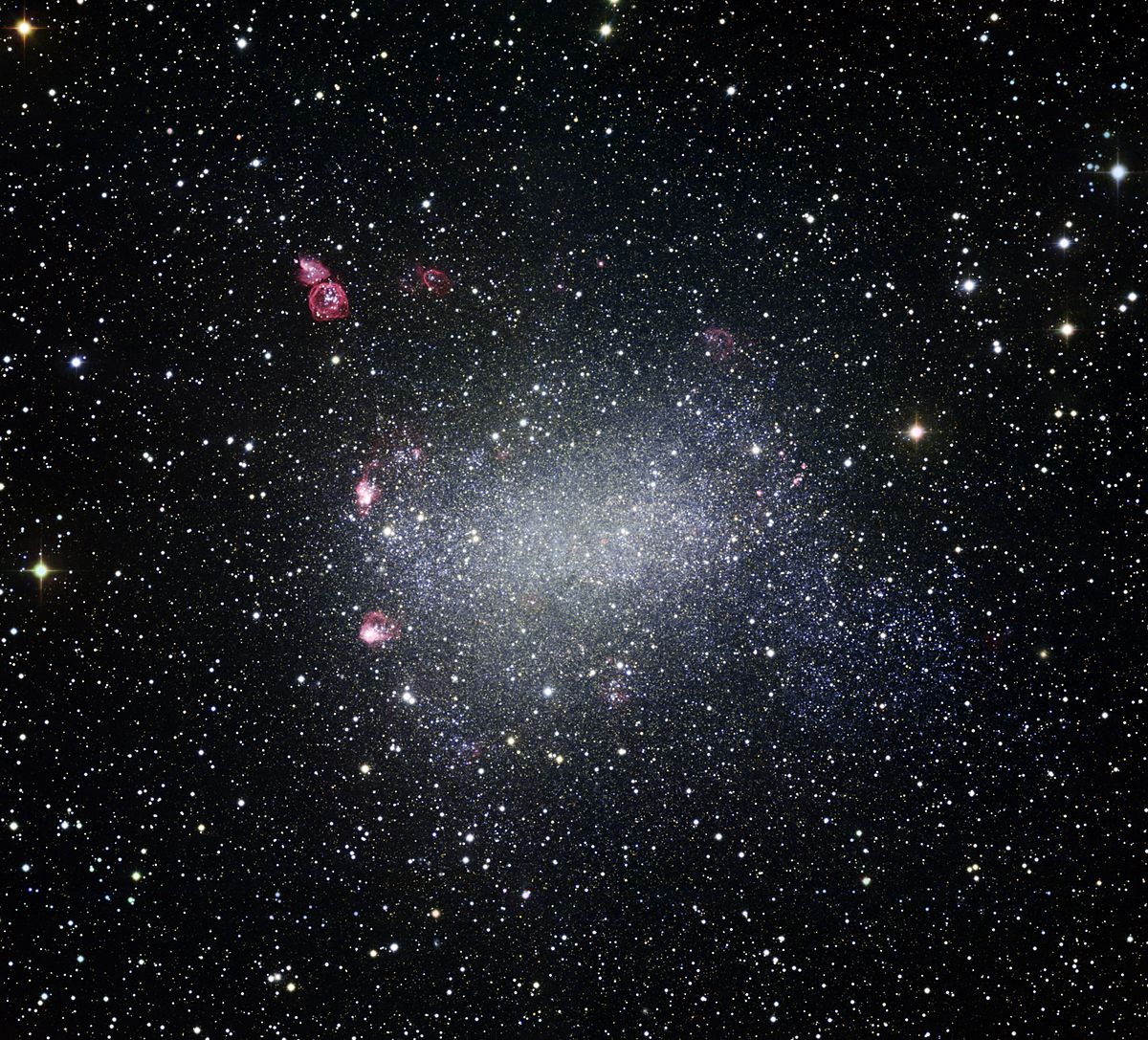
Caldwell 57 (NGC 6822) is a member of the Local Group - the closest non-satellite galaxy to us (1.6 Mly), and may have interacted with the Milky Way 3-4 Gyr ago; just after the Sun was born.
Webb’s Cross
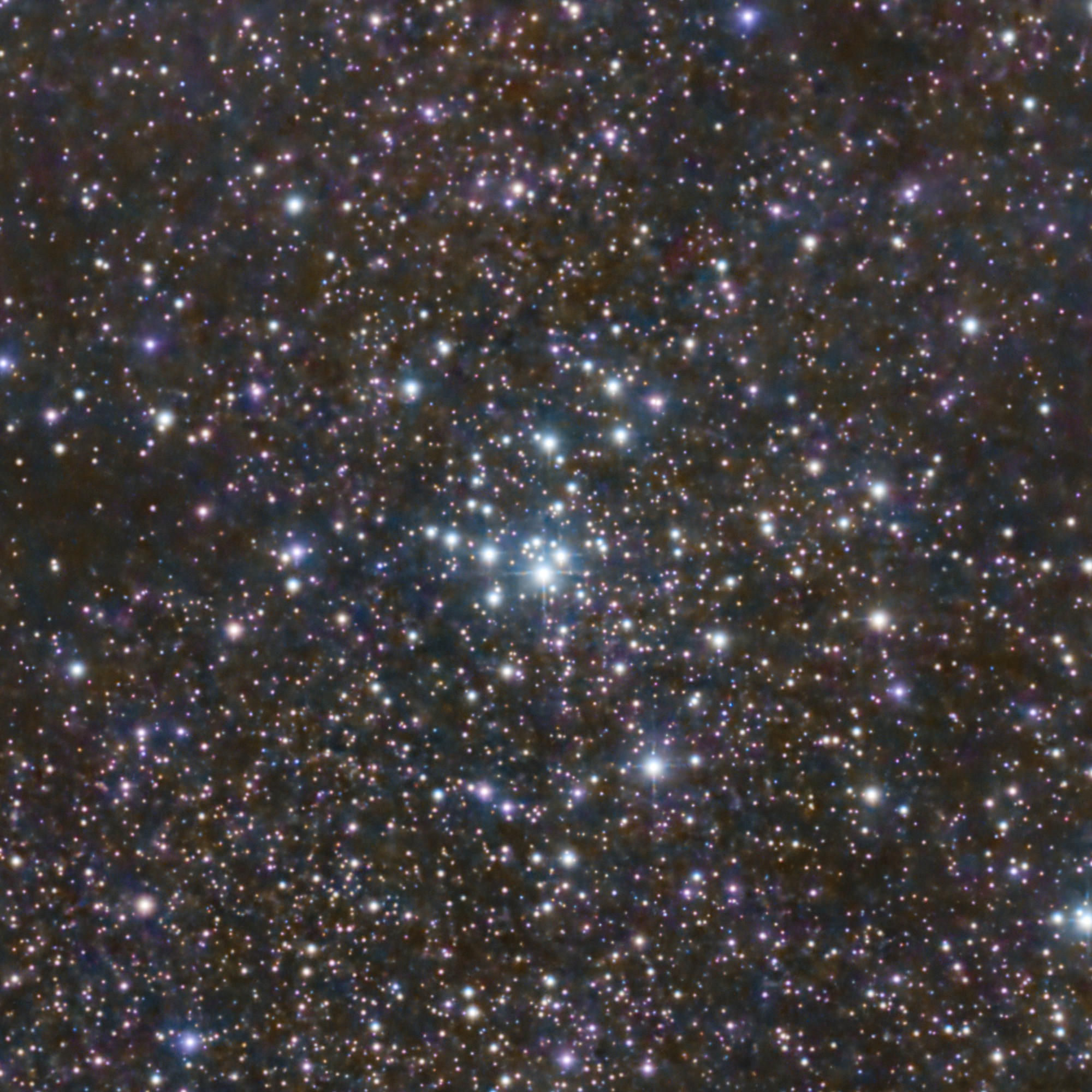
4000 ly away this very young (6.6 Myr) cluster has mostly lower-mass faint stars and fewer hot blue stars all packed into a cluster only 24 ly across. It’s findable with binoculars just north of the Trifid.
“Galactic Center”
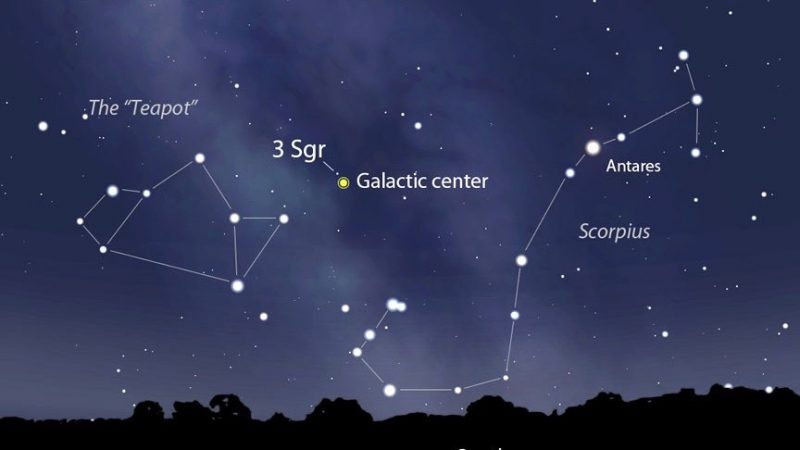
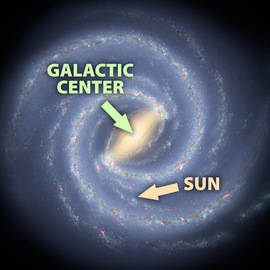
26,000 light years away sits a massive (~4 million solar mass) black hole - Sgr A - the center of our Galaxy, whose size (in the place of our Sun) would extend out to about the orbit of Mercury.
From the perspective of standing close to the center of galaxy (ignoring the black hole), the sky would look very different: the spiral arms are gone; within the “bulge” stars would be far more uniform in the sky in all directions and much denser because the average distance between them would be only a fraction of the ~1pc (3,26 ly) near the Sun.
Even though the density of visible stars is highest looking towards the galactic center, they’re just skimming the edge of the inner spiral arm closest to us: the actual galactic center is obscured to us by intervening interstellar dust: only very high energy light (gamma and X-rays) and very low energies (sub millimeter and radio) can penetrate that.