
Twilight Inner Planet Challenge
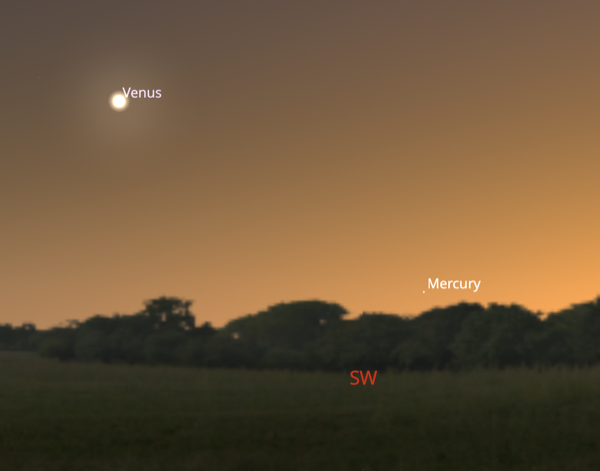
In the last week of November, if you’re lucky, you might catch both inner planets, Venus and Mercury low in the SW just after sunset. This image is for 11/17 at 5PM. While both planets are brighter than 0th magnitude, and Venus should be easy to spot, Mercury will only be 5° above the horizon but with some careful scanning along the horizon (prob. with binoculars) you might be able to spy it! With a telescope, both show a gibbous phase: Venus will be ~70% illuminated, Mercury 60% illuminated.
Meteor Showers
November is the time for the Taurid (peak 12 Nov) meteors followed by the Leonids (peak 17 Nov). Unfortunately both happen close to the Full Moon which will likely make seeing faint meteors impossible.
Around Perseus
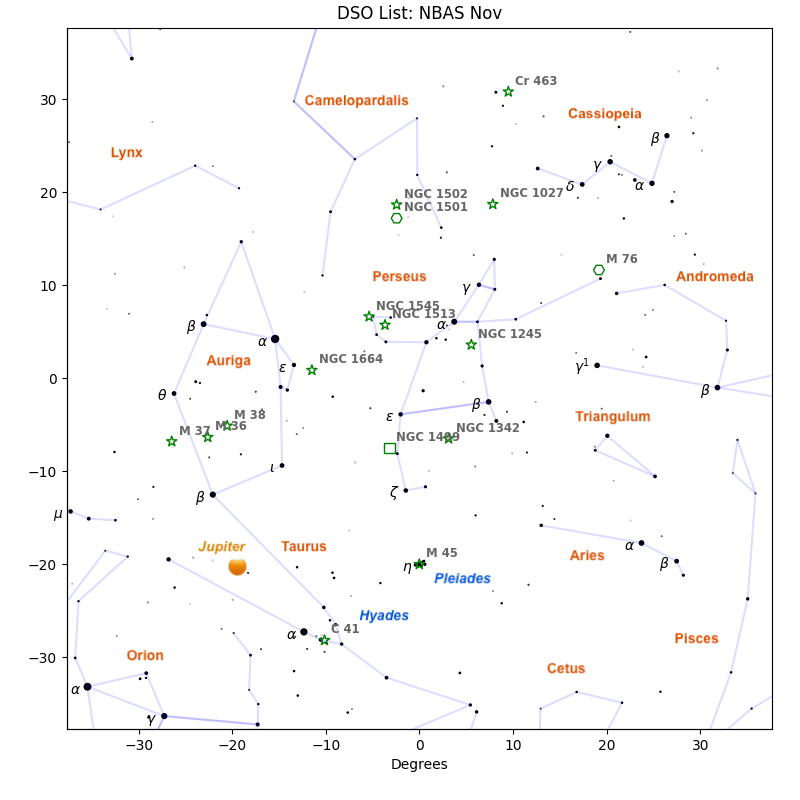
This month we’re going to work around the sky centering on Perseus. Most of these objects are good for binoculars; a few will need small/moderate telescopes.
Starting in Cassiopeia and meandering East through Camelopardalis, Perseus, and Auriga (taking in the two main clusters in Taurus: the Hyades and Pleiades), we encounter:
The Hyades (C 41) and Pleiades (M 45) are naked eye objects. Counting stars in the Pleiades is a fun task (both naked eye and with optical aid). The α Persei cluster surrounds the bright star.
Several large, bright clusters: 4-H (NGC 1664), Jolly Roger (NGC 1501), Patrick Starfish (NGC 1245), Little Scorpion (NGC 1342), and Running Man (NGC 1545). Collinder 463 (the Queen’s Reflection) is large and pretty. Others don’t have names: NGC 1027 and 1513.
The three Messier objects in Auriga (M 36, 37, and 38) are popular in both binoculars and small telescopes.
Finally, NGC 1499 - the California Nebula - is a challenge to detect with binoculars, but shows more presence and detail as you climb in aperture. Imaging scopes can show the expanse of nebulosity.
This Month’s Image
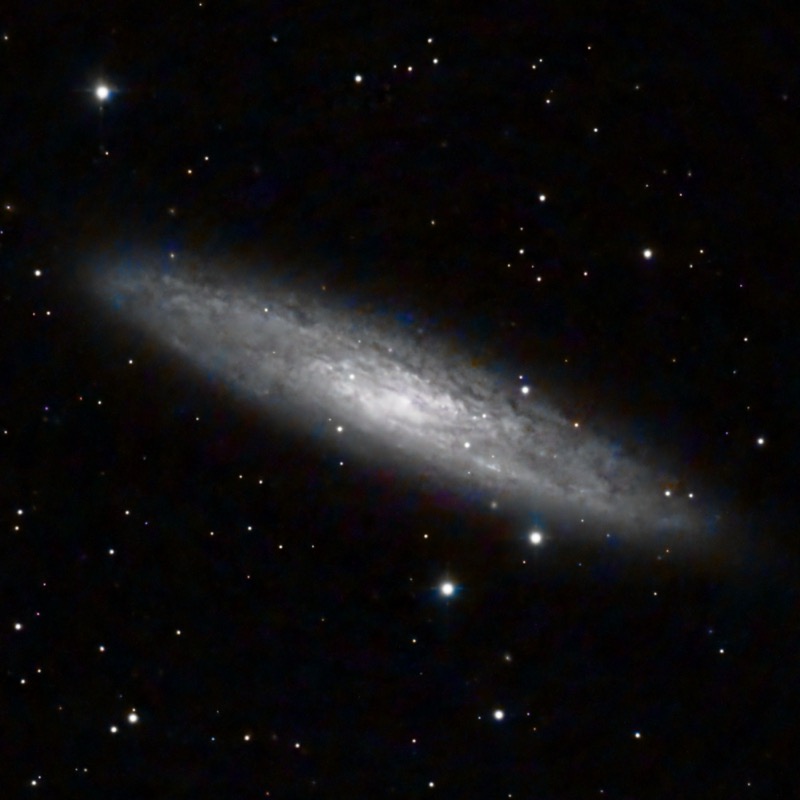
The Silver Coin Galaxy (Caldwell 65, NGC 253) tends to be missed in the Fall sky because it only reaches 20° altitude from our location hiding in Sculptor, but it’s big and bright!
12 Mly away and the central galaxy in the “Sculptor Group” is has a brighter inner region and disk mottled appearance with dust patches: it is experiencing significant star formation.
There are several other bright galaxies hugging the southern horizon in this part of the sky: if conditions permit, take up the challenge of finding them!