The Winged Horse
Pegasus is from Greek mythology - one of the original constellations listed by Ptolemy (2nd century) - is a winged horse with magical powers. When Perseus cut off the head of Medusa, Pegasus was born out of her blood. It was the horse for Bellerophon the killer of the Chimera (a fire- breathing creature, part lion, part serpent).
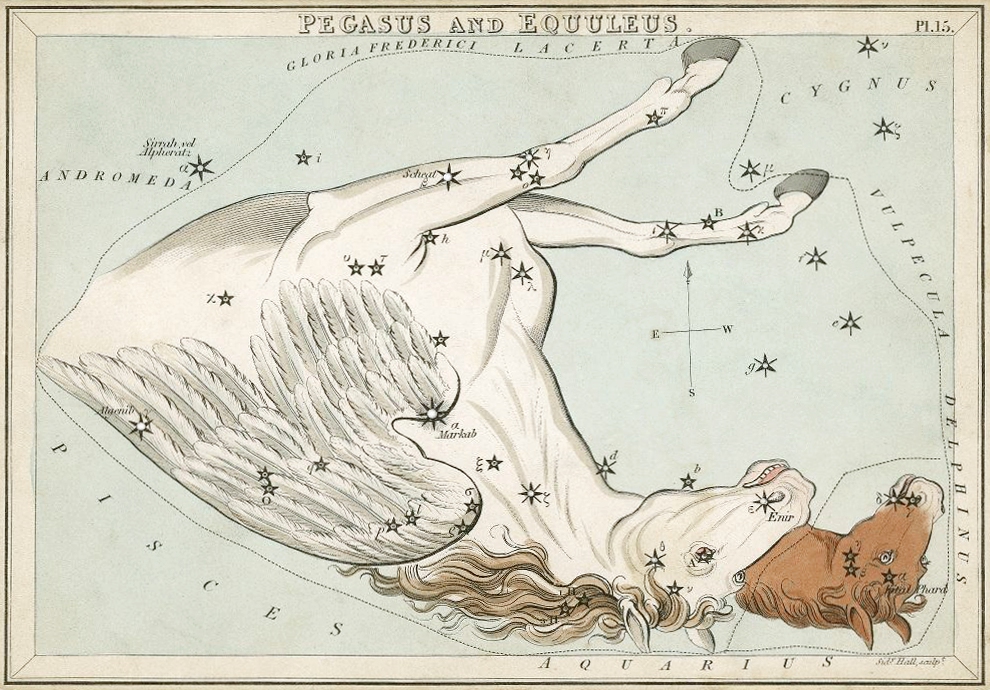
It was also seen as a horse to the Persians, though facing East instead of West. Black Tortoise of the North”. For the Hindus, it was a bed as a resting place for the Moon. To the Arawak in South America, it was part of a large asterism depicting a large barbecue.
Being away from the Milky Way, most of the observable deep-sky objects in Pegasus are galaxies with a few notable galaxy groups/clusters. The notable exception is the bright globular cluster Messier 15.
The Other Horse
Just west of Pegasus is the second-smallest constellation Equuleus
- the “Little Horse” made up of just a few dim stars, depicting either the offspring or brother of Pegasus. Unlike many of the other “minor” constellations, Equuleus dates back to Ptolemy and Hipparchus.
Map of Pegasus
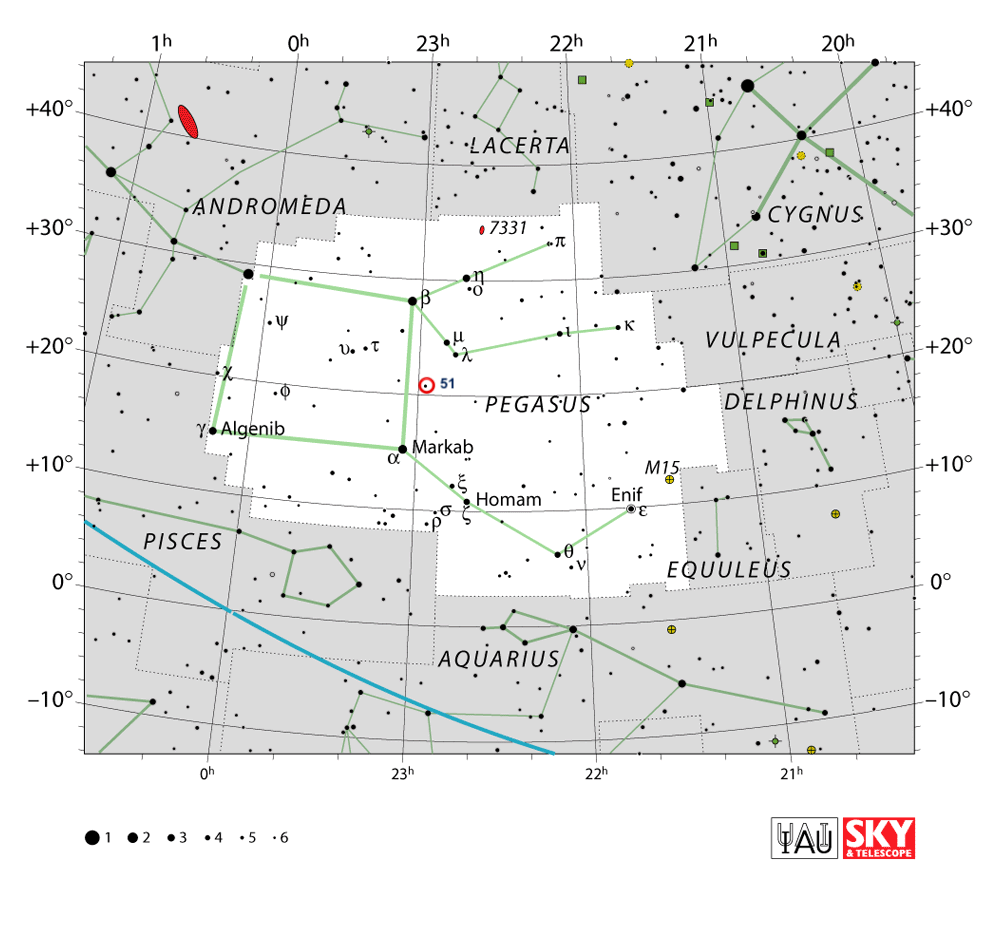
The eastern half of the constellation (7th largest in area) is dominated by the Great Square. The stick figure in the western half connects stars for the neck and head, and front legs. However, to Northern Hemisphere observers, Pegasus is upside-down!
The Great Square of Pegasus
It’s easy to locate because of the “Great Square of Pegasus” asterism, made up of the four brightest stars: α (Markab), β (Scheat), γ (Algenib), and δ (Sirrah - (although this has been re-assigned to Andromeda as “Alpheratz”). The star ε (Enif - and is the brightest star in Pegasus) marks the “nose” of the horse, and is conveniently located near the globular cluster Messier 15. One observing “test” is to count stars within the Great Square: with some light pollution only a few stars can be seen, up to 10–12 in darker skies, and theoretically (under the darkest skies) 35 are possible
Things to See in Pegasus
Quick Reference: Objects of Interest
| Object | Type | Equipment |
|---|---|---|
| Messier 15 | Globular Cluster | Binoculars/All Telescopes |
| Caldwell 30 (NGC 7331) | Spiral Galaxy | Small/Medium Telescope |
| Caldwell 44 (NGC 7479) | Spiral Galaxy | Medium/Imaging Telescope |
| Stephan's Quintet (HCG 92) | Group of Galaxies | Medium/Imaging Telescope |
| Caldwell 43 (NGC 7814) | Spiral Galaxy | Medium/Imaging Telescope |
| 51 Pegasi | Exoplanet System | Binoculars/All Telescopes |
The Great Pegasus Cluster
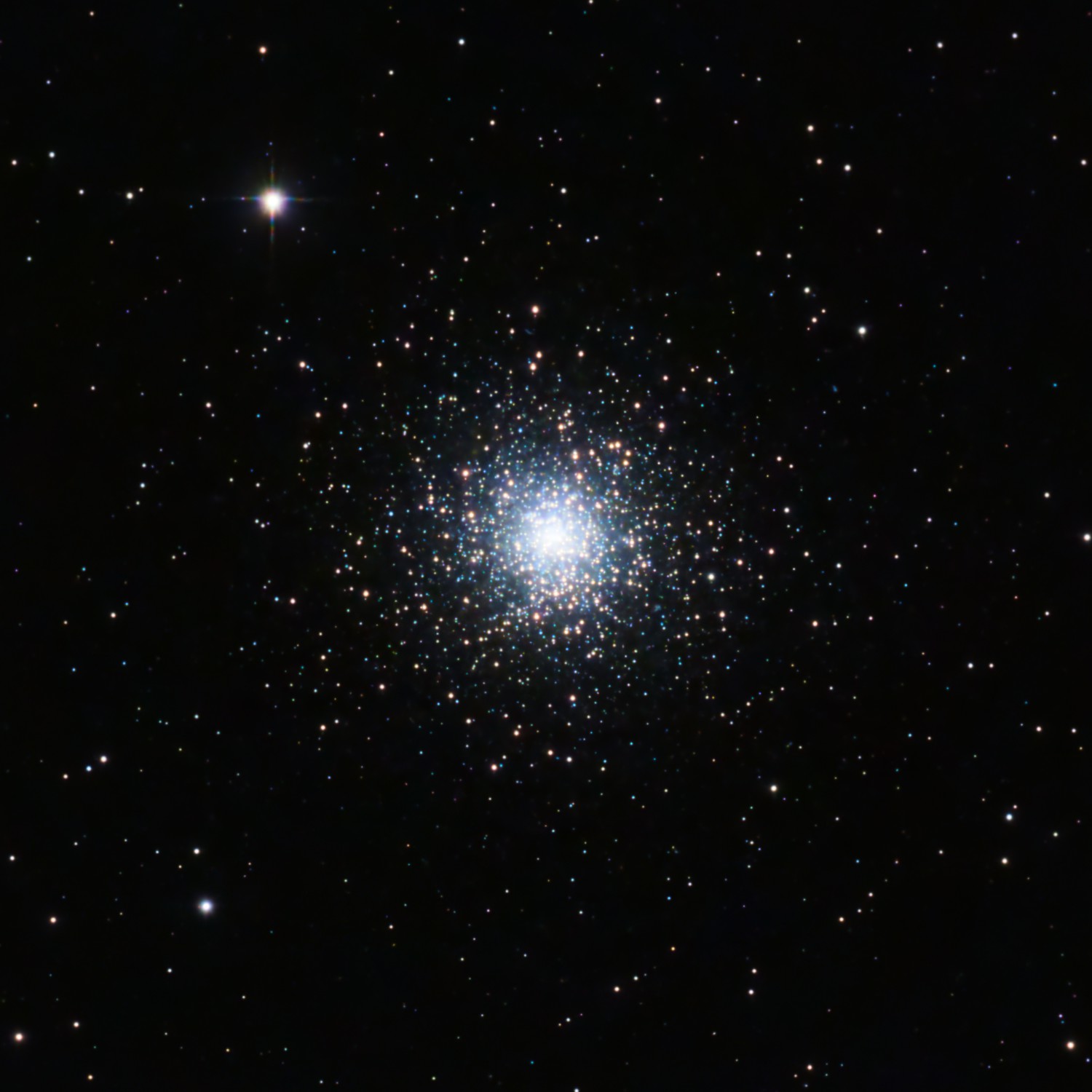
Messier 15 is one of the oldest globular cluster (12.5 Gyr), 35.7 kly from the Sun, and about 175 ly across, with over 100k stars. It hosts planetary nebula Pease 1 - one of only four globular clusters known to have one. It is easy to find - only 4° WNW from the bright star Enif - with binoculars and is even (barely) visible with the naked eye under very dark skies.
Deer Lick Group
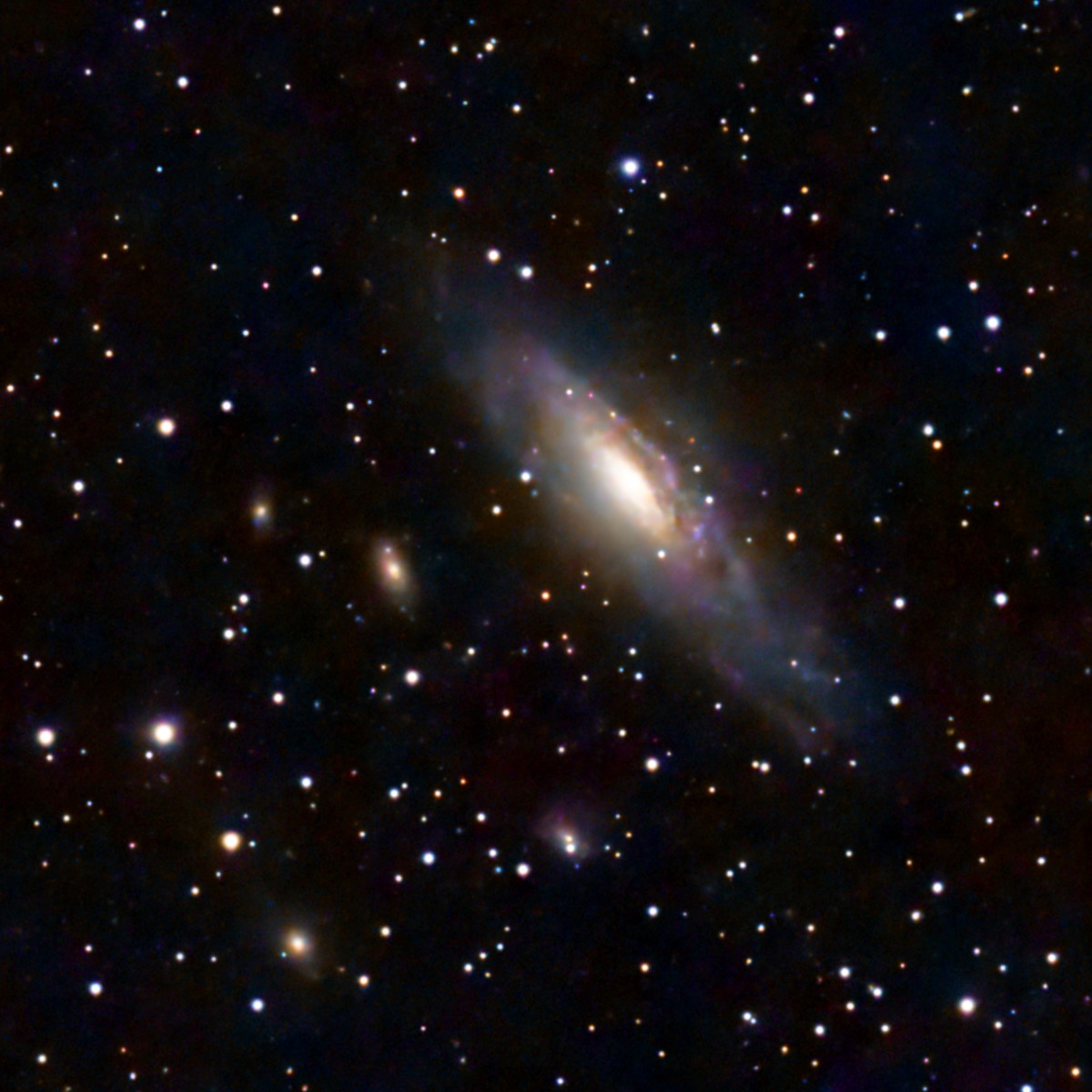
This grouping of five galaxies is a superposition of the bright foreground galaxy NGC 7331 (45 Mly away) and four more-distant galaxies (the “fleas” at 294–365) that might themselves be only weakly bound gravitationally. NGC 7331 is very similar to our own Galaxy in size, shape, and mass.
Extragalactic Superman
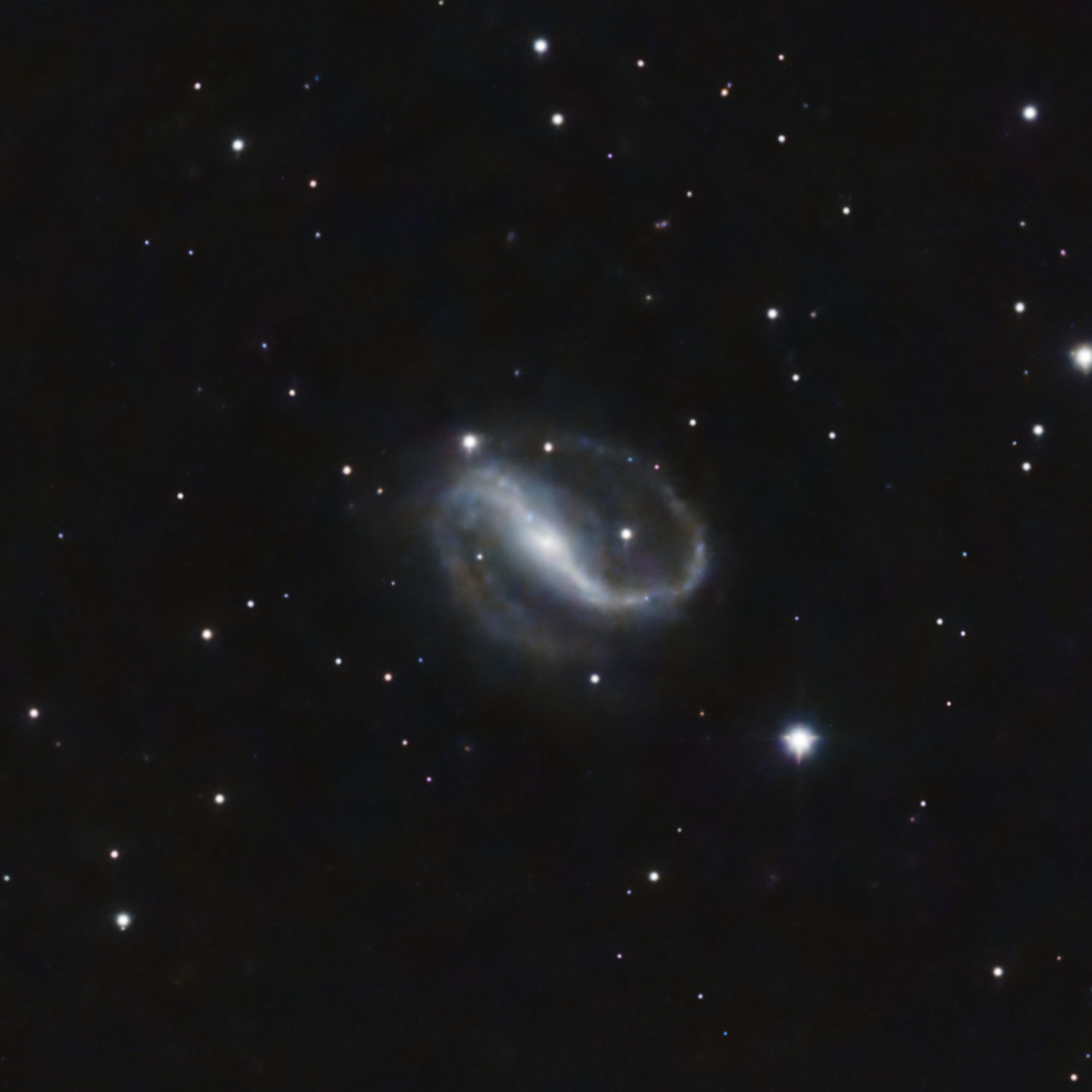
NGC 7479 is about 3° S of the bright star α Pegasi (Markab). Its two open sweeping spiral arms give it the name “the Superman Galaxy” (even though it’s a mirror image of a big galactic “S”. It is experiencing significant starburst activity.
Stephan’s Quintet
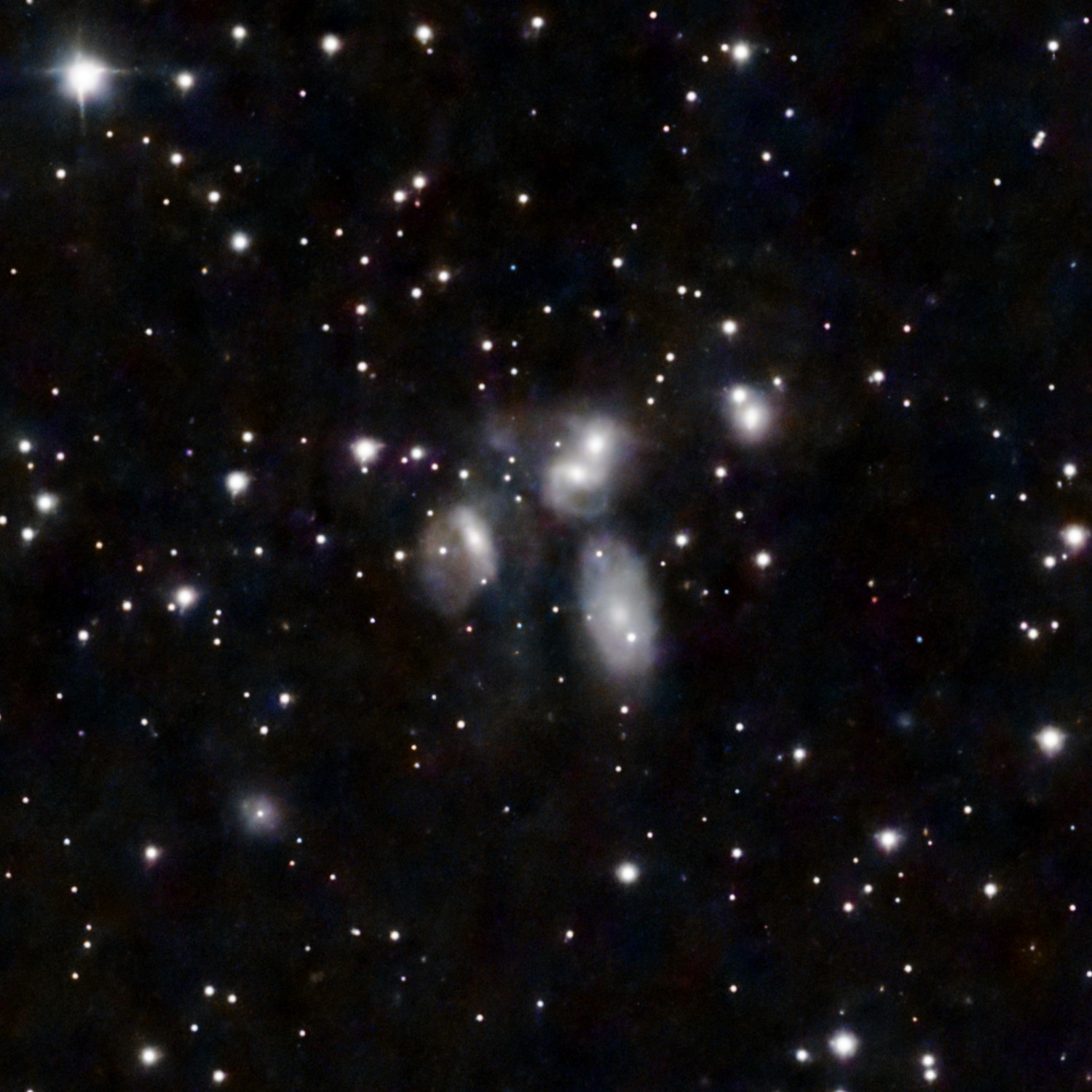
One of the most famous compact galaxy groups, like the Deer Lick group, the brightest galaxy (NGC 7320, bottom) is in the foreground (~39 Mly) but the other four (210-340 Mly) are interacting, and will eventually merge together: deep imaging shows several faint “tidal tails” connecting the galaxies. A sixth galaxy - NGC 7320C (bottom left corner) is possibly associated with the distant group as well.
Electric Arc Galaxy
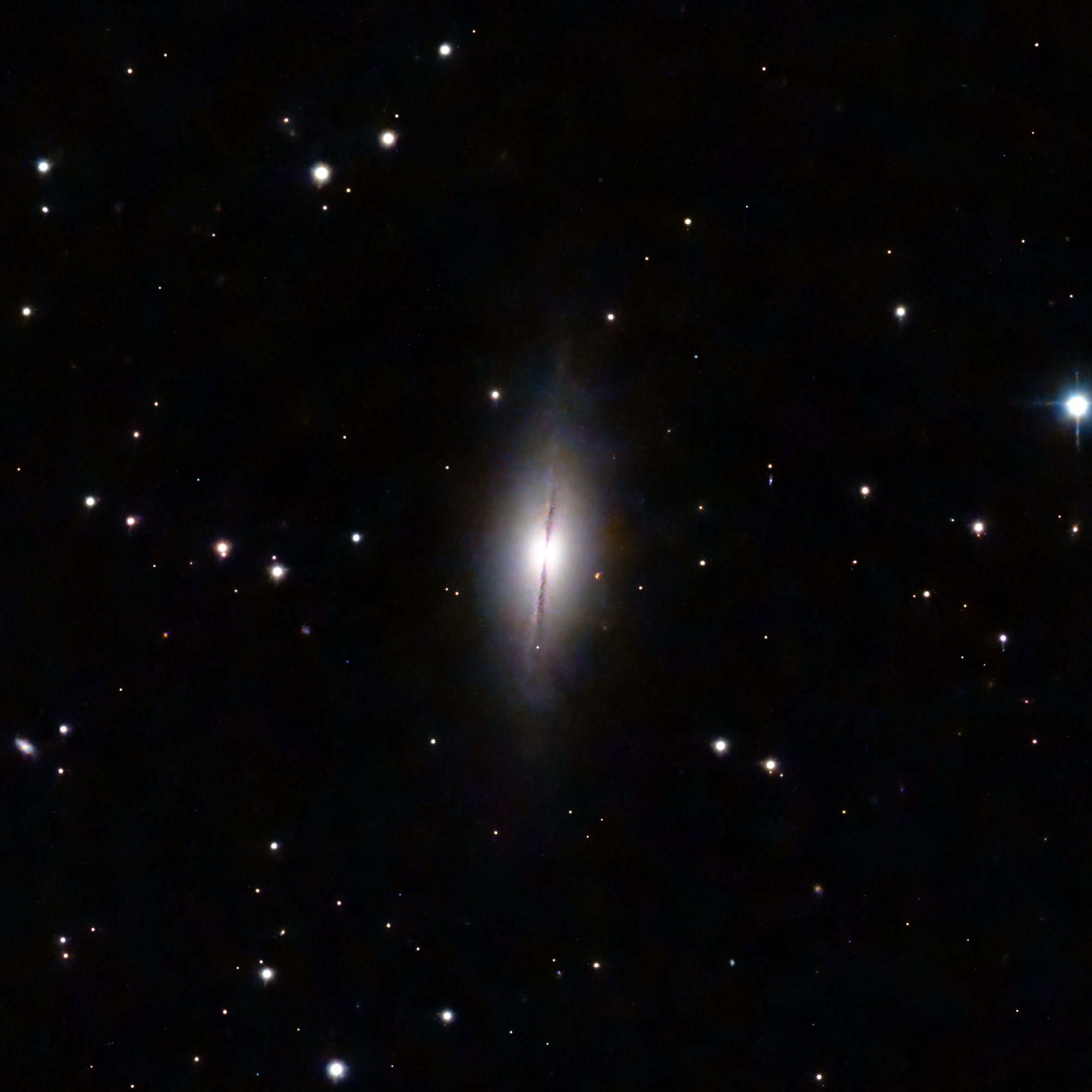
In the SE corner of the Great Square is another bright edge-on galaxy, NGC 7814. It has a prominent thin dust lane - very similar to the “Sombrero” Galaxy, M 104, in Virgo. It is 40 Mly distant. The disk is slightly warped. In the nearly background sky are a great number of very faint more-distant galaxies.
The First Exoplanet
800px-51_Pegasi_b_v3.jpg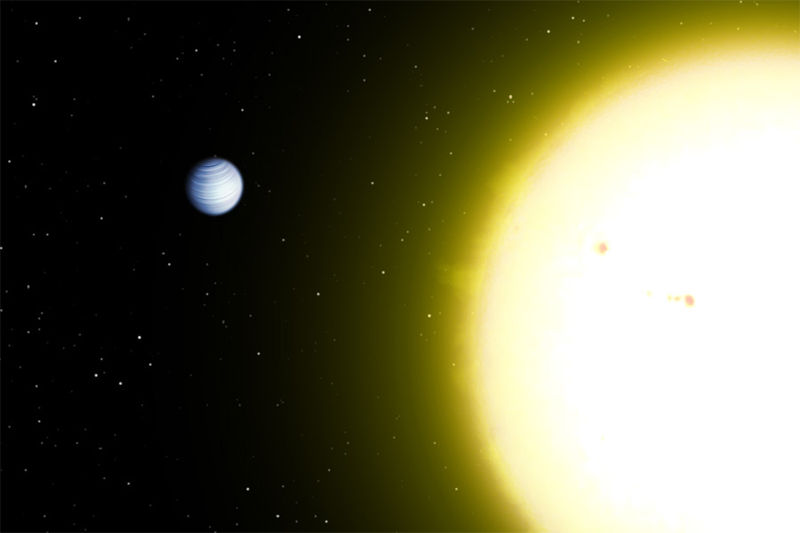
51 Pegasi - “Helvetios” is a star very similar to the Sun in properties and age. And - like the Sun - has at least one planet. It was this planet (“Dimidium”) that was the first-discovered exoplanet, beginning a new era in astrophysics.
51 Peg b, however, is unlike any planet in our Solar System. It is a “hot Jupiter” only 1/20th of the distance between the Earth and Sun, orbiting in just 101 hours, traveling at 300 thousand mph. While at first this appeared to be a very unique world, subsequent discoveries found that such planets are common: around 1% of planetary system might include a “hot Jupiter”, likely caused by inward migration of a planet that was formed further out. Why this didn’t happen in our Solar System is unknown: Jupiter appears to have started migration inwards, but might have been “pulled back” by the presence of Saturn.
In any case, this planet would be very strange compared to our planets: it would be tidally locked (as the Moon is to the Earth) and it’s closeness to its star would make is very hot (over 1200 K) and “puffy” (about twice the size of Jupiter, despite having only 1/2 its mass) with a red glowing atmosphere, and potentially clouds of silicates.
Visually 51 Peg is just a 5th magnitude star 51 light years away, but easy to locate in binoculars.