
The Whale
In the story of Andromeda, Cetus is the sea monster sent by Poseidon to curse the kingdom of Æthiopia because of Cassiopeia’s boasting. To placate Poseidon, she and King Cepheus offered their daughter Andromeda as a sacrifice. Cetus was consequently slain by Perseus to rescue Andromeda. It sets amongst several other “water” constellations: Aquarius, both “fish” constellations (Pisces and Piscis Austrinis) and Eridanus the River.
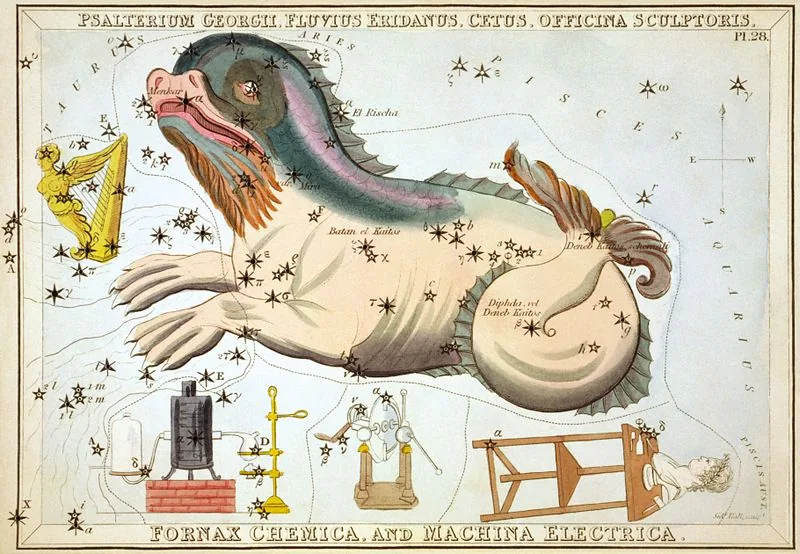
Constellation Scrapyard
Cetus is also adjacent to several dim constellations. To the South there’s Fornax (the Chemical Furnace) and Sculptor (the Sculptor’s Workshop) - both of which are dim but at least contain several prominent galaxies: “Machina Electrica” is an ex-constellation from the 19th century that was wedged in-between them. To the West and North are ecliptic constellations spanning from Aquarius to Taurus. To the East is the large constellation Eridanus with another “ex-constellation” Psalterium Georgii crafted to honor King George III.
Map of Cetus
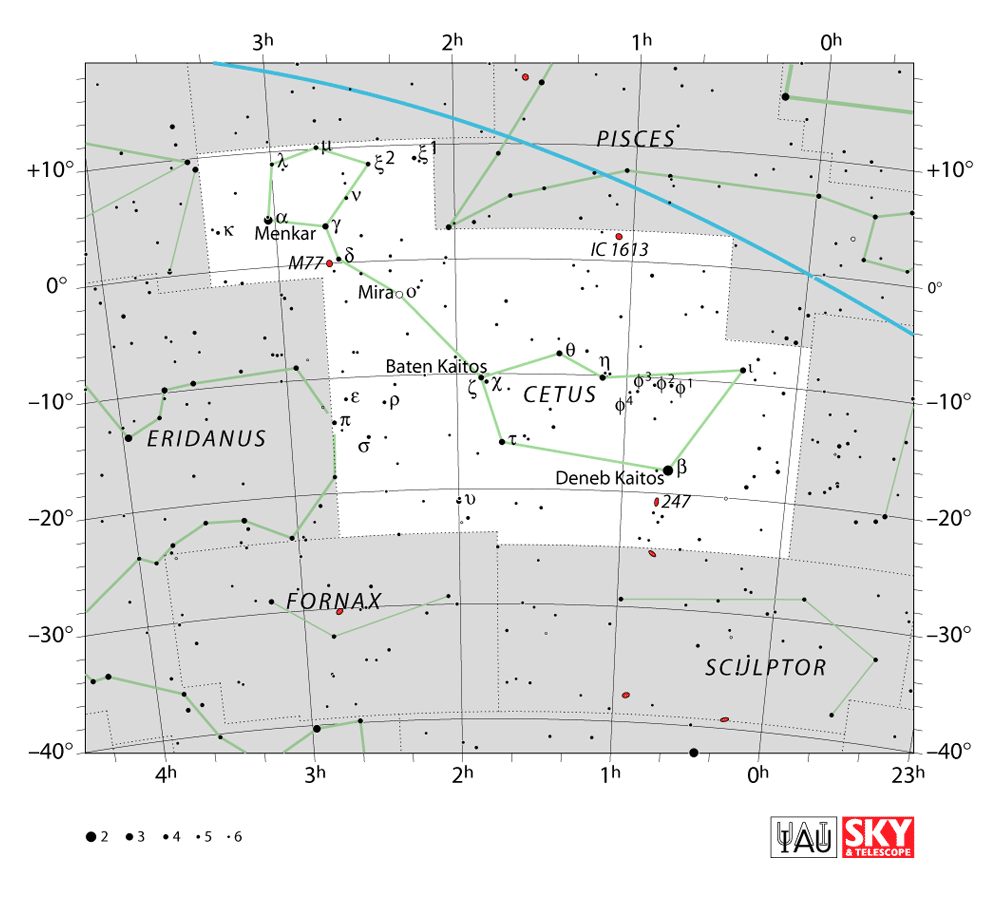
The “stick figure” of Cetus typically shows a “head” to the NE with its “body” to the South. Most of the stars are faint, although Menkar (α Ceti, marking the nose of the beast) and Diphda (β Ceti, its tail) - both magnitude 2 - stand out against the otherwise empty sky. In between, in the whale’s “neck”, is the very red star Mira which is a long-period variable. When at its brightest (every 11 months) its ruby color is especially striking.
Eliptic Adjacent
Cetus is not one of the Zodiacal constellations, but one corner is only 1/4° from the Ecliptic. Because planets have differing inclinations to their orbits they appear slightly above or below the Ecliptic and can briefly pass into Cetus. (Even the southern limb of the Sun can trespass into Cetus for about one day a year.)
Things to See in Cetus
Quick Reference: Objects of Interest
| Object | Type | Equipment |
|---|---|---|
| Messier 77 | Intermediate Spiral Galaxy | All Telescopes |
| Caldwell 62 (NGC 247) | Intermediate Spiral Galaxy | Small/Medium Telescope |
| Caldwell 56 (NGC 246) | Planetary Nebula | Medium/Imaging Telescope |
| Wolf-Lundmark-Melotte (WLM) | Irregular Galaxy | Medium/Imaging Telescope |
| Caldwell 51 (IC 1613) | Irregular Galaxy | Medium/Imaging Telescope |
| Omicron (ο) Ceti = "Mira" | Long-Period Veriable Star | Binoculars/All Telescopes |
The Squid
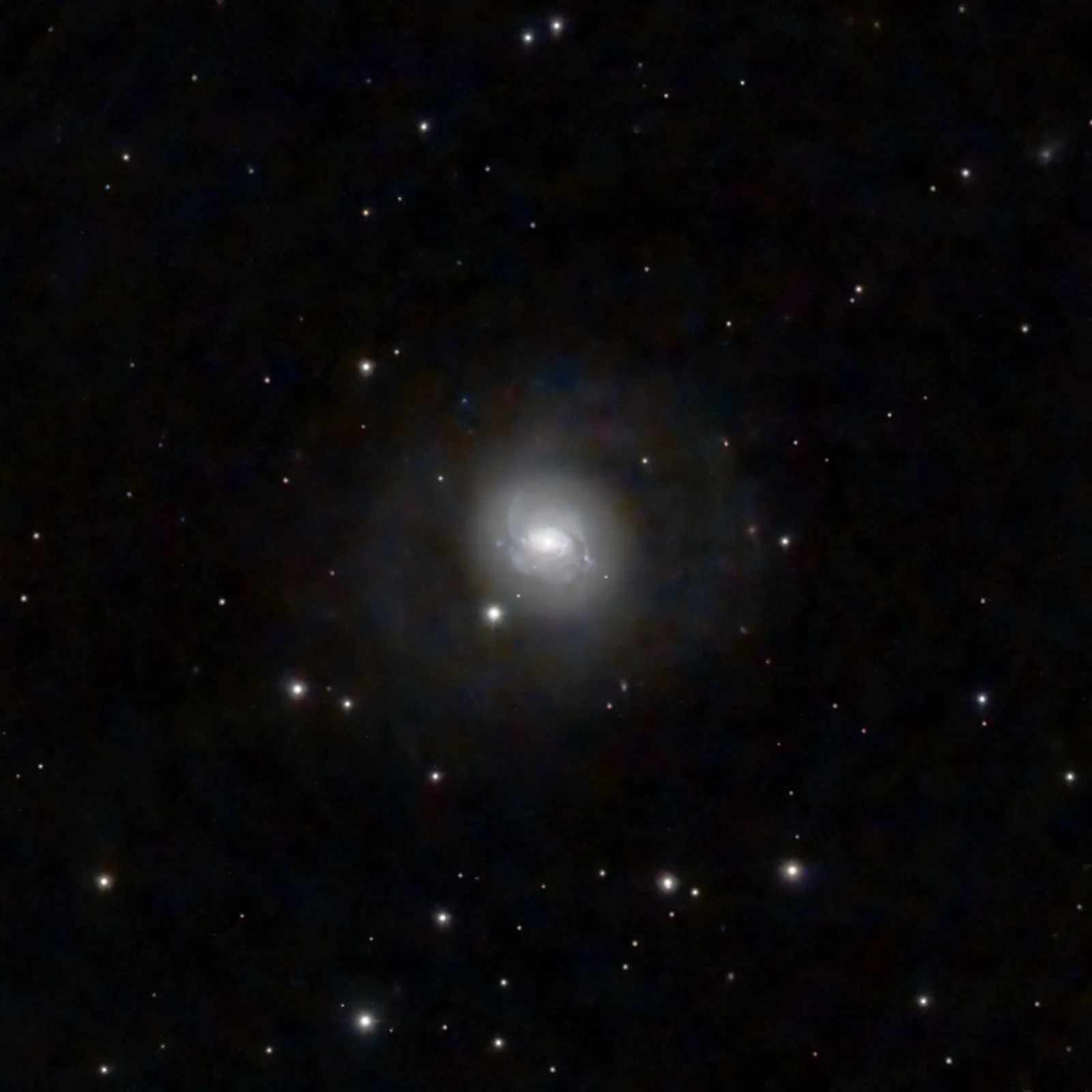
Messier 77 is 47 Mly from the Sun, about 170 kly across. It has an active center (making it a Seyfert galaxy) and is the brightest (and nearest) galaxy of this type in the sky. The arms are tightly-wound, giving it a fuzzy appearance in small scopes; larger (and imaging) telescopes begin to reveal the oval halo and finer details of the structure.
The Claw
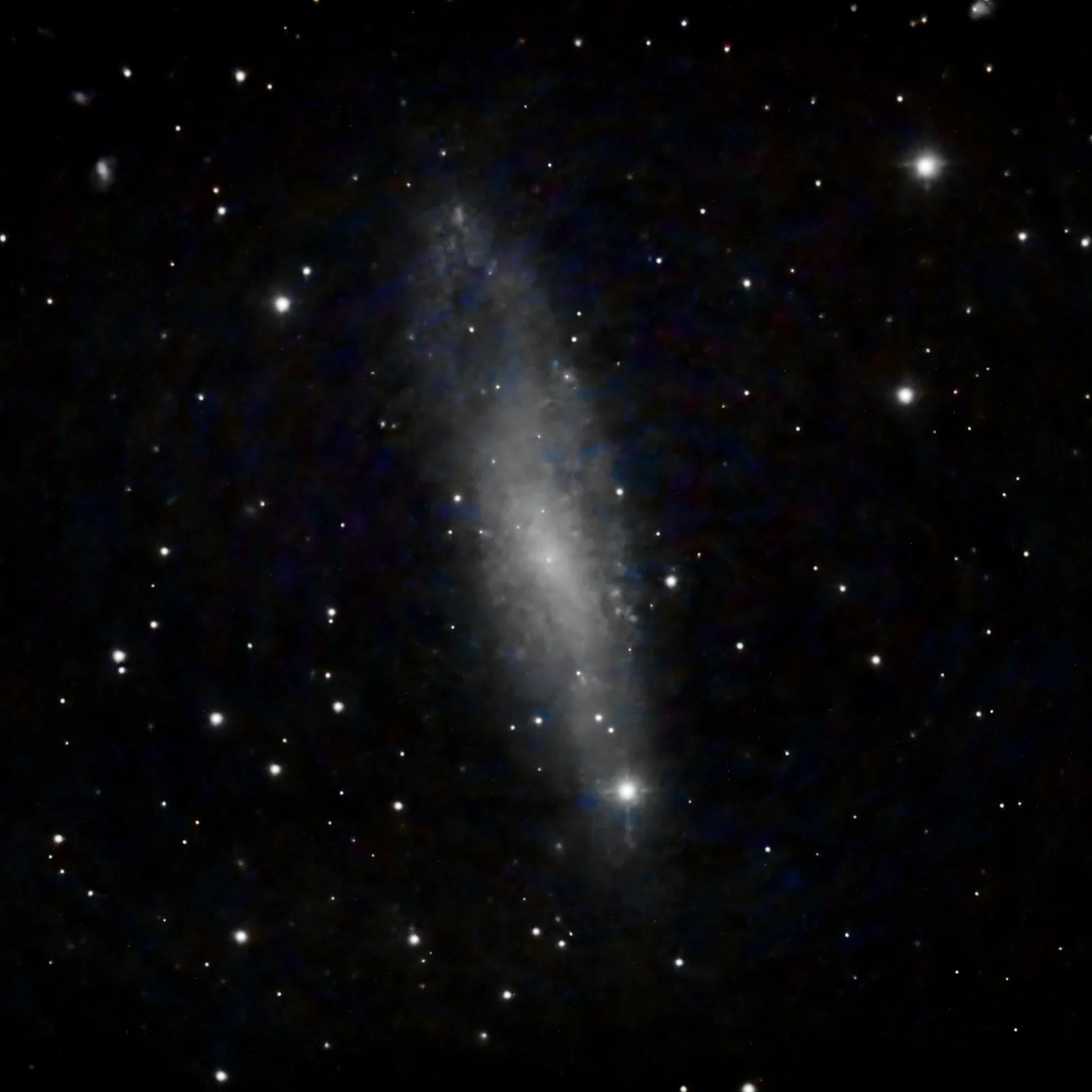
Closer to the Sun (only 11 Mly) is NGC 247 - the “Claw Galaxy”. It is mostly edge-on and very asymmetric with a “void” on one end containing no younger blue stars. 15-20’ to the N is Burbidge’s Chain: a line of five fainter and smaller background galaxies (mag 14-15, ~290 Mly distant).
The Skull
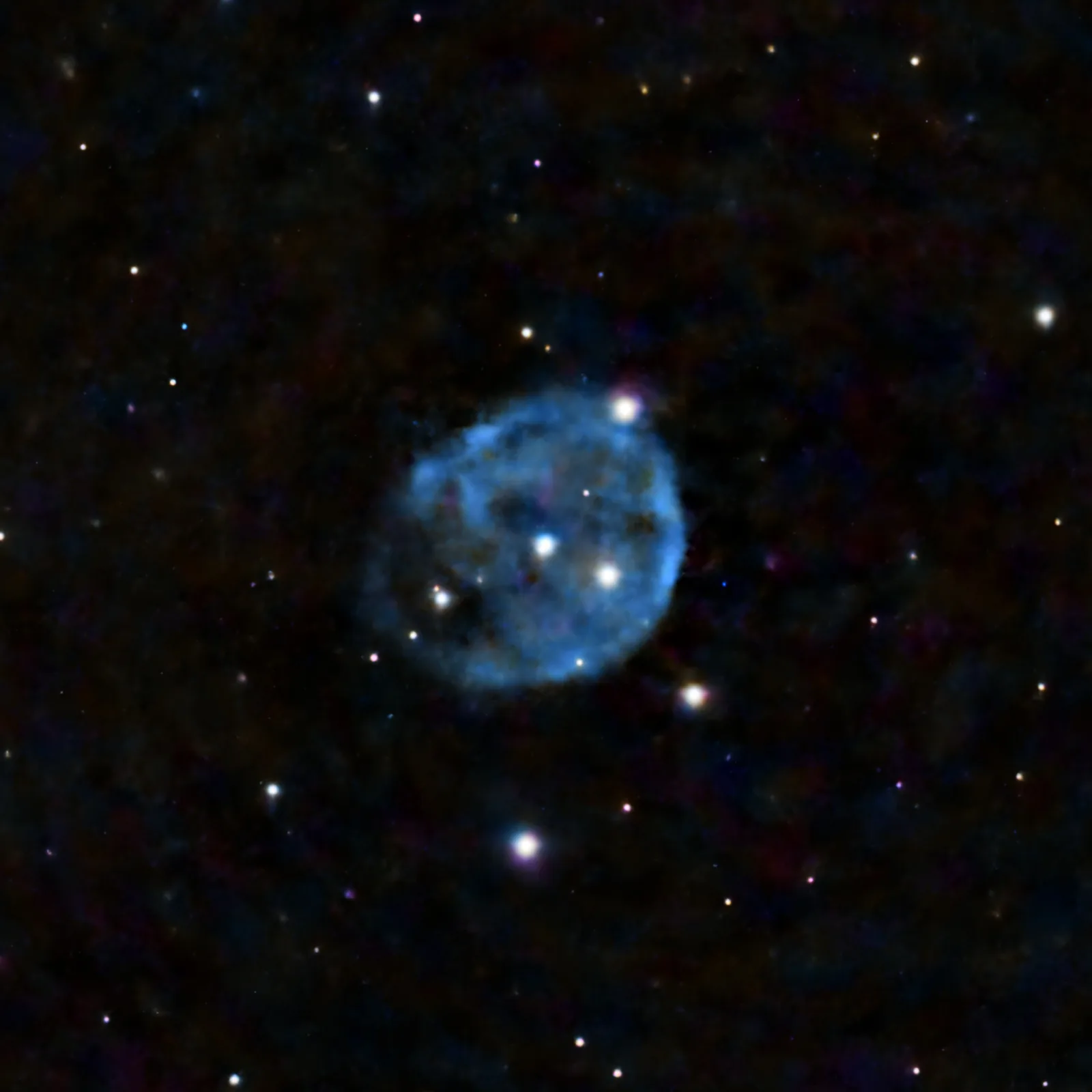
A 12th magnitude white dwarf star illuminates the planetary nebula NGC 247, itself part of a triple star system. It is about 1600 ly away, The nebula has a braided structure and is about 6-7 thousand years old (so slightly older than most PNs) and spans 2-3 light years across. Although it’s very dim (it will show up better with a narrow-band O III filter),
WLM

This irregular galaxy is on the fringes of the Local Group about 3 Mly away. Because of its comparative isolation, it has managed to avoid being cannibalized by other local galaxies. It is also rotating asymmetrically: one side moving faster than the other, which might mean it is passing through a denser medium. It has just one globular cluster - WLM-1 - mag 16) - identified on the image to left.
Another Dim Neighbor
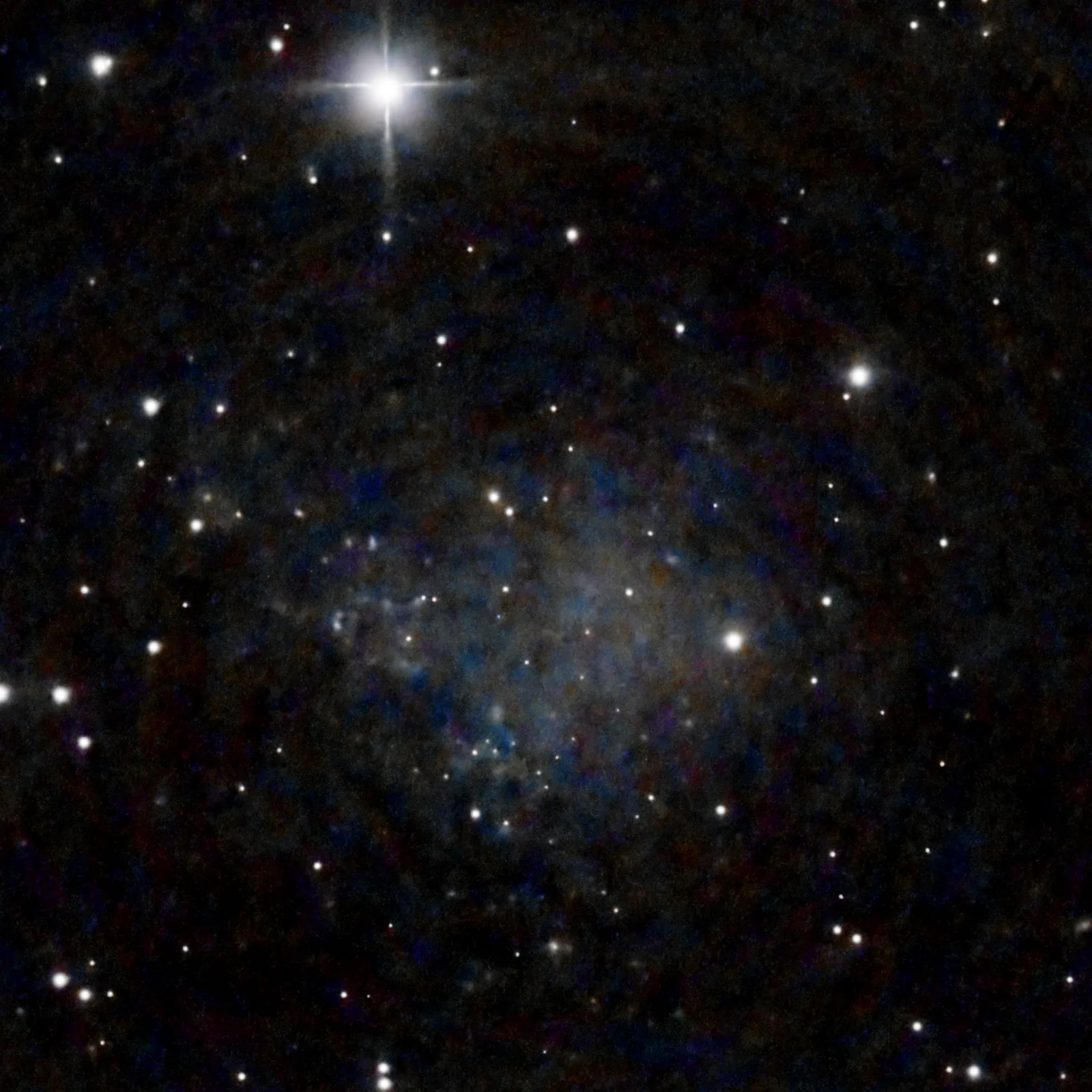
Another irregular dwarf galaxy in Cetus, also in the Local Group is Caldwell 51, slightly closer (2.37 Mly) than Andromeda (2.56 Mly). Its distance is well known, partly because it contains “standard candle” Cepheid and RR Lyrae stars, but also because it is uncharacteristically dust-free (both within the galaxy and to our line of sight).
Mira
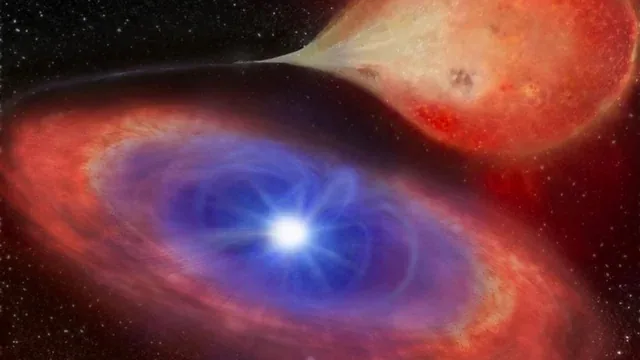
One of the first variable stars recognized, Mira is a binary star with a red giant and white dwarf pair. As Mira loses mass, some of that is accretes onto the companion. As a system they’re about 70 AU apart - the rest forming a tail 13 ly long formed over millennia.
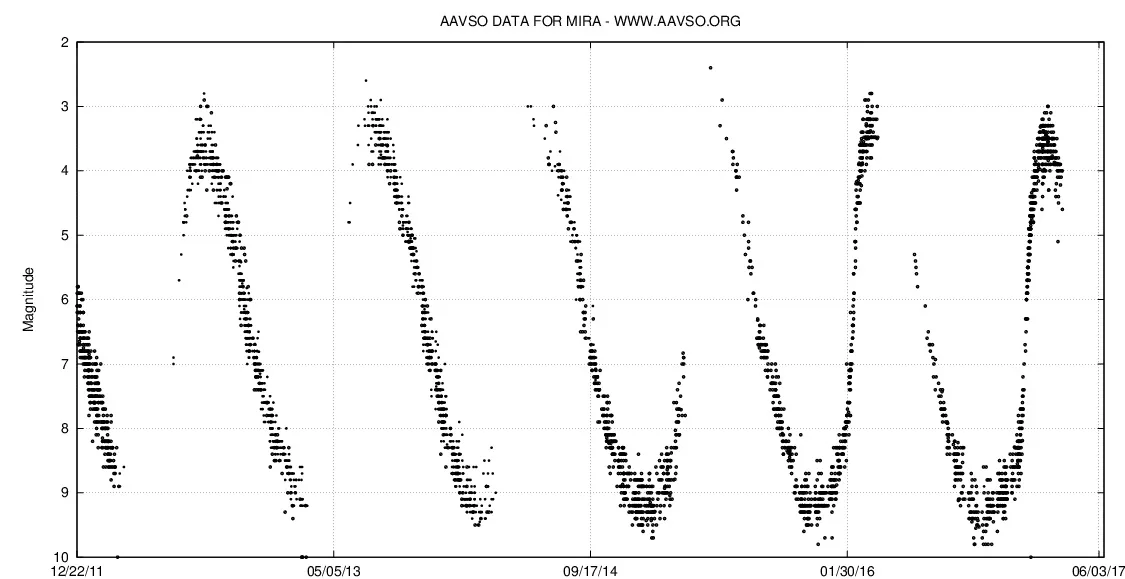
Mira is the archetype of the long-period pulsating variables. Over the cycle of pulsation, it varies in size from 330 to 400 times the size of the Sun (out to the distance of Mars) — though it’s largest at minimum phase and smallest when it’s brightest. Likewise, the temperature (and color) vary: coolest (and deep red) at minimum, hotter and (more orange) at maximum.
It has a period of ~334 days over which time it ranges from a minimum of mag 10 (so requiring a modest telescope to see) to as bright as magnitude 2-3 where it stands out both because of its very red color and having few bright stars nearby in the sky. The next maximum will be early April 2025, unfortunately when Cetus is close to the Sun: it’ll be a few more years when the maximum happens in the early winter skies.