Mars at Opposition
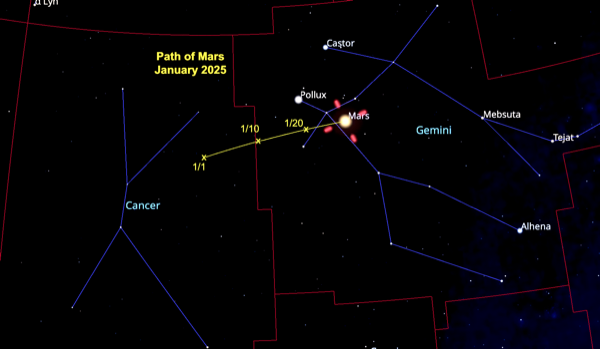
Mars at opposition is exciting because it’s when we’re closest to it, that it’s (finally) large enough to spy the polar caps, and try to detect surface features. Not so in 2025: while it is only 0.64 AU away on the 14th, because of Mars’ elliptical orbit, we’re passing it when it’s almost at its farthest point from the Sun. As a result, it’s only 15” wide (slightly smaller than Saturn minus the rings) - and while shining brightly close to Castor and Pollux during January, not the best conditions for observing the planet.
Oppositions of Mars happen roughly every 26 months. Next time, in 2027 and 2029, things will be slightly worse. At the next favorable opposition (0.42 AU; 22”) in 2033 Mars will be low in the sky (in Sagittarius), but Sep. 2035 will be much better: then Mars will be only 0.38 AU away, almost 25” in diameter!
This pattern repeats over 6 or 7 oppositions over a period of 15.8 years with 3 (or 4) aphelic (poor) or intermediate showings (when Mars’ Northern latitudes face Earth), followed by 3 consecutive perihelic (good) showings (when we see more of Mars’ Southern hemisphere).
Scanning Around Gemini
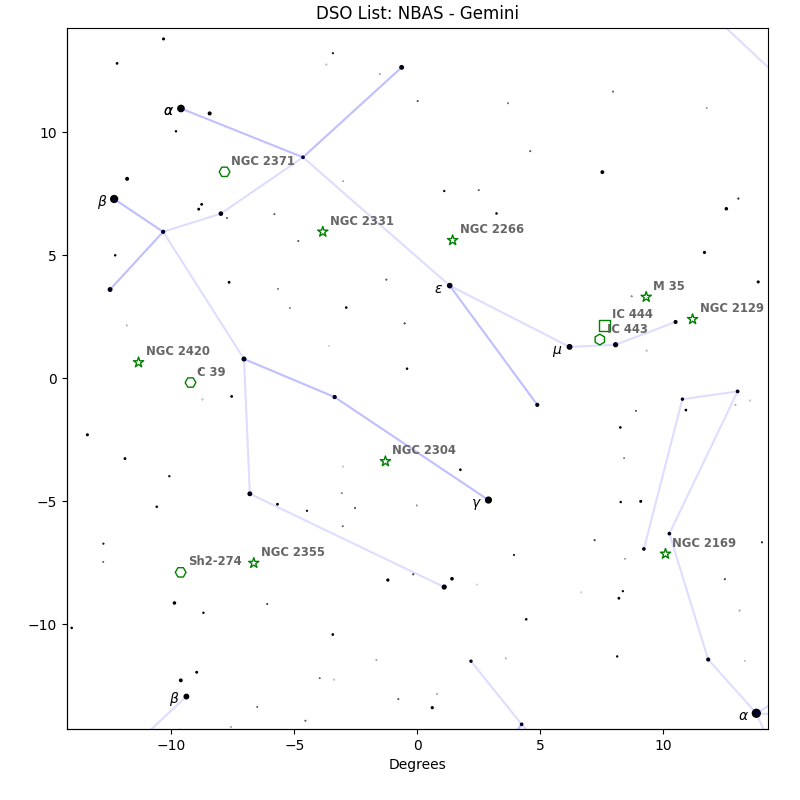
Aside from Mars dominating the region, there are plenty of DSOs to find in Gemini and a few real challenges!
First, over near Orion’s club just above the three stars marking “Castor’s foot” are several star clusters: Messier 35 is easy with any telescope or binoculars, but can you detect the nearby NGC 2158? The two clusters are an interesting comparison: M35 is young with hot blue stars, whereas NGC 2158 is much older with more red giants (it’s also 10x more distant). Nearby are IC 443 - the Jellyfish the winter’s answer to the summer’s Veil Nebula, and more challenging IC 444 about 12’ west of star 12 Gem.
Three planetary nebula: Caldwell 39 = NGC 2362 is the “Clown Face” which is a popular target though slightly challenging in smaller scopes; NGC 2371 the “Ant Nebula” is about the same size but fainter; and Sh 2-274 the Medusa Nebula that’s large (10’) but extremely dim - requiring long exposures with an imaging scope!
Finally, several open clusters reachable in small scopes and (with some practice) binoculars: rich NGC 2420 (the Twinkling Comet), NGC 2266 and NGC 2355 (both slightly wedge-shaped), NGC 2129, the misty (and fainter) NGC 2304, and very i open NGC 2331. Finally over in Orion the funky NGC 2169 - can you figure out what its nickname is from its shape?
This Month’s Image
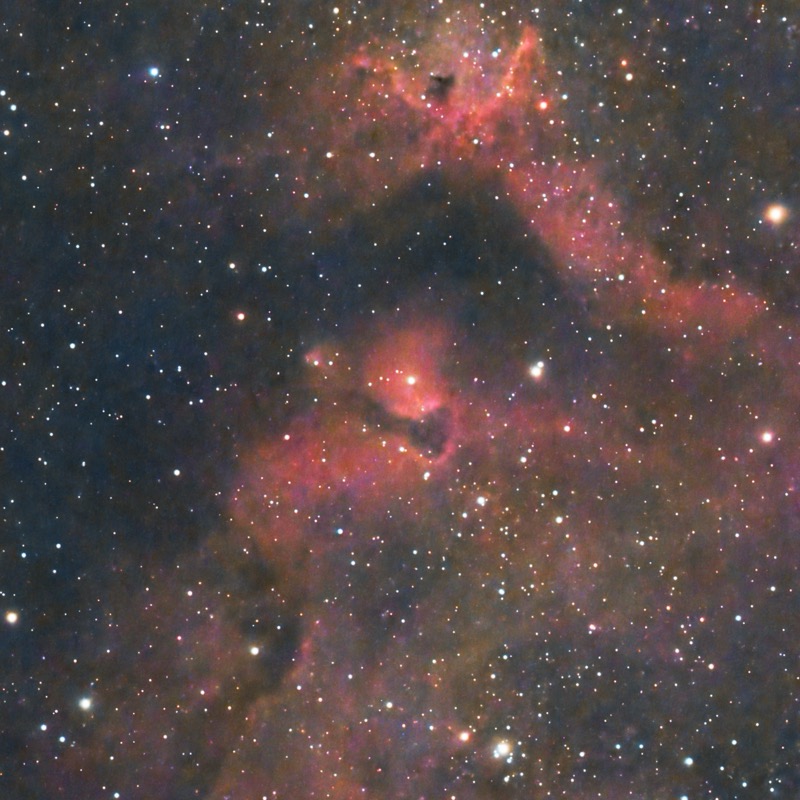
This is just a part of the Soul Nebula (IC 1871) in Cassiopeia (the Heart Nebula is nearby). It’s about 6500 ly away. These large nebulae have structure carved out from radiation and winds from the most massive stars, causing shocks that ignite and further additional star formation.