The Hunter
Globally, Orion is probably the most well- known constellation in the sky, as it straddles the Celestial Equator, and has been noted by countless cultures, into prehistory. In popular legend, Orion is born to Euryale and Neptune, and attacked by Gaia sending a scorpion, but then saved with an antidote by Ophiuchus - hence why Orion and Scorpius are never above the horizon at the same time, and why Ophiuchus is between them.
There is almost nowhere in this constellation that doesn’t have some kind of interesting object: clusters and nebulae abound. Stretching from Betelgeuse down in an arc to Saiph, extending over 10° is Barnard’s Loop: it is almost visible under the darkest skies, but can be captured with tracked DSLR cameras (it’s too big for telescopes or binoculars).
Many of the objects and brighter stars found in Orion are within the Orion Arm of our Galaxy - itself a branch from the Perseus Arm (the main outermost spiral arm). Our own Solar System sits along the inner edge of that. As such the Milky Way cascades through part of Orion (the NE section) but most of Orion is part of the Orion Molecular Cloud Complex - about 1400 light years away, hundreds of light years across, and one of the most-active regions of nearby star formation in the night sky. This complex contains nebulae of all types, and small clusters of young newly-formed stars - many of which are well-known to amateur astronomers.
Map of Orion
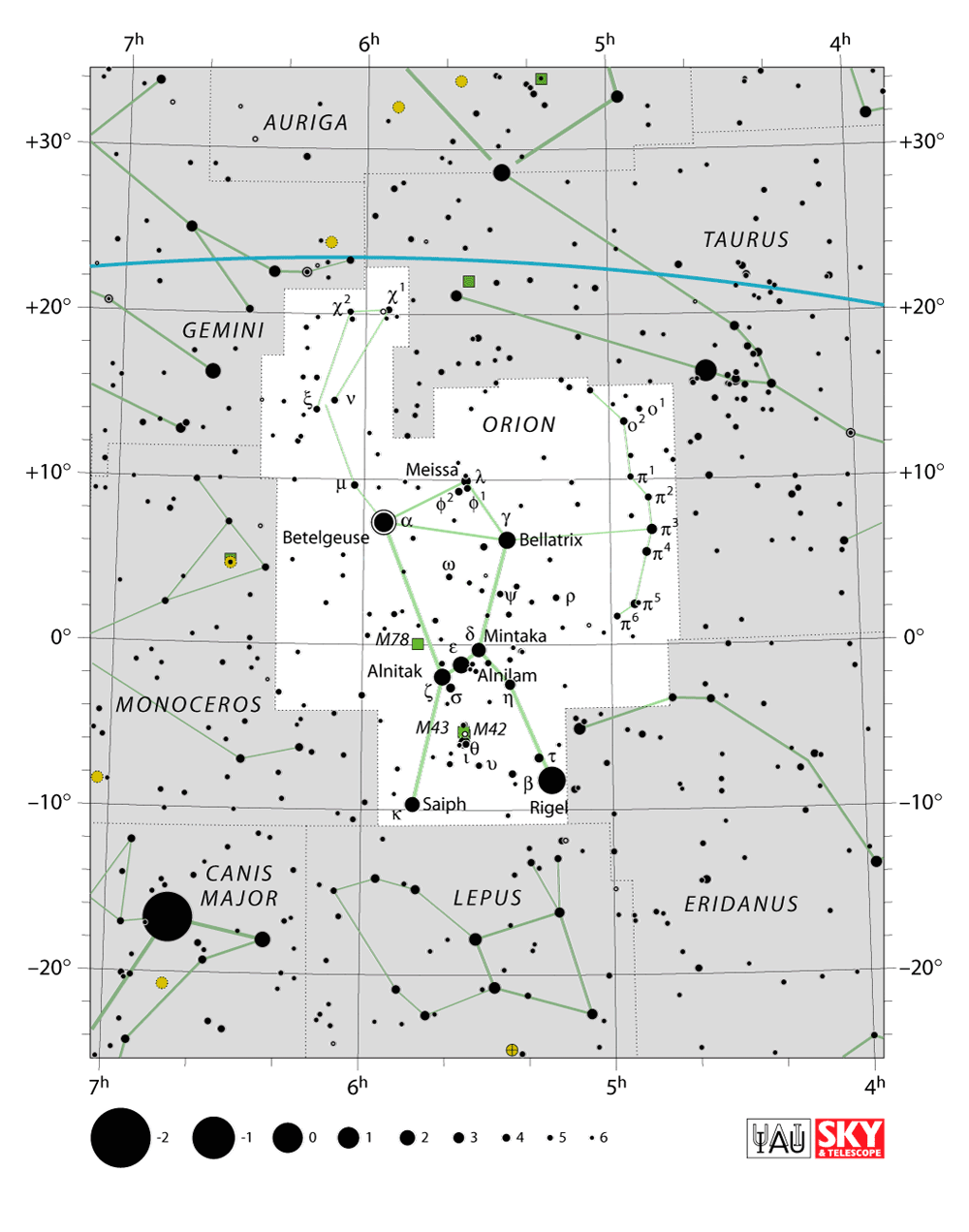
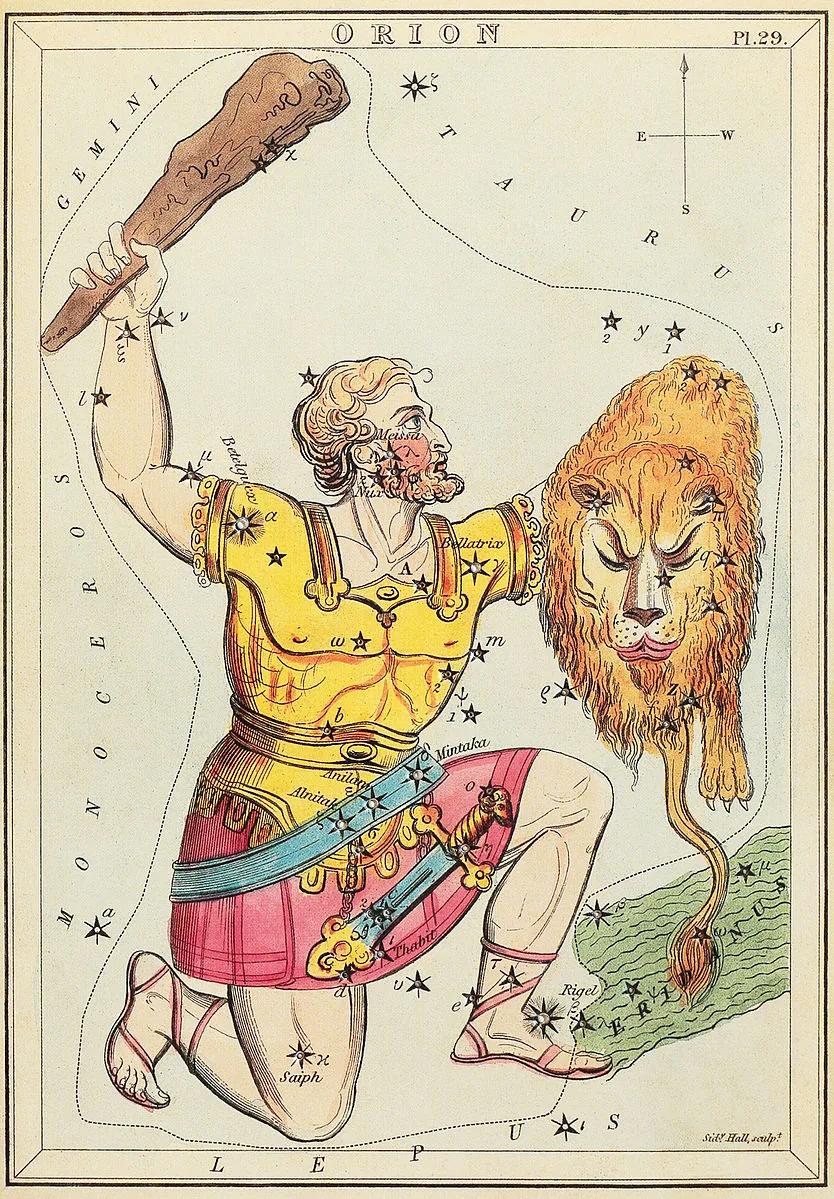
Orion is one of the relative few constellations that “look” like what it represents. Betelgeuse and Bellatrix mark Orion’s shoulders; Saiph and Rigel, his knees; and the line of three prominent stars (Alnitak, Alnilam, and Mintaka) are his belt.
Moving up from Betelgeuse (towards Gemini) are sets of fainter stars for his right arm (holding club), while west of Bellatrix an even fainter trail of stars are the lion’s mane he’s holding in his left hand. Below the belt are the “dagger” stars, with the bright Orion Nebula at the center. Dimly marking Orion’s head are a faint triangle of stars, Meissa being the brightest.
Quick Reference: Objects of Interest
| Object | Type | Equipment |
|---|---|---|
| Messier 42/43 | Emission Nebula | Naked Eye/All Telescopes |
| NGC 2024 | Emission Nebula | Small/Medium Telescope |
| NGC 2169 | Open Cluster | Binoculars/Small Telescope |
| Barnard 33 | Dark Nebula | Medium/Imaging Telescopes |
| LDN 1622 | Dark Nebula | Medium/Imaging Telescopes |
| Betelgeuse | Long-Period Variable Star | Medium/Imaging Telescopes |
The Great Nebula
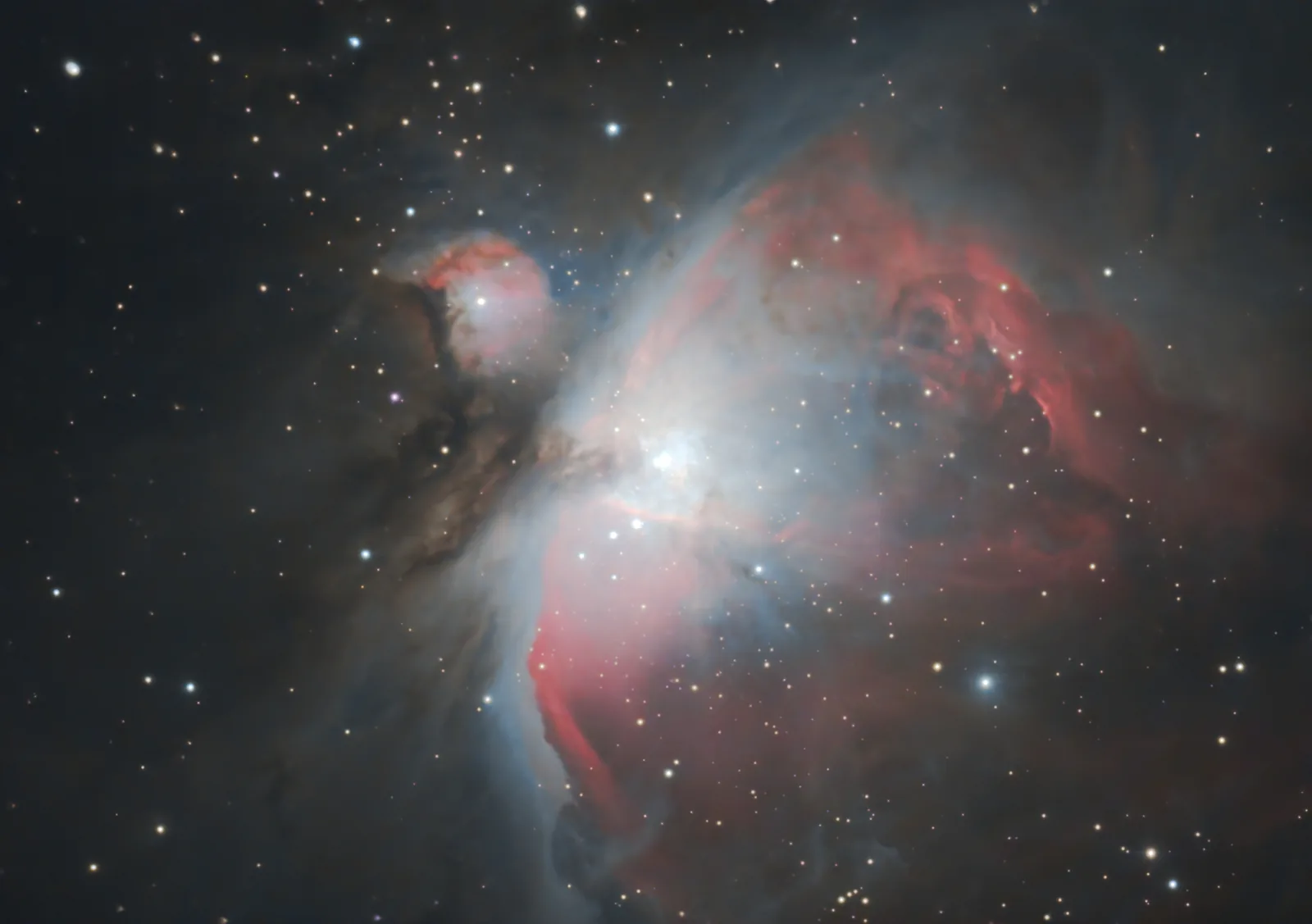
M 42 and M 43 are two of the most-observed objects in the Sky: the Great Orion Nebula, visible to the naked eye and spectacular in any telescope. 1350 ly away it’s the closest region of intense star formation to us: 24 ly across wrapped around a very young open cluster “the Trapezium” but over 700 stars in the process of formation have been cataloged within the nebula.
Cosmic Flame
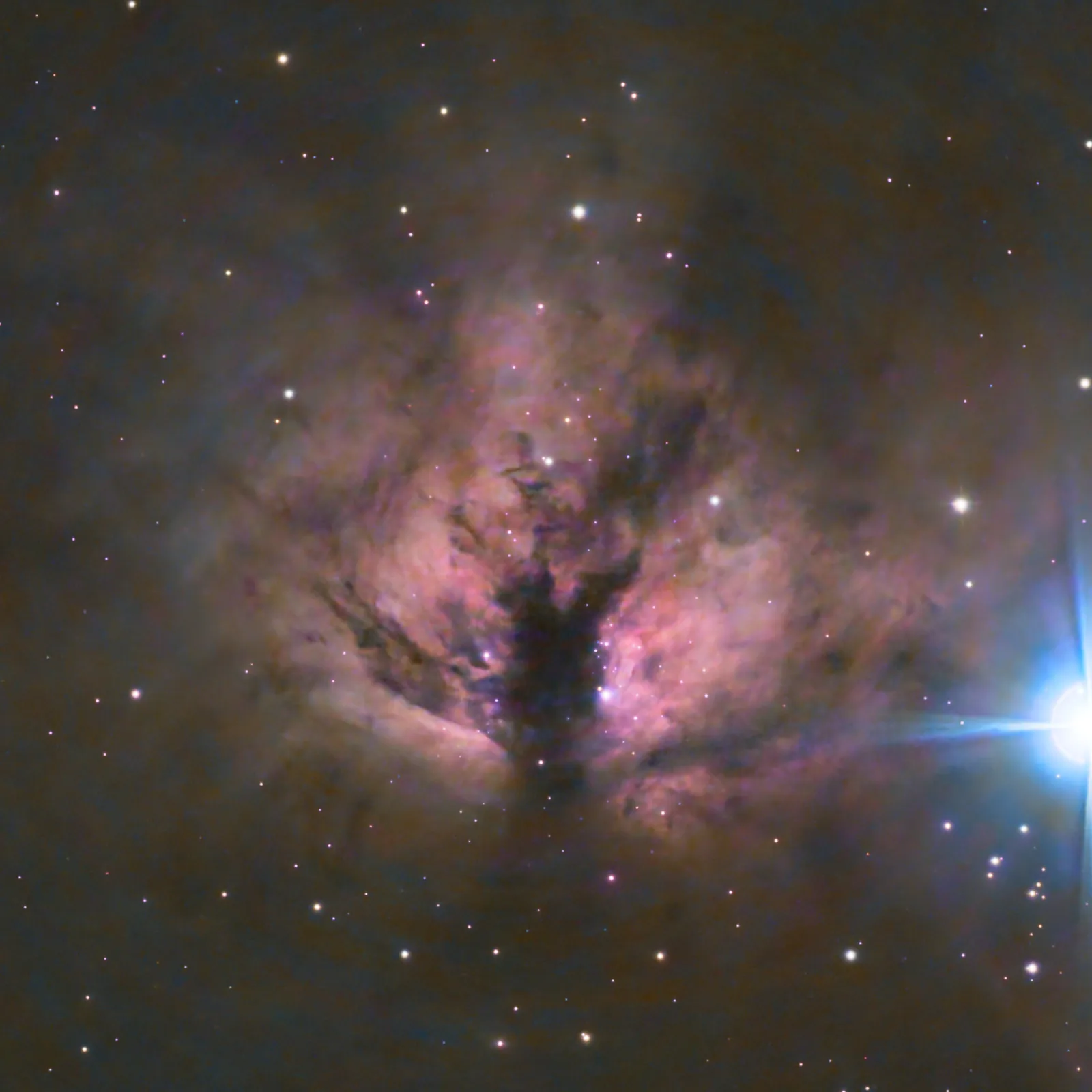
Next to the Horsehead Nebula is the Flame Nebula also part of the Orion complex (also 1350 ly away). Like the Orion Nebula it surrounds (and is lit by) the light of very young stars, but is more opaque with several dust lanes in its foreground, giving it a flame (or maple leaf) shape.
The “37” Cluster
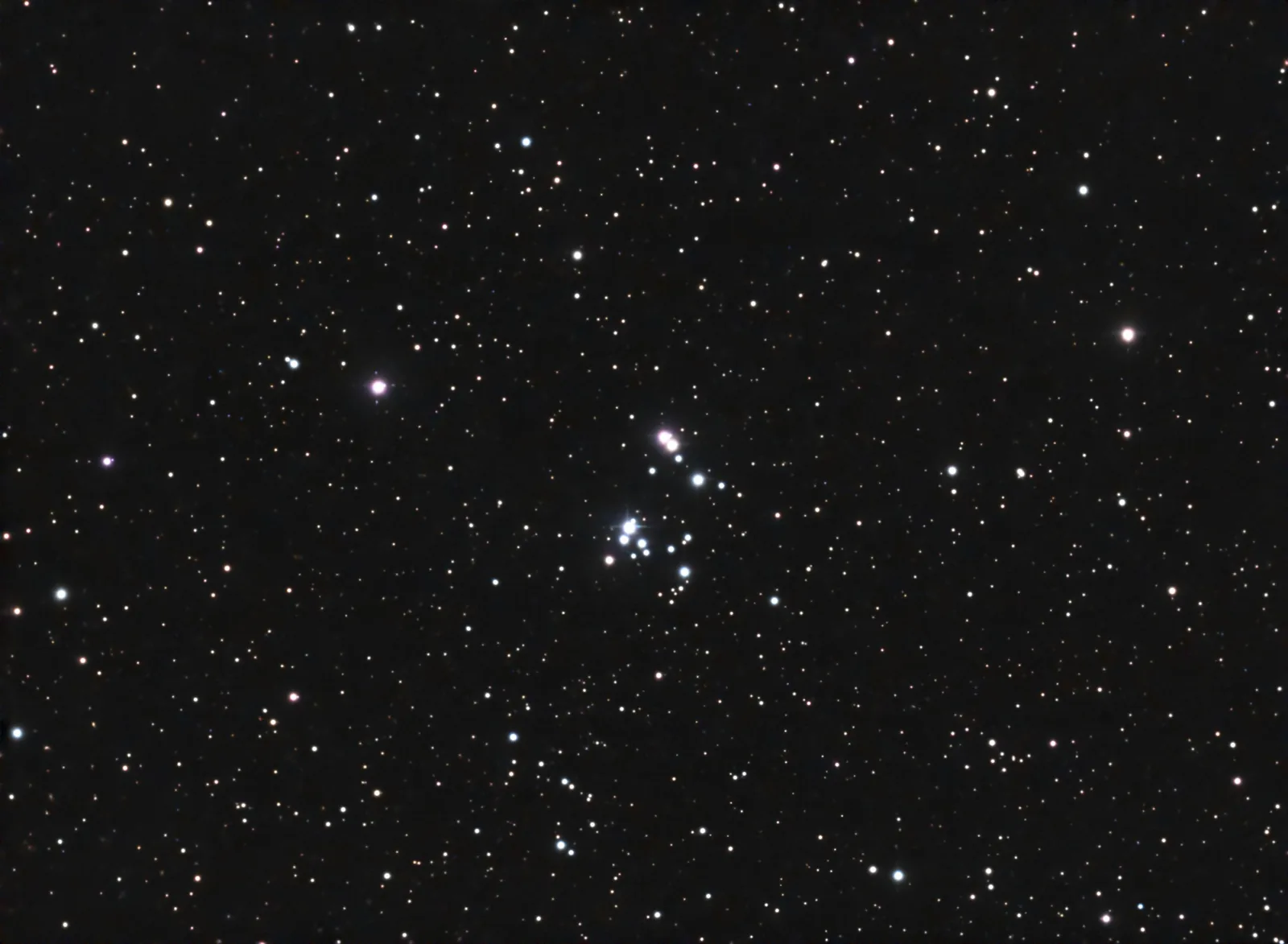
This loose star cluster (in Orion’s elbow) is not part of the Orion complex: it’s 3600 light years away. While not as rich as more famous star clusters, it’s a great target for small telescopes (or even binoculars with a tripod) because the stars in the cluster coincidentally form the number “37” in the sky from our perspective. Like many open clusters, it’s young - about 10 Myr - and will likely dissipate over time.
The Horsehead Nebula
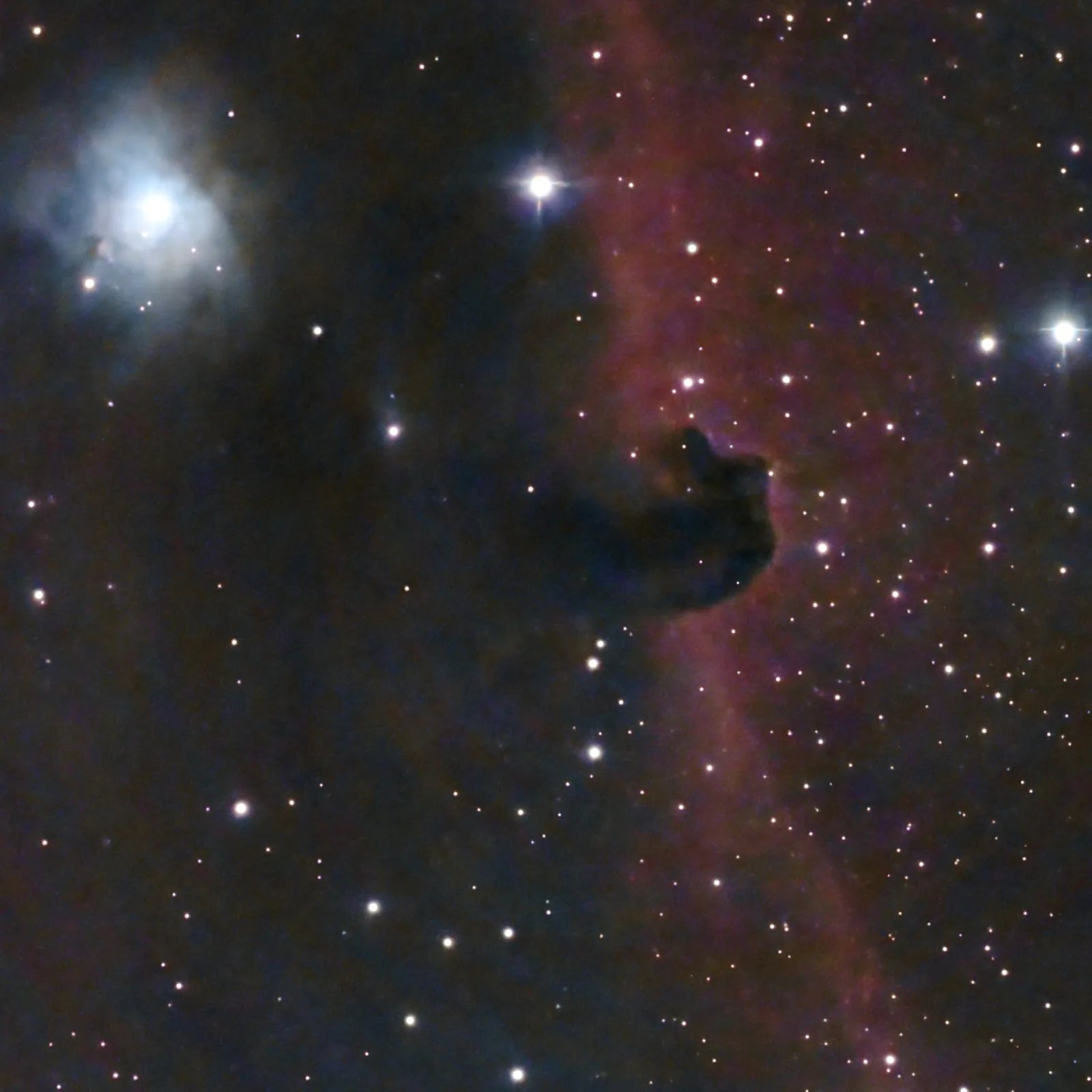
This small dark nebula is a favorite challenge for amateurs. It’s the most famous of Barnard’s Dark Nebulae because of its characteristic shape set against the backdrop of ionized hydrogen gas. Both are all part of the expansive Orion complex.
Boogeyman
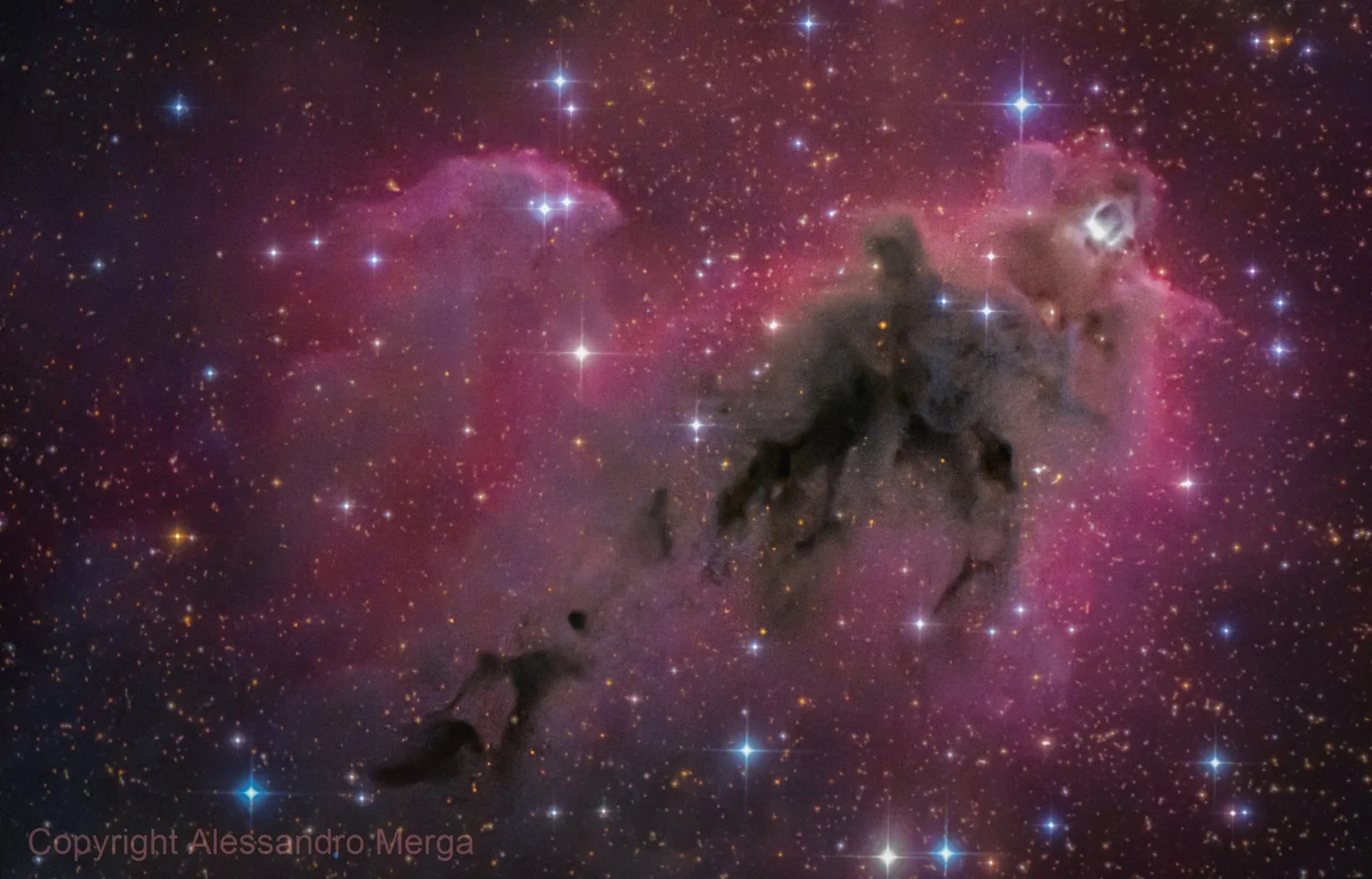
Another dark nebula situated roughly mid-way between Alnitak and Betelgeuse, and part of the Orion complex (and Barnard’s Loop) is the very faint “Boogeyman” nebula. It’s about 10ly across. Capturing it in imaging is a real challenge, requiring a few hours to get details, but it’s very striking and - frankly menacing!
Betelgeuse
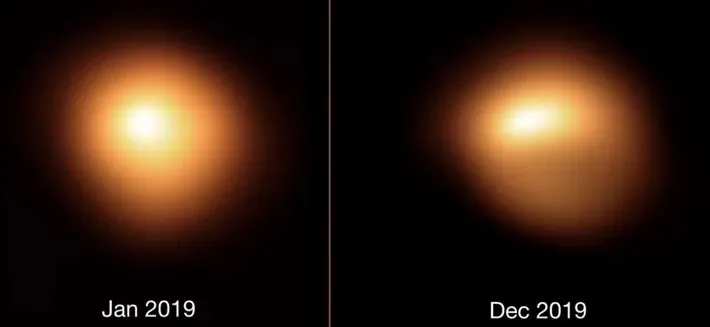
A red supergiant, and although it has the designation α (alpha), is slightly fainter than Rigel (β Orionis). It had a radius of ~700x the Sun: if placed in our solar system its surface would extend to the asteroid belt! At ~15x the Sun’s mass, it has a very short lifetime, only about 10 Myr and will likely become a supernova within the next 100 kyr - at which point it will be visible in broad daylight. Starting as a hot O- type star, is has evolved to a red supergiant and will eventually (but rapidly) heat up to a yellow and then blue supergiant, at which point it
Betelgeuse has significant light variations over months and years from mag 0.0 to 1.6; in 2019-2020, it dropped to mag 2.0 possibly due to an eruption of ejected hot gas that occulted the disk as it cooled, or perhaps from the presence of large starspots.
It is a runaway star from the Orion OB1 association (which includes the Belt stars of Orion as well as the star forming regions in the Orion Nebula: it’s moving through space at 30 km/s; with its extensive mass loss it is creating a bow shock over 3 ly across.