Uranus Challenge!
We might easily forget Uranus as it’s competing with Mars and Jupiter in the late-winter skies. But it’s actually easy to find with binoculars or a small telescope hiding in plain sight in Taurus near the Pleiades cluster.
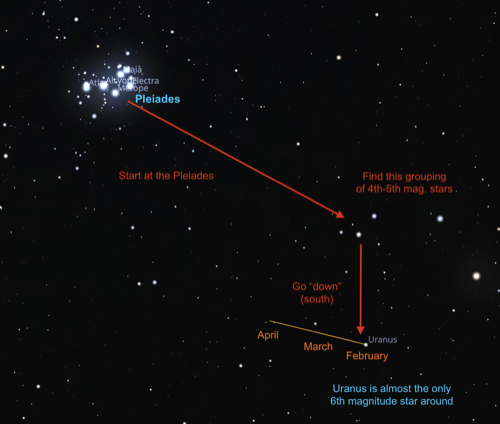
Starting with the Pleiades, use the “back” stars in its dipper shape (Alcyone and Merope) to move Southwest until you encounter a clump of 5th-6th magnitude stars (the brighter two are Tau-1 and Tau-2 Arietis).
From there, move South (and slightly East as we enter Spring), and it’s about the only 5th-6th magnitude “star” there. In March it will pass by the slightly-fainter mag-6.5 star HR 1036 but that will probably make it even easier to find!
Southern Open Clusters
While Spring is definitely “galaxy season”, late winter might be called “open cluster” season.
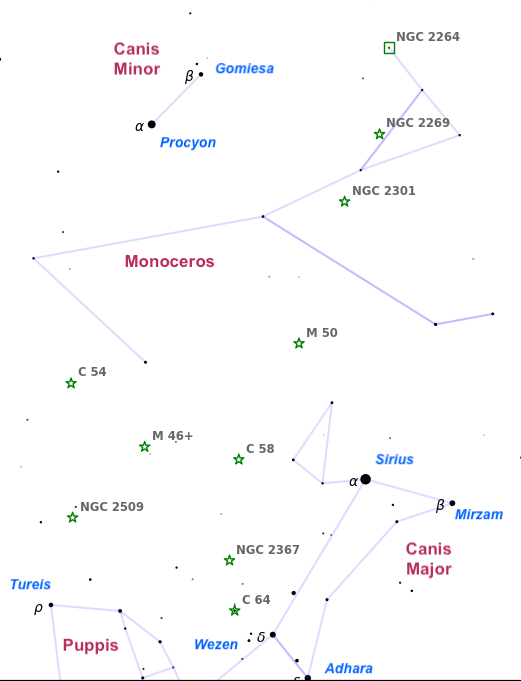
While you can follow the Milky Way starting in Cassiopeia, working down through Perseus and Auriga, and hit cluster after cluster, here’s a sample of open cluster, all pretty on their own merit that might get overlooked competing against other Winter deep-sky favorites:
Monoceros: Let’s start with NGC 2264 - the “Christmas Tree” cluster - (and associated with the Cone Nebula). NGC 2269 the “Headhunter”, and NGC 2301 “Hagrid’s Dragon” (it definitely looks like something swooping towards you). Moving south (and bypassing several other small clusters along the way), we reach Messier 50 - the “Heart-Shaped” cluster. At the other end of the unicorn, is Caldwell 54 which is bright and expansive (somehow Messier missed this one).
Canis Major: The “Big Dog” also has dozens of open clusters including Messier 41 - just south of Sirius, but also “Caroline’s Cluster” (Caldwell 58) that is dense, NGC 2367 “Charlie Brown’s Christmas Tree” (there’s a small upside-down V-shape), and the “Mexican Jumping Bean” cluster (Caldwell 64) surrounding the 4th magnitude star Tau (τ) CMa (another one missed by Messier).
Puppis: Here, Messier 46 is special in that there’s a planetary nebula hiding amongst the cluster stars (Messier 47 is just to its West). Finally, NGC 2509 is irregular - almost “lumpy”.
This Month’s Image
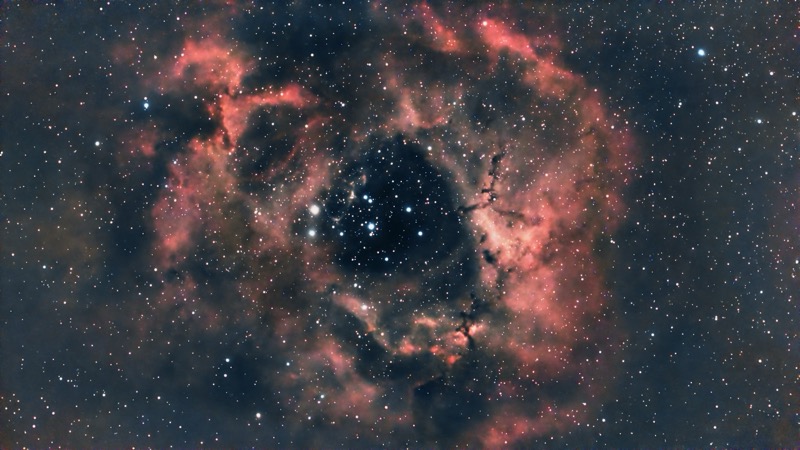
The Rosette Nebula is an H II region (ionized hydrogen) in Monoceros,
It’s a center of star formation, with about 2,500 hot young stars, ionizing the surrounding gas giving it its red glow. Dark lanes of obscuring dust hide stellar nurseries. The radiation from the stars will eventually dissipate the nebulosity over the next few million years.
The stars at the center form the Harp Cluster.
At 5,000 light years away, it’s over 3 times the distance to the Orion Nebula - another star- forming region - and about 5x larger.