The Herdsman
Despite being a somewhat prominent constellation (containing the 4th brightest star in the sky), the “back story” of Boötes isn’t as rigidly set as much as other constellations, in terms of who he is supposed to represent: a son of Demeter (Philomenus), or of Zeus (Arcas) or Icarius a winemaker who after making too-string wine was killed (with his dog), and presented to his daughter (Erigone) who committed suicide — all three then placed in the sky by Zeus as Boötes, Virgo, and Canis Minor.
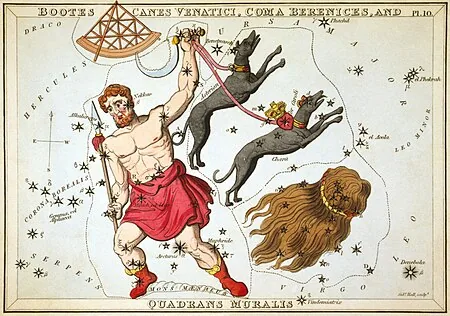
In the 1825 map at top, above Boötes’ head is the ex-constellation of Quadrans Muralis (the Quadrant), another early-19th century attempt to fill the sky with “new” constellations, several of which (as in this case) for scientific instruments. It didn’t “make the cut” for the official list of the 88 constellations, however, its brief legacy still lingers giving its name to the early-January Quadrantid meteor shower. The star 44 Boötis was a member of this defunct constellation and was given the official name “Quadrans” by the IAU Working Group on Star Names.
Map of Boötes
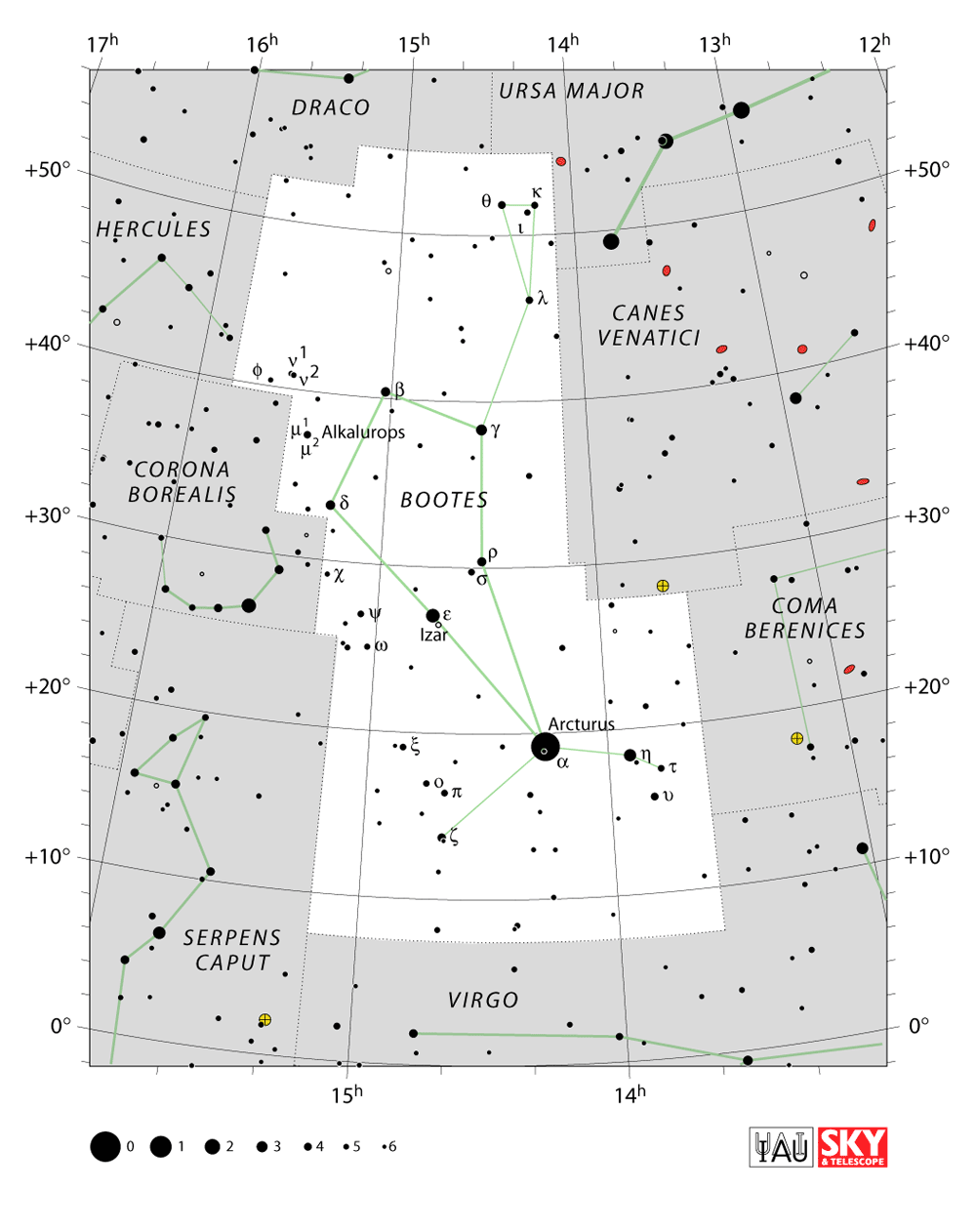
Boötes is easily found by following the “handle” of the Big Dipper, which points to its brightest star, Arcturus. Typically the “stick figure” of the constellation is kite-shaped, and is nearly overhead in the evening in the late Spring.
Quick Reference: Objects of Interest
| Object | Type | Equipment |
|---|---|---|
| Caldwell 45 (NGC 5248) | Intermediate Galaxy | Medium Telescope |
| NGC 5466 | Globular Cluster | Small Telescope |
| NGC 5529 | Intermediate Spiral Galaxy | Medium Telescope |
| Hickson 73 (Arp 42) | Compact Galaxy Group | Medium/Imaging Telescope |
| Izar = ε Boötis (Pulcherrima) | Double Star | Naked Eye/Small Telescope |
| Arcturus (α Boötis) | Red Giant Star | Naked Eye |
Caldwell 45
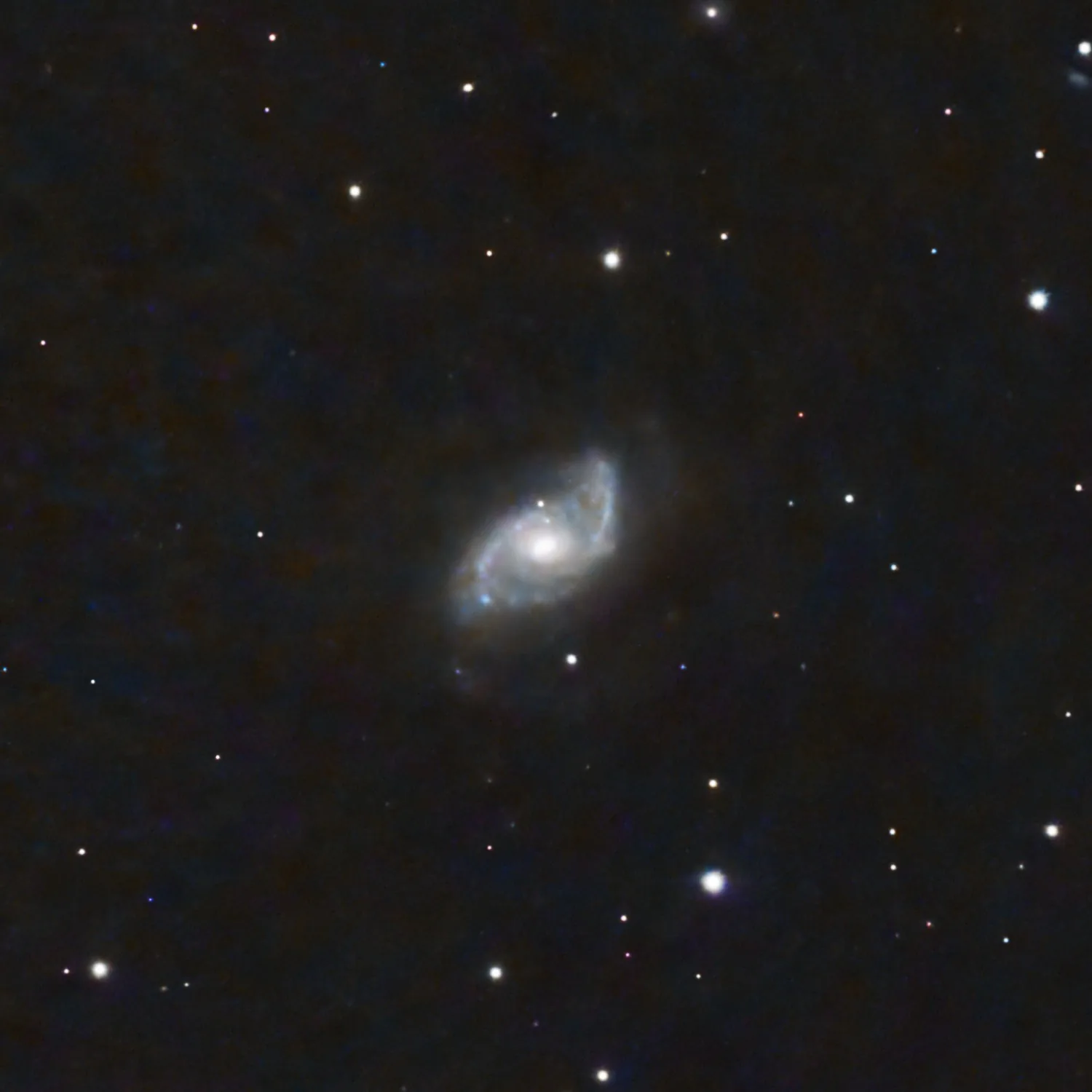
40 Mly away - this intermediate spiral galaxy is a member of the Virgo cluster. It’s one of the many cataloged by William Herschel (in 1784), who also discovered Uranus. Much of the “clumpy” structure in the spiral arms are from giant “starburst” regions: the inner edges of the spiral arms also have extensive dust.
Snowglobe Cluster
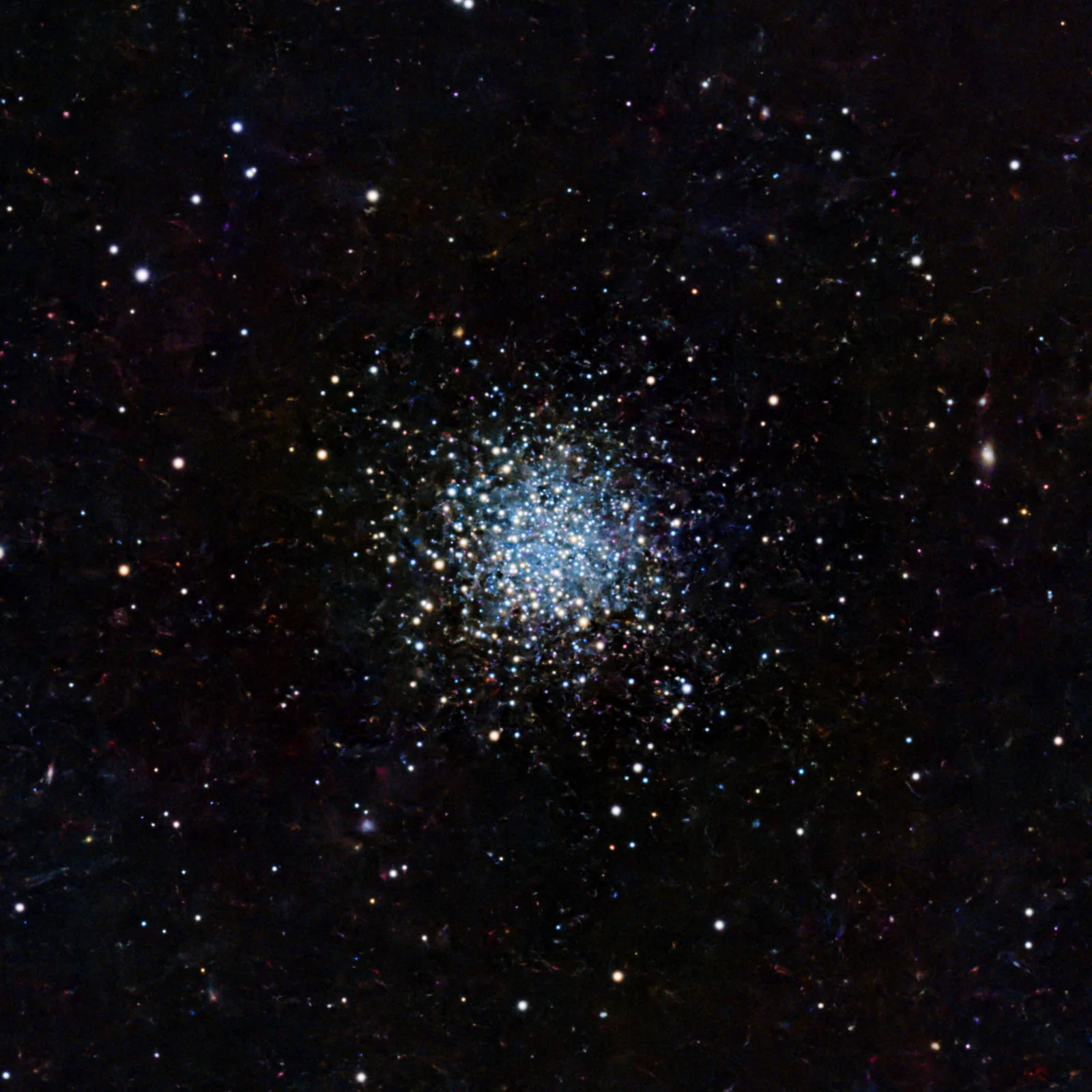
Another “discovery” by Herschel in 1784, is the globular cluster NGC 5466. The one tends to be overlooked in Spring observing, since there are other Messier globular clusters available, but what makes this one particular worth checking out is that it’s one of the “looser” globular clusters (class XII) a good comparator to denser globulars in the Spring sky like M 3 and M 13. It’s also likely been “adopted” by our Galaxy from a merger with a dwarf galaxy billions of years ago.
Edge-On Spiral
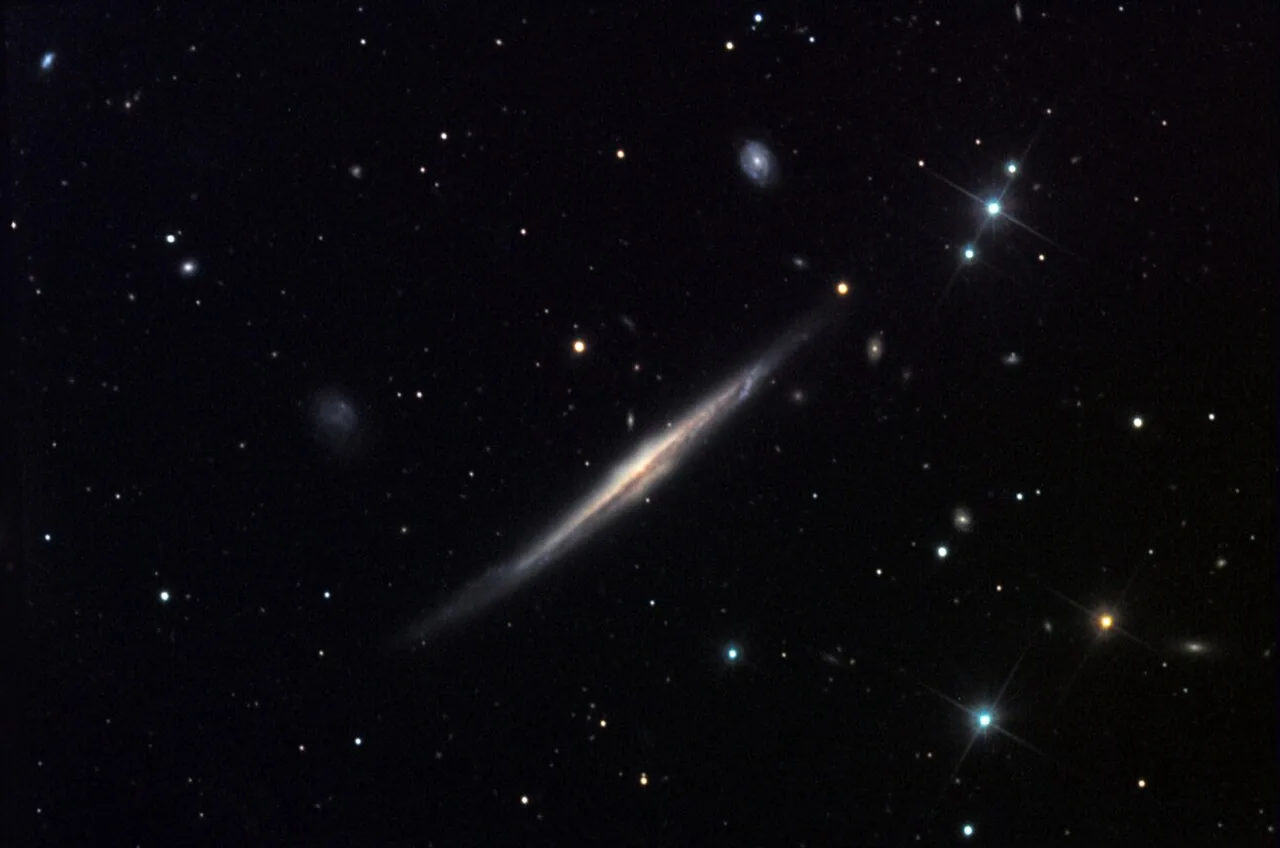
This edge-on spiral - yet another discovery by Herschel (in 1785), is further away than most of the brighter Spring galaxies: about 144 Myr. As a bonus - in larger/imaging telescopes there are several surrounding fainter galaxies (the two brightest are in the image at 9 and 1 o’clock, respectively.
(Mostly) Interactive Galaxy Group
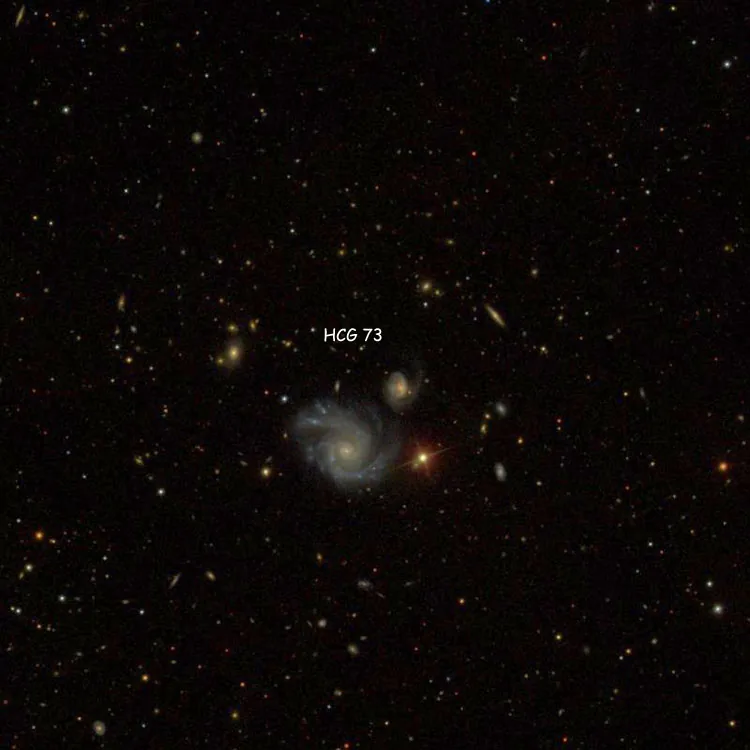
There are several galaxies groupings in the Spring (M 81/82, the Leo Triplet, Markarian’s Chain, etc.), but Hickson Compact Groups are great challenges (Stephan’s Quintet is probably the most famous entry in this catalog). Here, this quintet have 3 interacting members (“b” = IC 4526, plus “c” and “d”, all about 660 Mly distant) in a “V” shape above “a” = NGC 5829 (the brighter spiral who’s “photobombing” the group at 280 Mly), and tiny and more distant member “e” (at 4 o’clock, 1400 Mly).
High-Contrast Double Star

This bright double star is a nice challenge for small telescopes. The binary pair - 203 ly away are only separated by 3 arc seconds (or about 185 AU apart suggesting an orbital period of about 1000 yr). Splitting this double requires somewhat steady skies, but the two stars are bright (mag 2.6 and 4.8) with a striking color contrast (the primary is a red giant; the companion a white main-sequence star). Eventually the two will swap roles: by the time the white star enters its red-giant phase, the current giant star will have shed off its atmosphere in a planetary nebula with only a much fainter white dwarf star remaining.
Guardian of the Bear
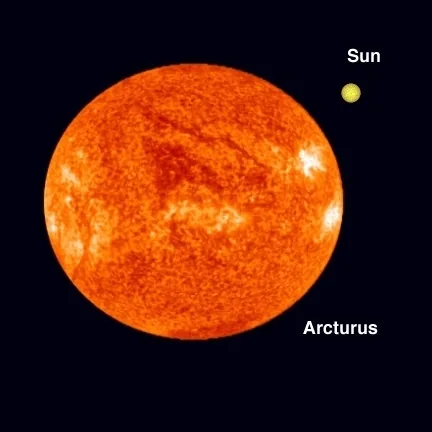
The brightest start in the Spring sky (and 4th overall), Arcturus has many “firsts”: it was the first star with recorded telescope observations during the day (in 1635), and its light was used with a photoelectric cell to open the 1933 Chicago World’s Fair. It was chosen for this honor because the distance estimate at the time was 40 ly, and the previous Fair was in 1893.

More precise measurements have the star only 36.7 ly away. However, it’s not the closest giant star to the Sun — that honor goes to Pollux.