One Bull, Two Planets
Jupiter and Uranus near the Pleiades
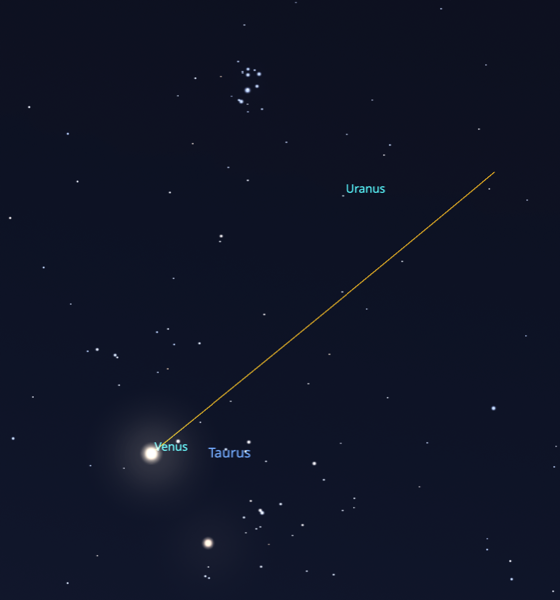
Before sunrise at the start of July, Venus passes below Uranus and then into the Hyades star cluster. This image shows things at 4AM on the 12th: Venus will be easy to see, of course, but Uranus is mostly by itself SW of the Pleiades cluster - it should be easy to spot with binoculars.
S. Delta Aquarid Meteor Shower
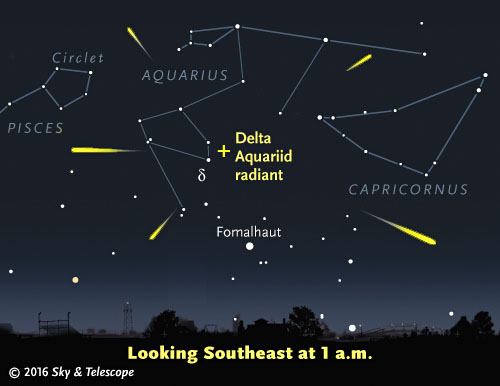
While generally not as bright as the Perseids (which happen a few weeks later, but this year close to Full Moon!), these early- morning meteors (the radiant rises just before midnight) peak at the end of the month, but overall this is a strong shower (avg. 15–20/hour).
Skimming Scorpius’ Southern Horizon
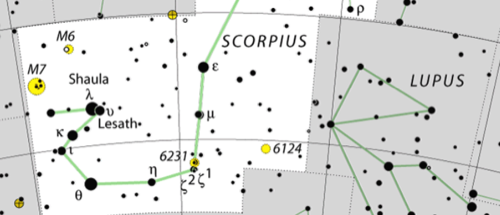
If you’re lucky enough to have a full view of the Southern horizon away from light domes, and an un-hazy clear night, you might try the challenge of checking out some of the “horizon grazing” objects in Scorpio! The constellation has the advantage of actually resembling a scorpion, but the tail end extends very far south —- it just barely rises over the horizon from our latitude!
Depending on the conditions, this might require binoculars, but with a reasonably remote observing location, it should be possible.
Following the body of the scorpion from Antares, you reach the bottom of the constellation with four stars: ζ1 and ζ2 (zeta) which are only 7’ apart (in reality they’re at very different distances from the Sun) - so that’s a nice challenge for the naked eye or binoculars; 3rd magnitude η (eta) - the southernmost, and θ (theta, “Sargas”) at mag 1.8 - making it the 37th brightest star in the sky, and brighter than Polaris - but mostly ignored by northern observers because it’s just that far South - so another great challenge!
Finally, we get to the “stinger stars”: λ (lambda, “Shaula”) - Scorpius’ 2nd brightest star and υ (upsilon, “Lesath”) that make another close naked-eye paring - 36’ apart - though like ζ1 and ζ2 this is coincidental. Above them are the two most-southern Messier objects: M 6 and M 7 - both bright and large open clusters; above ζ1 and ζ2 is NGC 6231 (Caldwell 76) - the “Baby Scorpion Cluster”
- though this might be the hardest challenge of all! There are a few additional small open clusters in the curving tail of Scorpius —- you might luck out and come upon a few scanning the area!
This Month’s Image
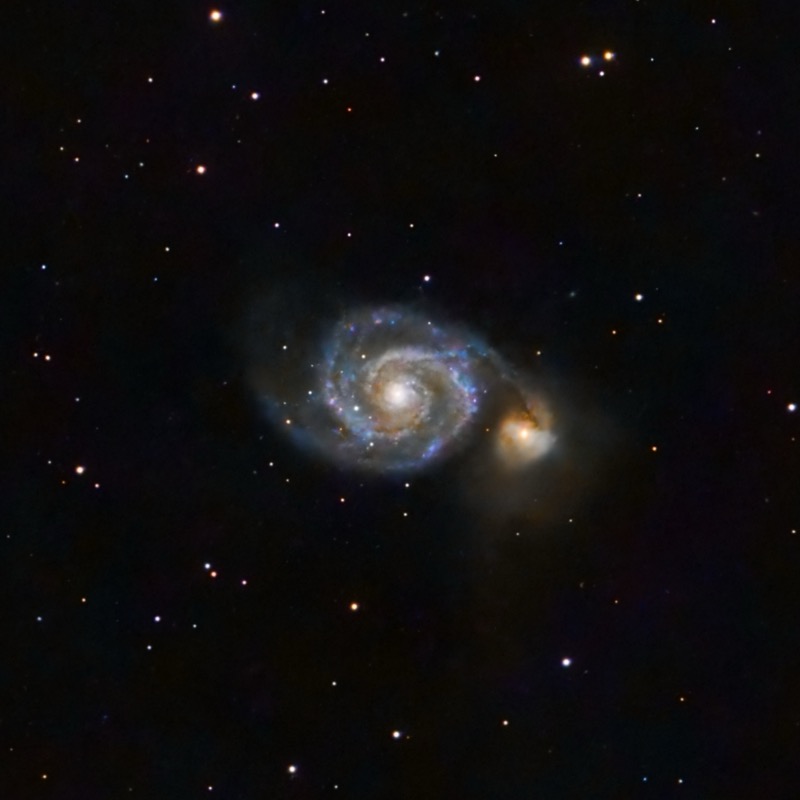
One of the best galaxies to look at in the early Summer is M 51 - the Whirlpool. This face-on spiral galaxy (the first “nebula” identified with this feature) is the brightest example of two galaxies in collision (with NGC 5195) - the companion probably passed through the main galaxy ~100 Myr ago, and is now slightly “behind” M 51. This collision has also enhanced star formation, especially in the spiral arms. The system is 31 Myr away from us.