Early Morning Close Approaches!
Jupiter and Venus
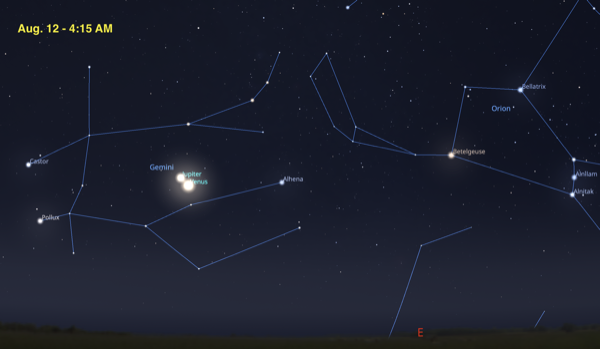
This is worth getting up for!
On August 12th, Venus and Jupiter are only 0.5° apart in Gemini. These two planets are the brightest objects in the sky — excluding the Moon and Sun. In a small telescope with a low- power eyepiece (or binoculars) they’re close enough to fit in the same field of view.
Adding Mercury and the Moon
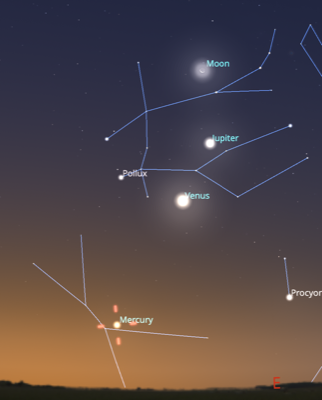
Then on the 19th, the waning crescent Moon and Mercury join in! Here’s the arrangement for the four objects on Aug 19 at 5:15 AM EST. (Saturn, Uranus, and Neptune will also be visible, and higher in the sky), so you could make a night of it for a planetary showcase, and hopefully might also catch some late Perseids too!
The “Other” Sagittarius Asterism
As is sometimes the case, when we think about a constellation, we tend to concentrate on a certain part of it: Ursa Major is more than just the “Big Dipper” and even Orion is more than just the 7 bright stars between Betelgeuse and Rigel.
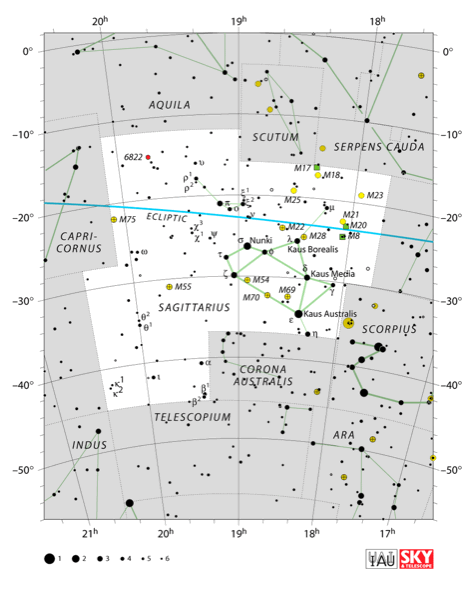
Sagittarius is a similar example: nearly all the attention is placed on the Western side of the constellation because that’s where so many interesting deep-sky objects are concentrated (as well as the Galactic Center), but also because the brightest stars are on that “side” and have the happy coincidence that they resemble a “Teapot” — one of the more popular asterisms in the night sky.
But to the NE, there are a few not-quite-as-bright stars (3rd–4th magnitude) yet around the same brightness as the stars marking nearby Delphinus — and are generally easy to find. Some star maps connect these stars (Rho ρ, Pi, π, Omicron, ο, and Xi ξ) together, but (usually) unattached to the Teapot. So, what might their connection to the Teapot be?
Say hello to a lesser-known asterism (and clearly a modern invention/addition): the “Teaspoon and Lemon” — after all if there’s a “Teapot” nearby, you’d probably want to serve that tea with something, right?
This Month’s Image
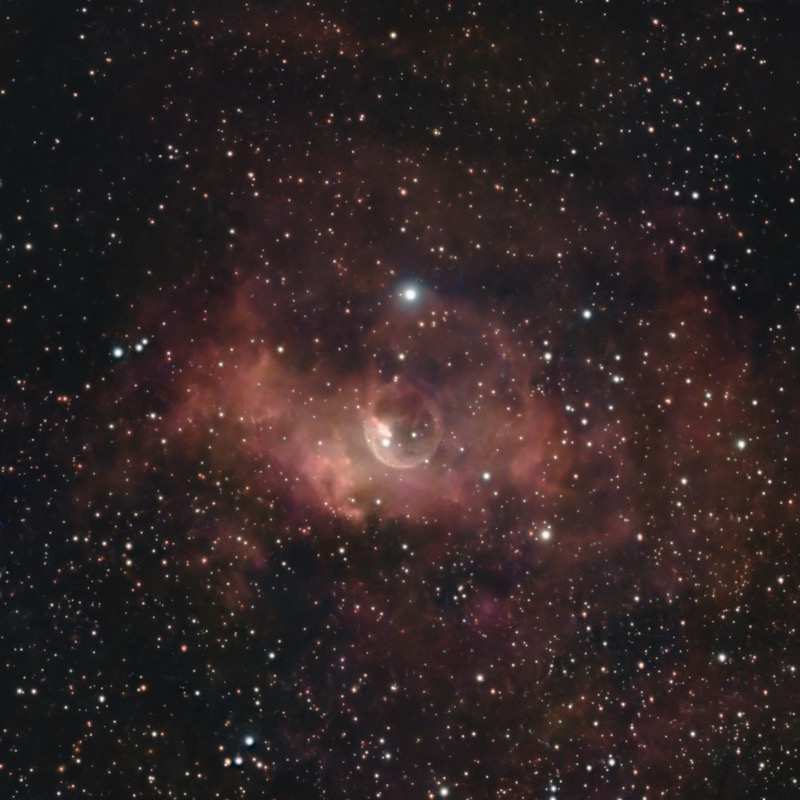
The “Bubble” Nebula (Caldwell 11, NGC 7635, Sh 2-162) is a bright and complex emission nebula almost 8 kly distant and ~35 ly across in Cassiopeia with a curious but prominent bubble feature. This is caused by stellar winds from a hot massive star pushing out the nearby material which is then constrained because the entire nebula is also embedded in a large molecular cloud resulting in a very defined “shell”.