The King
Husband to Cassiopeia, father of Andromeda, their story is a favorite legend among the constellations. It’s the most northern constellation, aside from Ursa Minor, and has been in the list of constellations for millennia, included in Ptolemy’s Almagest.
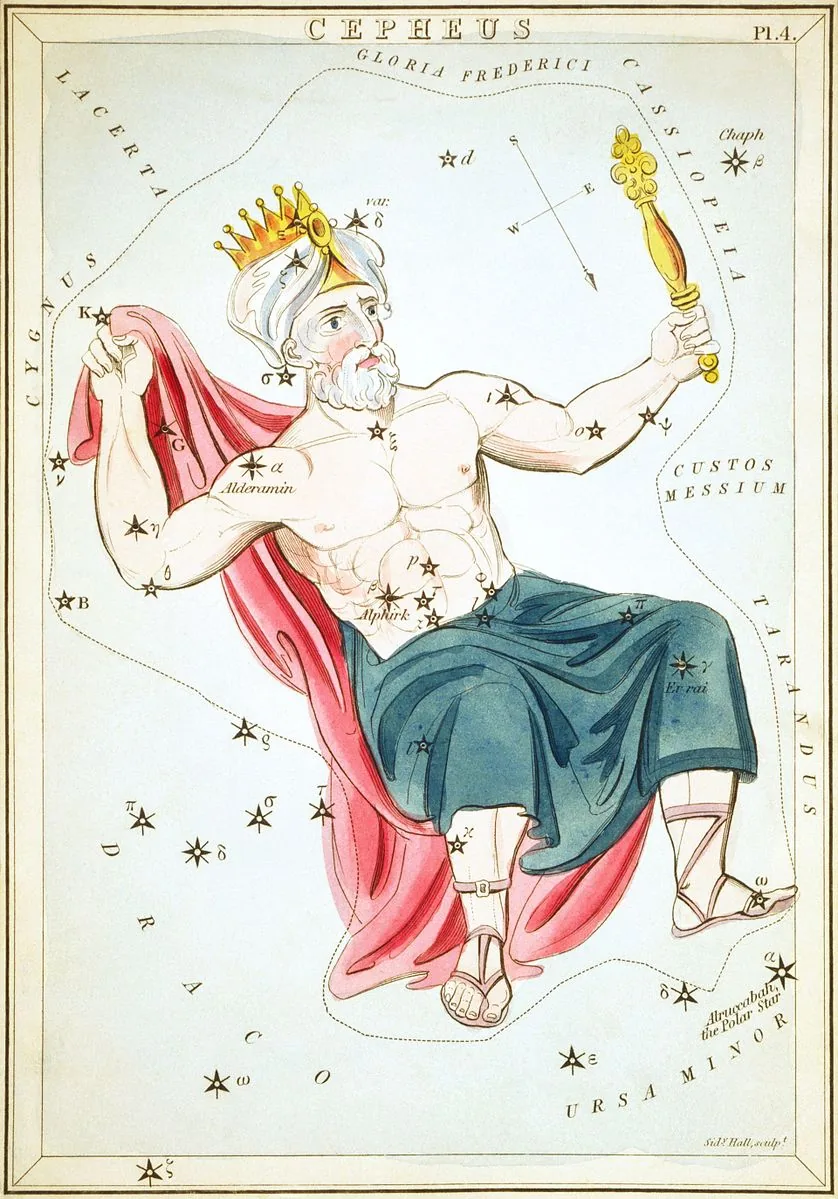
Before the conclusive reckoning of the “official” list of constellations, Cepheus shared a border with several now-ex-constellations:
Gloria Frederici - “Frederic’s Glory” added by Bode (1781) for King Frederic of Prussia, carved out of the NW part of Andromeda
Custom Messium - the “Harvest Keeper” taken from Camelopardalis by Lalande (1775) , to honor Charles Messier
Rangifer (also Tarandus) - the “Reindeer”, also taken from Camelopardalis by LeMonier (1736) to commemorate an expedition by Maupertuis to Lapland (in arctic Scandinavia) - which given its northern declination seems appropriate on both counts.
Of course, none of these three constellations made the final list: still it’s fun to try and locate their (always) dim stars, among the more-familiar constellations.
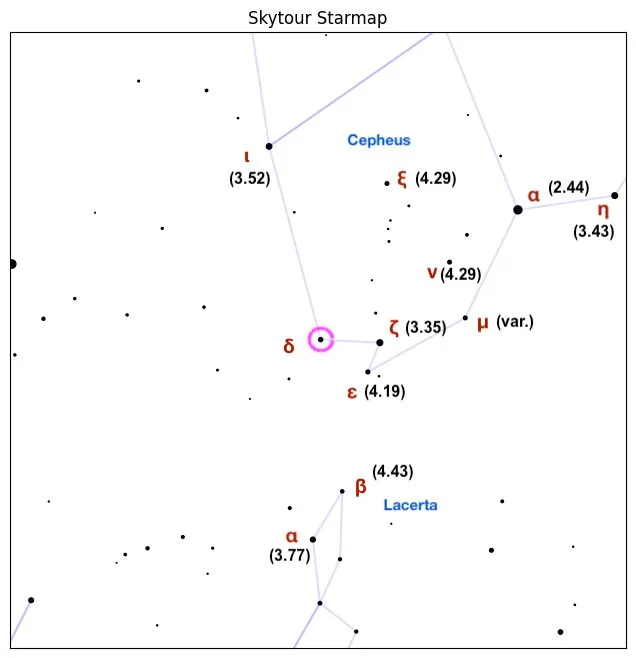
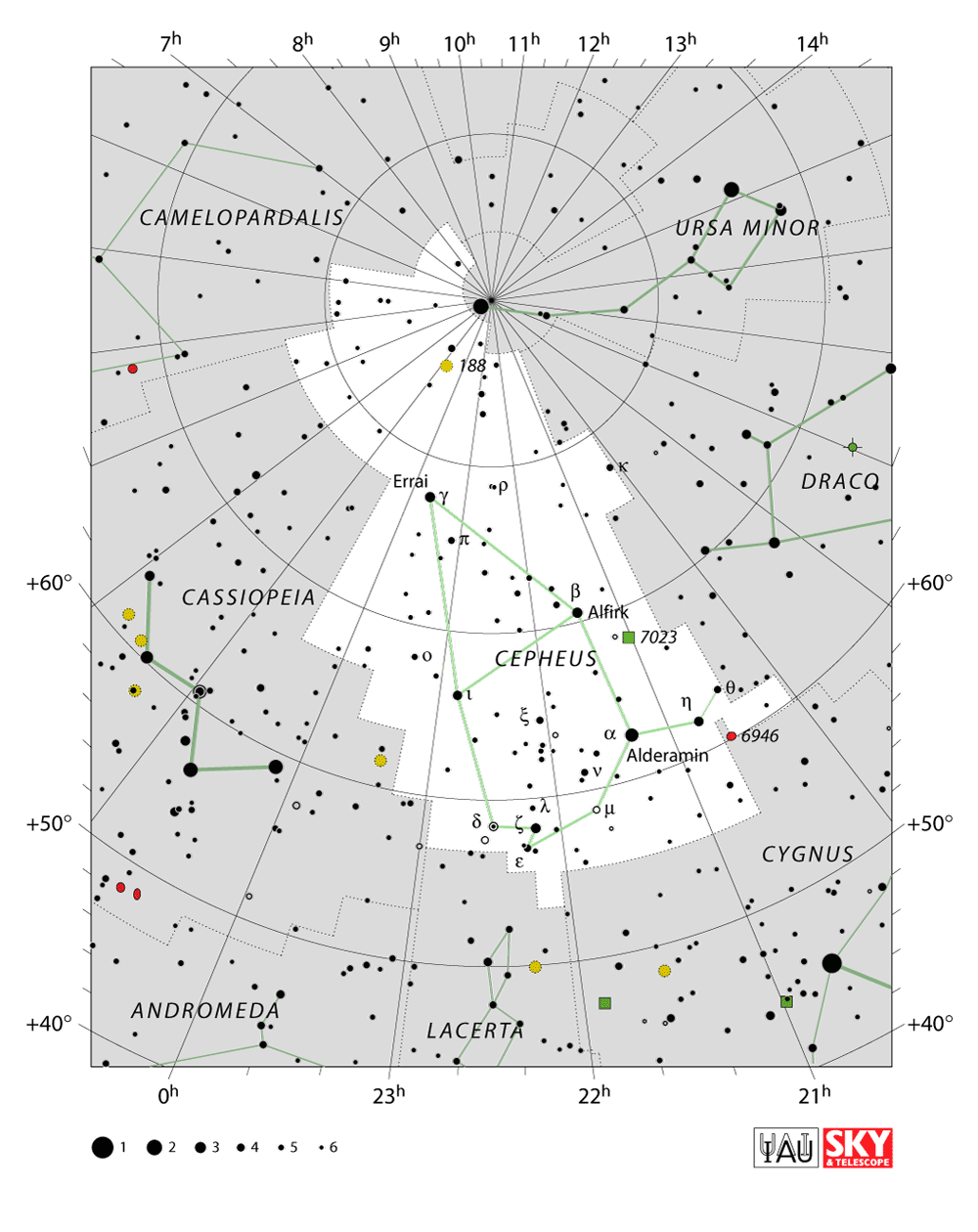
Cepheus’s brighter stars form the stick-figure most resembling a doghouse, though in the depiction above, he is rendered upside-down, with the tip of the “house”, γ (Gamma) Cephei as the king’s left knee. Other atlases have him in a more regal pose with this star as his head.
Map of Cepheus
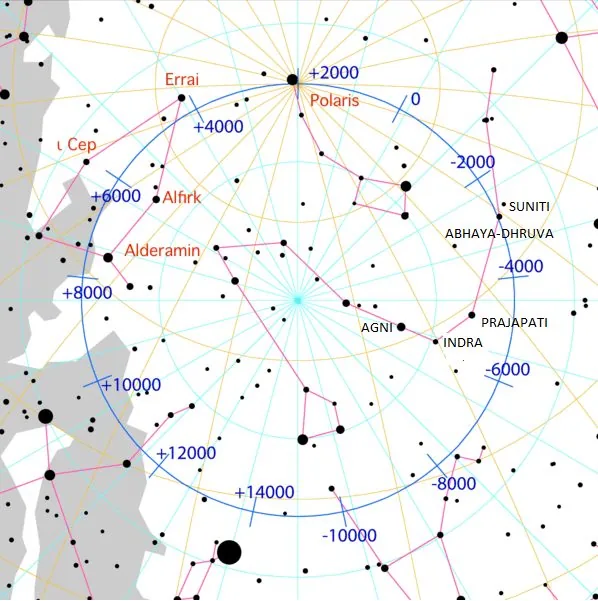
The identification of the “North Star” will include several stars in Cepheus over the next several millennia. The North Celestial Pole slowly moves away from Polaris, passing by Errai (Gamma Cep) 2000 years from now, then between Alford (Beta Cep) and Iota Cep, ~2000 years after that, then finally passing Alderamin (Alpha Cep) in another ~2000 years.
Quick Reference: Objects of Interest
| Object | Type | Equipment |
|---|---|---|
| Caldwell 1 (NGC 188) | Open Cluster | Medium/Imaging Telescope |
| Caldwell 4 (NGC 7023) | Reflection + Dark Nebula | Binoculars/Small Telescope |
| IC 1396 | Emission + Dark Nebula | Small/Medium Telescope |
| Sh 2-136 | Reflection Nebula | Imaging Telescope |
| NGC 7510 | Open Cluster | Binoculars/Small Telescope |
| Delta (δ) Cephei | Variable Star | Naked Eye/Binoculars |
Very Old Star Cluster
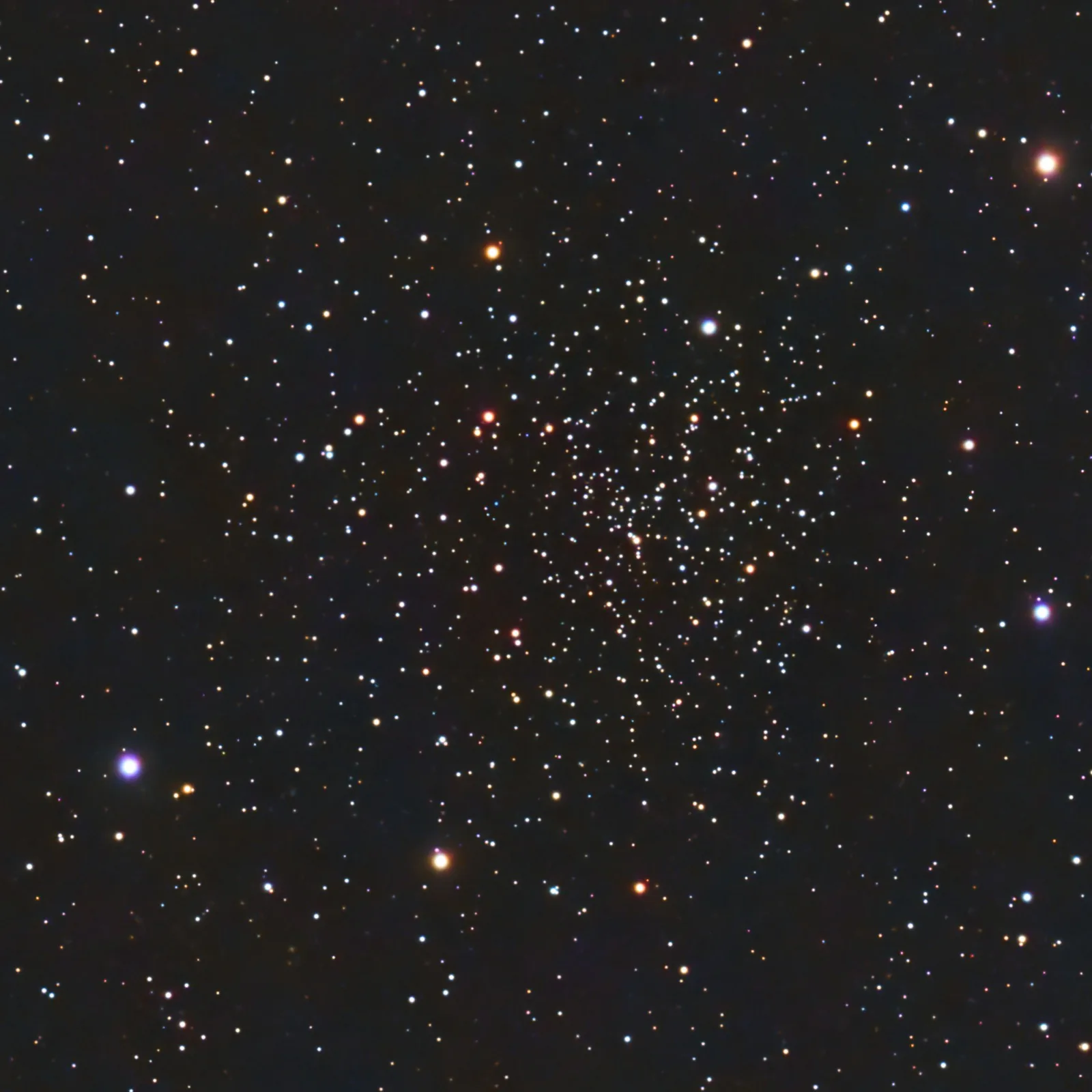
The open cluster closest to the celestial North Pole, which is why it was the first object in the Caldwell catalog (which runs north to south). However, this faint-but-rich cluster is more important because it is one of the very few older clusters - even older than the Sun (6.8 Gyr). It likely survived because of its location - it’s far above the Galactic Disk, and further from the Galaxy’s center than is the Sun.
Iris Nebula
Image "c_4-93TM-PIXRCADBEGHS-square.webp " not found.
The massive binary HD 200775 (mag 7.4), 1,350 ly away illuminates the surrounding dust grains to produce one of the most beautiful reflection nebulae in the sky. Aptly named the “Iris” Nebula (though it also looks like a pansy flower), the dust cloud which is 6 ly across shows a complicated structure. In small telescopes, the faint dark nebulosity looks more like an annulus of “missing” stars surrounding the nebula.
Elephant’s Trunk
Image "ic_1396-93T-PIXRCAABEGHS-LP-mosaic-cropped.webp " not found.
Almost 3,000 ly distant, this very complex nebulosity (this image only has the central part) is about 15-20 ly across. One curious feature (at about 1 o’clock in the image) is the “Elephant’s Trunk” a dark globule (that might coalesce and form a new star).
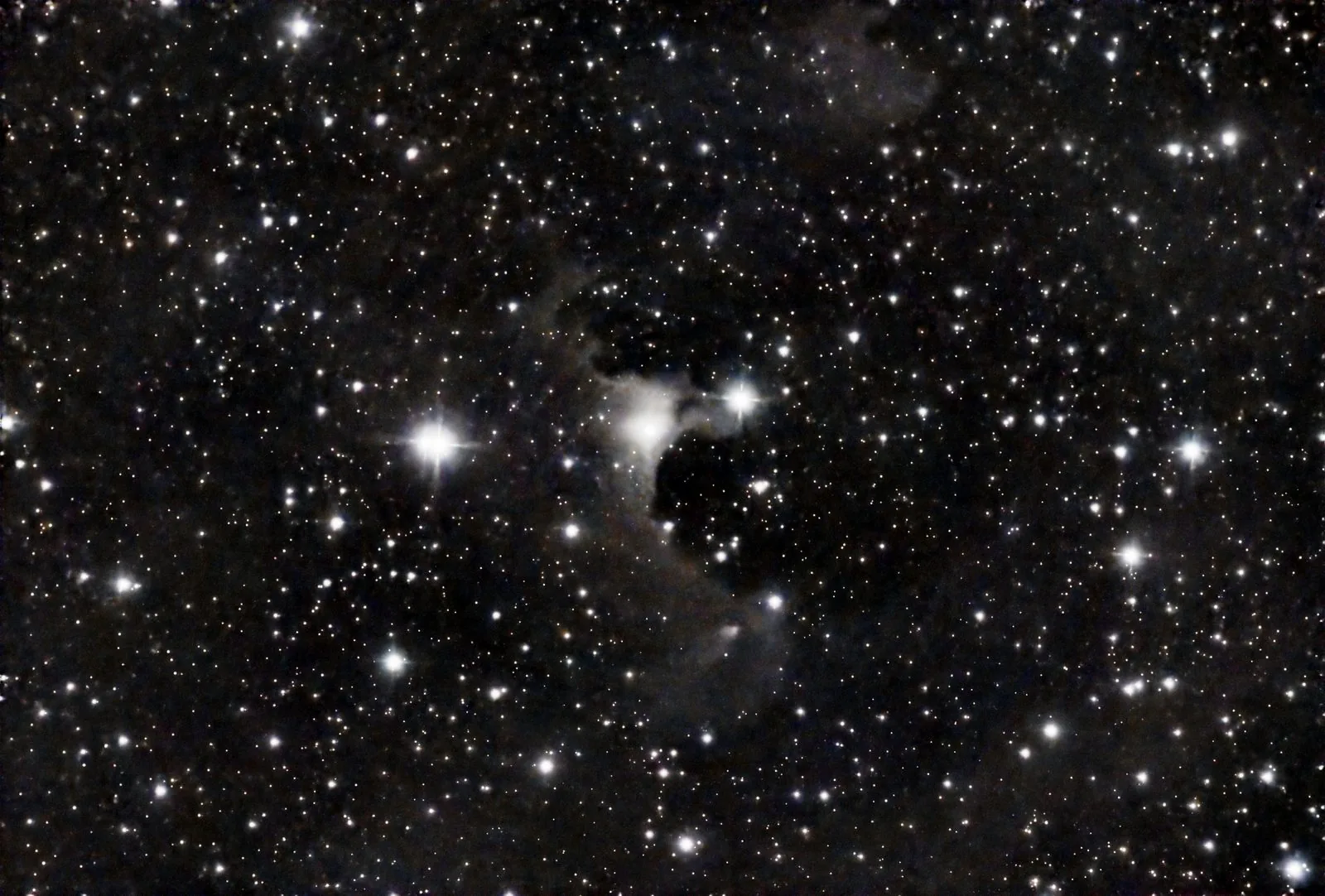
This eerie nebulosity is not only ghost-like, it almost looks organic in long exposures. The sprig-like features on the W side (upper left in this image) are reminiscent of the “Pillars of Creation” in the Eagle Nebula. At the opposite end, a denser globule appears to be pierced and split by an encroaching star. Definitely worth the time it takes to bring out all of the smoky detail.
Dormouse Cluster
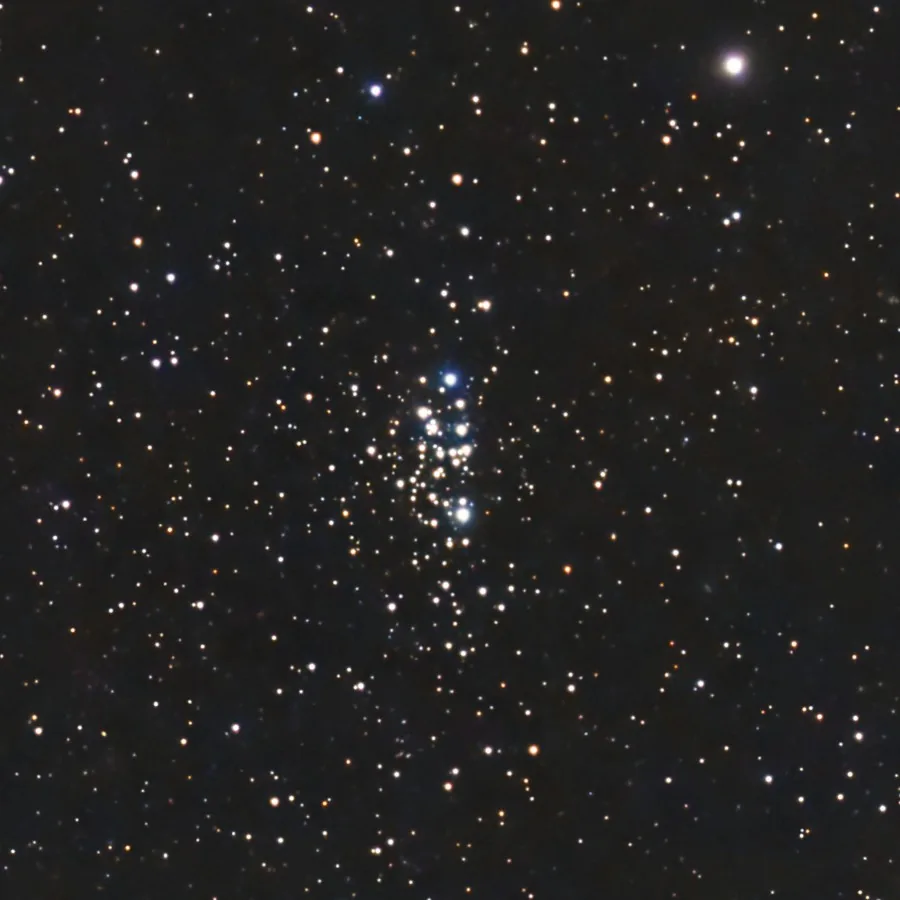
This irregularly-shaped star cluster — like most open clusters — is young: only 10 Myr. However, it is somewhat distant: about 11.4 kyr, such that interstellar dust and gas dims the light of its stars by almost a magnitude. It’s almost known as the “Arrowhead” Cluster.
Important Variable Star