The “Other Galaxy Season”
In the Spring we point to Virgo, Coma Berenices, Canes Venatici, and Ursa Major to get our fill of many bright and interesting galaxies. In the Fall, aside from the nearby favorites of M 31 and M 33, there are other galaxy-laden constellations, albeit a little more challenging! Stretching from Pegasus and across Pisces, Cetus, scarping the horizon in Sculptor and Fornax and all the back towards the winter Milky Way (and Orion) through Eridanus, there are challenges to explore:
Galaxy Groups in Pegasus: try for the Deer Lick Group (NGC 7331) and the nearby Stephan’s Quintet (NGC 7320) both with 4–5 small galaxies surrounding a central one.
Sculptor: How Low Can You Go?: there are several large bright galaxies overlooked by Messier (being very far south, though not much different than M 7 in Scorpius) but included in the Caldwell catalog: C 65 (the “Silver Coin”, with C 70 and C 72 at about the absolute limit of “how far South can you see”. NGC 7793 (Bond’s Galaxy) might be a little easier, plus globular cluster NGC 288.
Fornax: more “really down there” galaxies: C 67 (NGC 1097) is large and bright. The Fornax Cluster will extend from about – 30° down to the horizon but has over a dozen galaxies that if they weren’t so far south would rival many of the bright Spring galaxies in Virgo, UMa, and Coma. There’s also NGC 1360 which is a large and bright planetary nebula (the “Robin’s Egg”) to look for!
Eridanus: don’t “skip over” this constellation to “get to” Orion! NGC 1187, 1232 (the Eye of God) and NGC 1532 (Haley’s Coronet) are all spectacular (and reachable with effort) objects!
Excellent Conditions for the Leonids!
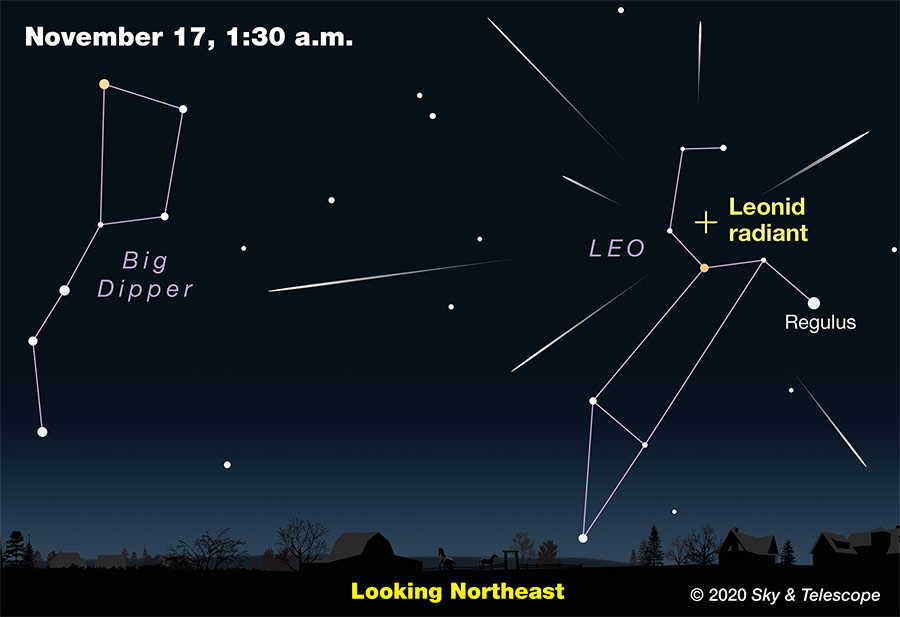
This mid-November meteor shower (peak: Nov 18) can be full of surprises. While we’re still a few years off from it’s periodic meteor storm outburst that happens every 33 years (next one is in 2032), being to its parent comet, 55P/Tempel-Tuttle, whose retrograde orbit also means these meteors are fast and sometimes very bright (mag –1.5). Plus, the interaction of trails with other solar system objects (particularly Jupiter), means smaller outburst can happen periodically in the days surrounding the expected peak — so, you might get lucky. greatly.
Uranus at Opposition
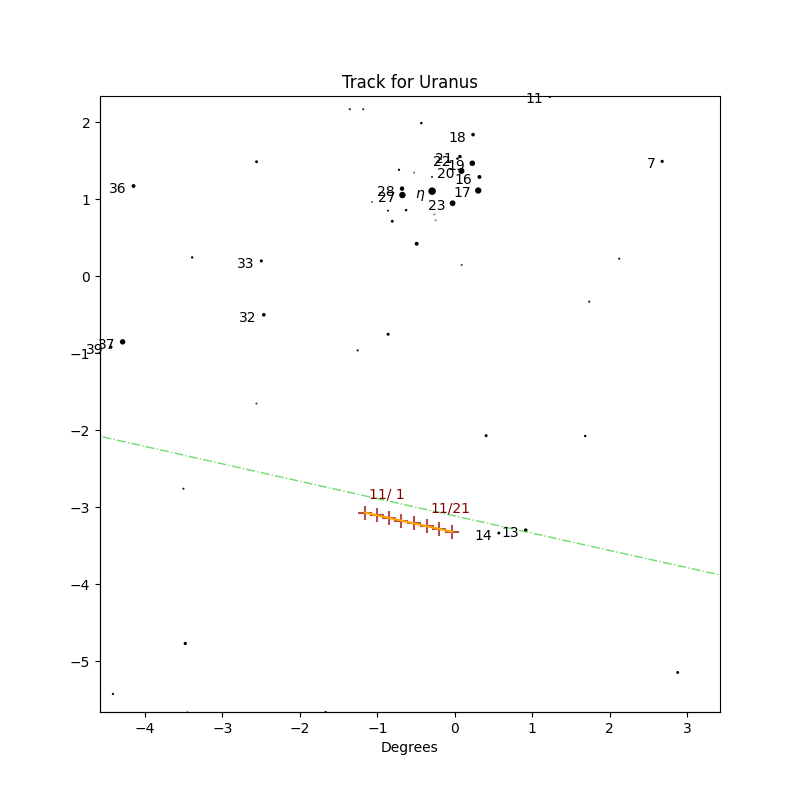
Uranus reaches opposition on Nov. 21st, in Taurus, just south of the Pleiades star cluster. Although it’s only naked-eye brightness in very dark skies (mag 5.6), it’s extremely easy to find in binoculars or a telescope! Starting with the Pleiades just go south about 4 1/2° until you reach stars 13 and 14 Tauri: to the east you’ll see a third “star” of the same brightness: that’s Uranus. The crosses show its track over the month (every 4 days).
This Month’s Image
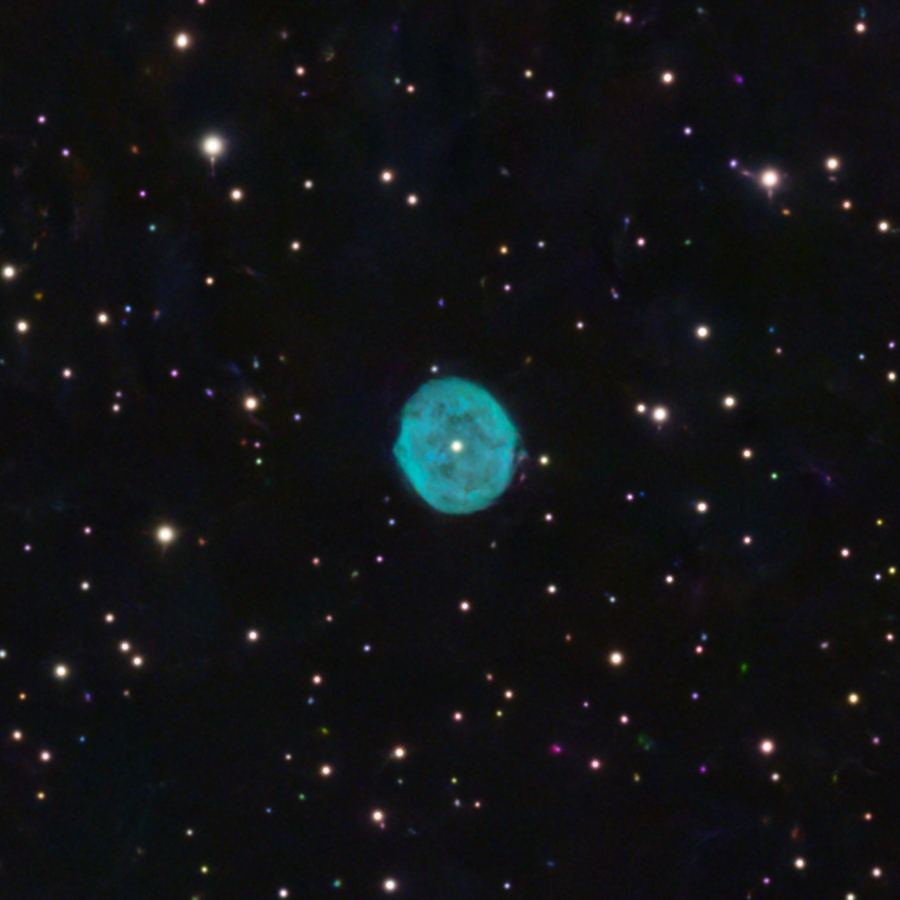
While we’re checking out the late-Fall constellations to the South, and peering into Perseus, faint Camelopardalis might get forgotten, though it has many interesting deep-sky objects, including the “Camel’s Eye” planetary nebulae, NGC 1501.
Unlike some of the other Fall PNs that are large but faint (such as the Helix), this little blue ball is slightly bigger than Jupiter in the sky and isn’t too faint (mag 11), definitely worth looking for, along with open cluster NGC 1502 (and Kemble’s Cascade) in the neighborhood.