Jupiter Returns!
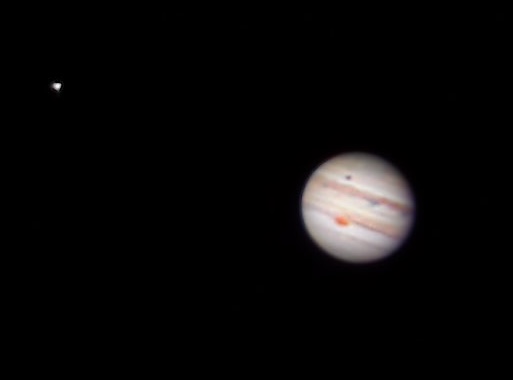
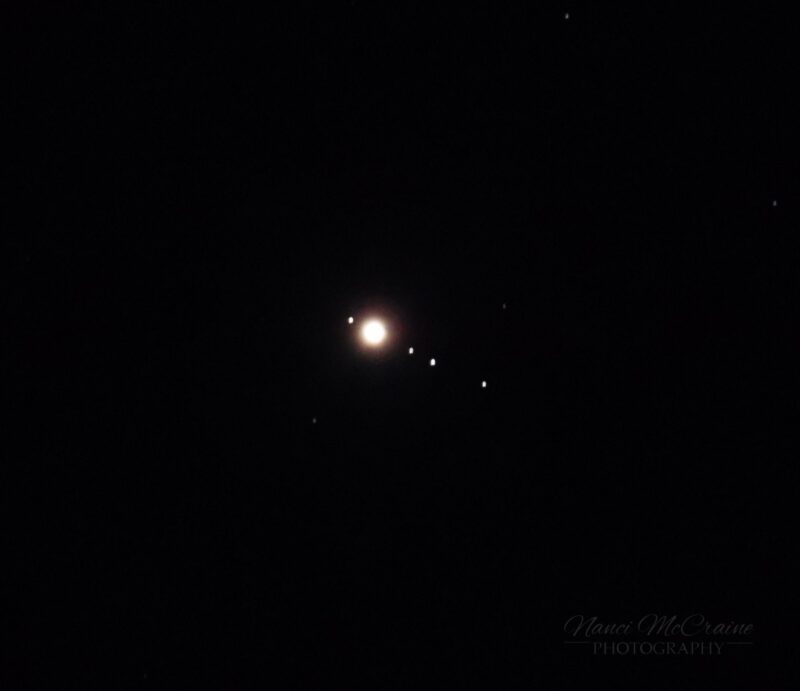
Rising just after evening twilight, Jupiter is definitely the brightest object in the evening sky (aside from the Moon) and is satisfying no matter how you want to observe it!
Naked Eye: You can follow Jupiter’s motion against the stars of Gemini throughout the winter and spring. From December to March it’s moving to the West (retrograde motion) passing close to the star Wasat in late January. Early in March it stars to move eastward (prograde motion) once again passing by Wasat around May 1st, and crosses into Cancer in late June, soon to be hidden by the Sun where it returns to the early morning skies in September.
Binoculars: Here, Jupiter almost shows a disk and you can spy the four Galilean satellites orbiting with periods ranging from 1.77 d (Io) to 16.69 d (Callisto).
Telescopes: Now Jupiter shows a disk under magnification: several of the dark bands are easy to see, and with steady skies (and good timing) you might catch the Great Red Spot (Jupiter rotates in 9h 55m). Another phenomenon is seeing moon shadow transits from one of the Galilean moons on the disk (sometimes even more than one).
Excellent Conditions for the Geminids!
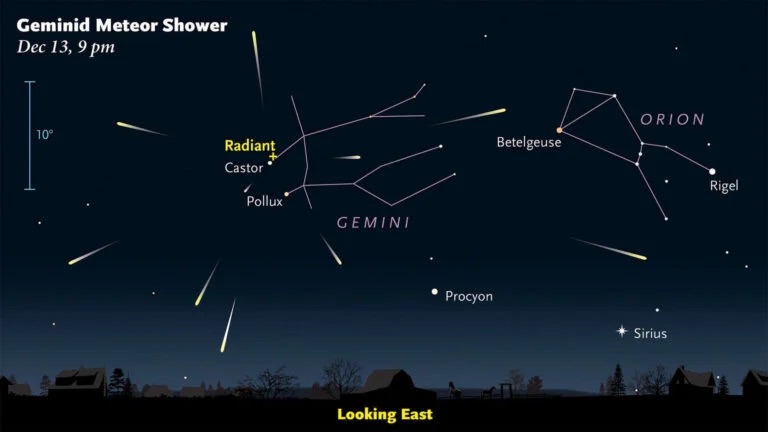
Through the middle of December, but peaking on the 13th are the Geminids. Unlike most showers, here the radiant rises just after sunset so the shower is well placed for the entire night. Under dark skies you might see as many as 100 per hour, some with persistent trails, possibly with some color (usually yellowish).
This shower is also abnormal because its parent body isn’t a comet, but the asteroid 3200 Phaethon (which in turn might originate from the break-up of a comet).
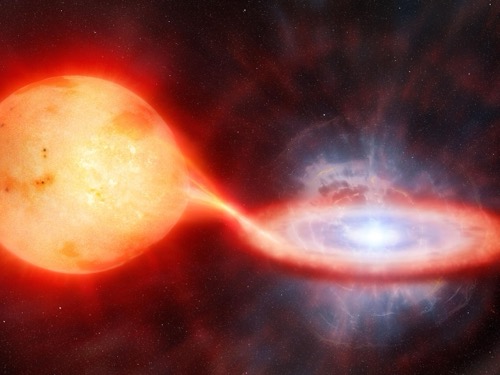
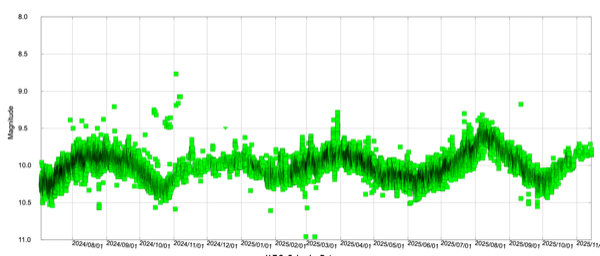
T CrB: Still no Outburst!
This Month’s Image
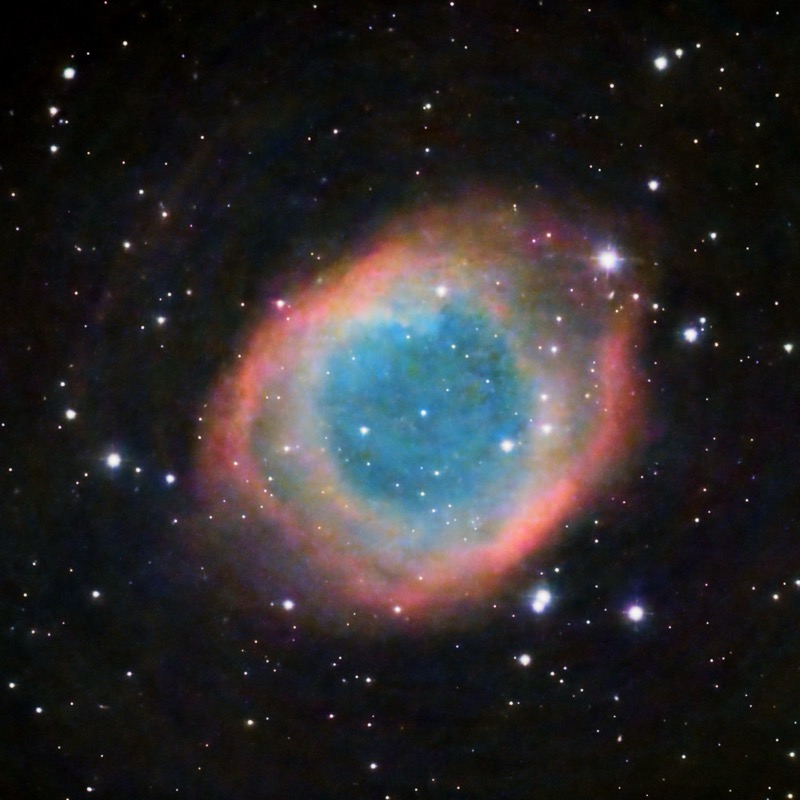
The Helix Nebula (C 63, NGC 7293) in Aquarius has a much larger angular size than most planetary nebulae (17.4’ across - over half the size of the Moon!) because it’s close (650 ly) but faint. Images show the same “rainbow” like pattern as do some other PNs (like M 57 the Ring Nebula). It’s about 10 kyr old (when the central star expelled its atmosphere, leaving the hot core) and almost 3 ly across!