Challenges: B 22 (Tau), C 49/50 (Mon), NGC 2024 (Ori), B 33 (Horsehead, Ori)
Easy (Binoc.): M 42/43 (Ori), M 41 (CMa), M 36, 37, and 38 (Aur), M 46, 47, and 93 (Pup)
Moderate (Small Tel.): M 79 (Lep), NGC 2264 (Mon)
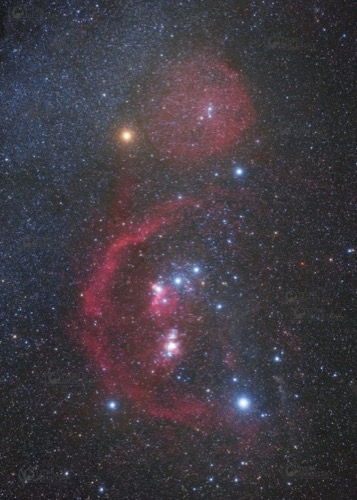
The Supergiants of Orion
The two brightest stars in Orion look very different in the sky:
very orangey-red Betelgeuse as Orion’s shoulder, blue-white Rigel
as his knee. But they’re more alike than you think! Both are
supergiants: starting out as hot massive stars, quickly burning
their hydrogen fuel and swelling up to their enormous present-day
sizes.
Betelgeuse
Rigel
Mass
15x Sun
21x Sun
Size
700x Sun
74x Sun
Age
10 Myr
8 Myr
Distance
700 ly
~850 ly
The difference is that Betelgeuse had a bit of a head start by a
few million years; it was briefly a blue supergiant star, and has
cool to its red supergiant phase, now burning carbon (after depleting
its helium). Rigel is following the same evolutionary path, but it
still burning helium, and has yet to cool like Betelgeuse (but it’ll
get there in a few million years). Both, however, share the same
fate: after burning through their carbon and what little remains
of heavier elements, they will go supernova, leaving either a neutron
star or a black hole. By the time we’d be seeing a very red Rigel
in the sky, Betelgeuse will just be a memory.
Evolution
Betelgeuse
Rigel
Started As
Hot O Star
Hot B Star
Blue Supergiant
8-10 Myr ago
Today
Red Supergiant
Today
few Myr from now
Fusing
Carbon
Helium
Supernova
~100 kyr?
few Myr
The Galactic “Anti-Center”
Whenever the Milky Way is above the horizon, there are plenty of
things to discover! Stretching from Perseus and Auriga almost
overhead, and all the way to the Southern horizon in Canis Major
and Puppis, you don’t need elaborate equipment and careful planning
to casually discover many open clusters and brighter nebulae with
binoculars or a small telescope: just point in that direction and
casually scan!
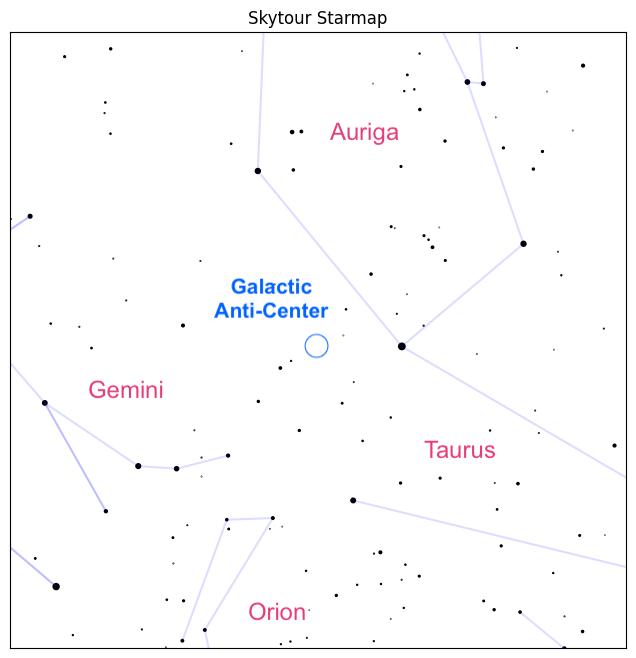
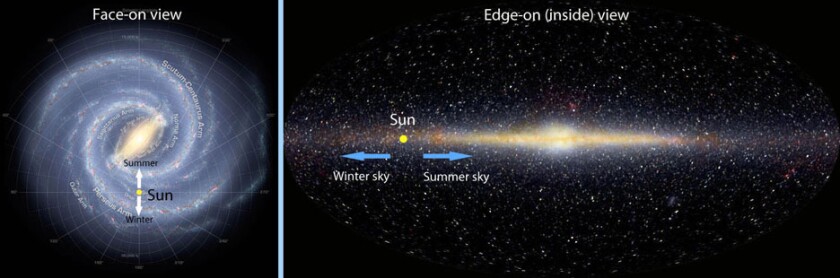
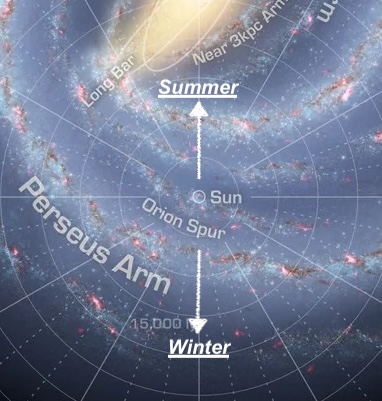
In contrast to the Summer Milky Way we’re now looking “out” and
away from the Galactic Center (at the spout of the “Teapot” of
Sagittarius); in fact the Galactic “Anti-Center” is in Auriga. Here
it’s the outer “Perseus” spiral arm we see and while it seems as
if we’re just peering into a much thinner section of our Galaxy,
you wouldn’t know it looking at the myriad of objects in Auriga,
Gemini, Monoceros, Canis Major and Puppis. Orion — for all its
magnificent objects — is really in the foreground, much closer to
the Sun; both are in a minor spiral arm called the “Orion Spur”.
Still, no matter what part of our Galaxy you observe (even the outer
halo with its globular clusters) - there are fantastic objects to
discover and appreciate!
This Month’s Image
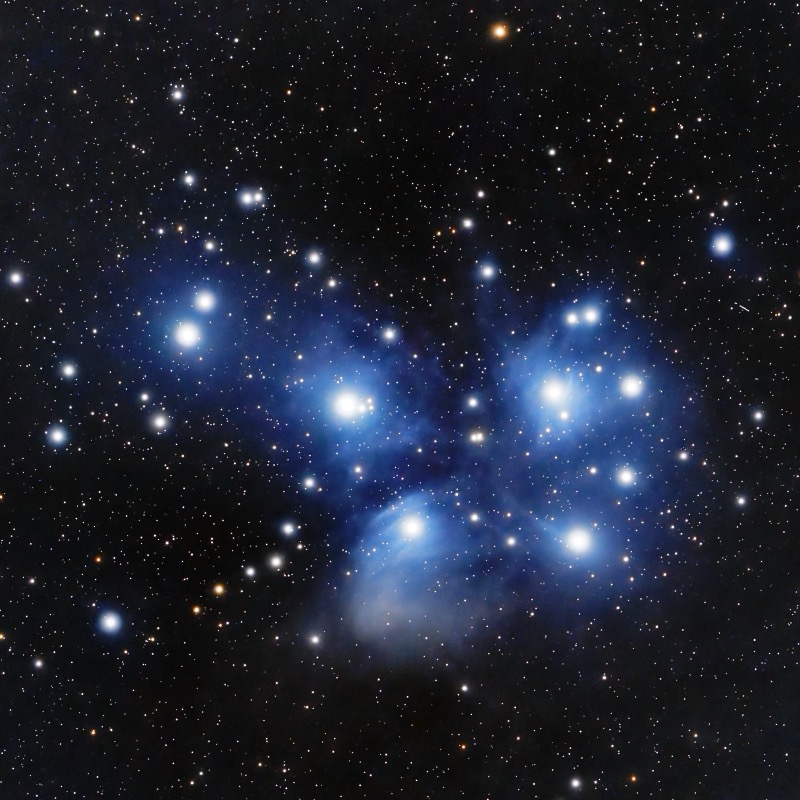
Bob Donahue, NBAS
The Pleiades is one of the oldest known deep-sky objects even though
its stars are very young. But which star is the 7th star of the
“Seven Sisters?” With simple imaging, the bright stars of the cluster
are embedded in dust: unlike emission nebulae like M42 in Orion,
the wispy structures are dust that the cluster stars are traveling
through and illuminating through reflection, and not a part of the
stellar nursery that spawned the cluster itself.
M 45 is important because accurate measurements of its distance
(423 ly) is a fundamental rung in the “distance ladder” constructed
to determine distances of objects in our Galaxy and far beyond!