The Triangle
Despite its small size (it’s the 11th smallest constellation), and overshadowed by the neighboring constellations of Andromeda (to the North) and Aries (to the South), Triangulum’s history goes all the way back to the Babylonians who included it in the MUL.APIN as “The Plough”, and the Greeks as Deltoton as it resembled the letter Delta (Δ) and thus became the constellation of the Triangle. It’s had minor name changes in different sources by the Greeks and, later, the Romans, even as late as the 17th century (such as “Triangulus Septentrionalis” to distinguish it from the (then) new Southern constellation of Triangulum Australe).
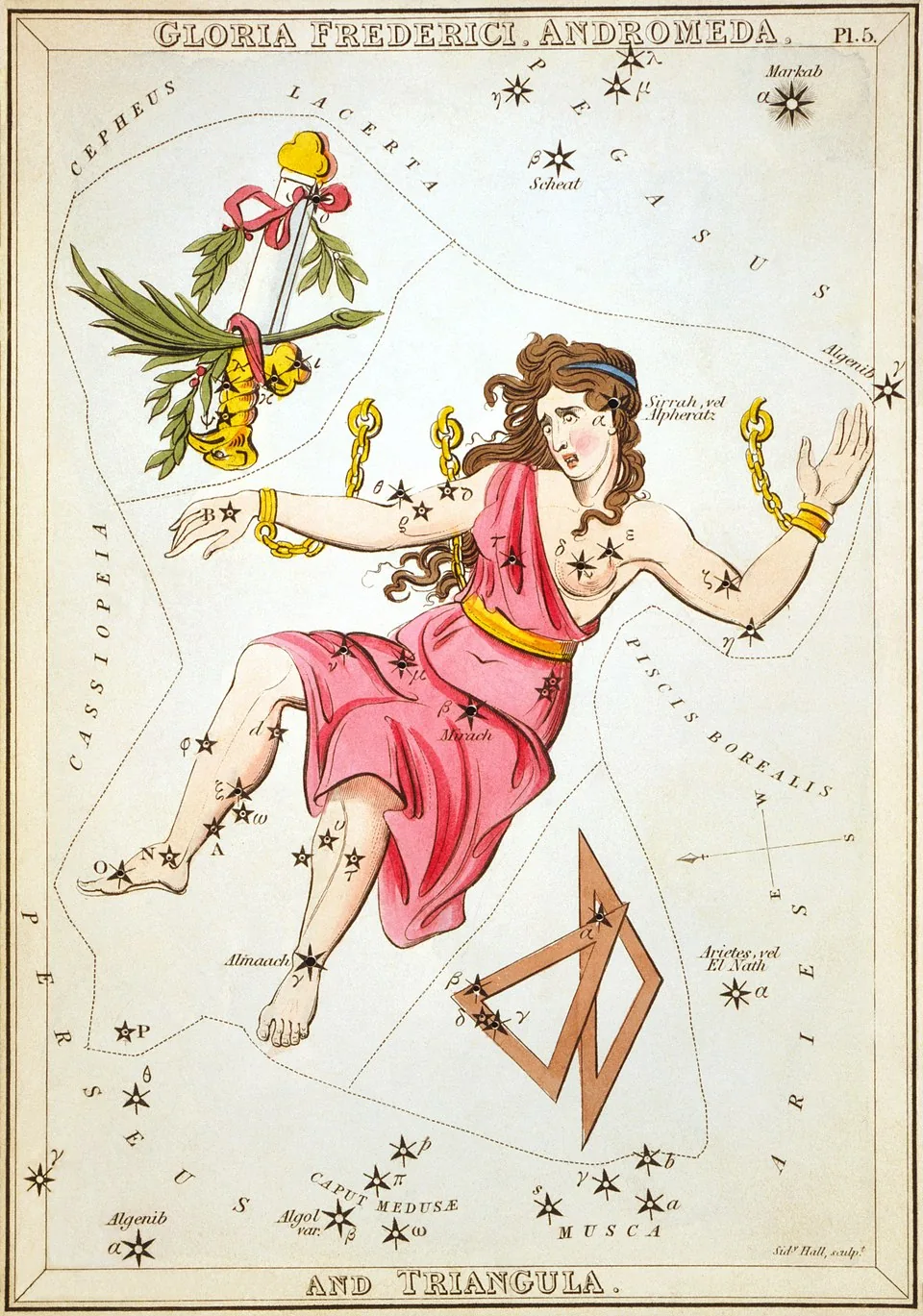
As if one triangle wasn’t enough, Hevelius added a second triangle “Triangulum Minus” from the stars Iota (ι), 10, and 12 Triangulii in his 1690 atlas. Iota is also TZ Tri: a variable star (only noticed as such in 1980) whose scant variability (only 0.08 mags) comes from its ellipsoidal shape caused by a close companion star in a 14.8d orbit, but also from starspots on the surface. The IAU has given the system the name “Triminus” to acknowledge the “ex-constellation”.
Map of Triangulum
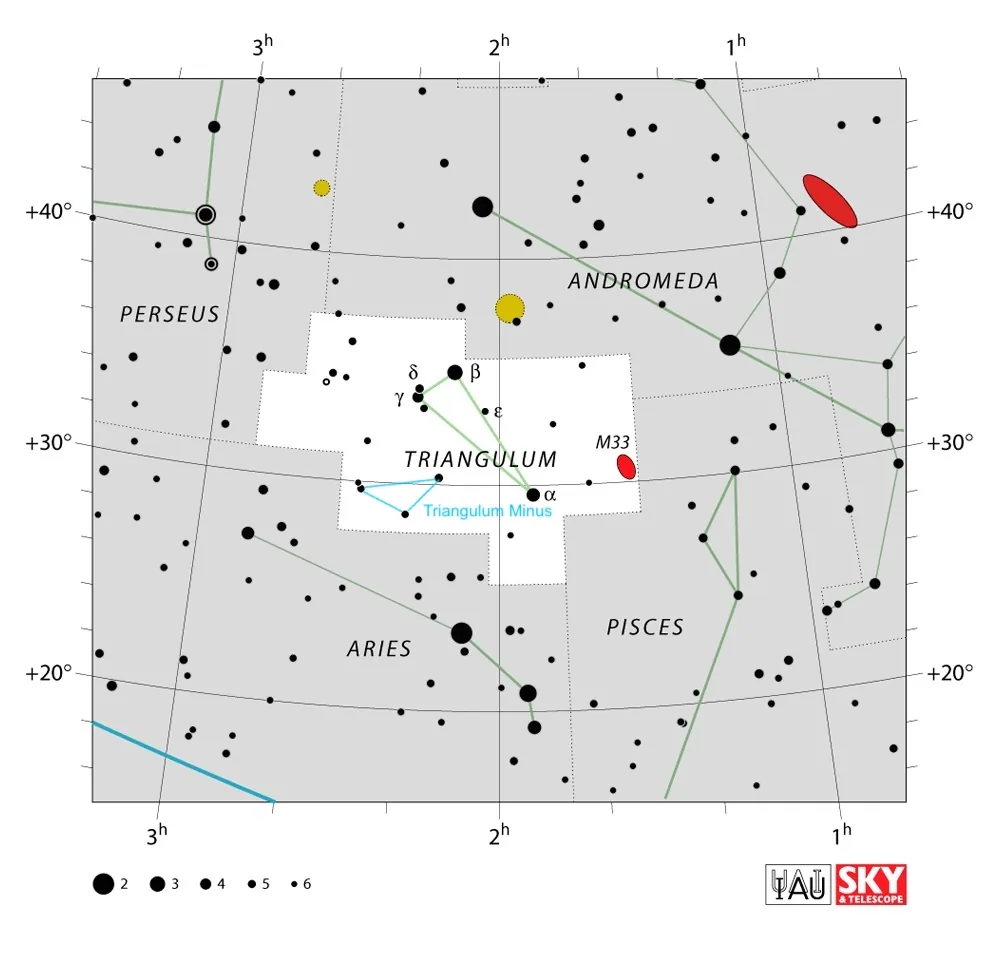
The thin triangle is made up of the constellation’s three brightest stars. Beta (β - newly named “Alaybasan”) is the brightest at magnitude 3.0, is a binary with a white subgiant star, just starting to move off of the Main Sequence plus a slightly less-massive companion. Alpha (α - named Ras al Muthallath, sometimes shortened to Metallah) at magnitude 3.4 is yellow-white subgiant star. Finally Gamma (γ - also with a new name of Apdu) is a white main-sequence star about 112 ly from Earth.
Immediately next to Apdu, are two fainter stars (which look neat together in binoculars): Delta (δ) Triangulii (mag 4.9) – like Beta and Gamma – has recently been assigned a proper name by the IAU as “Deltoton” in honor of the original Greek name for the constellation; and 7 Triangulii (mag 5.2), a still unnamed young white star.
Of course the most famous object in this constellation is the Triangulum Galaxy (Messier 33). Despite being one of the brighter Messier objects overall, it’s a bit of a challenge because of its low surface brightness. Under very dark skies, and when it’s close to zenith, you might be able to visually detect a faint fuzzy patch almost midway between Beta Andromeda (Mirach) and Alpha Arietis (Hamas): it might be a little easier with low-power binoculars. If you succeed, you’re gazing at the furthest object in the sky that can be seen with the naked eye! M 33’s visibility is one of the reference objects for visually determining sky brightness on the Bortle scale: it’s “doable” with Bortle 4 skies, getting progressively easier in darker locations.
Quick Reference: Objects of Interest
| Object | Type | Equipment |
|---|---|---|
| Messier 33 | Spiral Galaxy | Naked Eye/Binoculars/Telescopes |
| NGC 604 | Star-Forming Region | Medium/Imaging Telescope |
| NGC 672 | Spiral Galaxy | Small/Medium Telescope |
| Collinder 21 | Likely Asterism | Small Telescope |
| NGC 925 | Barred Spiral Galaxy | Small/Medium Telescope |
| NGC 784 | Spiral Galaxy | Small/Medium Telescope |
Triangulum Galaxy
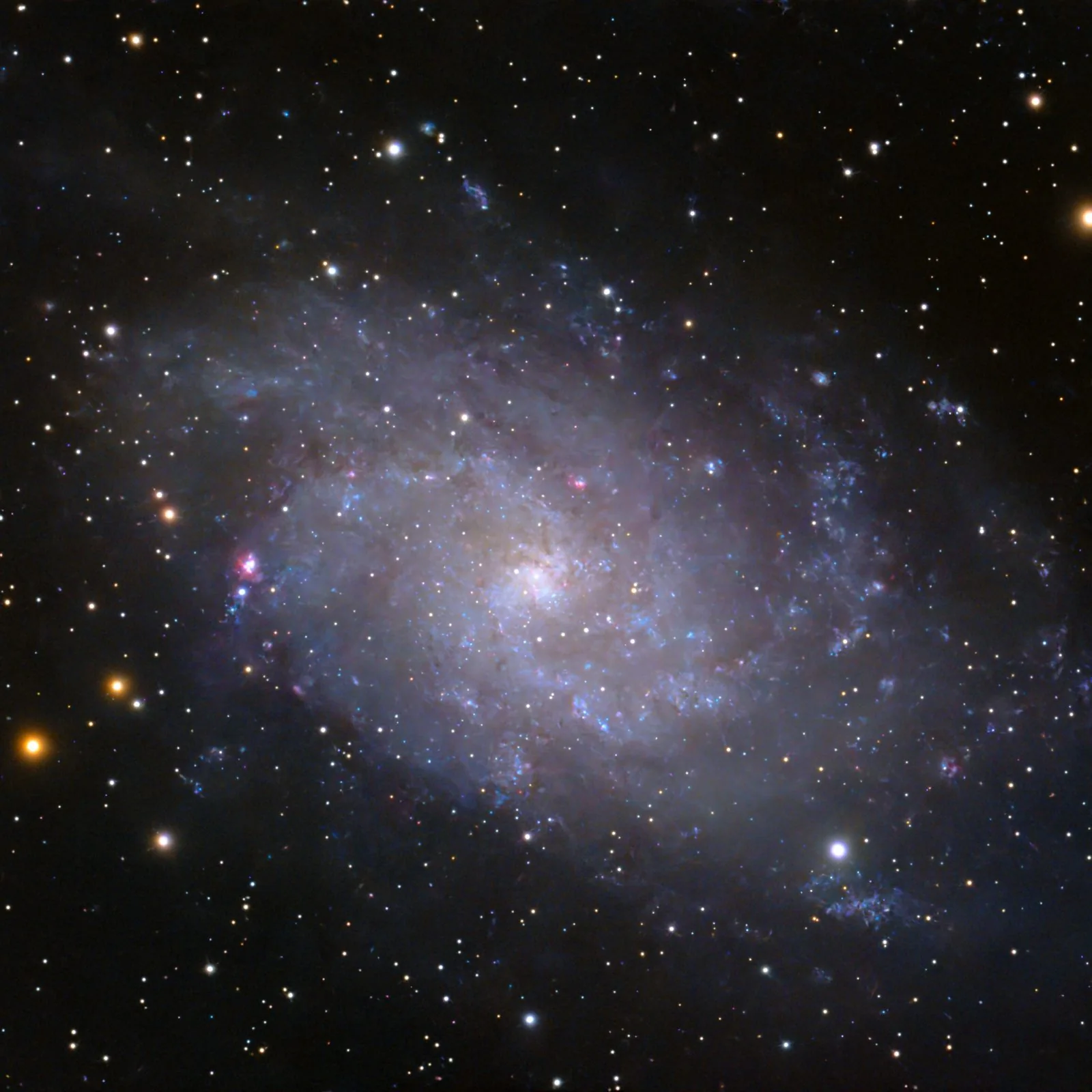
If you have dark skies, M 33 is a showpiece. It’s only 70% the size of our Galaxy, but is the 3rd largest member of the Local Group (after M 31 and the MWG) with about 40 billion stars. Visually it has two main spiral arms but like our MWG, has additional “spurs all of which are undergoing prominent star formation. Unlike most spirals, there does not appear to be a central black hole.
Embedded Star-Forming Region
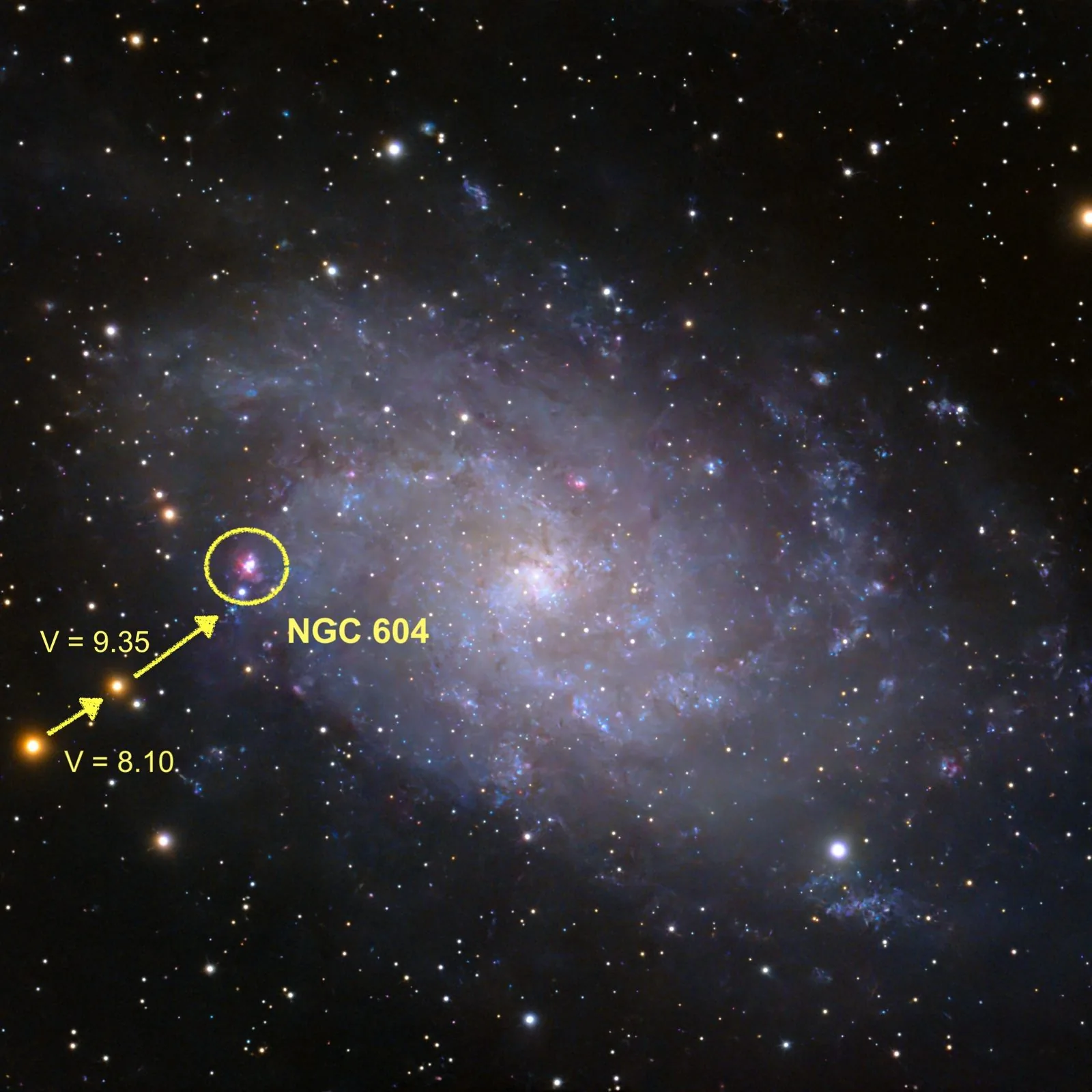
Another challenge is to look for NGC 604 - a star forming region in M 33! It might look like a 12th magnitude “star” about 12’ NE of the galaxy’s center (though it shows up easily with imaging) and you can use the foreground stars (marked to the left) to “point” to it. It is enormous - over 1500 ly across. This is only one of over a dozen nebulae visible in this galaxy’s spiral arms (mostly between mag 13–14): so additional challenges to undertake!
Binary Galaxy Pair
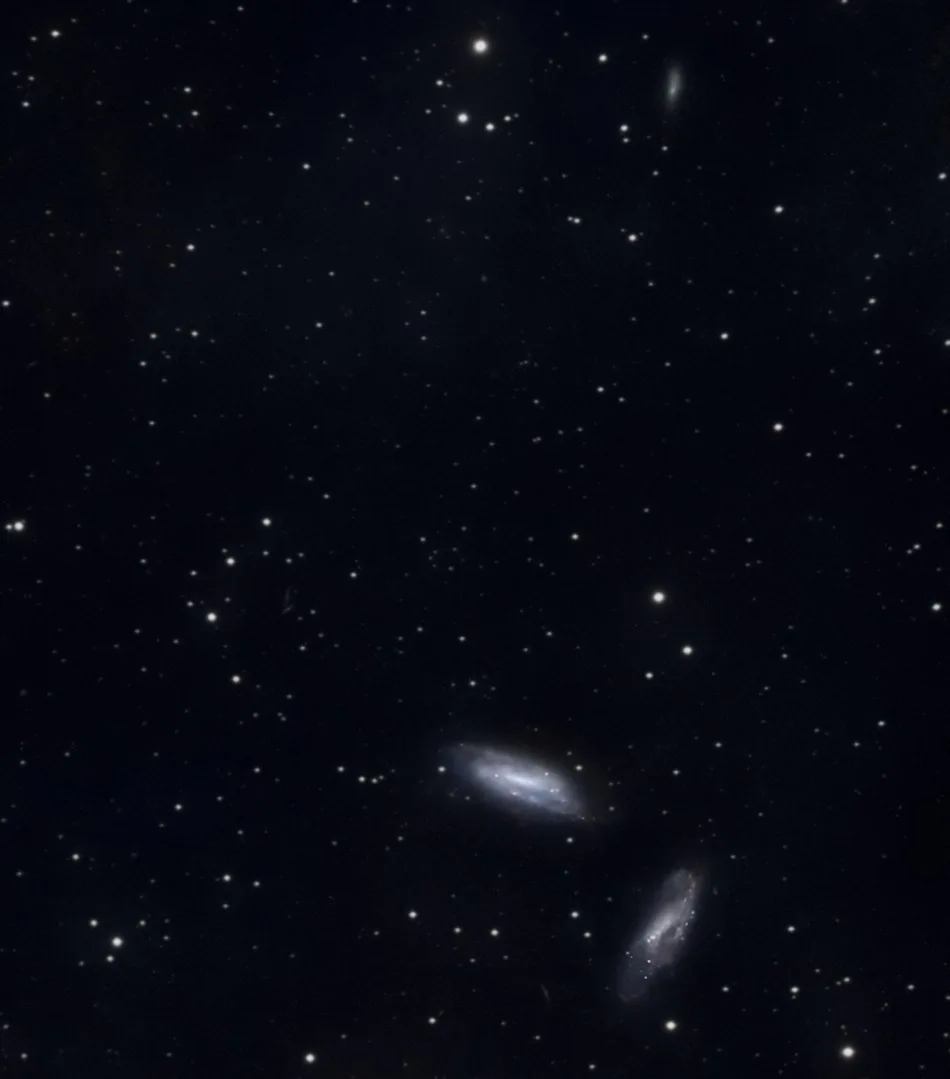
NGC 672 and IC 1727 are an interactive pair of not-so distant galaxies (23 Mly), but they’re only ~70 kly apart (just over a third of the distance from the center of our Galaxy to the SMC/LMC). IC 1727 has an irregular shape (and classification), possibly due to earlier interactions with NGC 672.
A Little Umbrella
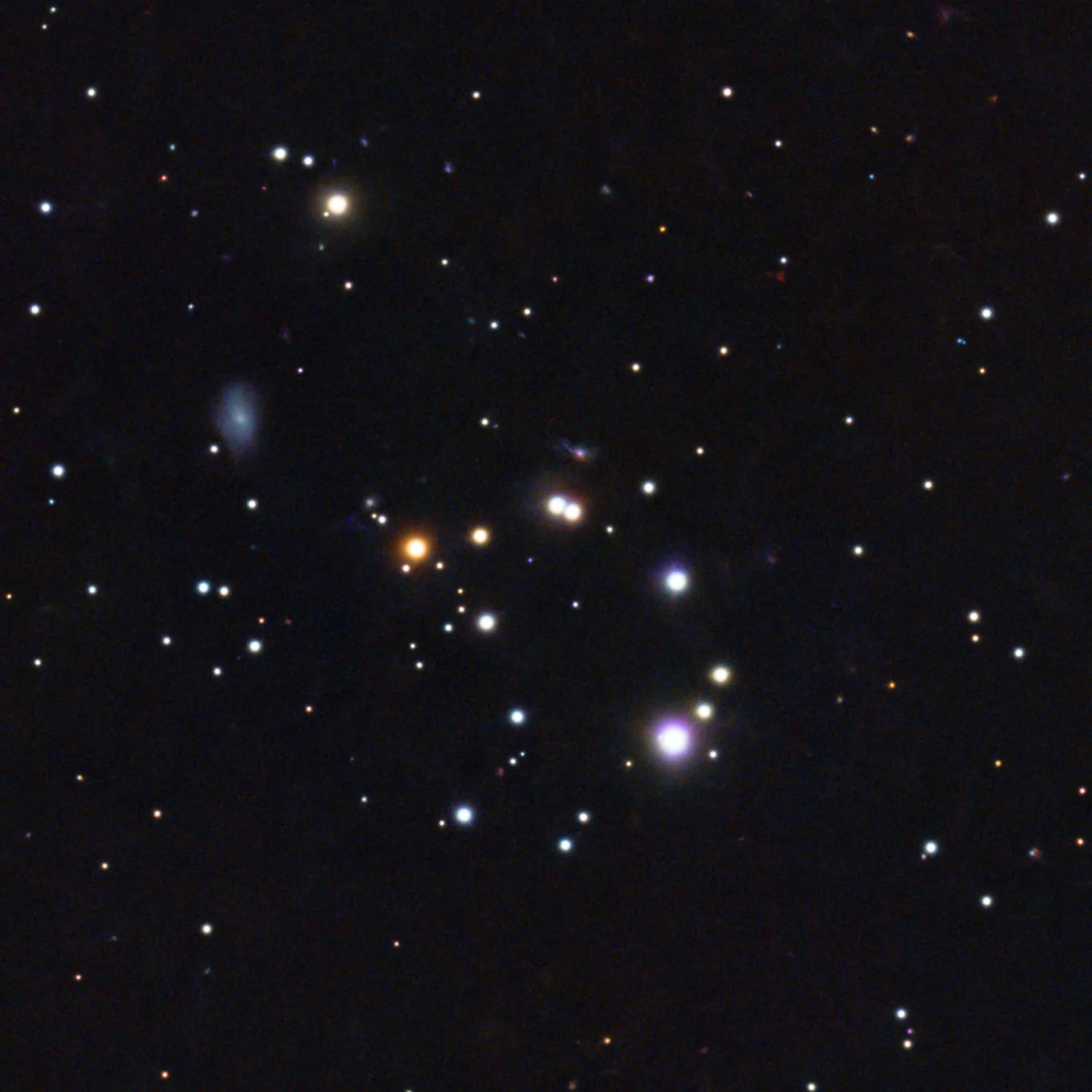
Slightly more than 1/2° SE from NGC 672 is a little clump of about 10 stars of mag 8-11 in the shape of an umbrella (or a mushroom, or an arrow, or a “D”, or a golf putter). This is Collinder 21. Like many grouping of a few stars, sparsely concentrated, it’s probably not a true open cluster, with the observed arrangement coming from only happenstance. Still, it has a nice variety of stellar colors, and is easy to find.
Amatha Galaxy
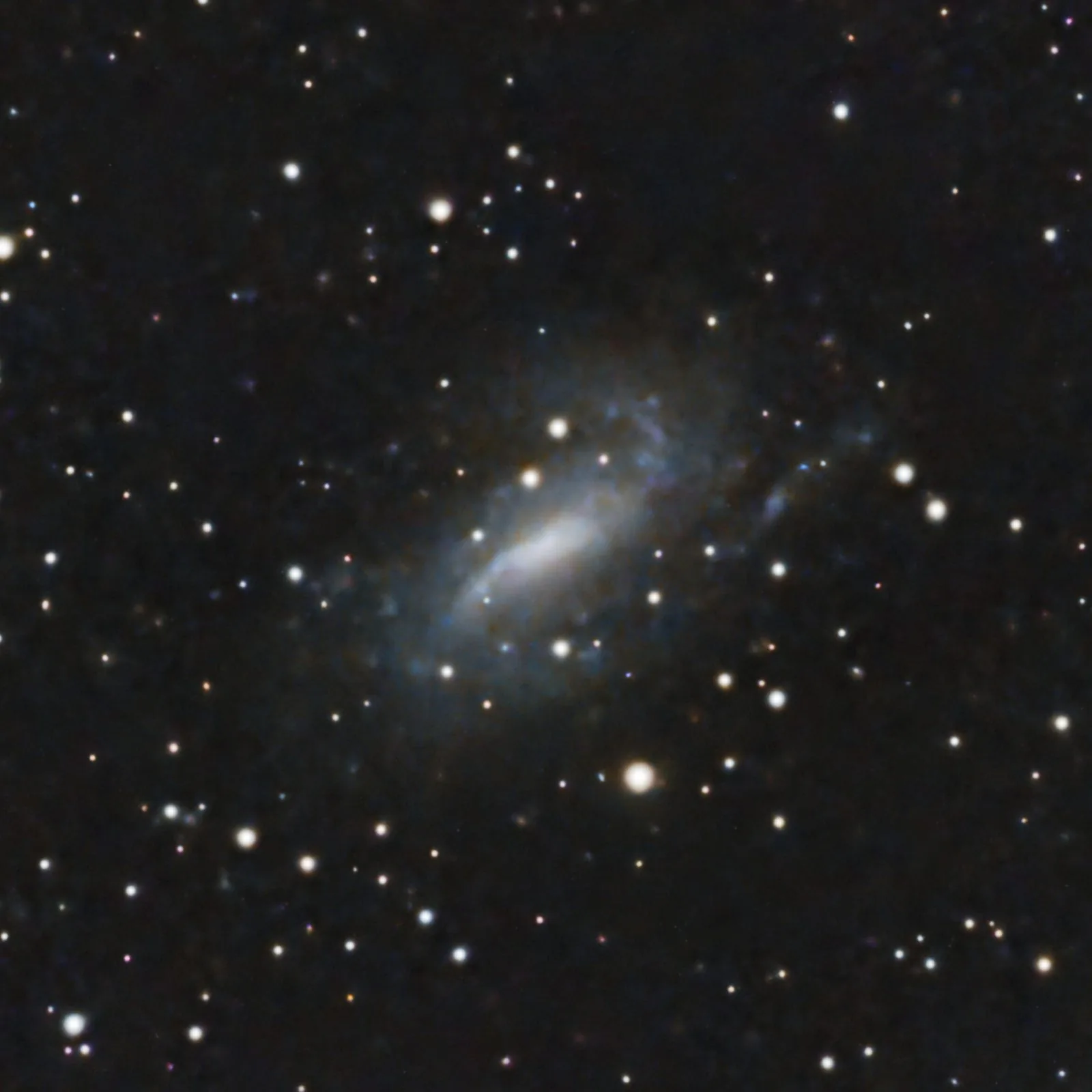
While this somewhat nearby (30 Mly) galaxy is only 10th magnitude, the spiral arms are much fainter. In a small telescope, it’s the central bar that stands out. So, it’s one of those objects where aperture or images work best to reveal its fainter features. Its common name probably is a corruption for the Arabic name for the constellation “El Methalleth” (which is also used for Alpha Triangulii’s name). Its classification is SB(s)d: the “d” indicating very loosely-wound spiral arms.
Another Barred Spiral for Comparison
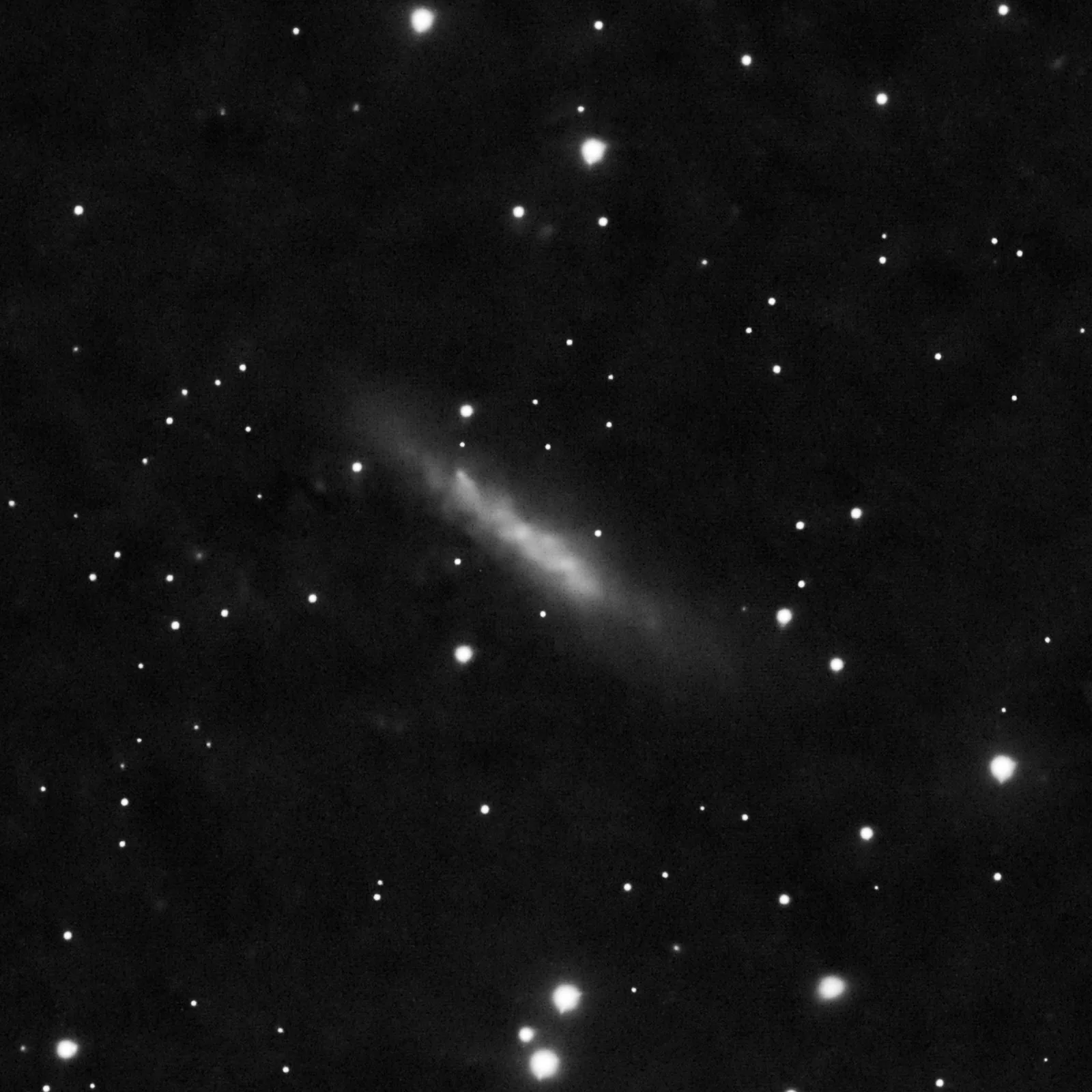
Next, we have NGC 784. It is very similar to NGC 925: highly inclined, SBd classification, with a central bar more prominent than its loose spiral arms. This is a little more challenging as it’s almost two magnitudes fainter though it’s less than half the distance of NGC 925 (only 17 Mly away) - it really is a smaller galaxy; the brighter parts are only a few ten-thousand light years across. In smaller telescopes, it looks like a thin streak.