The Charioteer
The stars of Auriga as a constellation go all the way back to the Babylonians, as a scimitar or the crook used by shepherds. The Greeks associated the stars here with Erichthonius who is said to have invented the four-horse chariot (of “Ben Hur” fame). However in most artistic depictions of Auriga, you see references to both cultures: he is holding the reins of the chariot horses (sometimes depicted as a whip), and carrying goats under his left arm.
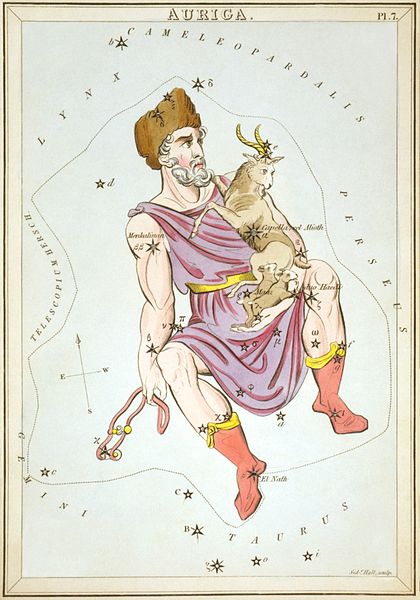
“The Kids” is a well-known asterism in the constellation: a narrow triangle next to Capella. Lesser known is the “Whip” asterism, seen in the map on the next page and the grouping of fainter stars marked Psi (ψ) 1 through 7,
In Schiller’s Coelum Stellatum Christianum where he renamed all the “pagan” constellations with Biblical references, Auriga becomes St. Jerome.
Auriga ranks 21st in constellation size, with the Milky Way passing through the southern half of the constellation. It is in Auriga that we’re looking directly “out” through the Galactic disk (180° opposite to the Galactic Center in Sagittarius); while the “Winter” Milky Way isn’t as prominent as we see in the Summer months (through Cygnus, Scutum, and Sagittarius), many of the same object types are found within the Winter constellations (Perseus, Auriga, Orion, Monoceros, and Canis Major). The striking exception to this is that globular clusters are few and far between above and below the Milky Way in the winter compared to the summer. This is also because they’re more concentrated in the Galactic Halo closer to the Galactic Center.
Map of Auriga
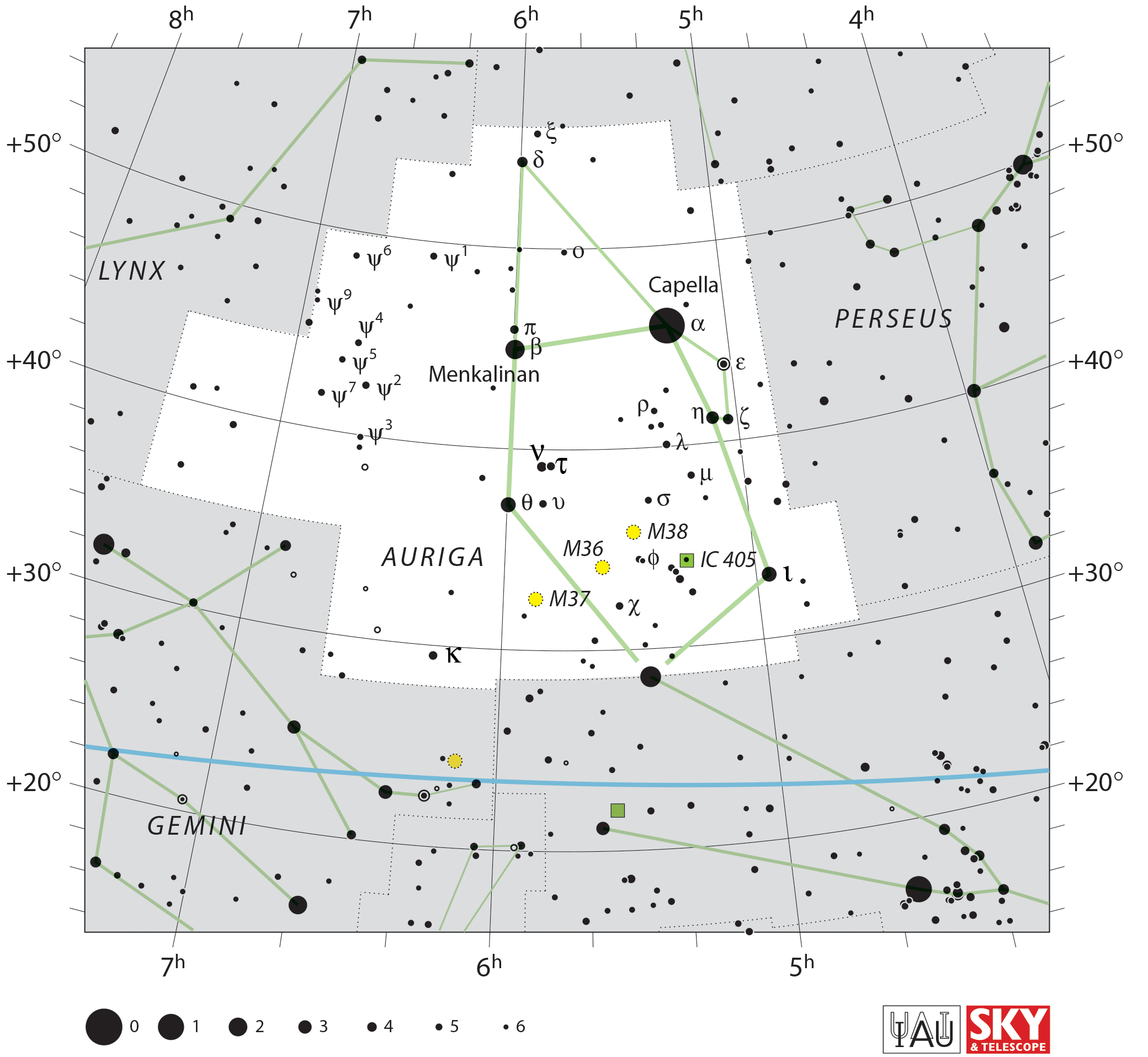
The brightest stars form a pentagon — including Capella, the sixth brightest star in the sky. Capella is a complex object: it’s actually a quadruple star system, consisting of two bright giant stars (Capella Aa and Ab) and two faint red-dwarf stars (H and L). Capella Aa and Ab are close with a separation about the same as the Sun and Venus, with an orbital period of 104 days. H and L are also a binary system 48 AU apart with a ~350 yr orbit but are remote from the giant stars: 10,000 AU. If Capella Aa were the size of a basketball, Ab would be 10 away, but H+L on this scale would marble-sized, 420 feet apart, but 21 miles from the primary pair!
The “gamma” star in Auriga: El Nath (at the bottom of the constellation on the map) is also associated with Taurus (as its “beta” star). The International Astronomical Union, when formalizing the list of constellations and their boundaries, arbitrarily placed the star in Taurus (presumably so the Bull could keep both of its horns).
Within the Milky Way, there’re several open clusters that can be discovered in binoculars or sweeping with a small telescope: the three brightest (M 37, M 38, and M 36) are close to each other and invite comparisons. There are also several nebulae, though requiring telescopes of larger aperture (or imaging) to bring out; they tend to be “second tier” amongst easier nebular targets in Orion and Monoceros, but are worth discovering. One extremely faint cluster that might even be an imaging challenge is Berkeley 18 (between El Nath and Iota Aurigae). It’s large, remote, and faint (the brightest star is only 16th magnitude!) but might be the oldest open cluster identified (as much as 9 Gyr, rivaling NGC 6791 in Lyra). Old open clusters are rare: they tend to dissipate after ~1 Gyr as they move orbiting the Galactic Center.
Quick Reference: Objects of Interest
| Object | Type | Equipment |
|---|---|---|
| Messier 37 | Open Cluster | Binoculars/Small Telescope |
| NGC 1893 | Cluster with Nebulosity | Binoculars/Telescopes |
| Caldwell 31 (IC 405) | Emission/Reflection Nebula | Medium/Imaging Telescope |
| NGC 1931 | Cluster with Nebulosity | Small Telescope |
| AE Aurigae | Variable Star with High Velocity | Binoculars |
| Epsilon (ε) Aurigae | Eclipsing Binary Star | Naked Eye |
Salt and Pepper Cluster
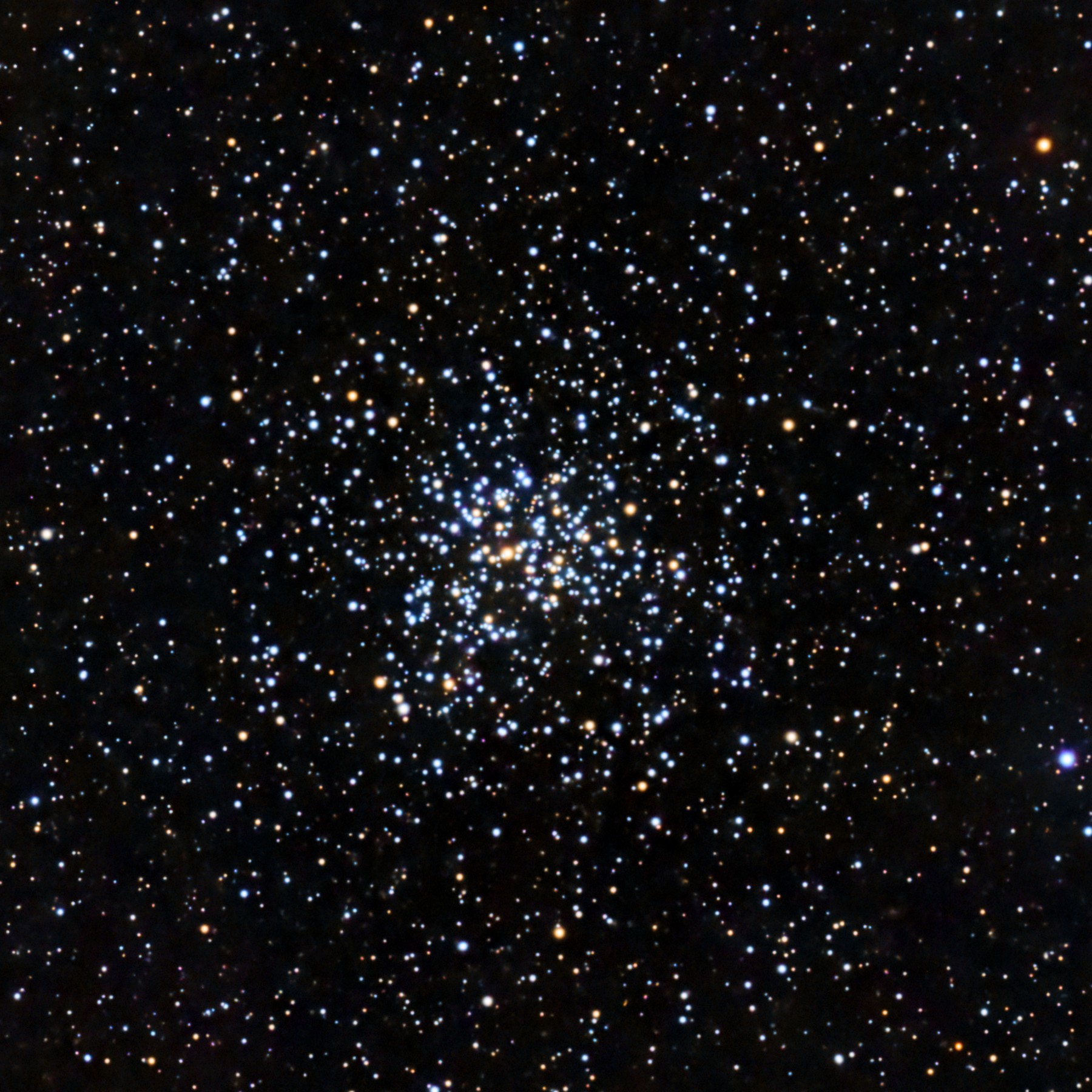
Auriga has three open clusters in Messier’s catalog (36, 37, and 38): M 37 is the brightest and largest. With a combined magnitude of 5.60 it is technically possible to find this with the naked eye under extremely dark skies when it’s nearly overhead; in binoculars it will be easy. It’s 600 Myr old so there’s a little more “spread” in the distribution of color in its stars: the more massive ones have already begun to evolve to red giants, but there are still some hot blue stars for contrast.
Brought to You by the Letter “Y”
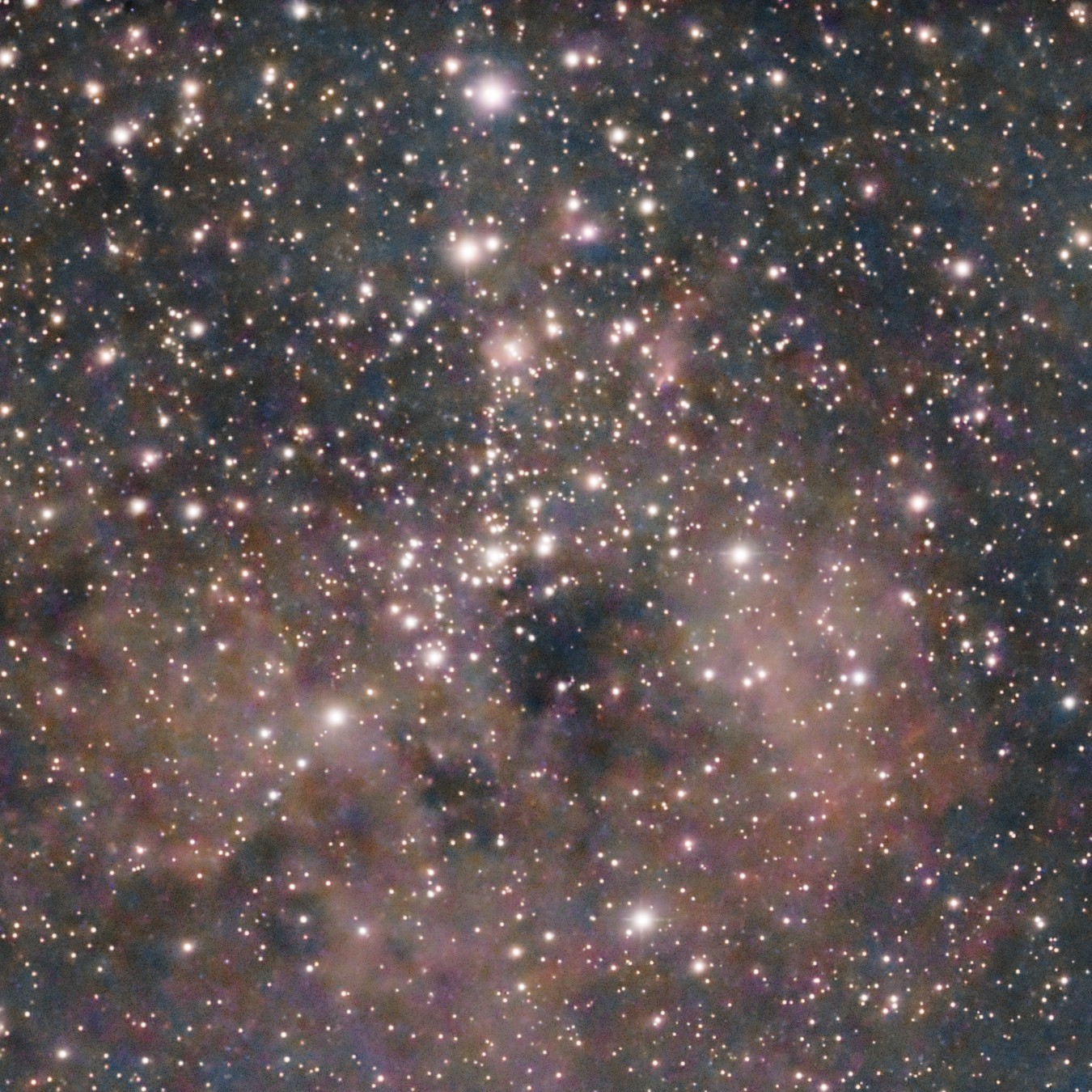
This cluster of young (only 3 Myr!) stars is embedded in a cavity within the emission nebula IC 410: stellar winds have evacuated the gas close to the stars. 70 ly across and over 10 kly away, the along with the “infant” stars, others are just beginning to form out of the cloud. The stars in the cluster take on a clear “Y” formation, hence its name as “The Letter ‘Y’ Cluster”. A small/medium telescope will definitely show the cluster; you’ll probably want imaging (and a nebula filter) to bring out the nebulosity and structure.
Fly in the Sky
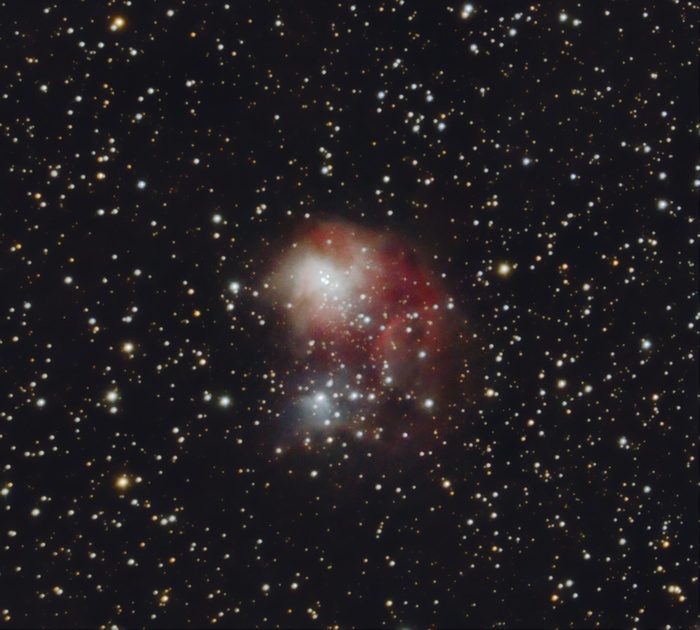
The “Fly” Nebula surrounds a young cluster of 10th-11th magnitude young (~12 Myr) stars, condensed into a region only 9 ly across (it’s 7.8 kly away). The nebula itself is very dense, and embedded within (but invisible to us) are many more pre-main sequence stars.
Flaming Star Nebula
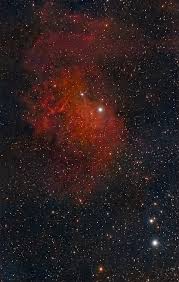
This nebula surrounds the star AE Aur, but unlike many nebulae the star wasn’t “born” there: it’s just passing through and coincidentally is illuminating it (see next entry). It’s a cloud of dust and gas about 5 ly across, and ~1300 ly away. It’s a challenge for medium telescopes (it’s large and faint); images using filters will capture the emission nebulae.
“Runaway” Star
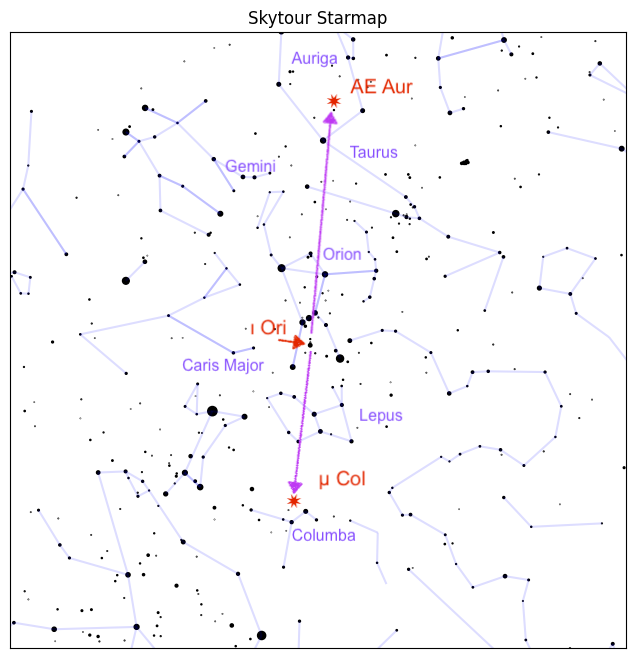
This very hot, young (4 Myr) star is a low-amplitude variable star, but that’s not what makes it intriguing. It has a very high space velocity: in an odd direction. But it’s not the only star like this: Mu (μ) Columbae has the same velocity, but in the exact opposite direction! If you trace the positions of these two stars back in time, they both intersect with another star: Iota (ι) Orionis (the star at the bottom of Orion’s sword). This coincidence demands an explanation, and that might be a collision between two binary stars, leaving one intact (Iota Ori), but violently splitting up the other binary, and throwing its two stars off in opposite directions across the Galaxy. They’re now 1600 light years apart!
A Very Long-Period Variable Star
This star is an enigma. First, every 27 years, it’s eclipsed by something, and the eclipses last two years: the last was in 2009-11; the next will be 2036-38. This was the longest period recorded for an eclipsing variable star (it has seen been superseded by AS Leonis Minoris with a staggering 69.1-year period. Epsilon itself, is a remarkable star: it’s an F-type supergiant (though pinning down its mass and size has been difficult) about 3300 ly from the Sun (or it’s closer) orbited by another unseen star of similar mass.
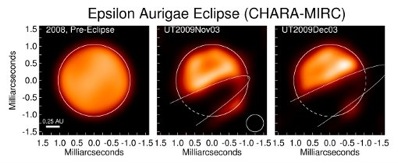
But what causes the eclipses? Over the last 100 years several theories have been offered; the current consensus is that the secondary star is a hot B-type star (or perhaps is a binary itself) surrounded by a flat disk of material that hides the companion star from view. The disk is rather large: 3.8 AU side, but very flat (only 0.5 AU thick), and blocks about 70% of the primary star’s light during the eclipse. Confirmation of the disk came from the CHARA telescope array at Mt. Wilson Observatory (see image above), with images taken during the most recent eclipse showing the progression of the disk across the primary star. At present, the disk is only the opposite side of the system: a “secondary” eclipse which has never been detected (but it will last until late-March 2028).