Catching Jupiter’s Great Red Spot
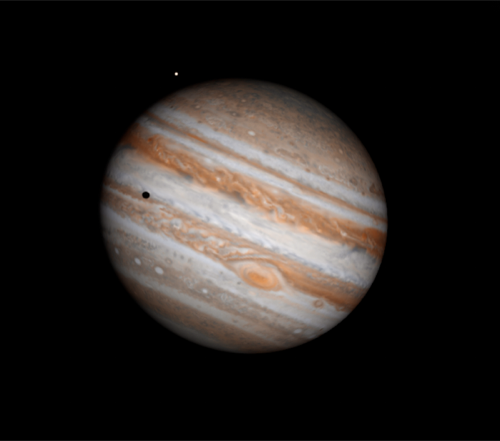
Jupiter’s rotation period is about 9h 55m, though the different bands and zones have slightly different values. The most famous feature is the Great Red Spot (GRS). When it first was observed is a little unclear: definite observations go back to 1831, though mentions of a Jupiter “spot” go back to 1664, though some of them might’ve been shadow transits of the Galilean moons, or a different “spot” altogether.
The spot we see now is an enormous cyclone whose top extends past the bands and zones crossing the planet. It’s about the size of the Earth though it has shrunk over the last decades, and – sadly – dimmed but it’s still within reach of moderate telescopes.
For February, here are the transit times (EST) during evening hours. The “window of opportunity” is ~45 min on either side of these times:
| Date/EST | Date/EST | Date/EST |
|---|---|---|
| Feb 5: 6:31 PM | Feb 14: 8:55 PM | Feb 24: 7:12 PM |
| Feb 7: 8:09 PM | Feb 16: 10:34 PM | Feb 26: 8:50 PM |
| Feb 9: 9:47 PM | Feb 19: 8:03 PM | Mar 3: 7:58 PM |
| Feb 11: 11:26 PM | Feb 21: 9:42 PM |
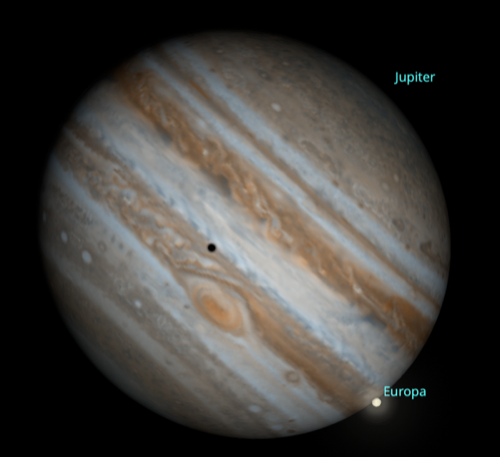
Or the GRS and Moon Shadow
| Date / EST | Moon |
|---|---|
| Feb 4: 11:15 PM | Io |
| Feb 16: 3:00 AM | Europa |
| Feb 18: 11:35 PM | Ganymede |
| Feb 26: 1:24 AM | Ganymede |
Mercury in the Evening
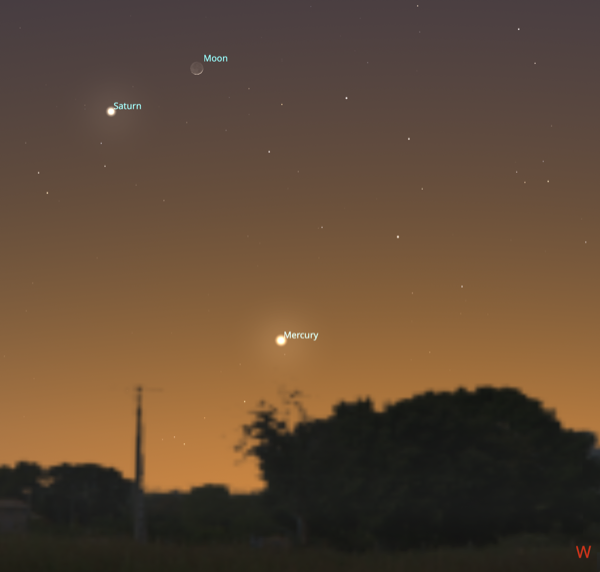
2026 isn’t the best year for catching Mercury, but the best chance might come on the evenings surrounding Feb 19th and 20th. While only 15° from the Sun, it sets right at the end of twilight, around 7 PM (the Sun sets at 5:30). The thin crescent Moon might help: it’ll be higher in the sky on the night of the 20th and “points” to Mercury’s position. (The night before the Moon will be just below the planet but with a very thin crescent!) Saturn is there too, but will be a magnitude fainter than Mercury.
This Month’s Image
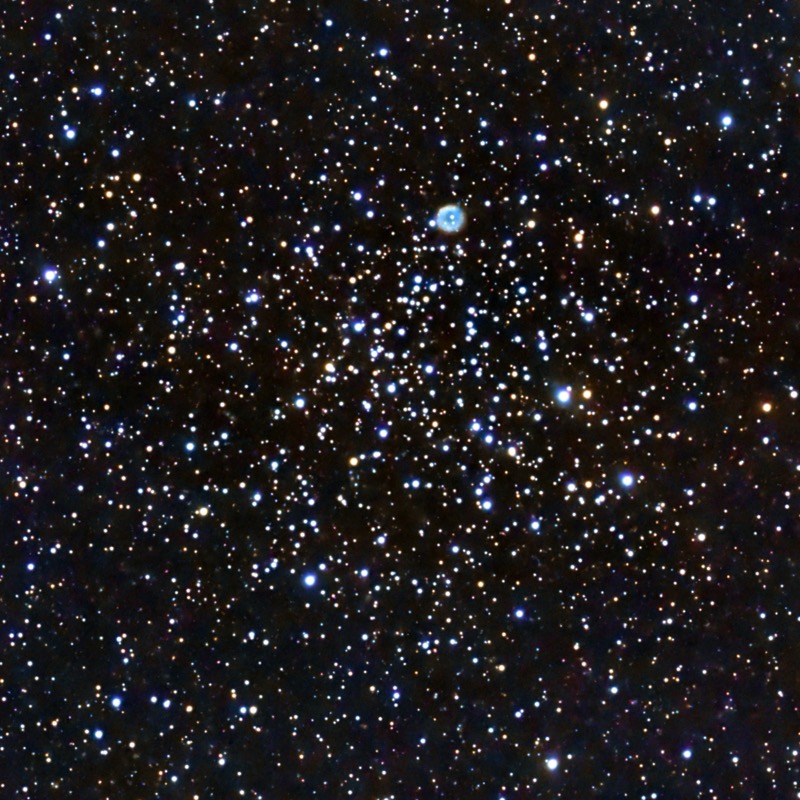
Cataloged as an open cluster, it’s typically overshadowed by other more-famous winter objects, but it’s an easy find in NW Puppis (and next to neighboring cluster M 47). It’s bright enough to be a easy target for small telescopes (even binoculars), but the cluster (5000 ly away) is being “photobombed” by a closer (1370 ly) planetary nebula, NGC 2438, that started forming 8.5 kyr ago when its parent star shed its outer atmosphere leaving a hot core heating the shed gases and creating the smoky ring of the nebula. As it expands and the stellar remnant cools, it will slowly fade away.