Easy (Binoc.): NGC 2244, Cr 70, NGC 2169, M 44, M 37
Moderate (Small Tel.): B 35/FU Ori, NGC 2269, NGC 1980, NGC 2024
Stellar Remnants
Looking at the late winter sky, it’s easy to be attracted to the
bright stars of the Winter Hexagon and their associated constellations,
but there’s some interesting developments that can be seen. Remembering
that massive giant stars like Betelgeuse and Rigel are short lived,
we can reflect on what happens “next” to stars as they use up their
nuclear fuel. Here are a few objects to examine:
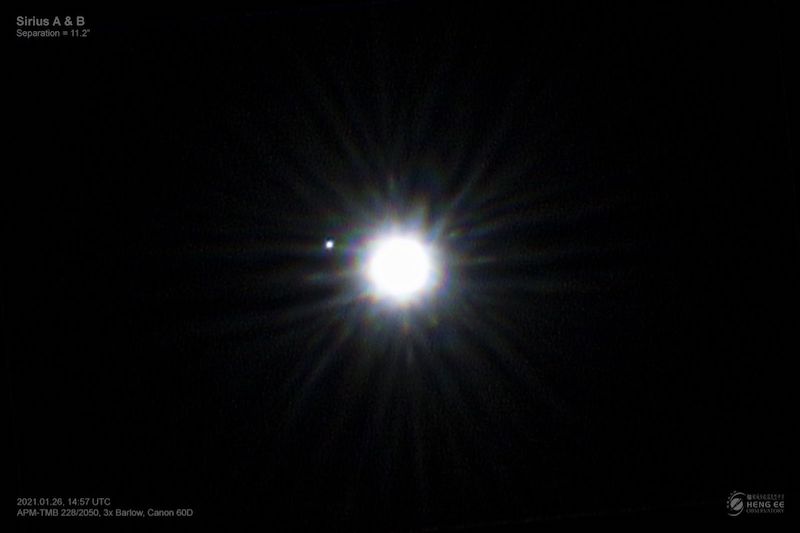
Sirius A and BSirius B and Procyon B: Both are actually the less-massive siblings
in systems that once hosted a brighter component, and have since become
white dwarfs. Of the two, the white dwarf companion to Sirius is a
challenging - but doable - target (the separation for Procyon and its
white dwarf is tiny, and out of reach for most amateurs). In fact, Sirius’s
two stars are close to their maximum separation in their 50-yr orbit
at present (about 10”). Sirius B, at mag +8.6 is 10,000 times fainter than A.
Sirius B once was a hot blue star almost 3x the mass of Sirius A.
It lost its atmosphere just over 100 Myr ago: ~1 Gyr from now, both
stars will have become a faint white dwarf binary stars.
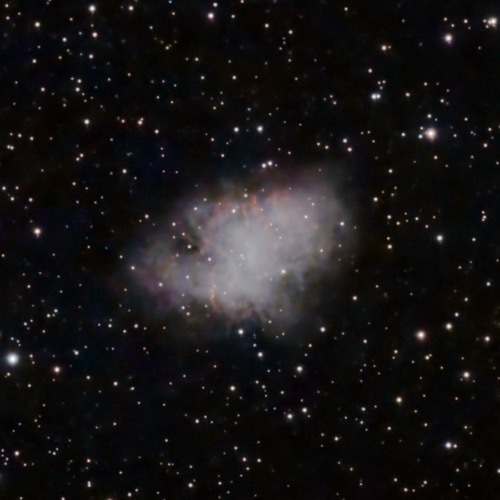
Bob Donahue, NBASCrab Nebula Pulsar:
In 1054 CE, a star that once was about 8-10x the mass of the Sun
exploded as a supernova (though only about mag +8 before then),
expelling its atmosphere and leaving a pulsar - a neutron star
with beams of radiation coming from it’s magnetic poles. The M 1
remnant spins at 30x/sec, but at mag 16.5 you’ll want imaging to
detect it.
`
… and Protostars
On the other side of stellar evolution, we can look at several
hotbeds of star formation in these same constellations! Stellar
nurseries show hot young stars, pre-Main Sequence stars, and nebula
features indicating as-yet unseen infant stars about to shine
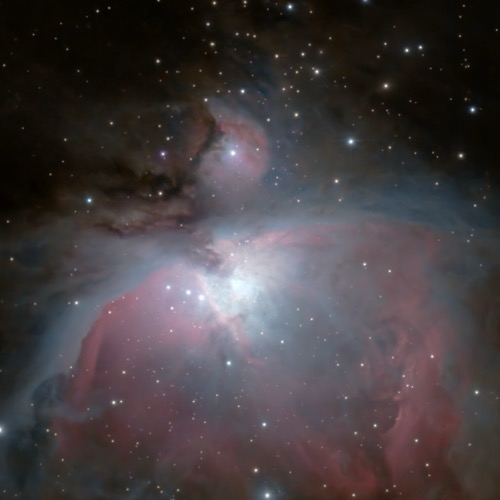
Bob Donahue, NBASOrion Nebula: the obvious place to start is the Trapezium
cluster at the heart of M 42. These four stars occupy a space of
only 1.5 ly: but the entire cluster (of ~1000 stars) is crammed
into a space only about 3-4 ly across! These stars are incredibly
young - some estimates place them at only ~300 kyr! Their winds
carve out a bubble in the nebula that allow us to see them: other
protostars are still contained within proto-planetary disks awaiting
their ignition. This intense star formation will continue for a few
million years, over which time Betelgeuse and Rigel will undergo
significant changes. Orion on the whole is changing before our
eyes!
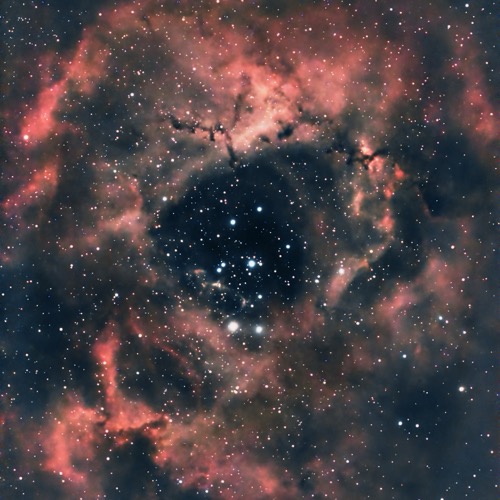
Bob Donahue, NBASRosette Nebula/Harp Cluster:
A few degrees to the East, we find the Rosette Nebula in Monoceros
that’s a little further along than the Orion Nebula in its evolution.
Here, the stars have carved out a “hole” in the center of nebula
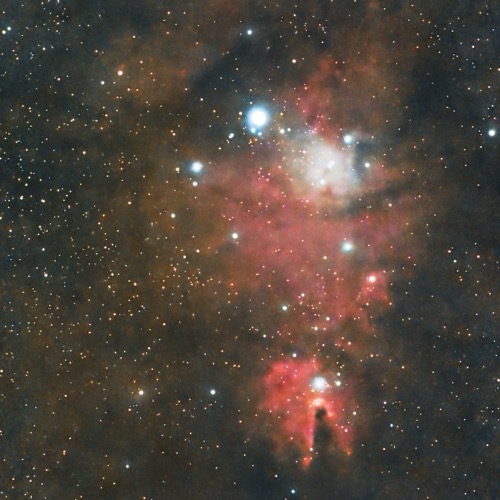
(which is about 100 ly across). This system is about 5 kly away.Bob Donahue, NBASCone Nebula and “Christmas Tree” Cluster:
Travel ~4.5° North towards the feet of Gemini, and we find yet-another
intense region of star formation. This cluster + nebula is at an
intermediate distance between Orion and the Rosette (about 2.5 kly),
and similar age. The Cone feature is about 7 ly long, and the other
two, hosts new hot stars just a few Myr old.
This Month’s Image
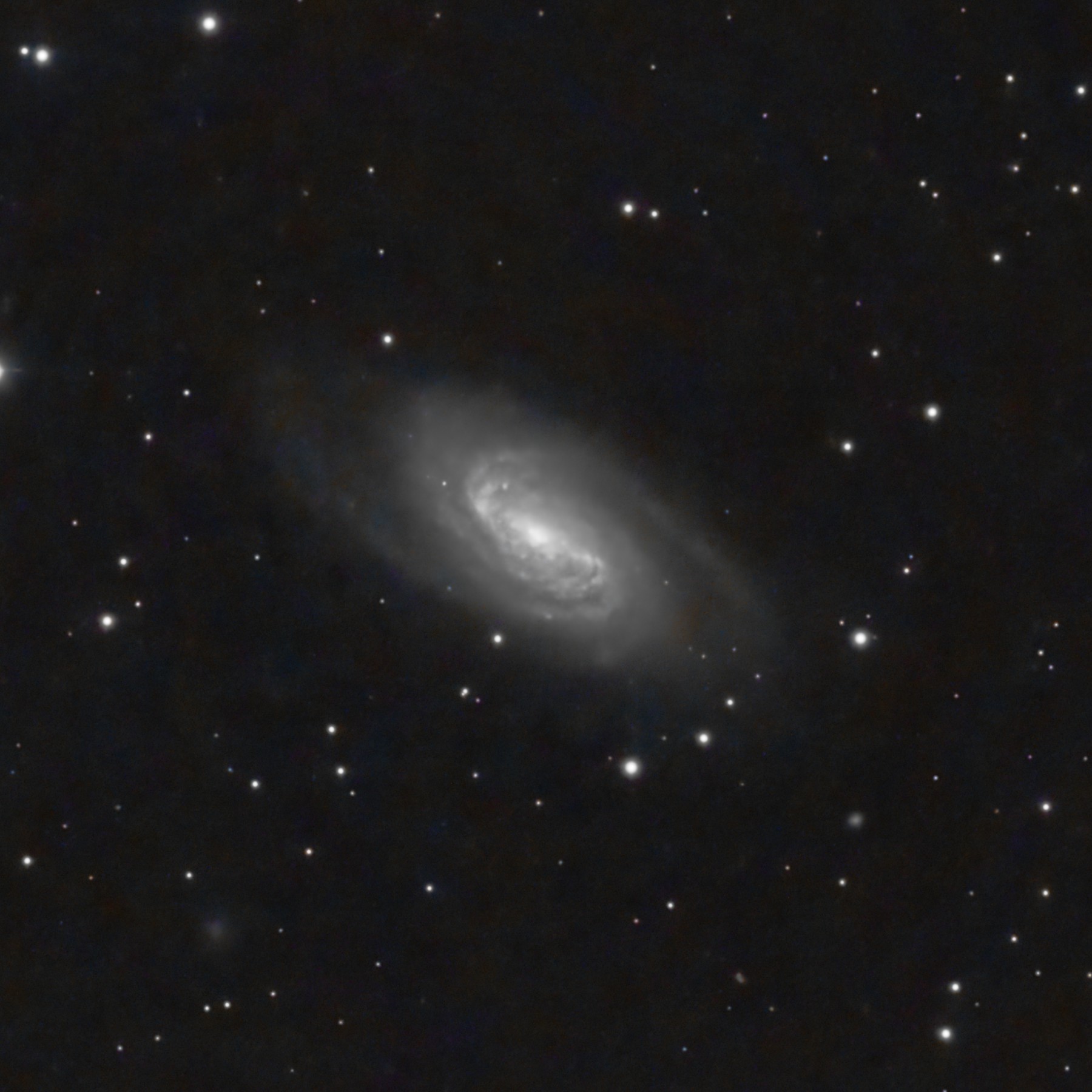
Bob Donahue, NBASSpring is coming! And that means Galaxy Season! One of the first
springtime galaxies to come up in the late evening sky is NGC 2903
in Leo (just off the lion’s nose). Somehow this bright and large
galaxy evaded Messier (and for that matter Caldwell). It’s about
30 Mly away and an outlying member of the Virgo Supercluster.