
The Crow
Standing on the back of the very long constellation of Hydra, our crow has a very long history: it was included in Ptolemy’s Almagest and was probably introduced to the Greeks about 500 years before that. The Babylonians also saw a crow figure here.
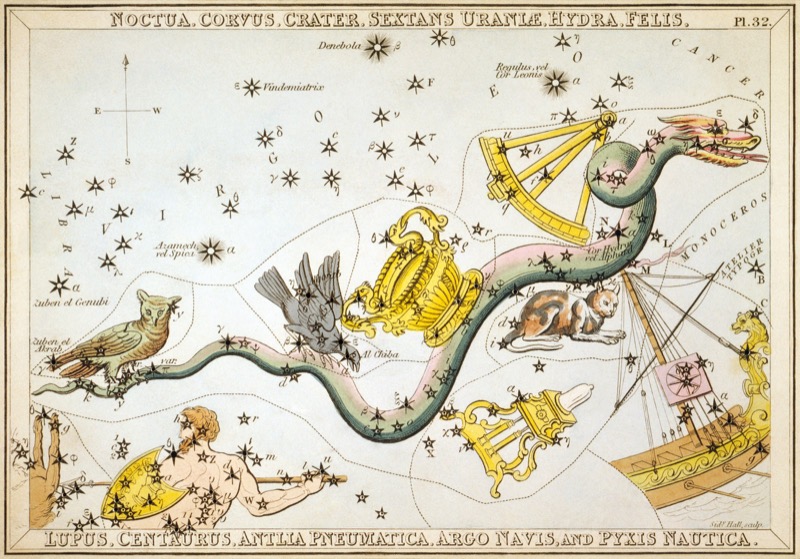
In one Greek legend, the crow was sent to fetch water for Apollo, but stopped to eat figs. Instead of honestly owning up to the reasons for his delay, he lied - claiming that a snake prevented him from getting to the water. Angered, Apollo cast the bird, the drinking cup and the snake to the heavens (giving us the constellations of Corvus, Crater, and Hydra). Another legend has Apollo learning of his betrayal from his lover Coronis from a white bird, and in his anger (and a case of “blaming the messenger”) turns the bird’s feathers black (and again banishing it to the heavens).
The skies surrounding Corvus are a bit of a hot spot for “ex”-constellations: to the East, below Spica we find another “bird,” Noctua the Owl (though other uranographers mark the area as Turdus Solitarius the Solitary Thrush). Across the slim body of the Snake to the West was Felis the Cat, which for unknown reasons the IAU cut from the final list: perhaps the committee was composed of only dog lovers! (There are four canine constellations: Canis Major and Minor, Canes Venatici, and Lupus, and three feline: Leo, Leo Minor, and Lynx - seems only fair to keep the balance and include Felis!)
Map of Corvus
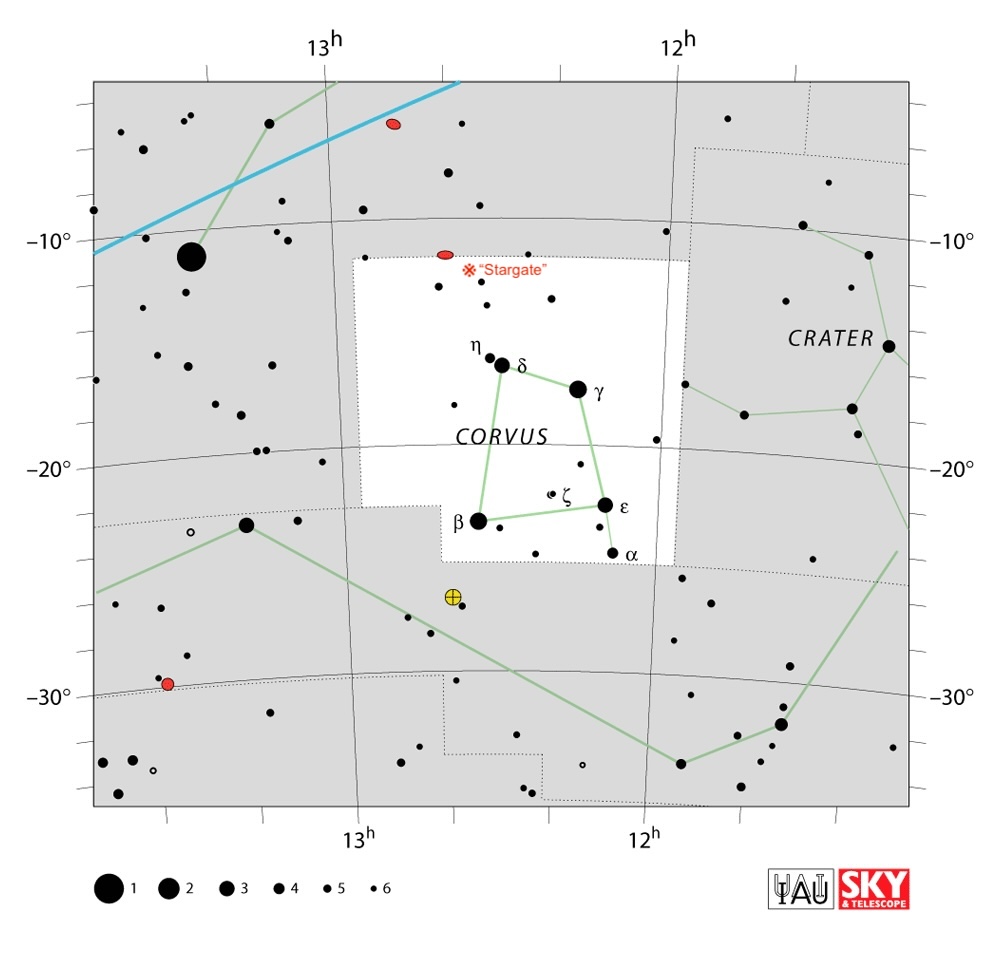
In the Spring sky the guide for locating bright stars is to start from the handle of the Big Dipper, “arc to Arcturus,” then “spike to Spica”. From there, the stars of Corvus, just SW of Spica should probably have the addendum “continue to Corvus.” The brightest stars in Corvus form a slightly mangled square, with an “appendage” off of one corner. The funny thing is that these stars aren’t all that faint: four of them are brighter than magnitude 3.0, which typically would make this a prominent grouping: many of the stars making up the stick figure of Leo are actually slightly fainter.
Corvus is another example where the designated “alpha” star isn’t the brightest star in the constellation – far from it – it ranks fifth by a whole magnitude (it’s a dimmer 4th magnitude star). One has to wonder how Bayer decided on the rankings here. The NE corner star Delta (δ, Algorab) makes a close pairing with Eta (η) – slightly more separated than the width of the Full Moon – and their relative brightnesses are very similar to the Big Dipper’s “naked eye double” of Alcor and Mizar, though here the separation is over three times wider: it’ll be easy to find and observe with binoculars. Another double star to find with binoculars is Zeta (ζ) Corvi, between the two bottom stars of the square: the two stars (blue and pale orange) are magnitudes 5 and 6, separated by 7’.
Quick Reference: Objects of Interest
| Object | Type | Equipment |
|---|---|---|
| Caldwell 60/61 | Interacting Galaxies | Medium/Imaging Telescope |
| NGC 4361 | Planetary Nebula | Small/Medium Telescope |
| NGC 4027 | Barred Spiral Galaxy | Small/Medium Telescope |
| NGC 4727+ | Pair of Galaxies | Medium/Imaging Telescope |
| NGC 4050 | Spiral Galaxy | Small/Medium Telescope |
| STF 1659 | Asterism | Binoculars/Small Telescope |
The Antennae
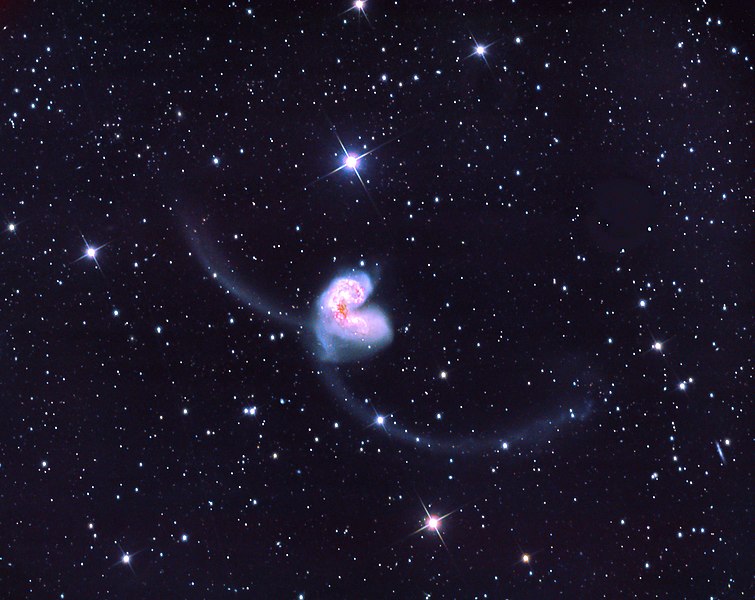
These two galaxies are in the midst of a violent collision that began about 700 Myr ago. Both have had their outer halos stripped away causing each to have a faint “ring tale” extending out for about 200 Mly. Studies of their motions suggest they’re currently in their second of at least three encounters. Even in moderate-sized scopes (4-6”) you’ll see that there’s something “wrong” going in; larger telescopes and imagers pick up variations in brightness, patches of star formation, and the distortions of each disk. Imaging will start to show the faint tails.
Warped Planetary Nebula
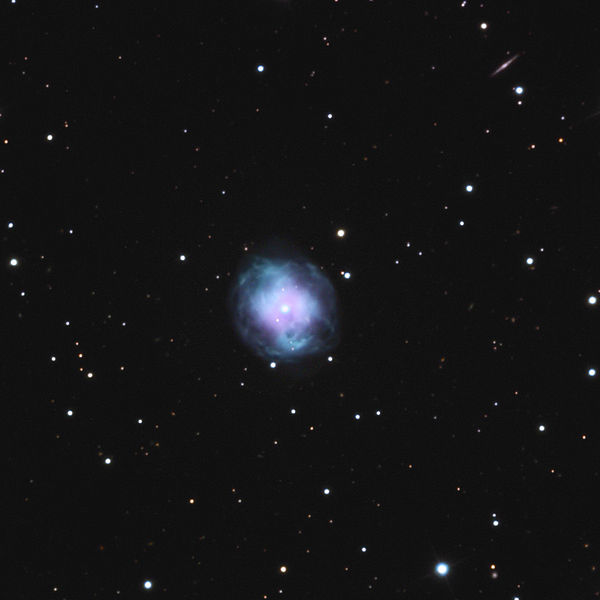
This PN is a bit hazier looking than others which might have to do with its location in the galaxy: the star is metal-poor and those stars seem to make nebula that aren’t as well defined as, say, the Ring Nebula in Lyra. It also has a complex structure (it almost looks like it has spiral arms) that suggests multiple mass-loss episodes, and possibly that there are – not one, but two – dying stars creating the nebular shells.
Highly Disturbed Spiral

This “one armed bandit” actually does have two arms, but one is highly truncated both dotted with star forming regions. How it got that way involved an irregular galaxy, NGC 4027A, 4’ to the South. Radio observations show a tidal ring extending between the two galaxies.
Non-Interacting System
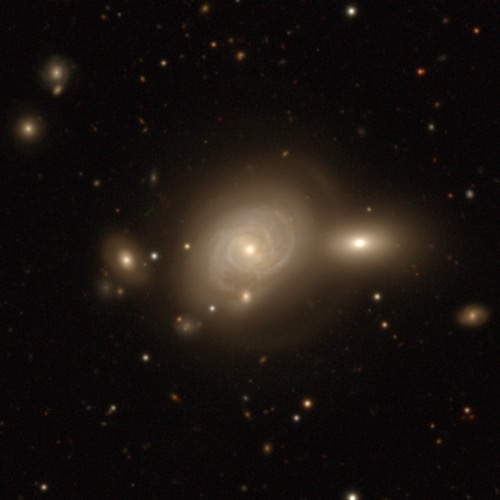
For this pair, we have the open (but hazy) spiral NGC 4727 and only 1’ W, the lenticular NGC 4724. But what looks like another interacting pair isn’t: NGC 4724 at just under 200 Myr distance is the closer of the two: NGC 4727 is 362 Myr away - almost twice the distance! There are several other faint galaxies in the nearby field arranged in a semi-circle - a great challenge for larger scopes and imagers.
Cosmic “Eye”
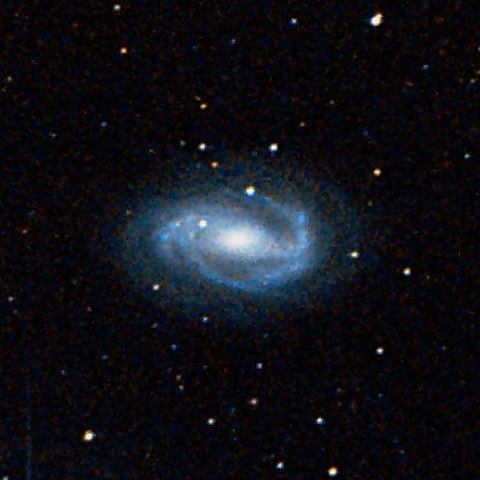
Rounding out our selection of Corvus galaxies, is NGC 4050, a barred spiral 125 Myr away. Here you’re seeing it “mostly” face-on, with a prominent bar and two (or three?) spiral arms in a very smooth oval shape, traced out with star-forming regions. The shape has the appearance of a staring “eye” looking back at the observer. Imaging might pick up the color contrast: hot blue stars out in the arms, with a redder inner core dominated by red giant stars.
The “Stargate”
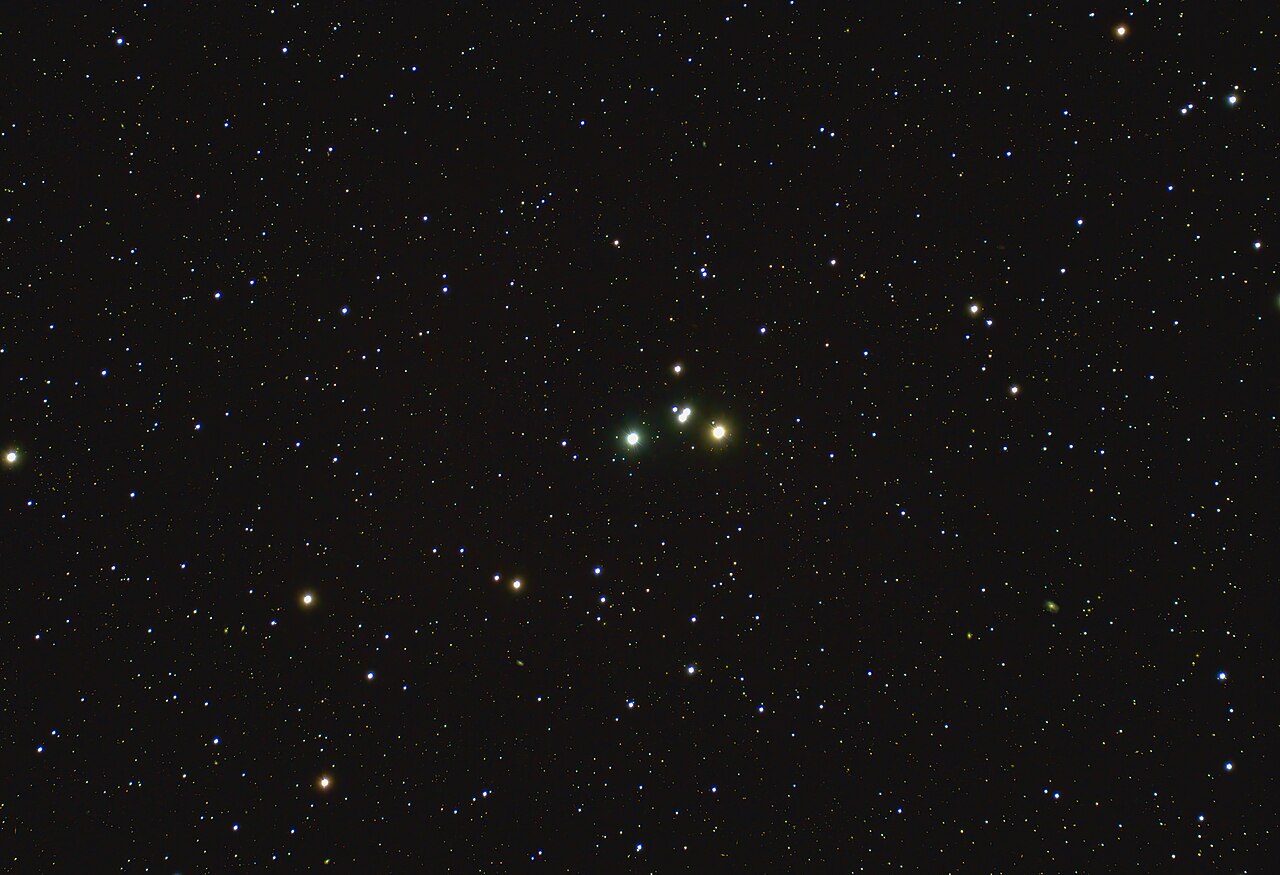
This “triangle within a triangle” gets its name from the movie because it resembles one of the glyphs on the Stargate. It’s made up of magnitude 7-9 stars. To find it, start from the wide pair of Delta/ Eta Corvi and scan North by about 4°. (We’ve marked it on the Corvus map, above). Aside from their proximity to each other on the sky, these stars don’t have any physical relationship: their distances span over 100 light years.