
One of the fun things about using “smart” scopes is not only when you get a great image of an object but it reveals details you didn’t know where there!
Here is an image I took of the Andromeda Galaxy with my
Seestar S50 (“Elusippe”): 82 min, back on 8 Nov 2024.
(Don’t mind the weird picture-frame border.)
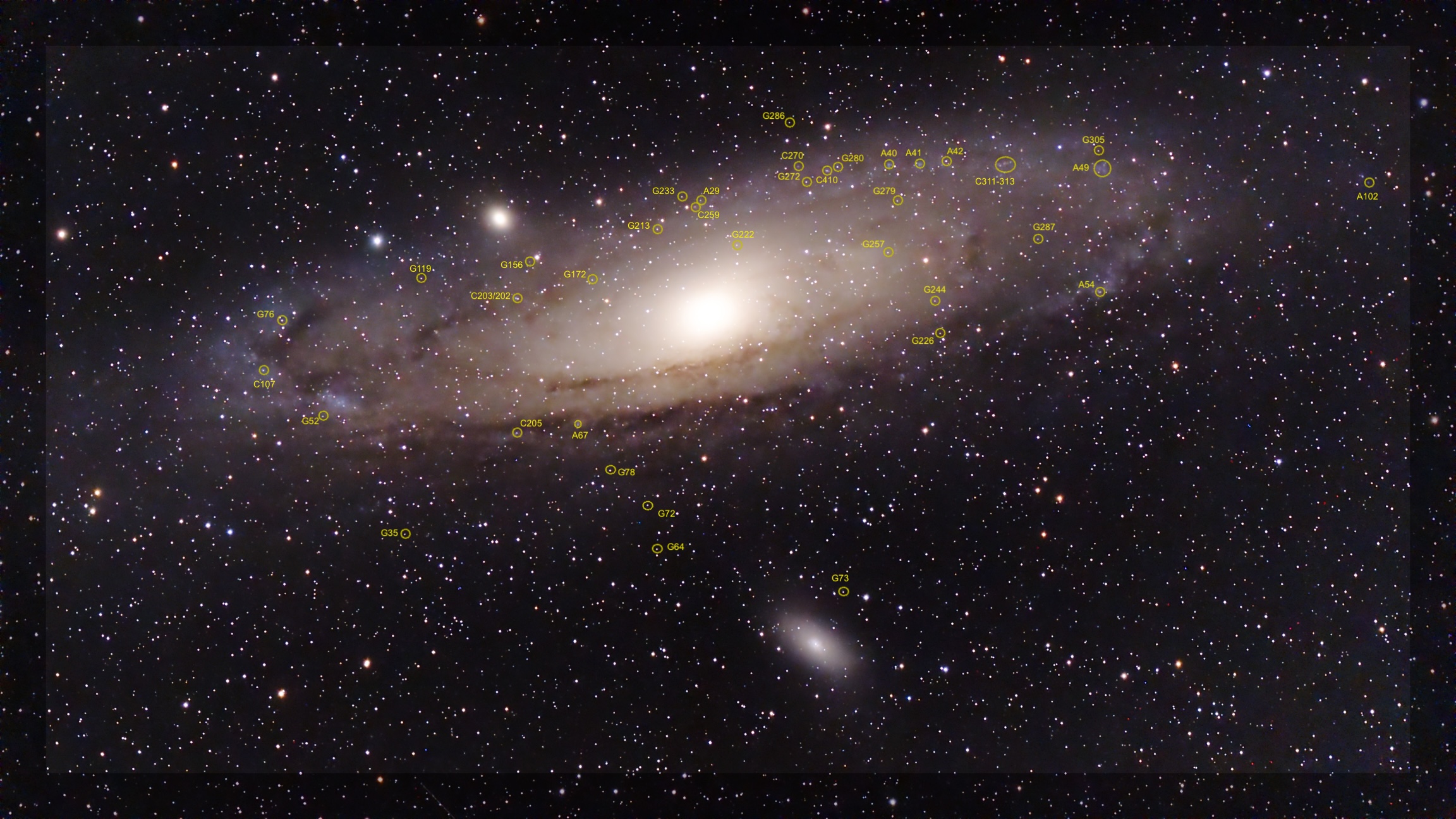
Anyway, what you first see is the main galaxy (obviously), and the two primary satellites, M 32 and M 110. Andromeda enthusiasts might also notice the massive stellar complex of NGC 206 on the lower-left of the outer spiral arm.
And of course lots of foreground stars, down to magnitude +15.5 or so.
But that’s not the whole picture!
I recently found a copy of the Observing Handbook and Catalog of Deep-Sky Objects by observing veterans Christian Luginbuhl and Brian Skiff. With their entry on Messier 31 they include a full-page picture with dozens of identifications of globular clusters, large open clusters, and associations. Of course that picture was taken with a much larger telescope than my 50mm Seestar. But… Why not look?
I’m glad I did. Sure enough all of the clusters Luginbuhl and Skiff identified are also there on my Seestar image. How about that. If you blow up my image, you’ll see all the tiny designations starting with the letters ‘G’ (for globulars), ‘C’ (for clusters), and ‘A’ (for associations).
Now I’m curious what other objects I’ve observed have DSOs disguised as foreground stars!