New names of minor planets are announced in the WGSBN Bulletin, which is published every three weeks by the International Astronomical Union’s Working Group Small Bodies Nomenclature. The latest issue contains 46 new names. Below is information on some interesting new names contained in this issue.
If you click on the “Orbit diagram” links below, you will be taken to an interactive orbit page, where you can see the current locations of each asteroid and the major planets.
(9660) Brucewillis
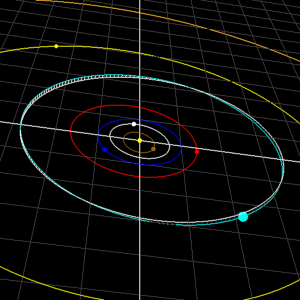
This main-belt object, discovered in 1996 by the Near-Earth Asteroid Tracking team observing from Haleakala, is named for the American actor Bruce Willis (b. 1955), best known for his roles in the Die Hard franchise and the sci-fi movie Armageddon.
Brucewillis is about 13 km in diameter and orbits the Sun every 5.7 years in a low-eccentricity (e = 0.125) orbit inclined 2° to the ecliptic plane.
Interactive Orbit Diagram for (9660)
(463368) Eurytus
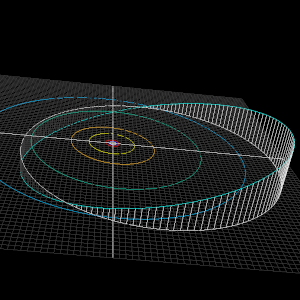
This Centaur-type asteroid was discovered in 2012 and is named for Eurytus the centaur, who took part in the battle between the centaurs and the Lapiths. Aocording to Greek mythology… Centaur-type objects are objects whose orbits remain in the outer solar system, beyond the orbit of Jupiter. One of the discoverers was the Lithuanian astronomer Kazimieras Černis, who was honored with the naming of (29692) Černis in this same issue. As a very active observer, it is odd that it took so long for him to get a minor planet.
Eurtyus is about 190 km in diameter and orbits the Sun every 159 years in a moderately-eccentric (e = 0.313) orbit inclined 15° to the ecliptic.
Interactive Orbit Diagram for (453368)
(533671) Nabu
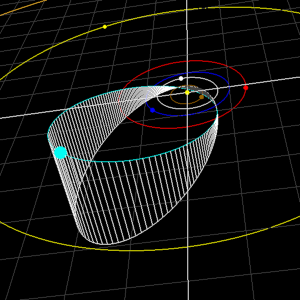
(533671) Nabu is named for the Mesopotamian god of writing and wisdom, and the patron of scribes in Babylonian mythology. Nabu is an Apollo-class object discovered by the NASA-funded Catalina Sky Survey in 2014, with an orbit whose perihelion (point of closest approach to the Sun) lies within the Earth’s orbit, but whose mean distance is beyond Earth’s orbit. The orbit is highly elliptical.
If you examine the orbit diagram and zoom in towards the Sun, you will see that the descending node (the point in the orbit where an object crosses the ecliptic plane [the plane of the Earth’s orbit] moving from above the ecliptic plane to below is just outside the orbit of the Earth. But the ascending node (where the orbit crosses from below the ecliptic plane to above is close to Mercury’s orbit. This is probably one of the few objects where Mercury has a significant effect on its motion. The aphelion point is close to the orbit of Jupiter, but close approaches to that planet (within 1 A.U.) are not possible since Nabu is more than 1.6 A.U. above the ecliptic plane at aphelion, thanks to its orbital inclination.
Nabu is about 2 km in diameter and orbits the Sun every 4.9 years in a highly-eccentric (e = 0.895) orbit inclined 24° to the ecliptic plane.
Interactive Orbit Diagram for (533671)
(721153) Gunda and (721154) Heinz
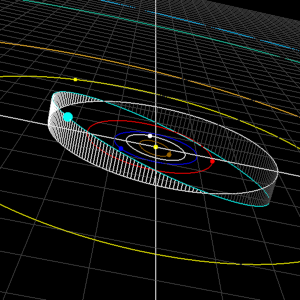
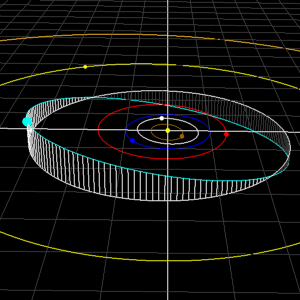
These two main-belt objects, discovered on the same night in 2003, were named by the discoverer (Felix Hormuth, a German amateur astronomer) for his mother and father.
Gunda is about 1 km in diameter and orbits the Sun every 5.2 years in a somewhat eccentric (e = 0.207) orbit inclined 15° to the ecliptic plane. Heinz is about 1 km in diameter and orbits the Sun every 5.3 years in a low-eccentricity (e = 0.119) orbit inclined 13° to the ecliptic plane.
Interactive Orbit Diagram for (721153) Interactive Orbit Diagram for (721154)
(858334) Gioacchinopecci
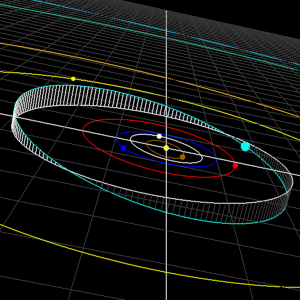
This was a slightly unusual naming, as it was named for Gioacchino Vincenzo Raffaele Luigi Pecci (1810–1903), who is better known as Pope Leo XIII. While there are rules preventing naming asteroids after living religious figures, historical cases are handled on a case-by-case basis. Leo was accepted as he had a great interest in the sciences and was responsible for the re-establishment and reform of the Vatican Observatory in 1891 within the walls of the Vatican. He also encouraged the Observatory to get involved in the Carte du Ciel project, a long-term photographic survey of the whole sky begun in 1887. The Carte du Ciel is worthy of a longer article at some point in the future. Černis was a co-discoverer of this main-belt object in 2012.
Gioacchinopecci is about 700 m in diameter and orbits the Sun every 5.2 years in a low-eccentricity (e = 0.085) orbit inclined 9° to the ecliptic plane.
Interactive Orbit Diagram for (858334)
(870437) Leilani
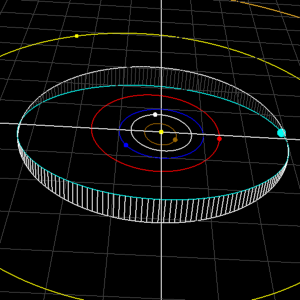
Another main-belt object, discovered in 2017 by the COIAS team observing from Maunakea, is named after the community in the Puna district of the Island of Hawaiʻi that suffered extensive destruction during the 2018 Kīlauea eruption.
Leilani is about 700 m in diameter and orbits the Sun every 5.6 years in a low-eccentricity (e = 0.053) orbit inclined 11° to the ecliptic plane.
Interactive Orbit Diagram for (870437)
Other names
As usual, many of the new names were of professional and amateur astronomers from all over the world.