
The Lesser Lion
Wedged between the more prominent constellations of Ursa Major and Leo, Leo Minor’s “space” on the sky was regarded by Ptolemy as “unformed” (as it had no bright stars). This didn’t stop later uranographers from carving up the sky (mostly to help produce their “new and improved” atlases) coinciding with the Age of Exploration (where the Southern Hemisphere skies were charted with their own constellation additions) crafting constellations out of those “unformed” regions.
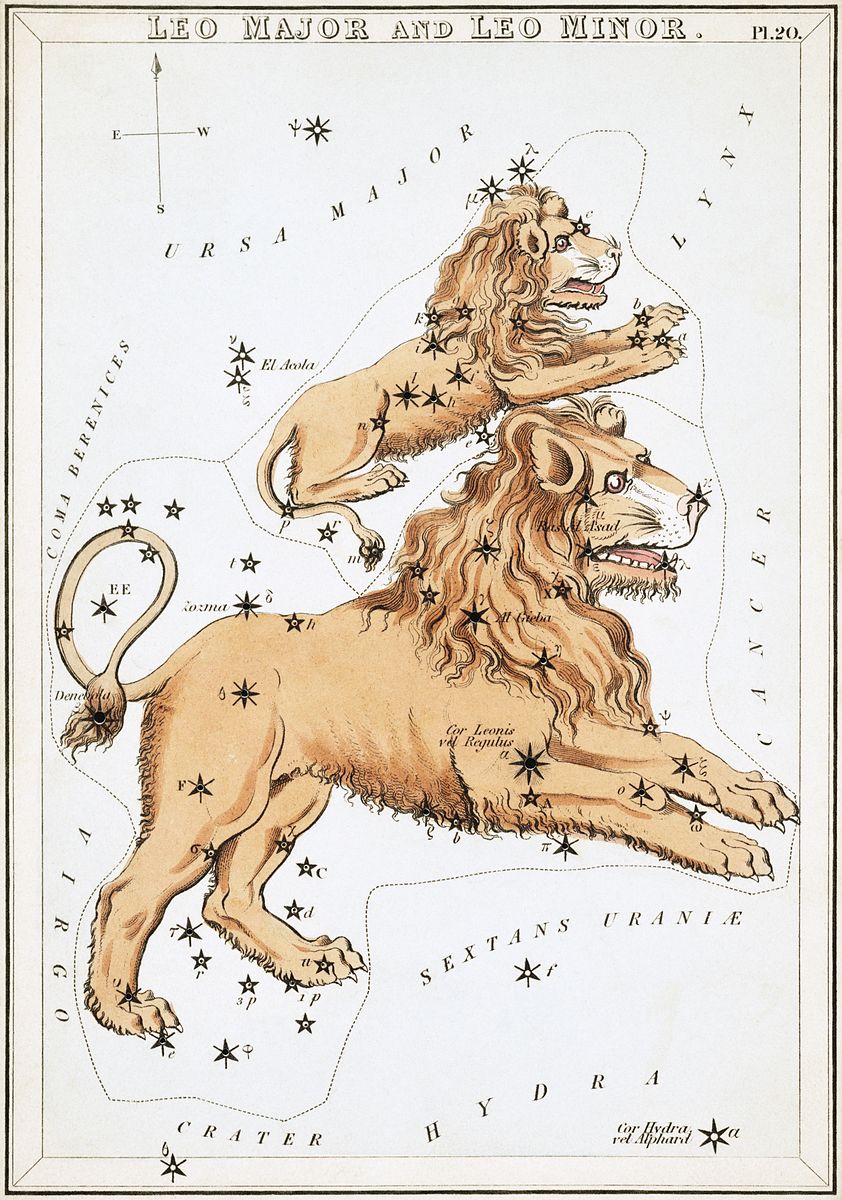
Leo Minor is one of these early “new” constellations, introduced by Hevelius in 1687, along with nearby Canes Venatici (the Hunting Dogs), Lynx (the Lynx), and Sextans (the Sextant), and by the time the International Astronomical Union set down the “official list” of the 88 constellations we now know, Leo Minor had been recognized for over two centuries, and therefore “made the cut”.
However, earlier - briefly - this part of the sky a small part of another defunct constellation “Jordanus”, suggested by Plancius in 1612, supposedly depicting the River Jordan, and managed to show up on a few celestial globes and maps of that time. Jordanus didn’t last long, probably for a couple of practical reasons: first it snaked all the way from Camelopardalis to Canes Venatici, underneath Ursa Major, so it really didn’t “define” an area of the sky, so much as it was forced into it, and there was the possibility of confusion with the “other” river constellation, Eridanus (which also snakes along, but mostly North to South). In any case, by the late 17th century, Jordanus was forgotten, and Leo Minor claimed its dim spot in the Northern skies.
Typical depictions of the two lions, since their constellations share a common boundary, make Leo Minor seem more of a “cub” than simply a “lesser” lion.
Map of Leo Minor
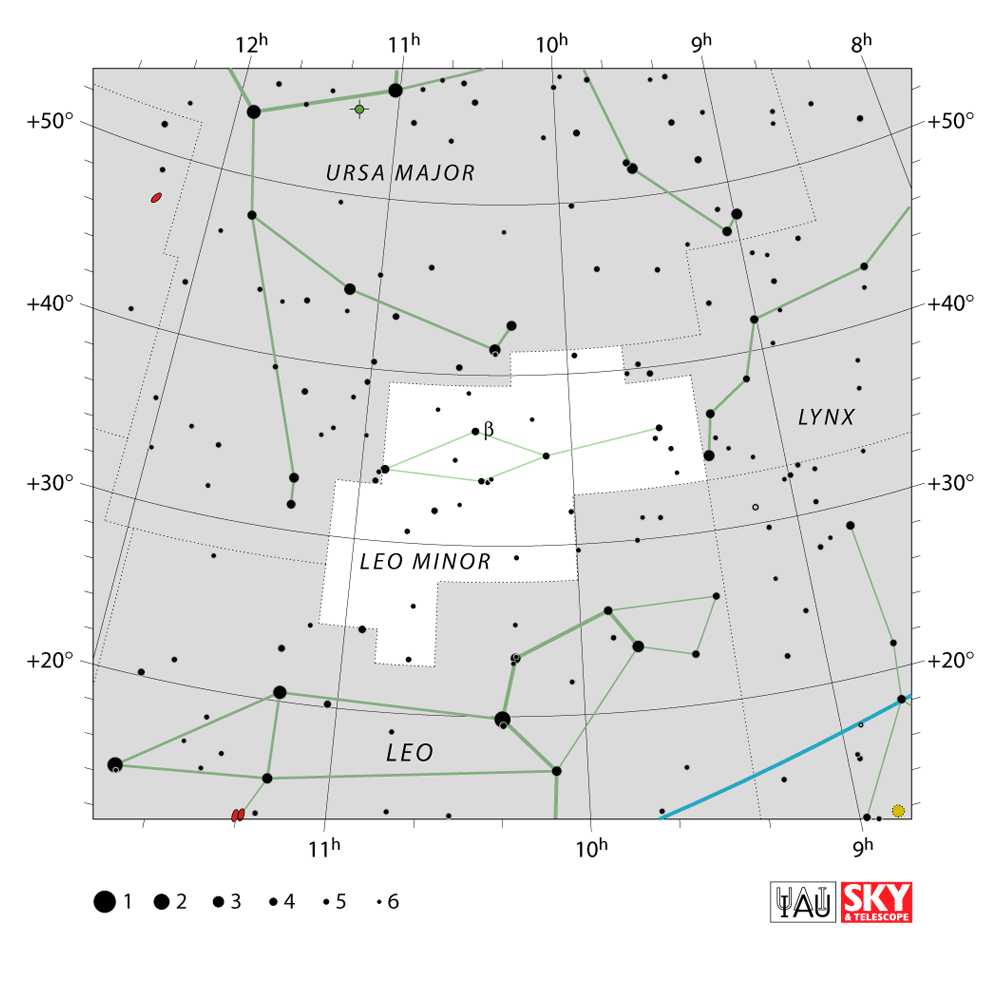
The “stick figure” representation of Leo Minor typically has a rough diamond (or warped parallelogram) shape with a “paw” extending to the West: the “cartoon” representation (as seen on the previous page) usually has the “lesser lion” oriented in the same direction as the “greater lion”, Leo, below it. (Most depictions of Ursa Major to the North also have the bear facing West.)
Only one bright-“ish” star in Leo Minor (at this time) has a proper name: 46 Leonis Minoris was bestowed the name Praecipua by the IAU (who has recently taken on the task of making “official” lists of star names, for some reason) — which is also the brightest star in the constellation. For whatever reason, Bayer did not give it the designation Alpha. On the map above, it’s the star on the Eastern corner of the diamond (on most star maps, as here, North is “up” and East to the “left”, almost touching the border of Ursa Major.
Leo Minor contains the radiants of two very minor meteor showers: the Leonis Minorids in late October (coincident with the more active Orionids) and the December Leonis Minorids in late December (competing with the Ursids). In both cases these would be noticeable only from seeing stragglers away from the more- active showers (and in the early morning hours).
But while to the naked eye Leo Minor is somewhat lackluster (to say the least), this region of the sky becomes far more interesting telescopically. Here, we’re looking away from the plane of the Milky Way, which means galaxies, and in this, Leo Minor does not disappoint!
Quick Reference: Objects of Interest
| Object | Type | Equipment |
|---|---|---|
| NGC 3486 | Spiral Galaxy | Small/Medium Telescope |
| NGC 3003 | Edge-On Galaxy | Medium/Imaging Telescope |
| NGC 3344 | Spiral Galaxy | Small/Medium Telescope |
| NGC 3395/6 | Interacting Galaxies | Medium/Imaging Telescope |
| NGC 3432 | Edge-On Galaxy | Small/Medium Telescope |
| 0ΣΣ 104 | Asterism | Binoculars/Small Telescope |
Seyfert Galaxy
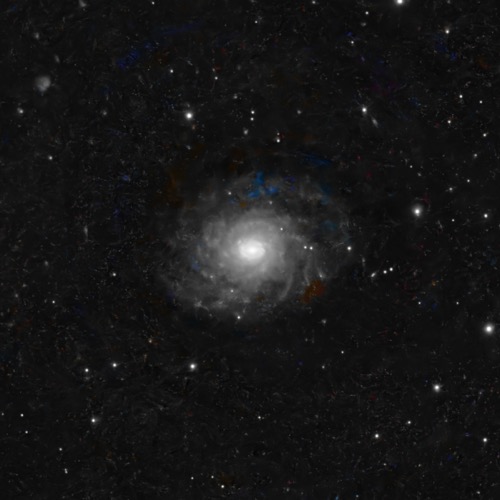
This nearly face-on barred-spiral galaxy is classified as a Seyfert galaxy, i.e., one with a nucleus whose brightness dominates the galaxy as a whole. It probably hosts a supermassive black hole at its center, though one that only that’s only 1 million times the Sun’s mass (ours is 4.15 million solar masses). It has several thin, loosely wound spiral arms that are “knotty” with star-forming regions.
An Almond-Shaped Bulge
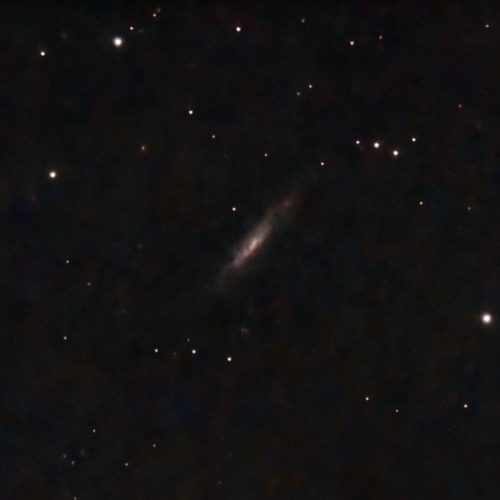
Another barred-galaxy (though the bar is hard to see), NGC 3003 is nearly edge-on whose star-formation regions are definitely asymmetric (most are on the W side, though there’s a region on the opposite side in a faint spiral arm that looks “detached” from the rest of the galaxy. It’s just under 64 Mly away.
The “Sliced Onion”
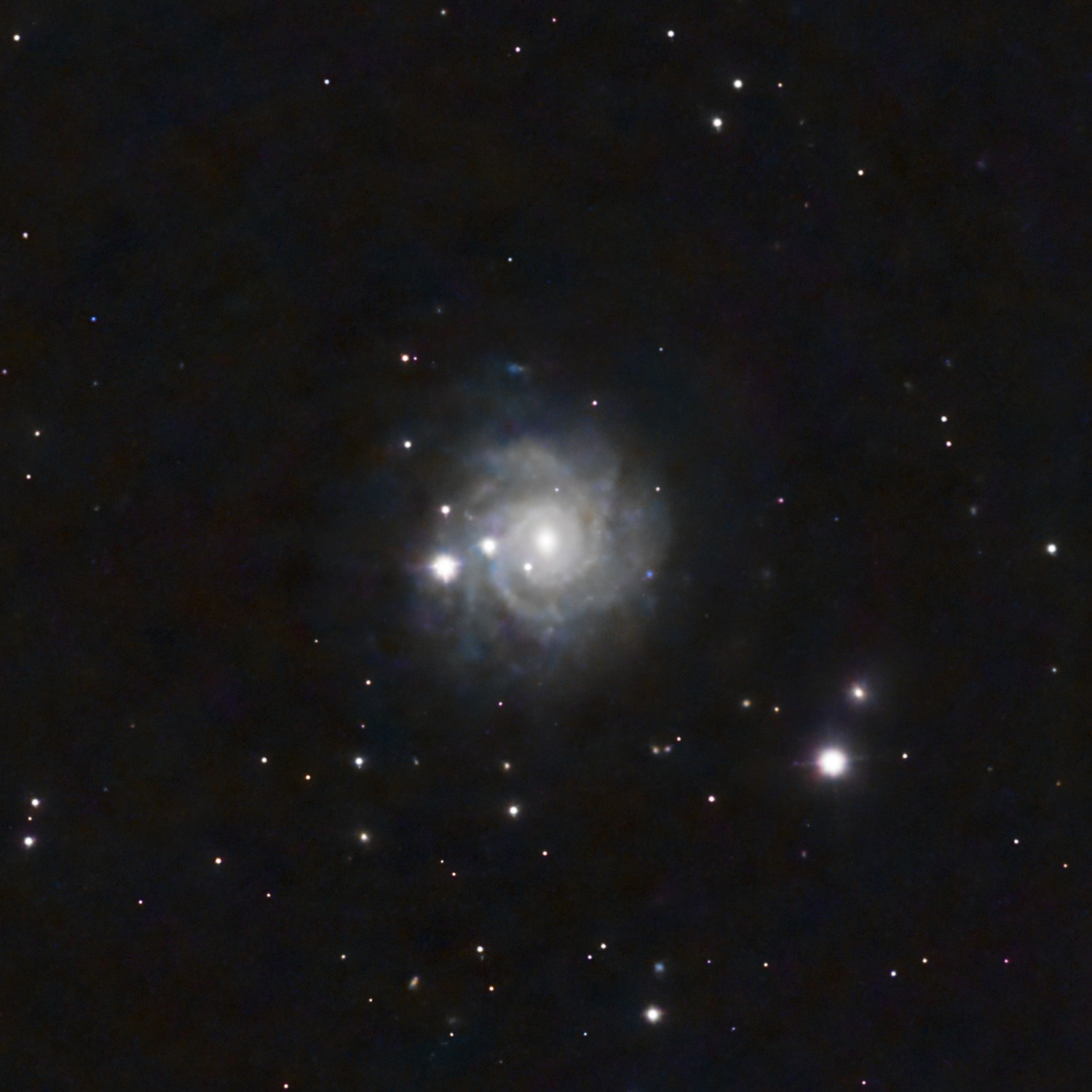
This double-ringed galaxy has a high star-formation rate in clusters all along the spiral arms. The very faint outer ring is asymmetric and not centered on the nucleus, which is odd because it doesn’t appear to have interacted with any other galaxy: in fact, its isolated with its closest neighbor NGC 3274 (almost 23 Myr away or roughly 10x the distance between our Galaxy and Andromeda). How the outer ring was formed (and how long it will last) is a mystery.
Spectacular Interacting System
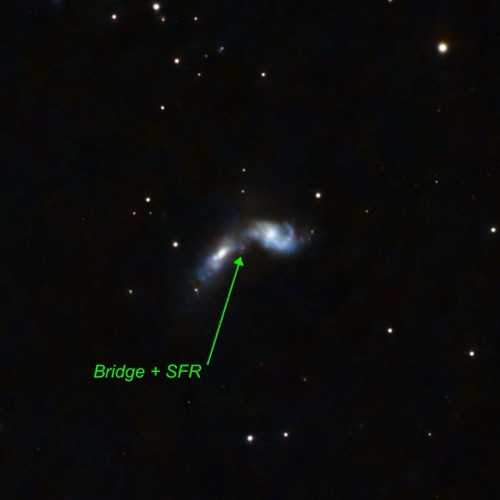
NGC 3395/3396 (Arp 270) are clearly interacting, and in an ongoing “relationship”: they appear to have had a collision event about 0.5 Gyr ago, and based on their motions will likely have another one in about ~50 Myr. They’re connected by a “bridge” with nebulous star-forming regions: you can see a hint of one in the image just below and to the left of where the two galaxies intersect.
“Knitting Needle”
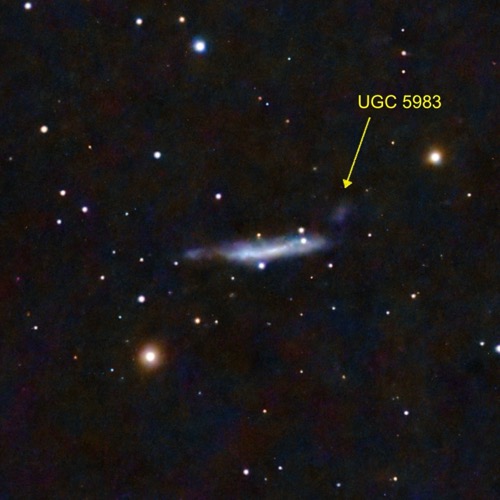
This interacting galaxy is 37 Myr away (with UGC 5983 off the right side) and in a “pre-starburst” phase, with is substantial star formation already underway (though still at a lower rate than the Milky Way). Very faint tidal streams connect it to the companion. A “false supernova - SN 2000ch - was recorded, but subsequent outbursts showed it was actually a Luminous Blue Variable (similar to S Doradus and Eta (η) Carinae): a very rare type of star (there are only a handful known in our own Galaxy, and S Dor itself is actually in the LMC). These stars show extremely energetic outbursts, losing significant mass and will eventually have that final explosion as a supernova.
Nice Grouping
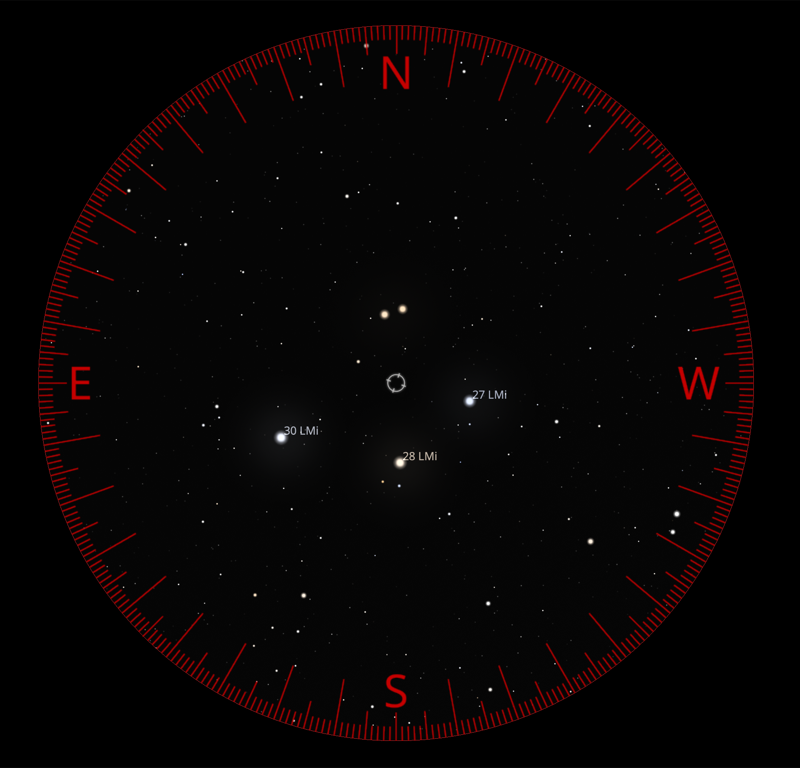
In binoculars or a small telescope this grouping of five stars is a nice find. Of particular interest is the double star at the “top” which has the jumbled designation of OΣΣ 104. This comes is from the catalogs of Otto Struve (and here, the double Sigma indicating his supplemental catalog of double stars). The Struve family contained five generations of astronomers and their names show up in several double star catalogs (using the capital sigma, Σ, to represent the family name).
These stars aren’t physically connected, but form a nice “clumping” of stars in our line of sight.