Introduction
Where you observe sometning in the sky, it’s sometimes important to consider it’s position in the sky relative to the horizon.
Altitude and Azimuth
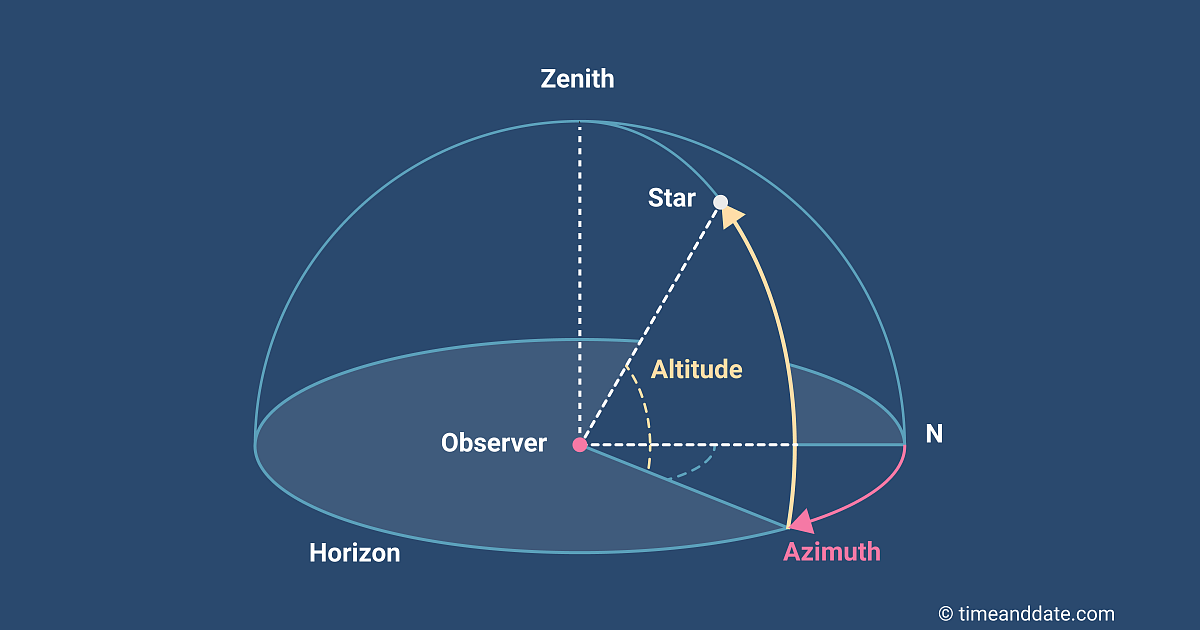
Unlike the others, this system is completely dependent on the observer’s location, and the date and time. Why it’s useful is that - it relates to the observer’s location and the date and time.
Altitude
Altitude is simple - it’s how many degrees above the horizon and object lies at that instant. Overhead is 90°. (Also, the declination at the zenith is equal to your latitude.)
Azimuth
Azimuth is basically the compass heading: North is 0°, East is 90°, South is 180°, and West is 270°.
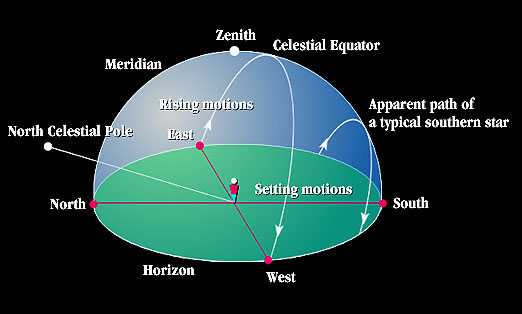
Objects with low declination never rise very high above the horizon: (if you love the math, $ Alt_{max} = 90° - | L - \delta | $ where $L$ is the observer’s latitude and $\delta$ is the declination of the object). That’s why when the Moon and planets are in the ecliptic constellations like Scorpius and Sagittarius, they’re not close to overhead like they are with Taurus and Gemini (from the Berkshies).
That also means that objects with very high declinations (more math: those with $| \delta | \ge 90^\circ - |L|$ - or anything north of +47.3° here in the Berkshires) never rise or set: they’re circumpolar. At the equator, nothing is circumpolar; at the North or South poles, everything is circumpolar.
And - you may have guessed - objects that are far south (below -47.3° declination) never come up over the horizon. So we’ll never get to see the Magellanic Clouds, or the Southern Cross, or Alpha Centauri. 😕 (But our Southern Hemisphere counterparts never get to see the Big Dipper, either.)
Air Mass
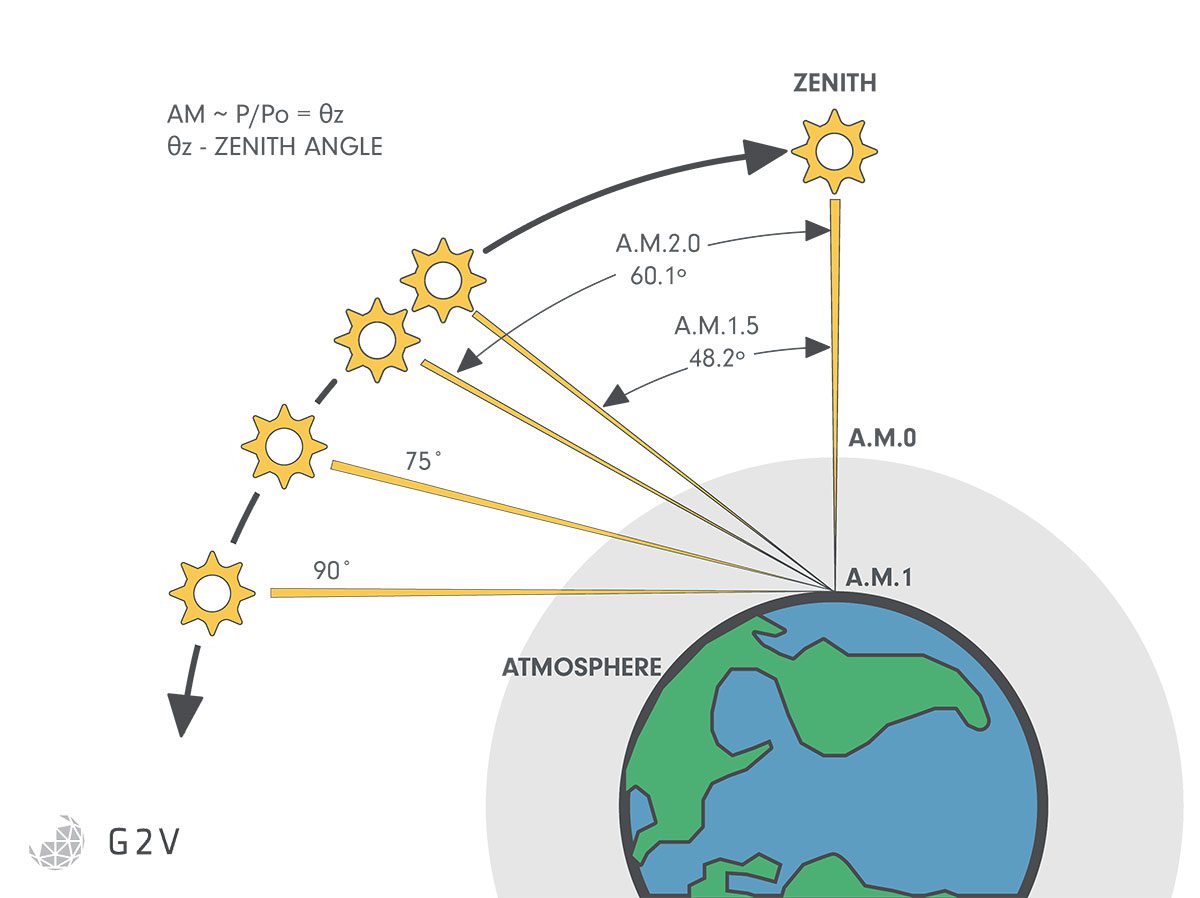
Think of it this way. When you’re standing on a globe and looking “up” you are looking through one air mass, the atmosphere and into space. But if you’re not looking straight up, that means you’re looking “out” but at an angle so the light you’re seeing has to travel through more atmosphere — more airmass to reach you.
As you get closer to the horizon, that’s a lot of atmosphere, and the fainter stars get pretty much attenuated along the way.
(Here comes the math: this can be modeled with sec(z) where $z$ is the distance from overhead or sec (90°-Alt.)". The “sec” is for secant and you might remember that’s the inverse of the cosine, so it’s also $1. / \cos(z)$.) When $z$ = 0° that’s sec($z$) = 1. As $z$ approaches 90° (the horizon) sec($z$) blows up going to infinity (which I suppose “the ground” pretty much does the job).
But at what point are you looking through 2 airmasses? 30° altitude, or 60° down from zenith. 4 airmasses? 14.5° altitude (or 75.5° down from zenith).
Atmospheric extinction
Another important consideration — especially for astronomical imaging is extinction. The closer an object is to the horizon, the thicker the atmosphere, which causes low objects to appear fainter. How much fainter? On average for visual observing it’s about 0.15 – 0.20 magnitudes per airmass. That doesn’t like much but for faint extended objects like nebulae and galaxies, it can have a profound effect.
So your 3rd magnitude star only 15° above the horizon will be almost a magnitude fainter than if it’s overhead. And that’s assuming completely dark skies: light domes from cities, and light pollution overall will decrease that more.
It’s also wavelength dependent: blue light suffers greater extinction than red; you already see this with every sunrise and sunset with the red solar disk as it hugs the horizon. Blue and violet light scatter more in the atmosphere (Rayleigh scattering) - it’s why the sky is blue - and it’s also way distant objects like mountains or city skyscapers look bluish.
Airglow
Astronomical airglow is a faint, natural luminescence of the Earth’s upper atmosphere caused by chemoluminescence, where atmospheric gases (oxygen, nitrogen) emit light—primarily green and red—after being excited by solar ultraviolet radiation during the day, ripping apart molecues that recombine at night, releasing energy. It occurs globally at all times, peaking at 90 – 100 km altitude, and is roughly 40% brighter during solar maximum.
This shouldn’t be confused with the aurora, though both happen in the upper atmosphere. The difference is that aurorae are powered by solar wind particles hitting Earth’s magnetic field.