
Introduction
Almost as soon as you start looking at the sky, or planning observations you’re confronted with a series of terms, and enough geometry that you’re immediately re-living high-school math class. Here’s some explanation as to what some of these terms mean and why they’re useful/important.
Coordinate Systems
In astronomy there are three coordinate systems that are used:
Equatorial: based on the celestial poles and the equator. These are defined by the rotation of the Earth, where “up” or “down” corresponds to the point in the sky above/below the North and South Poles. In the North that location is very close to the position of Polaris, the “North Star” (Southern Hemisphere observers aren’t quite as fortunate: the “South Star” is σ (Sigma) Octantis, which is barely visible to the naked eye.
This the system you’ll mostly deal with for amateur observations.
Ecliptic: based on the Earth’s orbit around the Sun. All the planets and the Moon move along the Ecliptic (mostly) though because each planet/Moon has it’s own orbital inclination, they might be slightly above or below the Ecliptic. Like the Equatorial system, there are also North and South Ecliptic “poles” (the North in Draco, and the South in Dorado).
For observing, this is mostly helpful in measuring things like elongations of the planets and other solar-system objects (comets and asteroids) from the Sun (how many degrees they are from the Sun’s position).
Galactic: based on the plane of the Milky Way.
For observing we don’t think about this too much: but it’s a little helpful in understanding why certain types of objects tend to have low “galactic latitudes” or high ones.
Open clusters and most nebulae tend to be in the disk of the galaxy, so you’ll find them closer to the Milky Way; galaxies are all over, but harder to see if they’re at low galactic latitudes: the Milky Way is “in the way”!
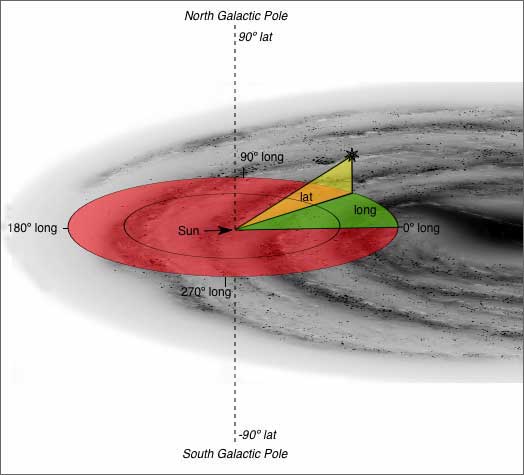
Globular clusters are slightly different: they tend to cluster close to the Milky Way, when you’re looking “inward” during the Summer because you’re looking “toward” the center, but above or below the plane. Since the Sun is out in the spiral arms of the galaxy, these clusters are mostly found surrounding the Milky Way’s bulge. (But there are always exceptions.)
The North Galactic Pole is in Coma Berenices, the South in Scluptor, and it’s not surprising to find that around those constellations you find many more galaxies then in the constellations closer to the Milky Way (though they’re there too - just harder to see).
How they’re All Arranged and Defined
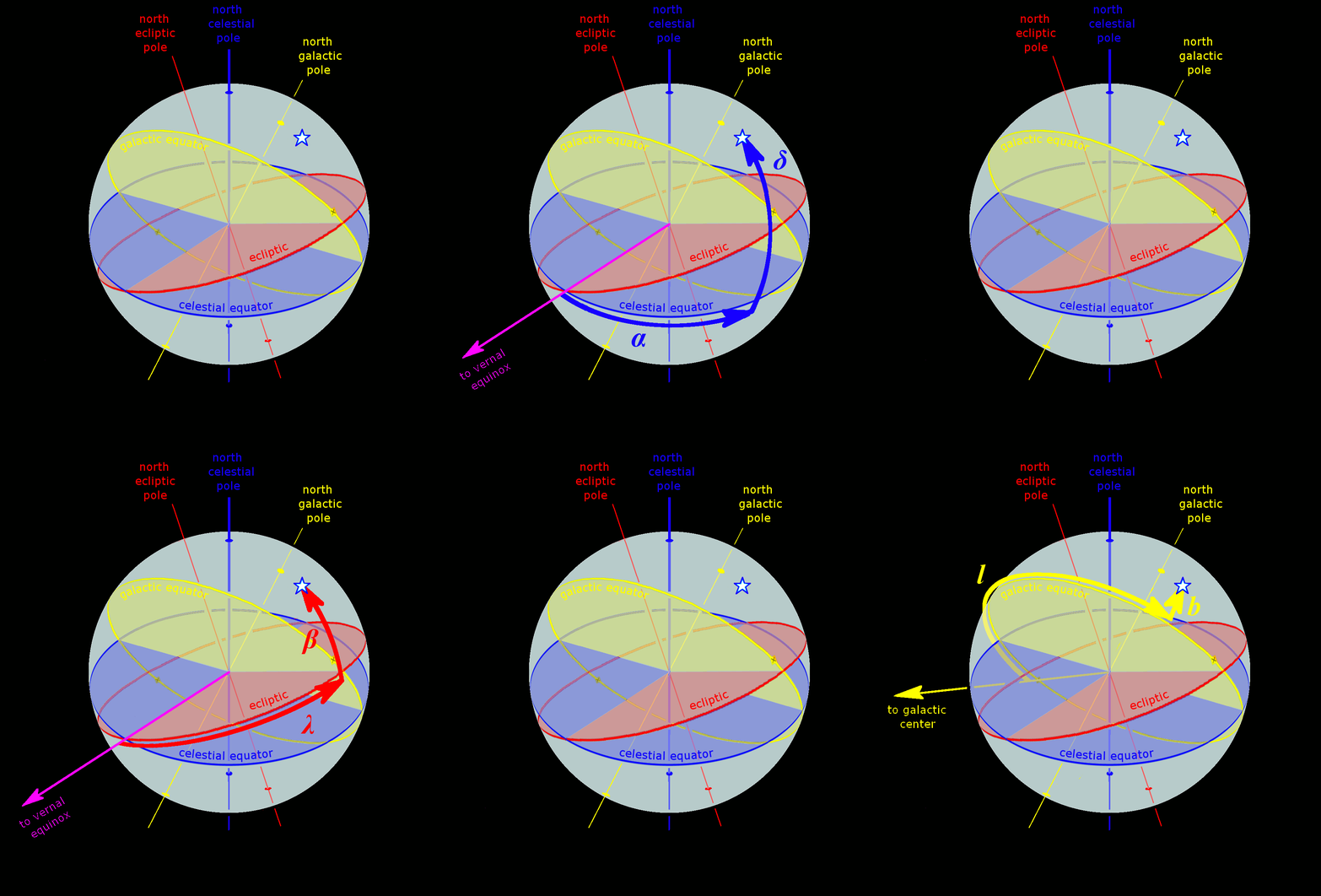
So each of them a have an equator and poles, and like latitude and longitude defining locations on the Earth, each has a latitude and a longitude:
And like latitude and longitude they’re measured in degrees: 0°to 360° for longitudes, and -90° to +90° for latitudes.
With one exception.
Right Ascension is measured in hours (0h to 24h). How does THAT work?
Why is Right Ascension measured in time and not degrees?
The reason for this is because the Earth is rotating. Before telescopes with clock drives and tracking, astronomers mostly set up their telescopes pointing South (or North in the Southern Hemisphere) and moved then up or down in altitude. Then they could take measurements of an object’s position based on how far it was from the horizon (the altitude, measured in degrees from 0° to 90° overhead), and just wait for objects to cross the meridian in front of the eyepiece’s field of view.
So, one rotation = 24 hours. Easy.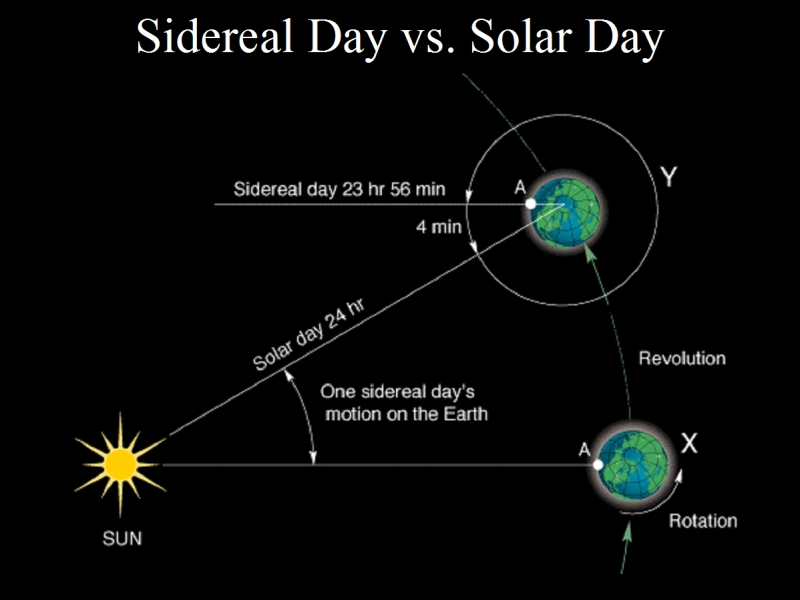
But that’s not right either! In that 24 hours, the Earth has also moved around the Sun a bit, so that if you observed a star at precisely 10:15:27.3 PM on one night, it wouldn’t cross at the same time the next night. In fact, it’d happen 3m 56s earlier.
What is the Vernal Equinox?
Latitude is easy because there are specific points for the poles: once you know where they are, you can measure the angular distance from either pole and confidently know you latitude. Just like on the sky with latitudes or declinations.

For the Galactic coordinate system that 0° point is defined as the Galactic Center, though no one knows exactly where that is, but they have a good idea, and astronomers have just agreed on one location that’s “close enough”.
For the other two 0° (and 0h) is in the same place. It’s where they intersect, defined by the point where when the Sun is in that position, days and nights are equal: in other words the instant Spring begins.
You’ll have noticed from the diagram that all three systems are at angles to each other: 23.44° between the Equatorial and Ecliptic systems, and 62.6° between the Equatorial and Galactic planes. The first is due to the tilt of the Earth axis. The second is the “tilt” between solar system and the Milky Way itself. Because the planets (and in particular the Earth) formed in a disk around the Sun, how that disk was tilted with respect to the Galaxy at-large is random.
What do you mean the coordinates are shifting?
As if things weren’t complicated enough, all the coordinates you measure are changing. Very slowly, but changing.
You might’ve read that Polaris hasn’t always been the North Star, and the location of “North” with respect to the background stars changes over time. This is the 26,000-year precession of the Earth’s axis - the “wobble” that it has.
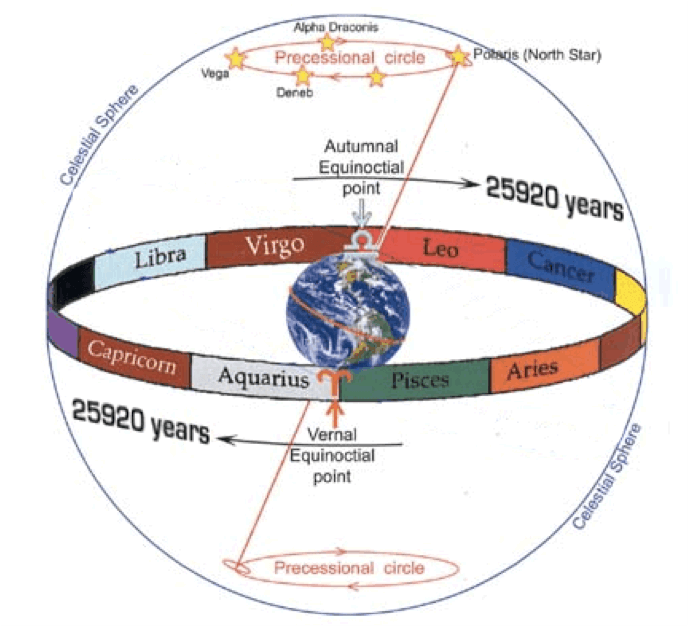
What this does is it moves that Vernal Equinox point westward over time. Right now it’s in Pisces. It used to be in Aries (and sometimes you’ll hear referred to as “the First Point of Aries” because that’s where it was about 2000 years ago), and eventually (a little over 500 years from now) it’ll move into Aquarius.
But because of that shift, and because the equatorial 0h location is also tied to that point, all the RA and Dec coordinates are changing all the time! To get around that astornomers refer all the Equatorial and Ecliptic coordinates to an epoch. These days 2000 is used, before that it was 1950, then 1900, and then 1875. (No idea what the plans are for 2050, if any).
And of course that’s not the only thing that affect’s a star’s coordinates! They’re also moving around the Galaxy in their own orbits, so there’s drift there too over time (most noticeable for the stars closest to the Sun). But that’s for another article.