New names of minor planets are announced in the WGSBN Bulletin, which is published every three weeks by the International Astronomical Union’s Working Group Small Bodies Nomenclature. The latest issue contains 35 new names. Below is information on some interesting new names contained in this issue.
If you click on the “Orbit diagram” links below, you will be taken to an interactive orbit page, where you can see the current locations of each asteroid and the major planets.
(30578) Lawless
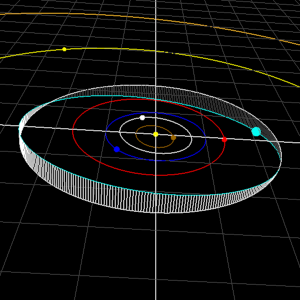
This main-belt object was discovered in 2001 by the Lowell Observatory Near-Earth-Object Survey at the Lowell Observatory in Arizona. It is named after the New Zealand actress Lucy Lawless, best known as the title character in the TV series Xena: Warrior Princess. She also portrayed a humanoid Cylon in the rebooted Battlestar Galactica TV series.
Lawless is about 3 km in diameter and orbits the Sun every 4.0 years in a very-low-eccentricity (e = 0.039) orbit inclined 9° to the ecliptic plane.
Interactive Orbit Diagram for (30578)
(79871) Earthrise
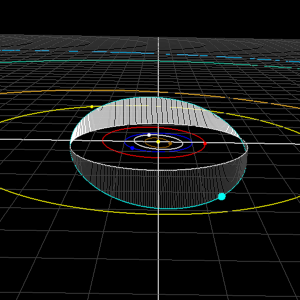
A somewhat unusual naming. This object is named after a photograph. The iconic photograph of Earth taken from lunar orbit by astronaut William Anders during the Apollo 8 mission that was the first to orbit the Moon. The Earthrise photograph has been credited as one of the inspirations for the first Earth Day in 1970. This mid-main-belt object was discovered by the Catalina Sky Survey at Mount Bigelow.
Earthrise is about 4 km in diameter and orbits the Sun every 4.2 years in a low-eccentricity (e = 0.070) orbit inclined 22° to the ecliptic plane.
Interactive Orbit Diagram for (79871)
(152341) Rupesnigra
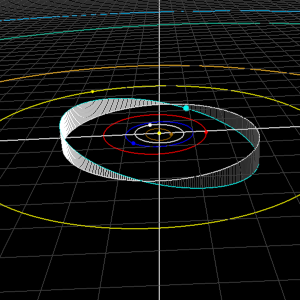
Another unusual naming. Rupes Nigra was a black rock believed to be located at either the North Magnetic Pole or the geographical North Pole. The rock was supposed to be magnetic, providing a supposed explanation for why compasses point north. The idea came from a now-lost work titled Inventio Fortunata, believed to have been written in the mid-14th century, but lost by the 1490s. It appeared on maps into the 17th century. Rupesnigra is an outer-main-belt object discovered by the Catalina Sky Survey at Mount Bigelow.
Rupesnigra is about 2 km in diameter and orbits the Sun every 5.0 years in a low-eccentricity (e = 0.064) orbit inclined 13° to the ecliptic plane.
Interactive Orbit Diagram for (152341)
(280924) Eurypterus
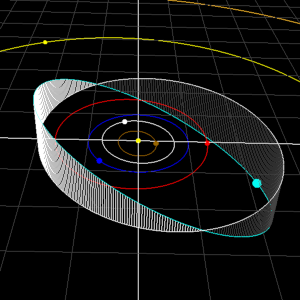
This is another unusual naming. The mid-main-belt object is named after the extinct genus of sea scorpion from the Silurian period, about 430 million years ago. The species Eurypterus remipes, which is the most common Eurypterus species, became the official state fossil of New York in 1984. The object was discovered in 2006 by the Catalina Sky Survey at Mount Bigelow.
Eurypterus is about 2 km in diameter and orbits the Sun every 4.4 years in a moderately-eccentric (e = 0.170) orbit inclined 28° to the ecliptic plane.
Interactive Orbit Diagram for (280924)
(666312) Aroneisenberg
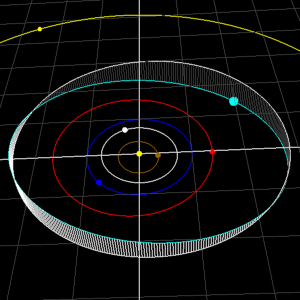
This mid-main-belt object has been named for the American actor Aron Eisenberg (1969-2019), best known for his seven-season stint on Star Trek: Deep Space Nine as the Ferengi Nog, son of Rom and nephew of Quark. The character developed from a youthful troublemaker into the first Ferengi to join Starfleet, where he excelled as a cadet and as an officer. Nog was the main character in the episode “It’s Only a Paper Moon”, in which he retreats into a holodeck program to cope with his PTSD as a result of losing a leg in an earlier episode. The object was discovered in 2010 by the Mount Lemmon Survey at Mount Lemmon.
Aroneisenberg is about 700 m in diameter and orbits the Sun every 4.2 years in a moderately-eccentric (e = 0.149) orbit inclined 12° to the ecliptic plane.
Interactive Orbit Diagram for (666312)
Other names
As usual, many of the new names were of professional and amateur astronomers from all over the world.
An odd coincidence…
You may note, if you look at the orbit diagrams on this page, that all five asteroids highlighted here are located south (or below) the ecliptic plane at the time this article was posted. Since an asteroid spends about one half of its orbit above and one half below the ecliptic planet, the chances of five random objects all being below (or above) the ecliptic is 1/(2^5) = 1/32. I said “about” in the previous sentence because the exact half/half split is true only for asteroids in perfectly circular orbits or where the perihelion point lies in the ecliptic plane. Objects that do not match either of those conditions will spend more time on one side of the ecliptic plane, specifically the side where the aphelion point lies. But for the sort of eccentricities encountered in asteroid orbits, the difference from an exact half-half split is not great. So 1/32 is a reasonable estimate for the probability.