
Introduction
Of the generally accepted dwarf planets, Ceres is the only one that’s within reach of most amateur optical telescopes.
With the smart scopes on the market, however, it becomes possible to reach out to the Kuiper Belt on the hunt for a few of these dim, remote, icy worlds.
Pluto is actually an easy target for these scopes (and we’ll get to it later in the summer). Right now, however, the next two brightest objects: Haumea and Makemake are within reach of many of smart scopes, though it might take some patience!
The Realm of the Dwarf Planets
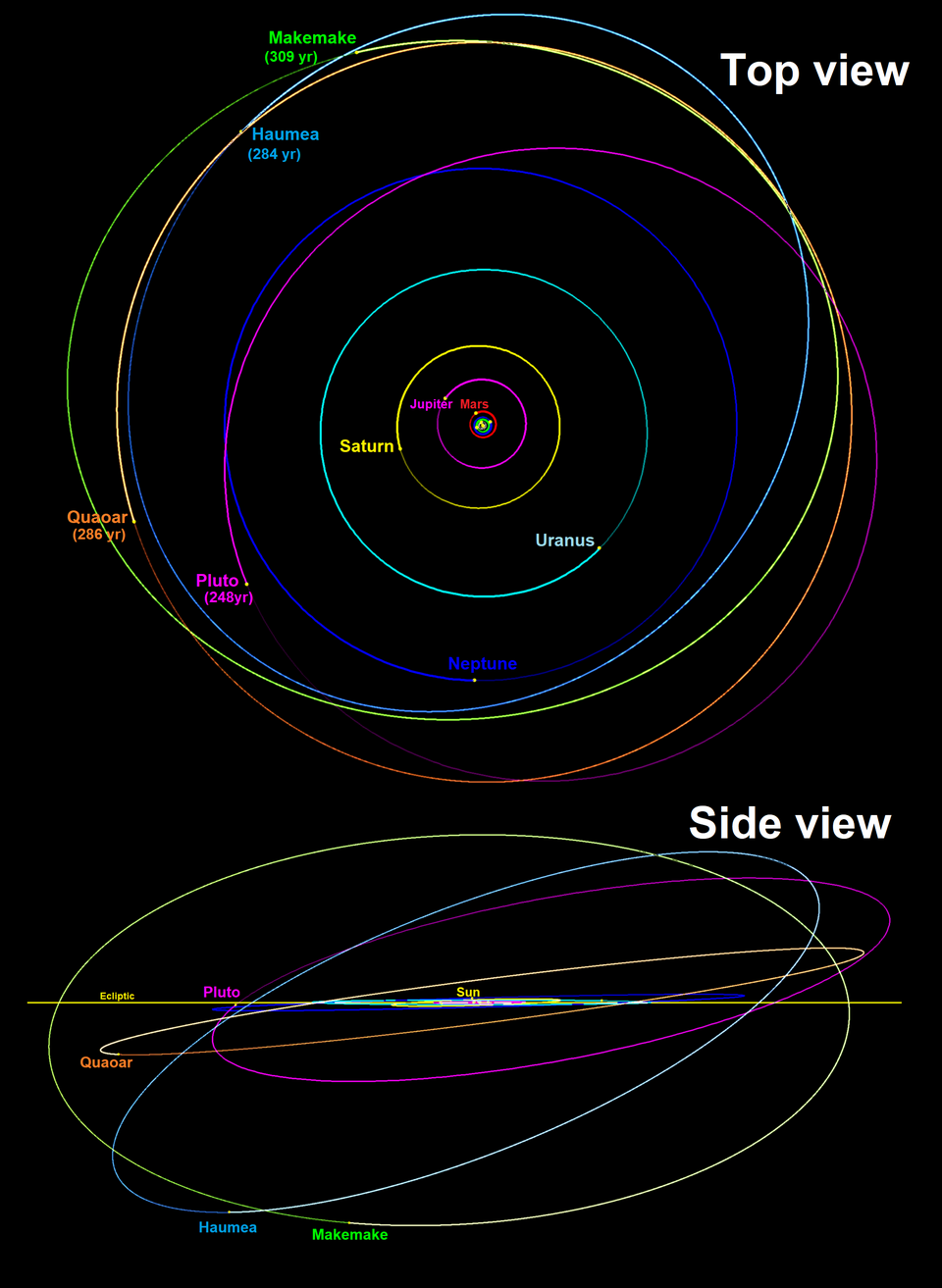
Out in this part of the solar system, we’re looking at objects whose orbital periods are in the range of over ~250 years. High inclinations and eccentricities are also common: these orbits suggest a turbulent history — gravitational interactions with the giant planets, particularly Neptune, scattered them into their current trajectories billions of years ago. Many are locked in orbital resonances with Neptune, Pluto being the most famous example in a 3:2 resonance. Compositions are dominated by water ice, methane ice, and nitrogen ice, with thin transient atmospheres in some cases that freeze out as they recede from the Sun.
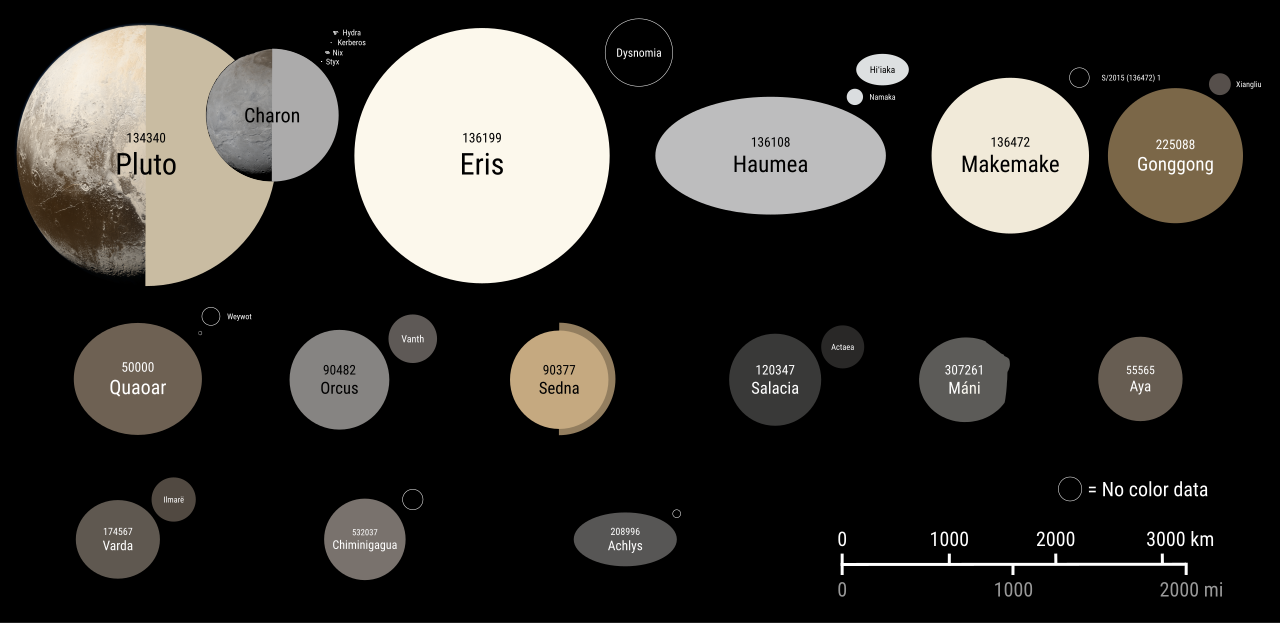
In terms of size, it’s evident how quickly these “planets” approach the sizes of some of the middle-sized moons of Saturn and Uranus. Regardless of anyone’s personal take on “Is Pluto a planet?”, it’s clear that these small bodies constitute a class to themselves, and further study of them will undoubtedly uncover a wealth of knowledge about the history of the Solar System.
Haumea - a very strange planet
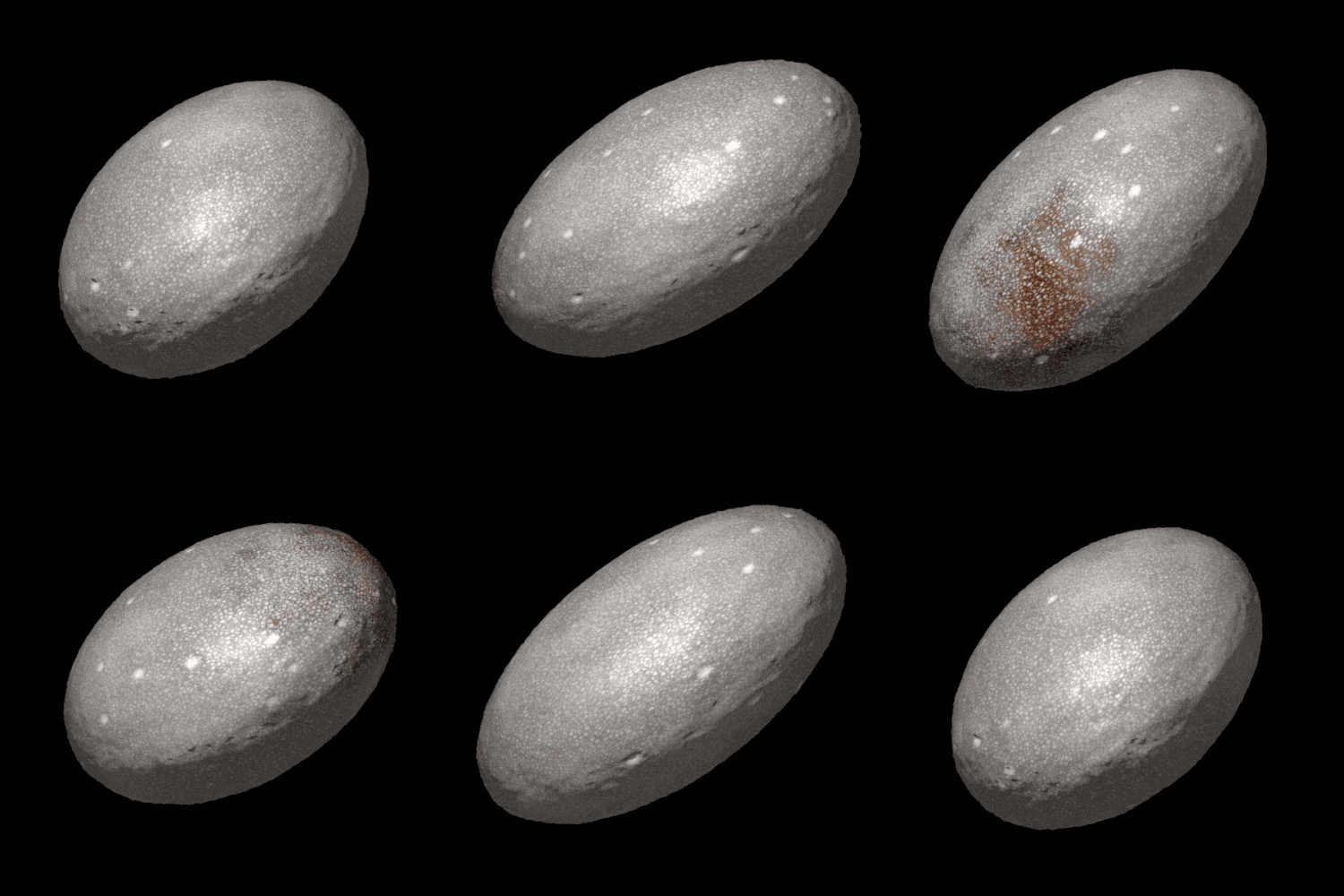
Currently and slowly crossing through Boötes, Haumea is a 17th magnitude object at opposition. While almost every planet can boast several “cool facts” about them, Haumea is definitely an oddball:
- it’s clearly ellipsoidal: it’s twice as long as it is high, and 60% wider (2100 x 1680 x 1074 km);
- it has a rotation period just under 4 hours;
- it has an eccentricity of 0.196 so it’s distance from the Sun varies from 34.6 to 51.6 AU with a period of 283.12 years;
- the orbital inclination is 28.2° higher than Pluto;
- it has two small moons;
- it has a ring (much closer in than the moons).
Measurements of its change in brightness in different colors shows there’s a brownish “spot” on the surface; otherwise it’s sort of a snowy white (not as reflective as some of Saturn’s moons, but definitely covered in ice).
Some of its oddities suggest that it was involved in some sort of collision in the “recent” past - about 100 Myr ago. The orbits and physical characteristics of over 20 Trans-Neptunian objects are close enough to Haumea to suggest that they were all part of a larger body; there are also identified “collisional familes” in the Main Belt - Haumea is the largest member of this “family”, the first found in the Kuiper Belt.
Still it definitely belongs in the class of dwarf planets: over 500 Haumeas could fit within the Earth (or 11 within our Moon).
I was able to catch it with my eQuinox2 rather handily: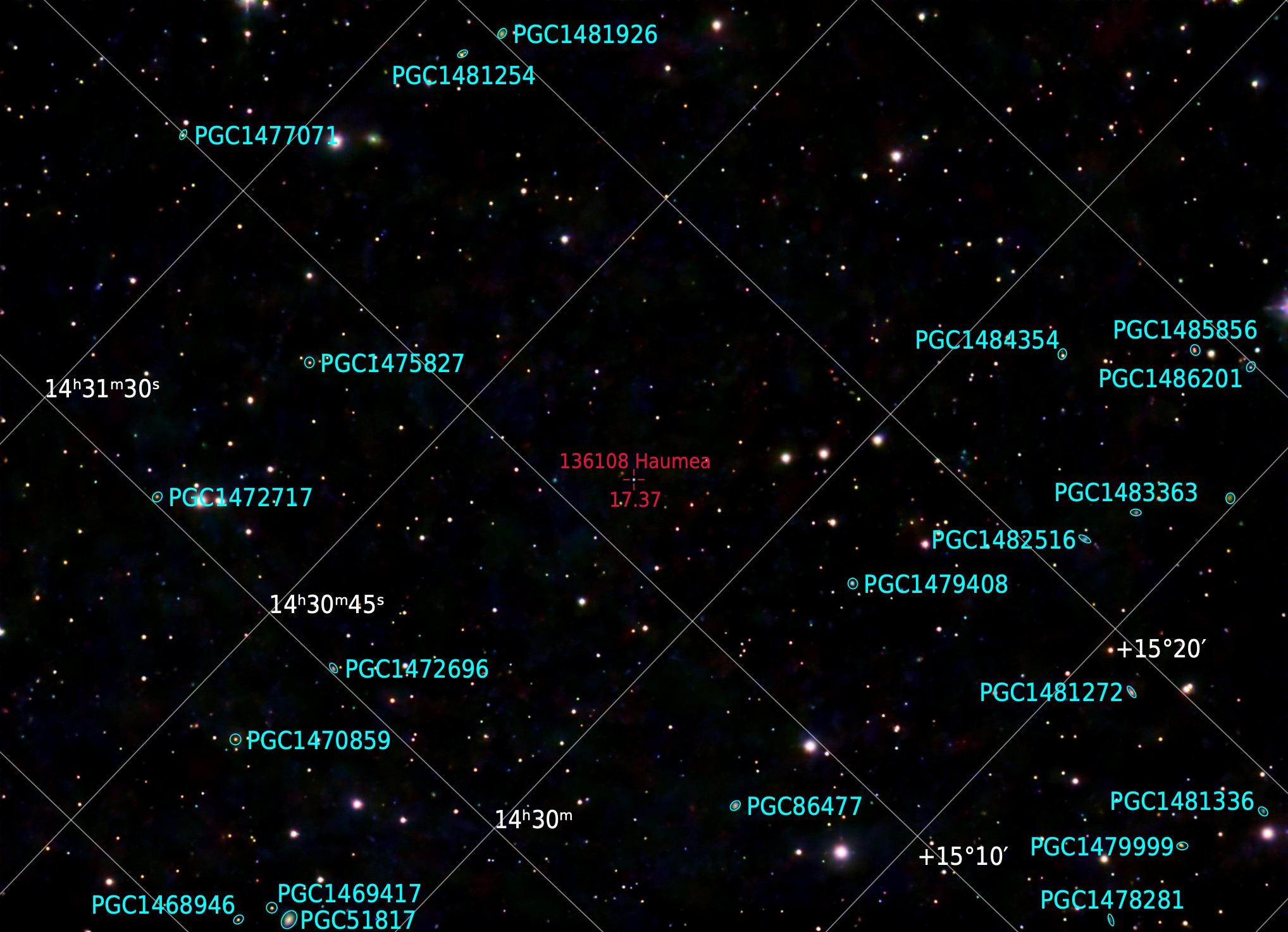
Despite it being so small and faint such that it will only look like a dim star, it’s fun to think that an object only discovered in 2003 is reachable with an amateur scope.
Mysterious Makemake
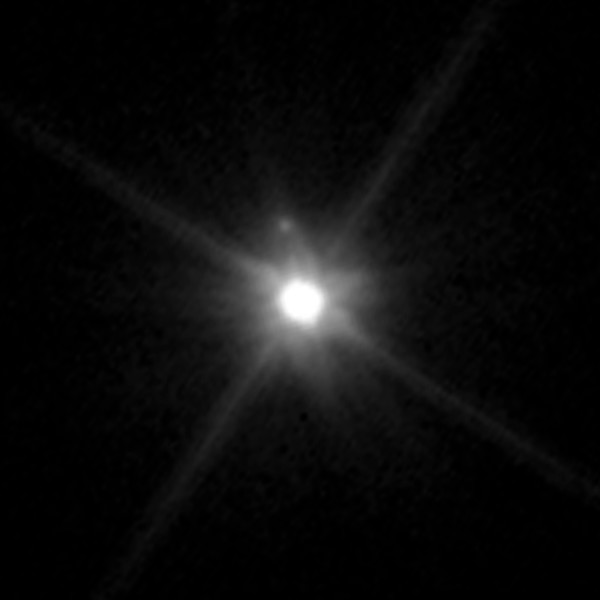
Its surface probably is similar to Pluto, but slightly more reflective from
what appears to be fresh methane ice.
Makemake takes 306.7 years to go around the Sun with an elliptical orbit (e = 0.16) that’s inclined (29°), putting its distance from the Sun between 38.2 and 52.8 AU. Currently it’s near aphelion (52.7 AU) so this is about as un-optimal for observing: come back in 150 years and it’ll be about ~1.5 magnitudes brighter!
My one successful observation of Makemake almost didn’t happen: I put in the
wrong coordinates, and it was at the very top of the image (the previous
attempt had it behind a nearby telephone pole)!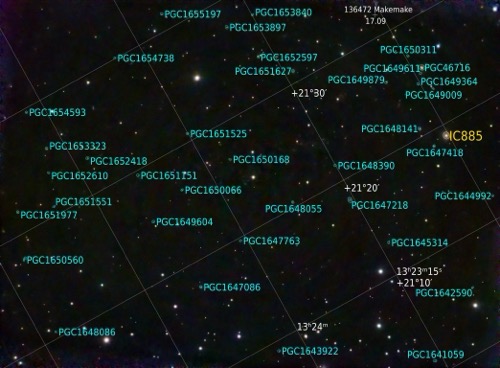
How to Observe Them
Both of these objects are mag 17.2-17.3: while that’s at the fainter-but-easy end of the range for the larger smart scopes (the eQuinox2, and the Origin), if the conditions are good (no Moon, dark sky location, not hazy), it is technically possible to detect both with a Seestar S50 (the S30’s aperture might be just too small, but it’d still be worth the attempt, esp. if you do post-processing of your images). Because they’re going to be points of light like faint stars, unlike a galaxy or nebula, that light isn’t spread out.
The Lucky Shot
Go to the object’s coordinates (see tables below) on your smart scope app: the app will either let you just enter in coordinates (eQuinox2 users - that’s in the “Move” section - hit the “crosshairs” button and you’ll get the interface for entering RA and Dec; Seestar users - create a custom object, and you can enter in the RA and Dec that way - it’ll only be good for the one observation, so you’ll have to change it for any repeat observations).
Integrate for at least a good portion of an hour. For the smaller scopes it might be 1-2 hours.
Then, check it against Stellarium, but understand that Stellarium might be working off old/less accurate orbital elements, though it should be at least in the general vicinity.
The Confirmation
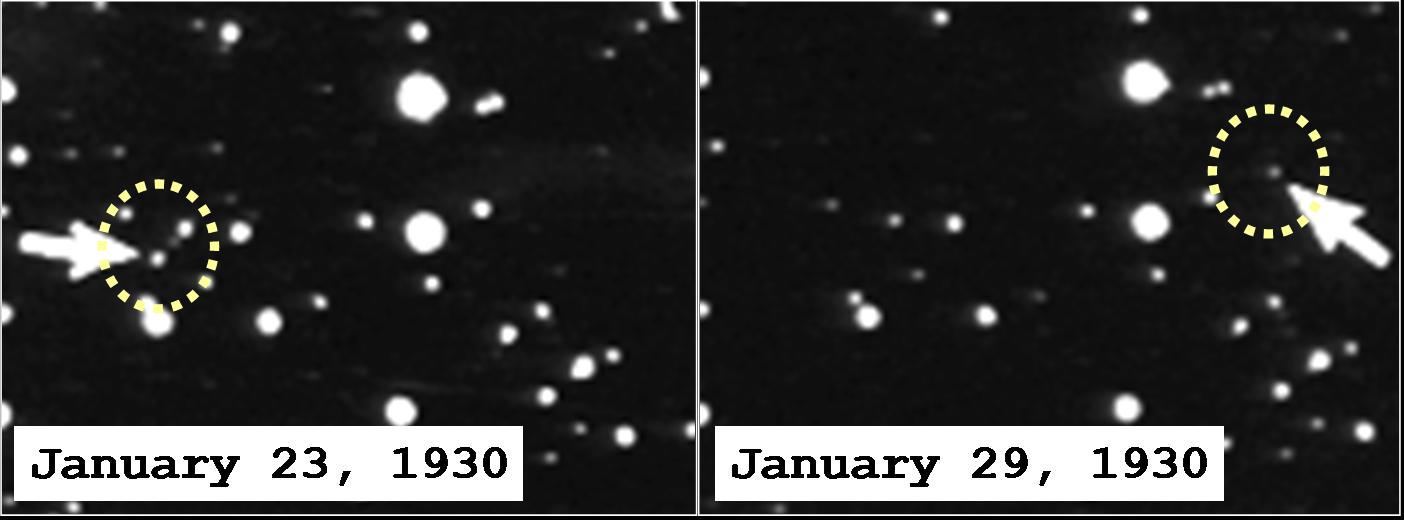
Of course the best way to show you’ve successfully caught either of them is to make a repeat observations a few days later. Or even a couple of weeks: they’re only moving about 25"/day so that’s only about 3’/week.
Comparing the two image should (hopefully) show the dwarf planet moving against the background stars.
Ephemeris Predictions
Positions were obtained from the NASA Horizons website.
Haumea
| Date | R.A. | Dec. | Mag. |
|---|---|---|---|
| 2026-May-28 | 14 39 26.62 | +14 43 21.1 | 17.213 |
| 2026-Jun-02 | 14 39 08.59 | +14 43 10.8 | 17.220 |
| 2026-Jun-07 | 14 38 51.55 | +14 42 43.5 | 17.227 |
| 2026-Jun-12 | 14 38 35.64 | +14 41 59.1 | 17.234 |
| 2026-Jun-17 | 14 38 20.99 | +14 40 57.9 | 17.241 |
| 2026-Jun-22 | 14 38 07.73 | +14 39 40.3 | 17.247 |
| 2026-Jun-27 | 14 37 55.99 | +14 38 07.1 | 17.253 |
| 2026-Jul-02 | 14 37 45.84 | +14 36 18.8 | 17.259 |
| 2026-Jul-07 | 14 37 37.37 | +14 34 16.2 | 17.264 |
| 2026-Jul-12 | 14 37 30.66 | +14 32 00.0 | 17.269 |
| 2026-Jul-17 | 14 37 25.77 | +14 29 31.1 | 17.274 |
| 2026-Jul-22 | 14 37 22.76 | +14 26 50.5 | 17.277 |
| 2026-Jul-27 | 14 37 21.66 | +14 23 59.5 | 17.280 |
| 2026-Aug-01 | 14 37 22.47 | +14 20 59.2 | 17.283 |
Makemake
| Date | R.A. | Dec. | Mag. |
|---|---|---|---|
| 2026-May-28 | 13 23 17.75 | +21 02 38.6 | 17.099 |
| 2026-Jun-02 | 13 23 04.77 | +21 01 30.5 | 17.105 |
| 2026-Jun-07 | 13 22 53.22 | +21 00 06.4 | 17.111 |
| 2026-Jun-12 | 13 22 43.21 | +20 58 26.8 | 17.117 |
| 2026-Jun-17 | 13 22 34.82 | +20 56 32.3 | 17.122 |
| 2026-Jun-22 | 13 22 28.13 | +20 54 23.6 | 17.126 |
| 2026-Jun-27 | 13 22 23.19 | +20 52 01.7 | 17.130 |
| 2026-Jul-02 | 13 22 20.03 | +20 49 27.5 | 17.134 |
| 2026-Jul-07 | 13 22 18.67 | +20 46 41.9 | 17.137 |
| 2026-Jul-12 | 13 22 19.15 | +20 43 46.0 | 17.139 |
| 2026-Jul-17 | 13 22 21.48 | +20 40 40.8 | 17.141 |
| 2026-Jul-22 | 13 22 25.65 | +20 37 27.4 | 17.142 |
| 2026-Jul-27 | 13 22 31.63 | +20 34 07.2 | 17.142 |
| 2026-Aug-01 | 13 22 39.38 | +20 30 41.4 | 17.142 |