
Introduction
Arcturus is the brightest star in the spring sky (and the Northern Hemisphere), and 4th overall in the night sky. It’s name means “Guardian of the Bear” in ancient Greek, and is one of the few stars with a Greek name. It’s the brightest star in Boötes (Bo-OH-teez) the Herdsman.
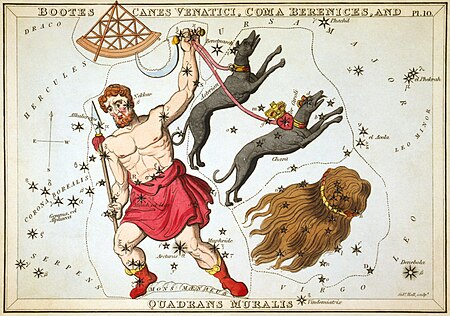
A modern addition to this adds the dim constellation Canes Venatici (which is in-between the Herdsman and the Bear) as the hunting dogs of Boötes. Canes Venatici is a modern addition to the sky - it was introduced by Hevelius in 1687. (He also added other minor constellations including Leo Minor the Lesser Lion (Cub), Lynx (the Lynx), and Sextans (the Sextant) all of which take up some of the mostly “empty space” in the Spring skies.
Arcturus in the Almagest
Ptolemy’s Almagest, written around 150 CE, lists 48 constellations, the associated star catalog has just over 1,000 stars but only 11 were given proper names. Instead, there are descriptions of where the stars were located in relation to the figure the constellation represents. The Latin translation of the entry for Arcturus read as:
Quae est inter crura et vocatur Arcturus subrufa
which translates as “which is between the legs (thighs) [of the herdsman] and is called the slightly red Arcturus”.
Many of the proper names of stars are Arabic - this happened over the next 1,000 years when the Almagest made it to Persia and was translated: Arabic star names were added, then the “revised” catalog made it back to the West (at which point the constellation names were Latinized).
Finding Arcturus
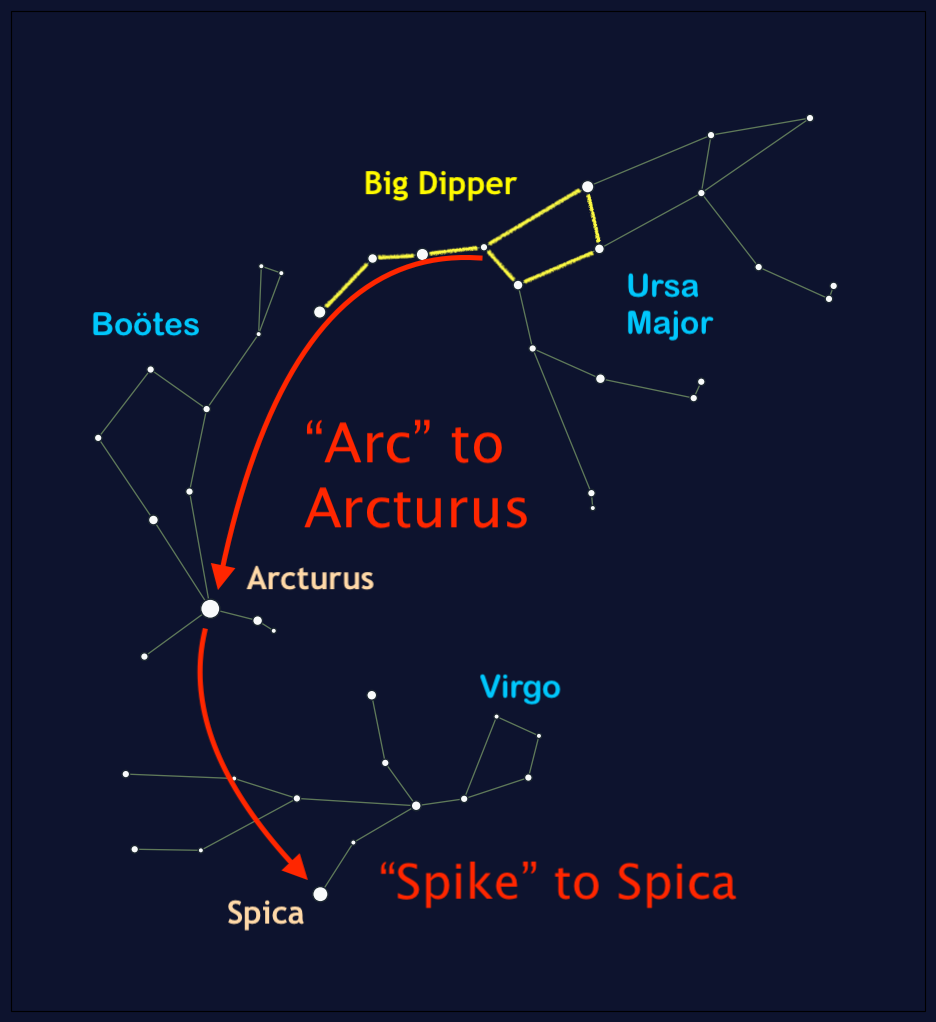
“Arc to Arcturus”
Even though Arcturus is a bright star and stands out, one commonly used trick is to start with the Big Dipper and then follow the curve of the handle stars over and “down” until you encounter Arcturus.
“Spike to Spica”
You can then extend that curve further south and you’ll reach another bright star: Spica - the brightest star in Virgo (15th overall).
Nearby Constellations and “Ex-” Constellations
Corona Borealis
East of Boötes is Corona Borealis “The Northern Crown” a not very prominent constellation but the semi-circle arc of stars is easy to make out under suburban skies.
Quadrans Muralis
If you look at the historical drawing up top, you might notice a weird “constellation” over the Herdsman’s head that you won’t find on a modern star map. This is Quadrans Muralis (the Mural Quadrant) - a long arc-shaped device use to measure the positions of stars before the invention of the telescope (Tycho Brahe used one). Like Canes Venatici it was “added on” to the list of constellations - this time by Joseph Lalande in 1796. There were dozens of “new” constellations added over time - it was a way to make your “new” atlas “new and improved” - or to curry favor with your king or duke by making a constellation in their honor.
Over decades the skies became very crowded with constellations, made of fainter and fainter stars, some even overlapping or being different things in different atlases. To get some degree of sanity back, the International Astronomical Union stepped in and unilaterally “decided” on the list of 88 constellations we know today (and their boundaries).
Even though the constellation is no more, the star 44 Boötis was named “Quadrans” to commemorate it, and the Quadrantid meteor shower just after New Year’s still retains it name.

Mons Maenalus
Not pictured above, but there was another ex-constellation - this time under the Herdsman’s feet, Mons Maenalus (for Mount Maenalus) whose existence was pretty much to give Boötes something to stand on. This one was also introduced by Heveleus in 1687, but was pretty much obsolete by the late 1800s.
A Few Firsts
Some Arcturus trivia: it was the first star recorded to have been observed in daylight with a telescope back in 1635 by the French astronomer Jean-Baptiste Morin.

The 1933 World’s Fair
The light of Arcturus was used with a photoelectric cell to trigger the opening of the 1933 Chicago World’s Fair. It was chosen for this honor because the distance estimate at the time was 40 ly, and the previous Fair was in 1893.
A Nearby Giant Star
More precise measurements have the star only 36.7 ly away - the second closest red giant star to the Sun (the “first” in this category goes to Pollux in Gemini).
Arcturus is an old disk star - older than the Sun - and in its Main Sequence phase was probably slightly hotter and whiter than the Sun - very similar to Alpha Centauri A. It has used up its core hydrogen (there’s still a shell of hydrogen surrounding the core), but that shift has caused the star to swell up by over 20 times. The compressed helium core will start to heat up, and reach 100 million Kelvin - triggering a “helium flash” (and in fact this may have already happened). The core will cool and the star will shrink - for a time.