Introduction: The Summer Sky
I’ll save some tips on how to observe with binoculars for the end - let’s jump in and start the journey!
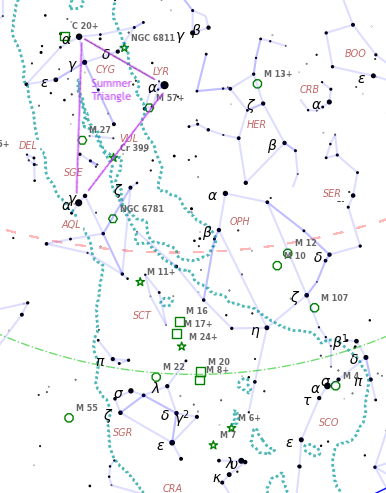
We’ll be going from almost overhead in Cygnus, working our way down through the summer constellations: Vulpecula, Aquila, Scutum, Serpens, and then Sagittarius and Scorpius. Even without binoculars, looking at the sky and identifying the constellations (even the small faint ones) and stars is fun! You can use a planisphere to do that (old school), or an app that will align you with the sky (more modern).
Follow the Birds!
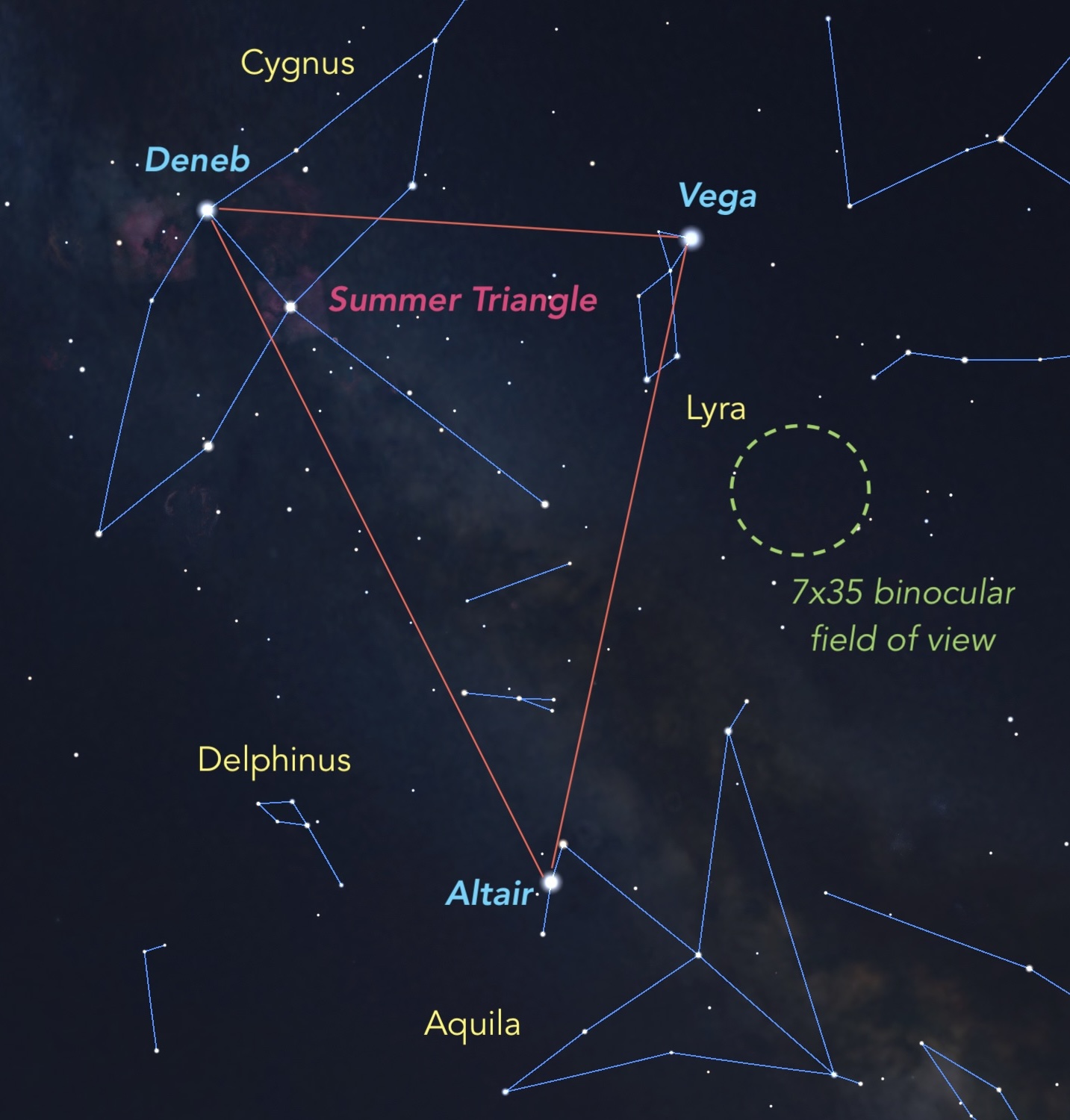
To start, locate the bright star Deneb (it’s part of the Summer Triangle of bright stars). Deneb is the bright star in Cygnus, the constellation of the Swan, and it’s flying above the Milky Way, heading to the South, behind another soaring bird, Aquila the Eagle with the bright nearby star Altair.
Deneb is a blue supergiant star - it’s 2,600 light years away, much further than the other two Summer Triangle stars, Vega and Altair which are almost in our back yard.
In dark skies you can make out how both of these constellations resemble birds with Cygnus having a long craning neck, and Aquila wide outstretched wings. Both of these constellations were identified this way going back millenia - we like to “connect the dots” into shapes that are familiar to us and many of the constellations do sort-of resemble the figures they represent (some better than others).
But one thing always puzzled me about the arrangements of the “bird” constellations: why are the bright stars in the tail feathers?
The Great Rift
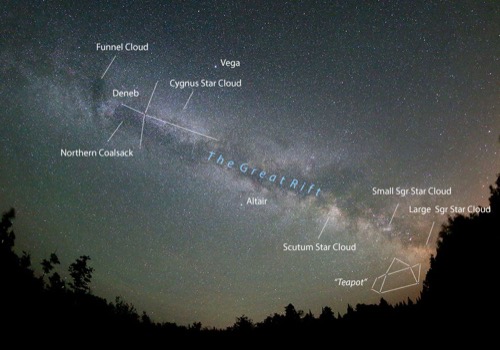
That’s not an illusion - that’s the Great Rift. In galaxies like ours, we are immediately drawn to the pinwheel-like spiral arms, but don’t notice the “dark side” - all the dust. Dust lanes are an observed feature of many “edge-on” galaxies, but the Earth and Sun ARE in the Milky Way’s disk, so looking up at the Milky Way, we DO see those dust lanes superposed against the misty expanse of stars.
Once You See It, You Can’t Unsee It
When we reach Cygnus’ head with the moderately bright star Albireo (which is a great double star in small telescopes), we move into Vulpecula - the Little Fox - a faint “invented” constellation by Hevelius and introduced in 1687. Anyway, you might spy something that’ll make you stop and blink:
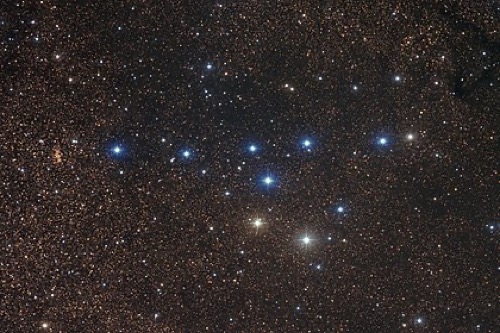
This is one of my favorite asterisms - Collinder 399 - also known as Brocchi’s Cluster. It’s not a real star cluster - the stars are at very different distances from each other, but from our point of view they just happen to line up in this VERY unmistakeable pattern!
At the East end, is the open star cluster NGC 6802 - if you’re lucky and have a larger set of binoculars (10x50 or 15x70) you might be able to see it as a faint fuzzy spot: a piece of “lint” to go with the Coathanger!
A Very Dense Open Cluster
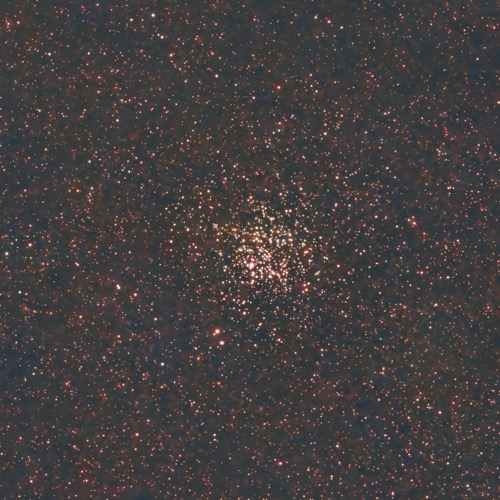
Messier 11 - the Wild Duck Cluster (again with the bird motif…), is SO dense, it almost looks like a globular cluster in larger telescopes: we’re looking at almost 1,000 stars within a region that’s less than 30 light years across! Imagine what the view must be from a planet orbiting a star there!
In binoculars it’s a hazy ball - but still standing out against some of the brightest parts of the Milky Way. (This is the Scutum Star Cloud, and you should be able to detect it with the naked eye.)
Dark Clouds
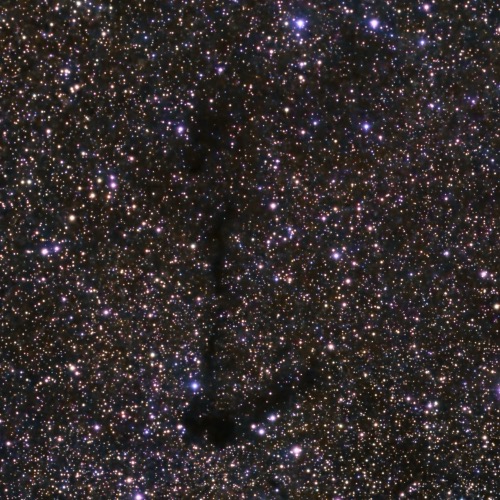
Highly Structured Star-Forming Region
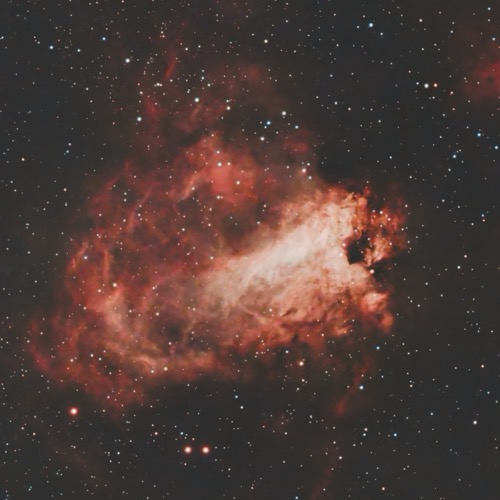
Finding the Galactic Center
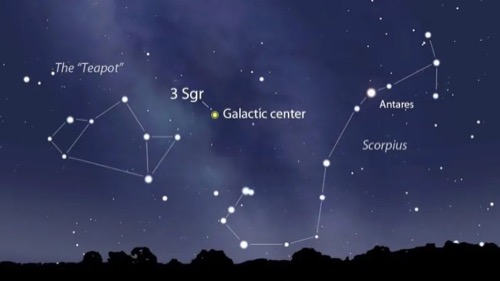
We can use the Teapot asterism to locate the approximate location of the center: if you imagine spilling some “tea” out of the “spout”, that’s pretty much the right direction. From there, the Sun is sitting on the edge of one of the outer spiral arms, 25,000 light years “out”.
Two Bright Open Clusters
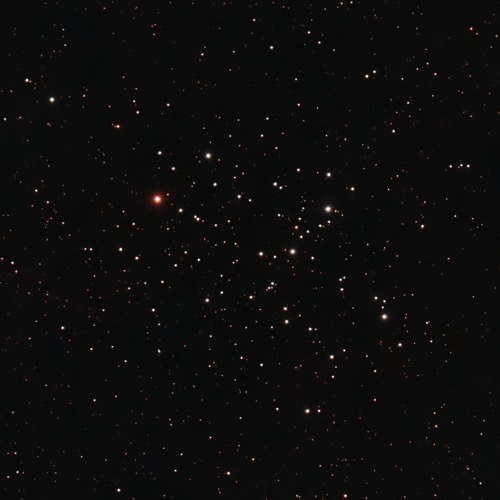
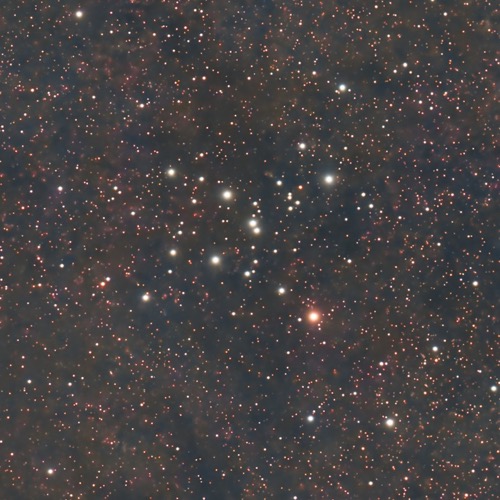
Going west we enter Scorpius the Scorpion - another constellation whose stars are arranged in a way you can actually make out the shape of a scorpion. Near the “stinger” stars on its tail are two nice open star clusters - Messier 6 and 7 - that are a bit of a challenge from New England - they never get very far above the horizon (and in fact M 7 is the southern-most object in Messier’s catalog).
But they’re both bright, pretty, and not hard to find - if you look. Naked eye observations of M 7 go back millenia - it’s easier to see from more southern locations; M 6 is also a naked-eye object under dark skies but a little more challenging.
Antares
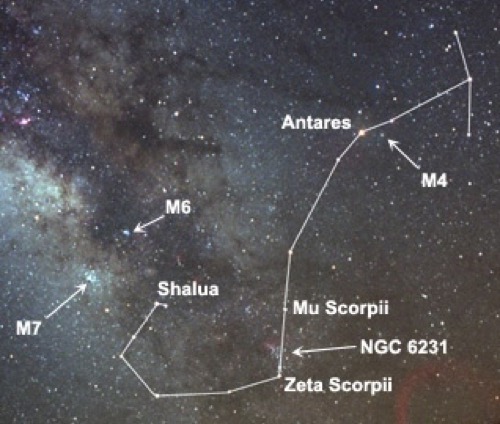
Like its winter cousin Betelgeuse, it’s rapidly burning through its nuclear fuel and will eventually explode as a supernova: about 1.0-1.4 million years from now.
Cluster in the “Galactic Suburbs”
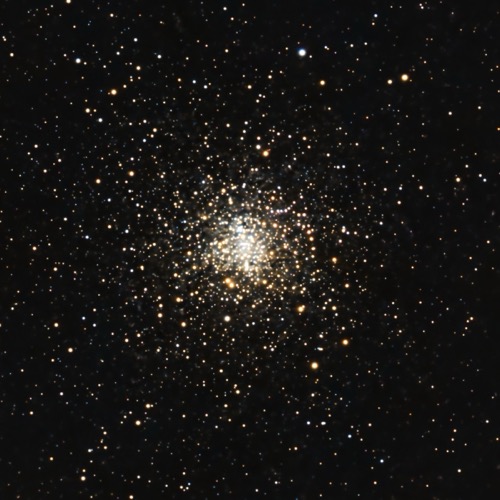
M 13, the “Great Hercules Cluster” is also a popular naked eye challenge
(and would be visible in the NW sky).
Globular clusters live off of the disk and spiral arms in the halo of the Galaxy and are very old. Some may have not originated here, but formed in other small galaxies that collided with the Milky Way long ago, leaving these “adopted” clusters as the only remnant of the encounter.
Of course these few objects are just a small fraction of all the things you can see with binoculars in the summer sky. Scanning on either side of the Milky Way there are even more clusters to be found, and interesting star pairings - you might even “discover” your own arrangements like the Coathanger to show off!
Tips for Observing with Binoculars
Now that we have an idea of what to look for, let’s end with some tips in how to make this the most fun.
I find using binoculars cumbersome - they can get heavy holding them up and at the same time trying to look through them.
Many binoculars have a hole in the bottom for mounting them on a tripod. Use this! You’ll spend more time looking at things instead of trying to hold them steady. If your binoculars don’t have this feature, even anchoring them with zip-ties on the tripod might work well enough.
If you don’t have a tripod, try to get comfortable! With a “chaise” lawn chair (or pool lounger) that adjusts you can more easily hold the binoculars up to the sky and observe without straining your neck.
Take your time! You’re gazing at a great expanse of our Galaxy - most of the Summer Milky Way is the inner spiral arms thousands of light years away. That’s a lot to contemplate. And you’ll encounter so many interesting groupings of stars, and nebulae - discovering them is part of the fun!