
History
This galaxy was discovered by Pierre Méchain who collaborated with Charles Messier (and is credited with discovering about one-quarter of all the objects in Messier’s catalog) in 1781. Like Messier, he wasn’t particularly interested in the “nebulae” themselves: he was looking for comets (and discovered eight of them) - the catalog was really just to identify things that could have been mistaken for comets with the telescopes available at that time.
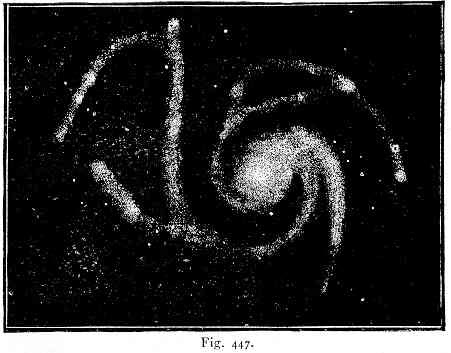
Of course once astronomical photography had developed, the true splendor of this “island universe” became apparent.
Similar to the Milky Way - Or is It?
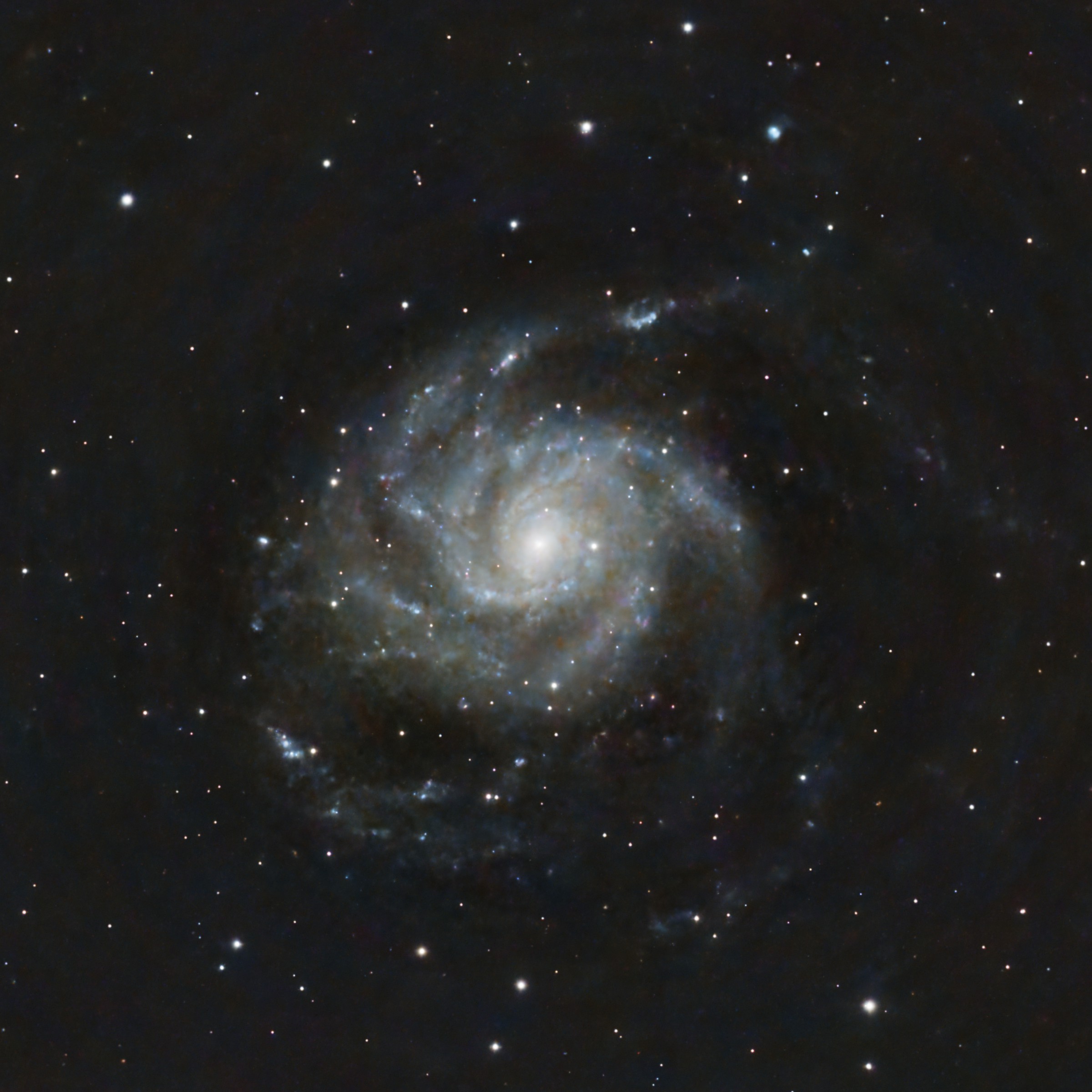
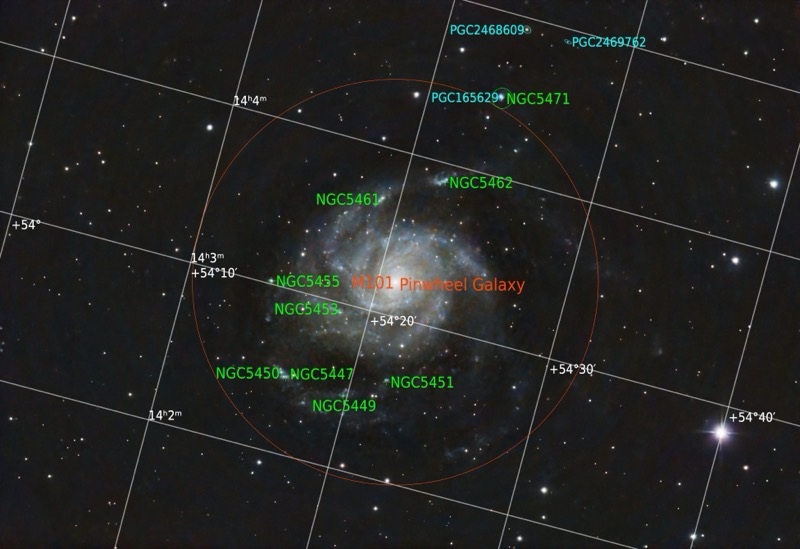
Messier 101 is optimally oriented to our Galaxy - it’s almost completely face-on so that we can clearly see the whole spiral structure “from above”. It has a “grand design” spiral structure with several spiral arms extending in a counter-clockwise fashion from the bright core.
But compared to our own Galaxy there are some very important differences. First it is much larger than the Milky Way Galaxy: about 3x larger, in fact, and contains over 1 trillion stars. Like many spiral galaxies, it has a high population of H II region - hot gas in which star-formation is happening. These hot young stars have winds that can push out the gas and form huge bubbles.
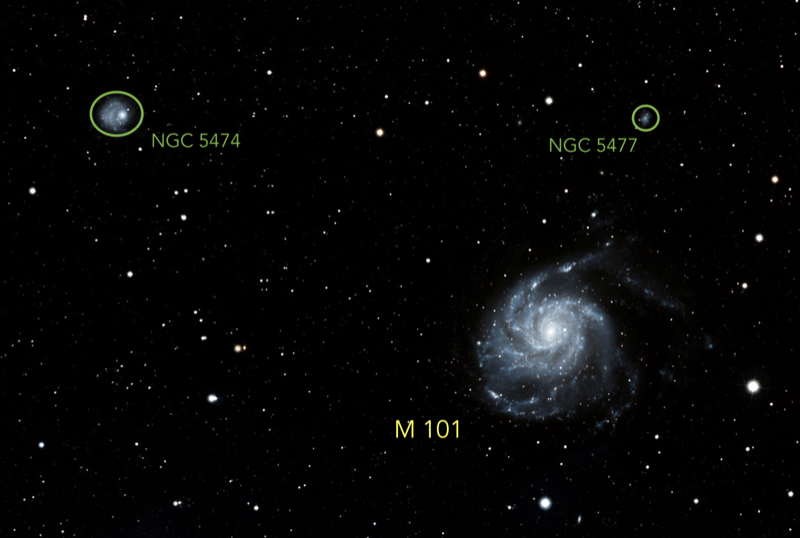
But those spiral arms - though distinct - are not entirely symmetric: they’ve been warped a bit through interactions with its companion galaxies.
Observing M 101
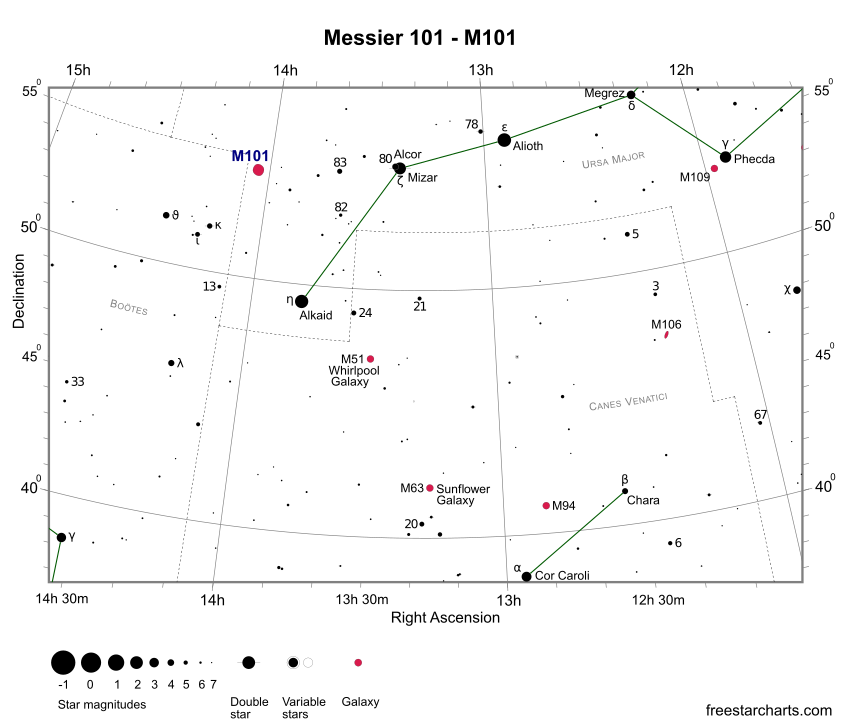
It’s even possible to detect with binoculars under very dark skies and especially in the (northern) Spring when the Big Dipper is nearly overhead.
M 101 is one of the brighter spirals, and might even be a slightly easier target than M 31 or M 33 because its light isn’t spread out so much. Even in a 2-3" telescope you should see a glow that’s not entirely uniform, and is brighter towards the center. Mid-sized scopes (around 6") it’ll appear even more mottled, and under dark and steady conditions you might start to make out the spiral nature. Larger telescopes (like Dobsonians) will show many details: brighter spots in the core and along the spiral arms.
A Well-Observed Supernova
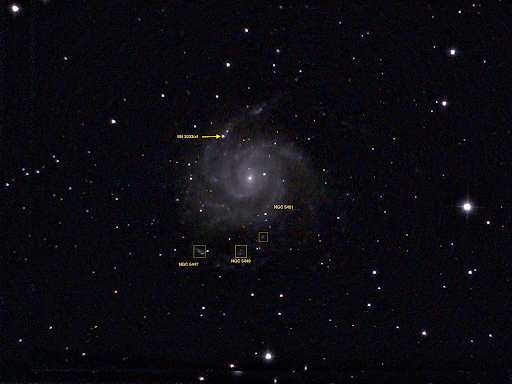
In May 2023, a supernova was reported in M 101 by Kōichi Itagaki, a Japanese amateur astronomer, and given the designation SN 2023 ixf. (He has discovered over 150 supernovae, and several comets.)
Because M 101 is an amateur favorite, it was a common target for astrophotograhy, especially the new “smart” scopes. The image above is one taken in July 2023 while the supernova was decreasing in brightness but still clearly visible in an outer spiral arm.
What is really impressive however is that owners of Unistellar’s smart scopes could submit their images to a citizen science program for supernovae. Unbeknowst to some of them, they actually captured pre-discovery images of the galaxy, some just hours after the explosion.
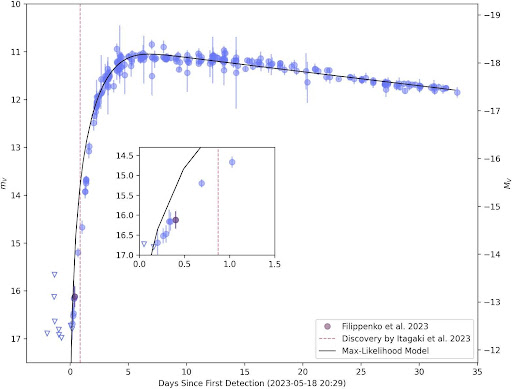
Here the red dashed line is the timing of Itagaki’s discovery observation, when had reached magnitude 14, and about 5 days before it had its peak brightness at magnitude 11. However, because this is such a popular galaxy, several people had observed it the same night “just for fun” because it’s a very pretty galaxy. What they did not know is that they caught the supernova possibly in the first hours after the explosion!
What this shows is just how important amateur observations are: typically supernovae are discovered well after the explosion - sometime days or even weeks after the event and while you can use the light curve to “backtrack” in order to fashion a model, having early observations are critical to generating a precise model. In the case of SN 2023 ixf, the generated model fits the data well long after the explosion (in the decline phase), but if you look at the early data - they don’t fit: either there’s something special about this particular supernova, or there’s something missing in our understanding of Type II supernovae.
This makes amateur observing even more exciting - you never know if what you think it a routine image of a galaxy, or a comet, or a nebula might actually have caught an important datum or a new discovery.
There are citizen science programs with interests that span the cosmos: from extra-galactic supernovae billions of light years away, to helping determine the sizes and composition of asteroids in our own back yard, or refining the orbits of asteroids whose paths might come dangerously close to the Earth. Amateurs have also been monitoring variable stars for over a century, thanks to the American Association of Variable Star Observers (AAVSO).
So the next time you point your scope at M 101 — or any galaxy — remember that you’re not just sightseeing. You’re part of a global network of observers whose combined data is actively shaping our understanding of the universe. Méchain found it by accident while hunting comets. You might find something just as unexpected.