Introduction
Point your telescope on a summer night up toward the constellation Lyra, and just south of the brilliant star Vega, you’ll find what looks like a tiny, ghostly smoke ring floating in the dark. This is Messier 57, the Ring Nebula — arguably the most recognized planetary nebula in the sky, and a perennial favorite of amateur astronomers. Even a modest telescope reveals its unmistakable shape, and a smart scope like the one used to capture the image above begins to show its colors and structure.
But here’s the thing: while the “smoke ring” appearance is unmistakable, it’s only one perspective on a far stranger object. Viewed from elsewhere in the galaxy, M57 would look nothing like this. Let’s take a closer look.
Discovery
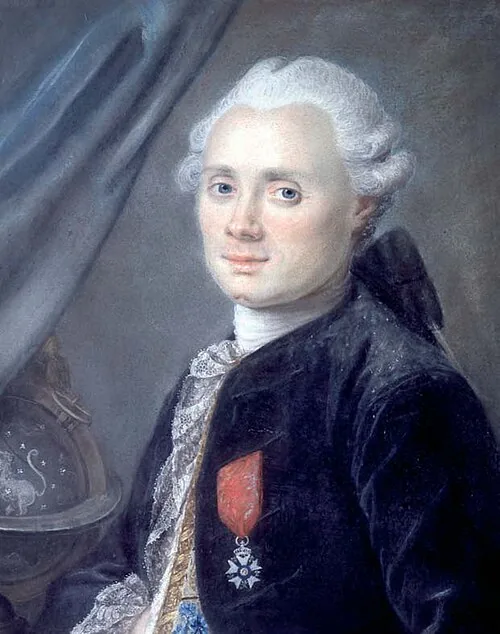
The Ring Nebula was discovered in January 1779 by Charles Messier. At the time, anything that wasn’t stellar-like was described as “nebulae” without any understanding of what any of them might be: it was generally thought that they were just clouds (which some of them are, of course).
Messier wasn’t even trying to find nebulae: his passion was comets, and the only reason he created his catalog was to mark things that weren’t comets, presumably to avoid the embarrassment of announcing a new “comet” that actually wasn’t.
Following up on his discovery, another comet hunter, Antoine Darquier de Pellepoix noted that the nebula was about the same size as Jupiter in the sky, and round — and this casual observation may be how these objects became known as “planetary nebulae,” a name that has stuck for 250 years despite having nothing whatsoever to do with planets.
It was William Herschel who first suggested the term “planetary nebula” formally, struck by how these round, disk-like objects resembled the planets through the telescopes of the day. He wasn’t wrong about the resemblance — just the cause. Herschel speculated they might be made up of faint stars, simply too distant and crowded to resolve into individual points of light. It would take another century of advancing technology before the true nature of planetary nebulae was understood.
Finding M 57
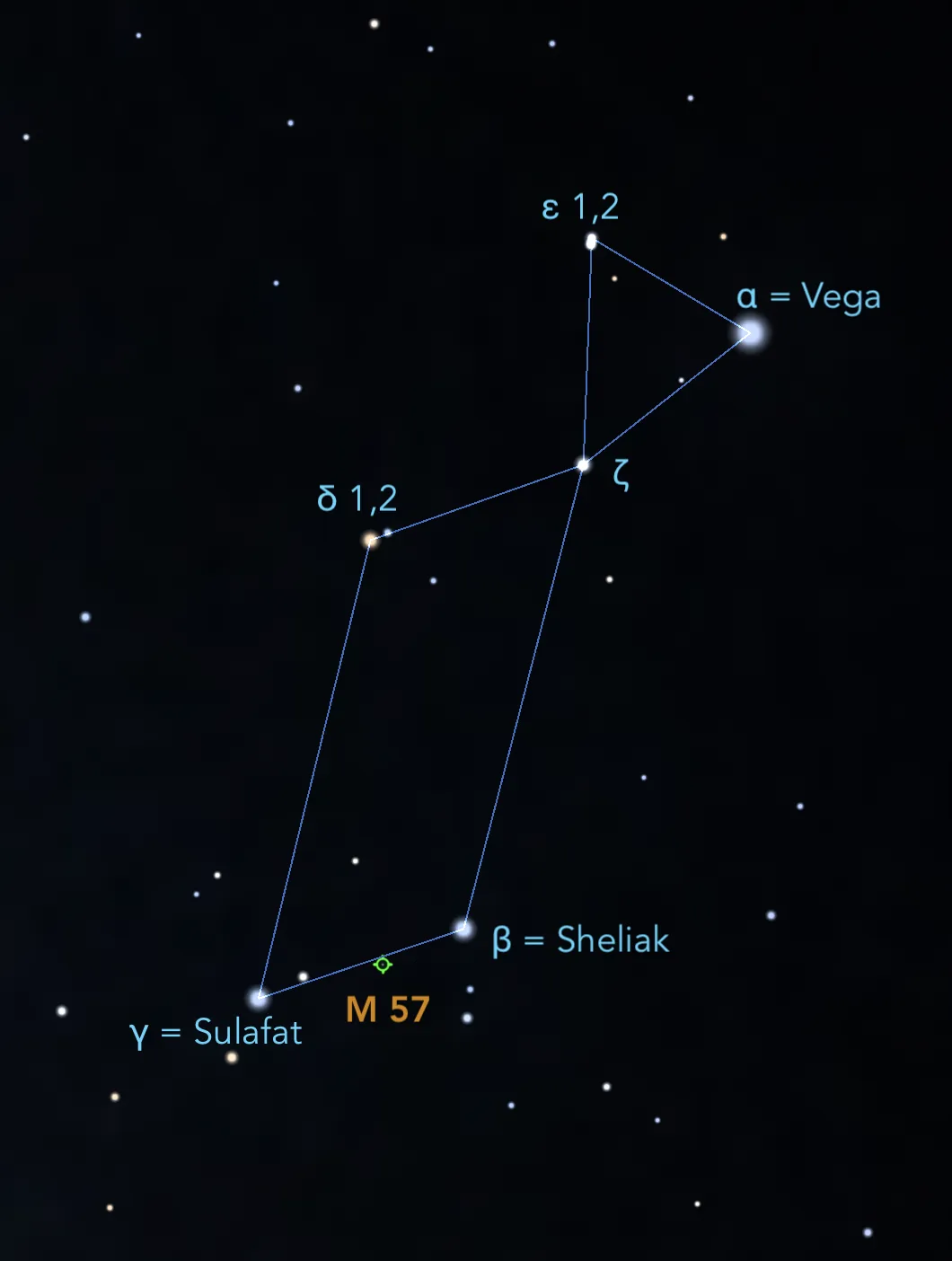
The Ring Nebula is one of the easier objects to find in Messier’s catalog. It lies almost exactly midway between two bright stars: β (Beta) Lyrae (Sheliak) to the west and γ (Gamma) Lyrae (Sulafat) to the east — only about 2° apart. Even at low magnification, you’ll notice something distinctly “fuzzy” between them that refuses to resolve into a star. That’s your target.
At higher magnification the ring shape becomes apparent. A 4-inch telescope will show the cirular nature clearly; larger apertures begin to reveal subtle structure and hint at the darker central region. Color is largely a gift of the camera — though experienced visual observers with dark skies report a subtle greenish-cyan cast in telescopes of 8 inches and above, with hints of reddish highlights in truly large instruments.
What You’re Seeing in Your Image
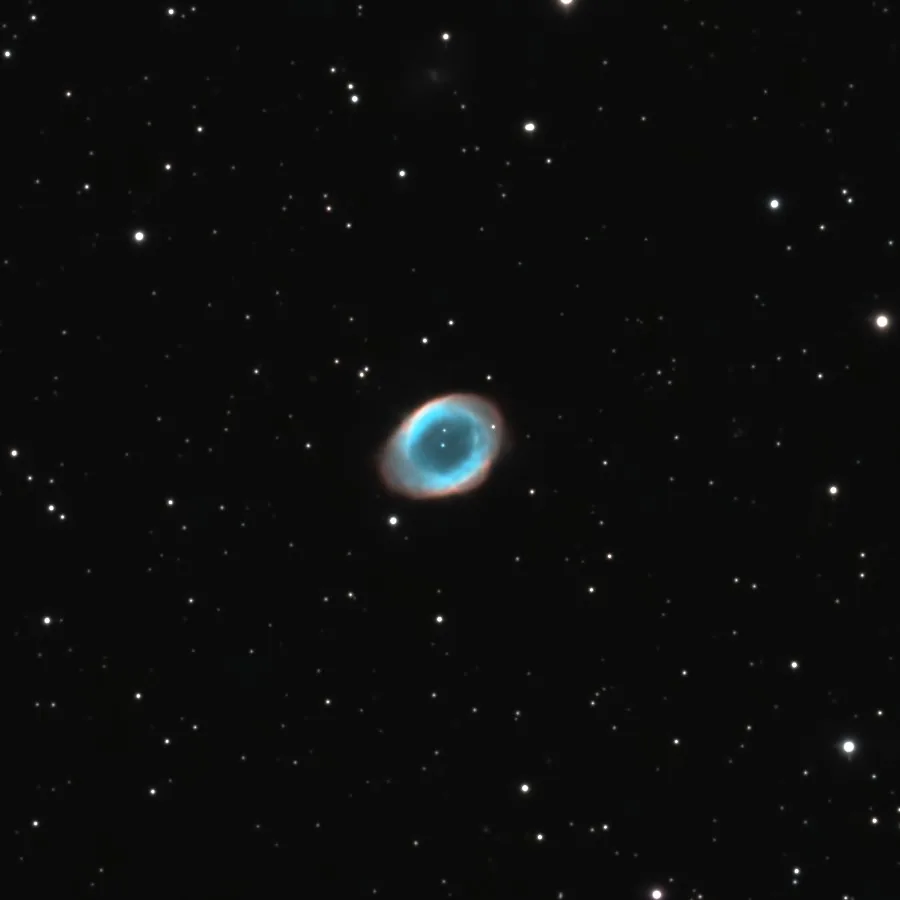
If you have a smart scope, the Ring Nebula is an easy target (because it’s bright) though slightly challenging (because it’s somewhat small). But even exposure times of a few minutes is enough to exceed visual observations.
The Colors
Look at the image above and the first thing you notice is that M57 isn’t just a grey smudge — it has distinct color zones. The outer edge of the ring glows with a reddish-orange hue, transitioning through a yellowish band, before shifting to a striking blue-green interior. This isn’t an artifact of the camera — it’s real, and it tells you something profound about the physics happening inside the nebula.
The colors map directly to temperature and ionization. The red outer ring is dominated by hydrogen gas — the most abundant element in the universe — glowing as it’s energized by ultraviolet radiation from the central white dwarf. Moving inward, the gas is closer to that fierce radiation source and more highly ionized, producing the blue-green glow characteristic of doubly-ionized oxygen (O III). The yellow band in between is the transition zone where both processes overlap.
It’s not that the elements themselves are stratified that way - this is where the temperature comes in: closer in, it’s too hot to create the red hydrogen feature; further out, it’s too cool to doubly ionize oxygen and produce that greenish blue spectral feature.
In a sense, you’re looking at a natural spectrograph: the colors reveal the chemical and physical structure of the nebula laid out in space, from the cooler outer fringes to the hotter, more energetic interior.
Orientation
Now look at that image again. It looks like a ring — a cosmic smoke ring hanging in space. But that’s not what it is.
What you’re actually seeing is a barrel-shaped cloud of gas roughly 4.6 light years across, and you happen to be looking straight down one end of it. The “ring” is the walls of that barrel, and the darker center is simply the more-hollow interior — the mouth of the barrel opening toward you across 2,570 light years of space.
Other Bright Planetary NEbulae
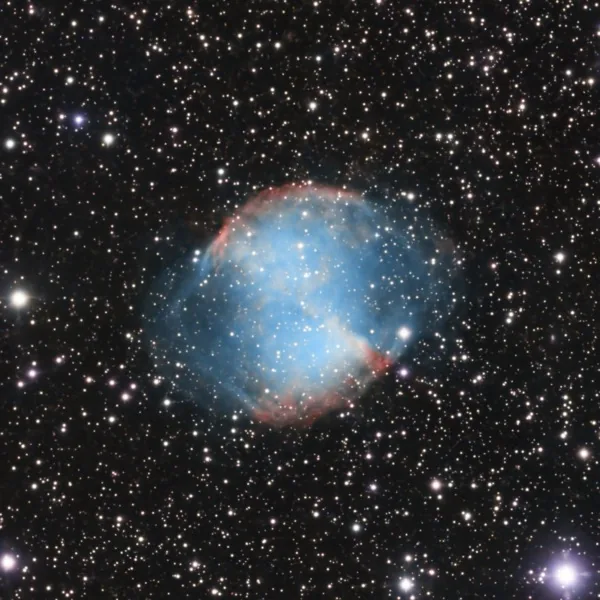
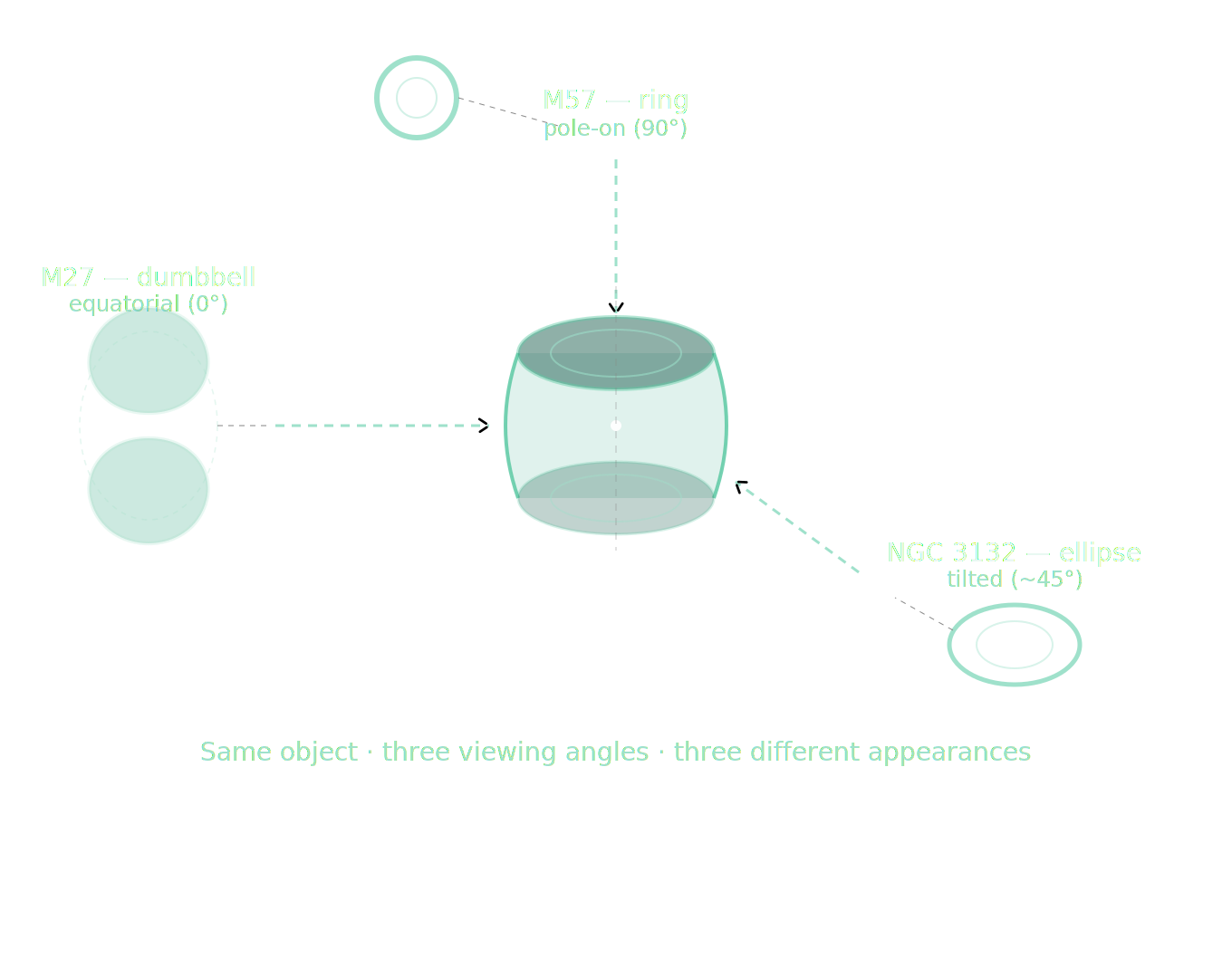
To understand why how this orientation changes, consider M27 — the Dumbbell Nebula in Vulpecula. M27 is a planetary nebula very similar in nature to M57, but we’re viewing it from the side, roughly edge-on to its barrel. That’s why it has that distinctive double-lobed “dumbbell” shape rather than a ring. If you could somehow teleport to a point 90° around M57 in the galaxy, it would look remarkably like M27. And somewhere out there, observers looking at M57 from that angle are probably calling it their version of the Dumbbell Nebula.
(And likewise, if you could move in space “around” the Dumbbell Nebula, it would start to look very “ring”-like.)
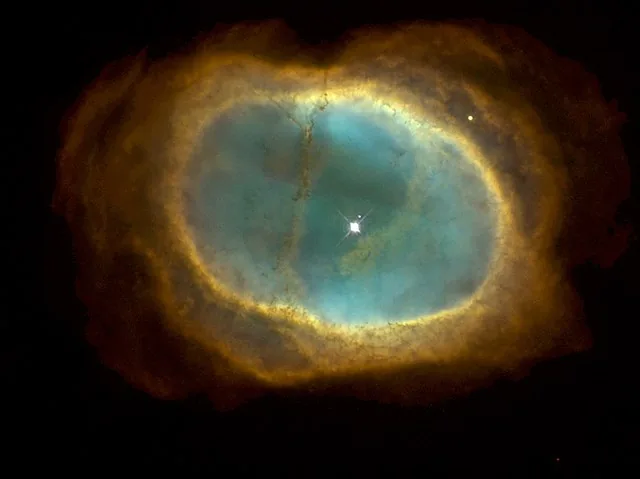
There’s a useful way to think about the range of appearances a planetary nebula can have depending on viewing angle. At one extreme you have M57 — pole-on, looking straight down the barrel, appearing as a ring. At the other extreme, M27 — equator-on, appearing as a double lobe. Roughly halfway between those two orientations sits NGC 3132, the Eight-Burst Nebula, which appears as an obvious ellipse — the barrel tilted at roughly 45° to our line of sight.
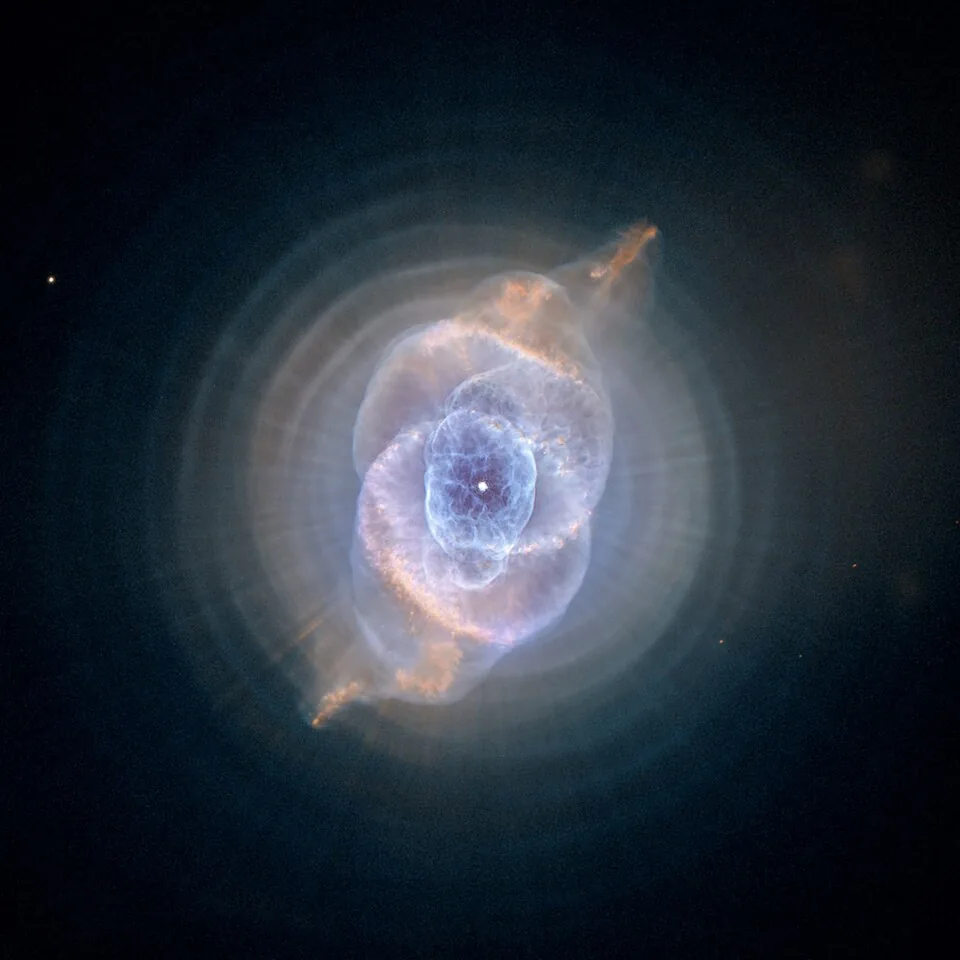
And then there are objects like NGC 6543 (Caldwell 6), the Cat’s Eye Nebula — which throws all of the above out the window. Its complex nested shells, jets, and asymmetric structure are a reminder that not every planetary nebula follows a neat rulebook; some are shaped by forces — likely binary interactions — that we’re still working to fully understand.
Same type of object. Four completely different appearances. The difference is simply where you’re standing.
How and Why They Form
Our Sun, like most stars, will not end its life in a dramatic supernova explosion. Instead, in about five billion years, it will exhaust its hydrogen fuel and swell into a red giant — enormous, cool, and luminous — before beginning to shed its outer layers into space. What remains at the center will contract into a white dwarf: an Earth-sized ember of incredible density, no longer fusing hydrogen, slowly cooling over billions of years.
The gas expelled during that shedding process — moving outward at tens of kilometers per second — is what we call a planetary nebula. The white dwarf at the center floods the surrounding gas with intense ultraviolet radiation, causing it to fluoresce in the colors we see in the image above. It’s a brief, brilliant phase: the dying star’s last act of illumination before fading into darkness.
The term “planetary nebula” is one of astronomy’s great misnomers — these objects have nothing whatsoever to do with planets. The name stuck from the era of William Herschel, who noted that through the telescopes of his day they resembled the disks of the planets. We’ve known better for over a century, but the name remains.
The Central Star
Look carefully at the center of the image. That faint pinpoint of light — easy to miss — is the reason everything else exists. It’s a white dwarf, the compressed remnant of a star that once burned much like our own Sun, and it’s one of the hottest objects in the observable universe, with a surface temperature approaching 120,000 Kelvin. For comparison, our Sun’s surface is a relatively cool 5,800 Kelvin.
Before all this happened, this star was probably between 1.5 to 2.0 times the mass of the Sun, a little hotter and a little whiter/bluer. It probably resembled the bright star Procyon or maybe Altair.At magnitude 15.8, it’s a challenging target — you won’t see it visually except in large telescopes under excellent conditions. The fact that it’s visible at all in a 21-minute smart scope exposure says something about how extraordinarily hot and luminous it is despite being Earth-sized in diameter.
That white dwarf is doing all the work. Its fierce ultraviolet output is what ionizes the surrounding gas, producing every color you see in the image. Without it, the nebula would be invisible — a dark, cold shell of gas expanding silently into the interstellar medium. The white dwarf is essentially floodlighting its own funeral shroud.
Is it a Binary System?
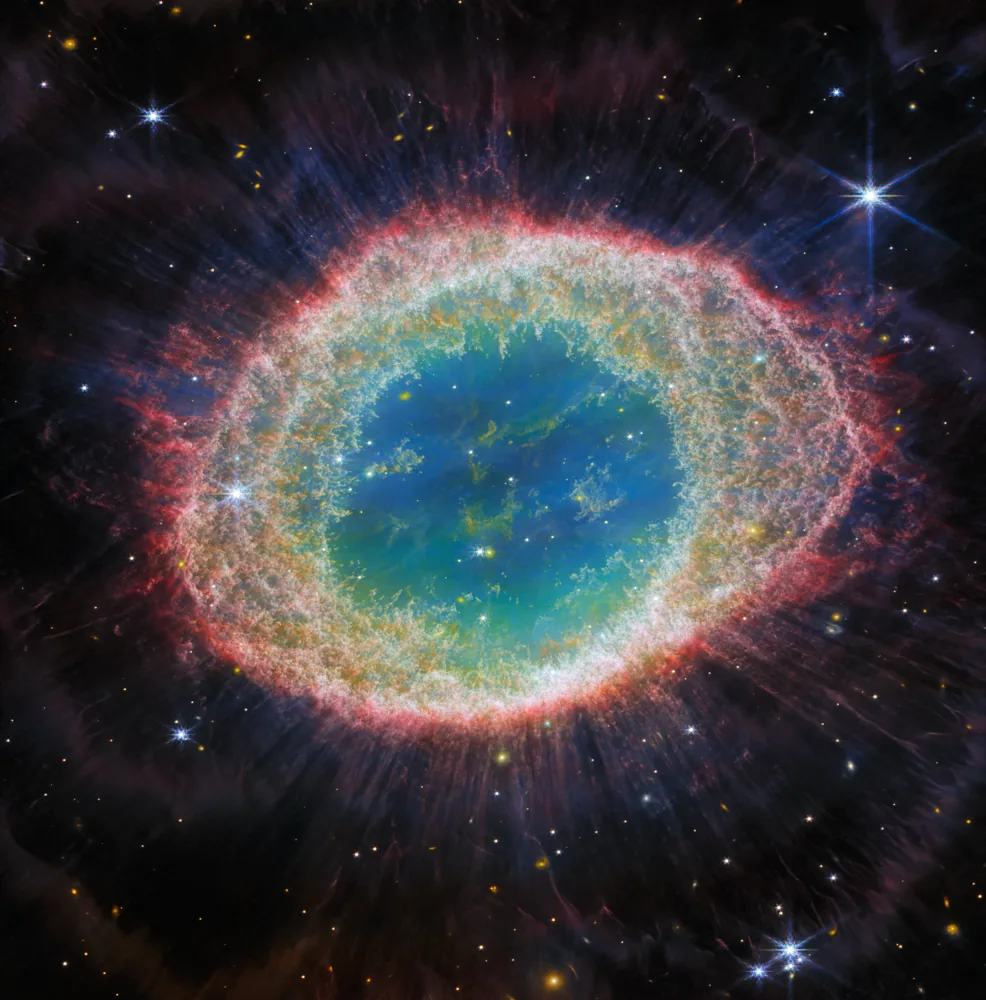
Look at this image taken by the James Webb Space Telescope. Beyond the main ring, faint filamentary structures extend outward into the surrounding space — and buried in that data are clues that M57 may not have been formed by a single star acting alone.
High-velocity blobs of gas have been detected shooting out from each end of the barrel — material ejected with far more energy than the main outflow can explain. A companion star interacting with the dying red giant is the most likely culprit. Researchers have also identified faint concentric arcs in the outer halo suggesting periodic disturbances during the mass-loss phase — consistent with a companion in a long-period orbit.
What’s intriguing is that no companion star has been directly observed. It may have been consumed by the red giant during its expansion, or it may still be there, hiding in the glare of the white dwarf. Either way, M57 may owe its very shape — that elegant barrel we’re looking down — to a gravitational dance between two stars playing out over millennia.
Measuring the Age
How old is M57? The answer turns out to be surprisingly precise — and surprisingly recent.
By measuring the current size of the nebula and the speed at which the gas is expanding — roughly 20-30 kilometers per second — astronomers can simply run the clock backwards. The math points to the red giant shedding its outer layers approximately 6,000 to 8,000 years ago. In human terms, that’s not ancient history — it’s roughly contemporary with the earliest written records of civilization. Somewhere in the night sky above the first Mesopotamian cities, a star quietly began its death.
That expansion is not just theoretical — it’s been measured directly. Photographs taken over 50 years show the nebula growing at roughly one arcsecond per century. The nebula is currently about 80 arcseconds across, so the change is imperceptible in a human lifetime — but it’s there, confirmed by careful comparison of old photographic plates with modern images.
Planetary nebulae are genuinely fleeting on astronomical timescales — the nebula phase typically lasts only 10,000 to 50,000 years before the gas disperses into the interstellar medium and becomes undetectable. You’re catching M57 in a narrow window. In another 20,000 years or so, it will be gone.
Experience It Under Your Skies
The next time you point a telescope at that tiny smudge between Sheliak and Sulafat, take a moment before you move on to the next object. What you’re seeing is not just a pretty ring — it’s a barrel of glowing gas four and a half light years across, caught in a narrow window of cosmic time, lit by the dying ember of a star that breathed its last six thousand years ago.
You’re also seeing your own future. The Sun will do this. Not soon — not in any timescale that matters to anything living — but the physics that shaped M57 are already written into our star. Somewhere, billions of years from now, someone may point their telescope at a faint ring in the sky and wonder what star made it.
And if you’ve looked at other planetary nebulae: M27, or NGC 3132, or the Cat’s Eye — you now know something most casual observers don’t. You’re not just seeing different objects. You’re seeing the same type of object from different angles, at different ages, shaped by different histories.
M57 is waiting for you on any clear summer night, right there between Sheliak and Sulafat. See if you can imagine the barrel opening toward you, that pinpoint of white dwarf at the center, notice the shadings and color. That shift — from looking at an object to experiencing what it actually is — is what makes the difference between a night under the stars and a night doing astronomy.
Welcome to the view.