
Introduction
On a clear summer evening, high overhead in Hercules, sits one of the finest globular clusters in the northern sky — and almost nobody talks about it. Messier 92 shines at magnitude 6.5, bright enough to glimpse with the naked eye under dark skies and an easy binocular target even from the suburbs. So why does it get so little attention?
Simple: it lives in the shadow of its famous neighbor. Messier 13, “The Great Hercules Cluster,” sits just a few degrees away, and whenever anyone points a telescope toward Hercules, M 13 gets all the glory. M 92 doesn’t even have a popular name. Maybe it’s time we gave it one — “The Other Hercules Cluster” — and gave it a proper look.
A Belated Discovery
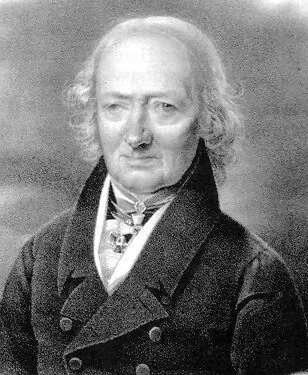
For a cluster this bright, M 92 was surprisingly late to be noticed. Clusters like M 13, M 5, M 4, and the great southern showpieces Omega Centauri and 47 Tucanae were all catalogued first — some of them mistaken for stars until someone looked more carefully. It wasn’t until 1777 that German astronomer Johann Elert Bode recorded M 92, and a few years later Charles Messier added it to his famous list of “fuzzy things that aren’t comets.” William Herschel, with his more powerful telescope, resolved it into individual stars in 1783. And then, for the most part, the world moved on to its neighbor and forgot about it.
Finding M 92
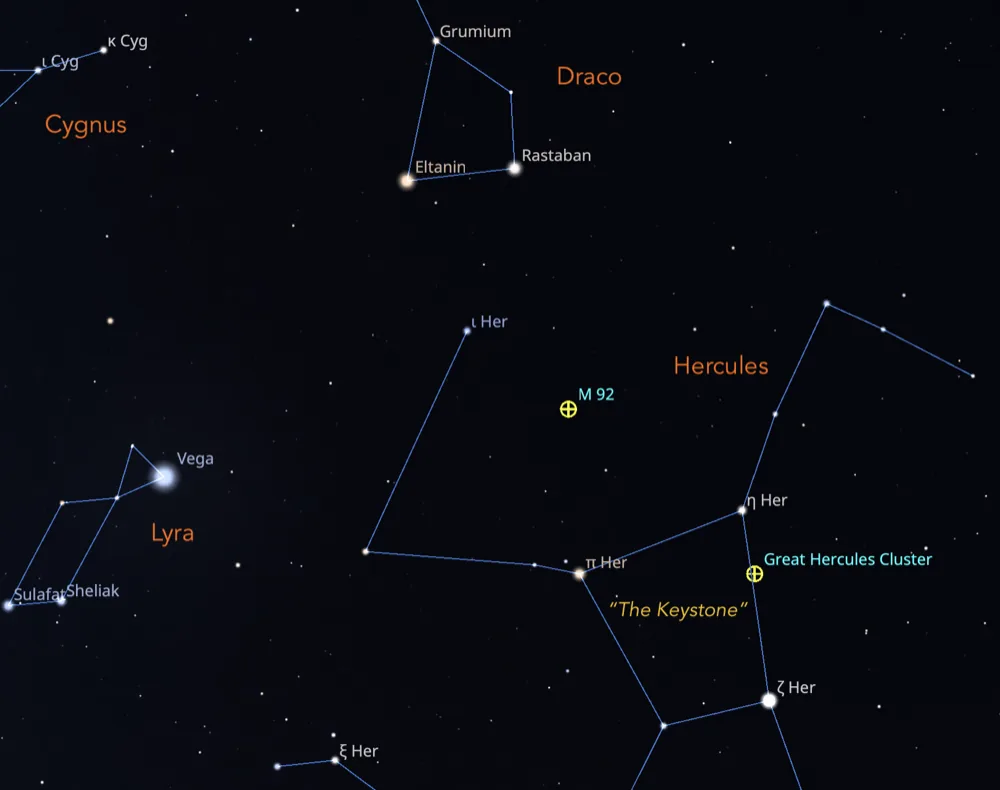
M 92 lies between the northern stars of the “Keystone” asterism — the four-star trapezoid that forms the body of Hercules — and the head of Draco. On a dark summer night at mid-northern latitudes, Hercules climbs nearly overhead, and M 92 is well-placed for hours. Sweeping from the Keystone northward, you’ll hit a faint smudge even in light-polluted skies. In a small scope, a soft glow with a brighter core. In a larger one, a brilliant, tightly-packed ball of stars, its dense center compressing into a blaze of light.
Globular Clusters: Fossils of the Early Universe
Globular clusters are among the oldest structures we know of. Unlike the loose, temporary associations of stars that populate the disk of the Milky Way as open clusters, globulars are self-contained, gravitationally-bound spheres — sometimes with hundreds of thousands of stars held tightly together across a space of 50–200 light years. They formed when the universe was very young, before most of the heavy elements we take for granted (carbon, iron, oxygen) had been forged in stellar furnaces and scattered by supernovae. The stars within them are therefore “metal-poor” in astronomer’s parlance — made almost entirely of hydrogen and helium, the original stuff of the Big Bang.
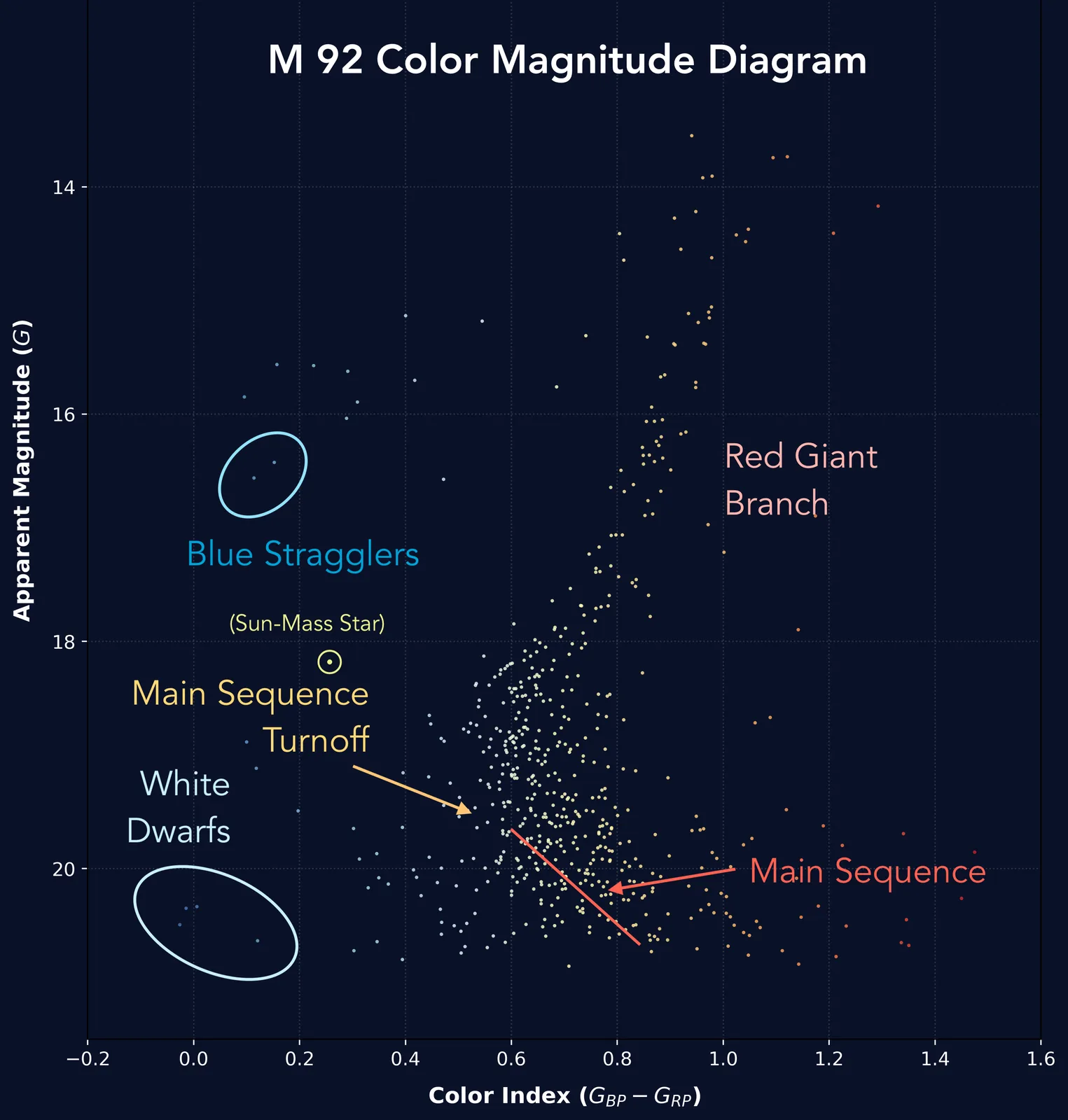
We can read a cluster’s age from its Color-Magnitude Diagram: a plot of each star’s brightness against its color. In a young cluster (like the Pleiades), brilliant blue stars dominate. In an old one, those massive stars have long since burned out, leaving only the long-lived low-mass stars, many of which have now swelled into orange and red giants. M 92’s diagram tells a stark story: at an estimated 14.2 billion years old (give or take 1.2 billion), it is one of the oldest known globular clusters.
Now you may have noticed that there’s something “wrong” about that age estimate since cosmologists have settled on the age of the Universe being about 13.7 Gyr. Clearly M 92 isn’t older than the Universe itself - that apparent “error” really means that our models still have work to do. But even among other globular clusters, M 92 is one of the oldest: the stars there formed when the Universe was much denser and very different than how we see it today.An Immigrant from Another Galaxy
Here is where M 92’s story gets extraordinary. For decades, astronomers assumed globular clusters formed with the Milky Way. We now know that’s only part of the picture.
Our galaxy has a history of cannibalism. The most famous example is Gaia-Enceladus, a dwarf galaxy that collided and merged with the Milky Way about 10 billion years ago — an event violent enough to leave permanent structural scars in our galaxy’s stellar halo, and to deliver a collection of globular clusters as spoils. But Gaia-Enceladus wasn’t the only victim. Evidence now points to an even earlier merger with a galaxy astronomers call Pontus, and M 92 is among the clusters believed to have arrived with it, along with M 13 in Hercules, M 30 in Capricornus, M 56 in Lyra, and NGC 288 in Sculptor, among others.
This means M 92 did not form here. It formed in another galaxy, orbited there for billions of years, and then — when its home was torn apart and absorbed — was captured into the Milky Way on a wide, eccentric orbit that carries it as far as 16,000 light years above the galactic plane. It is, in the truest sense, a visitor that never left.
What You’re Seeing in Your Image
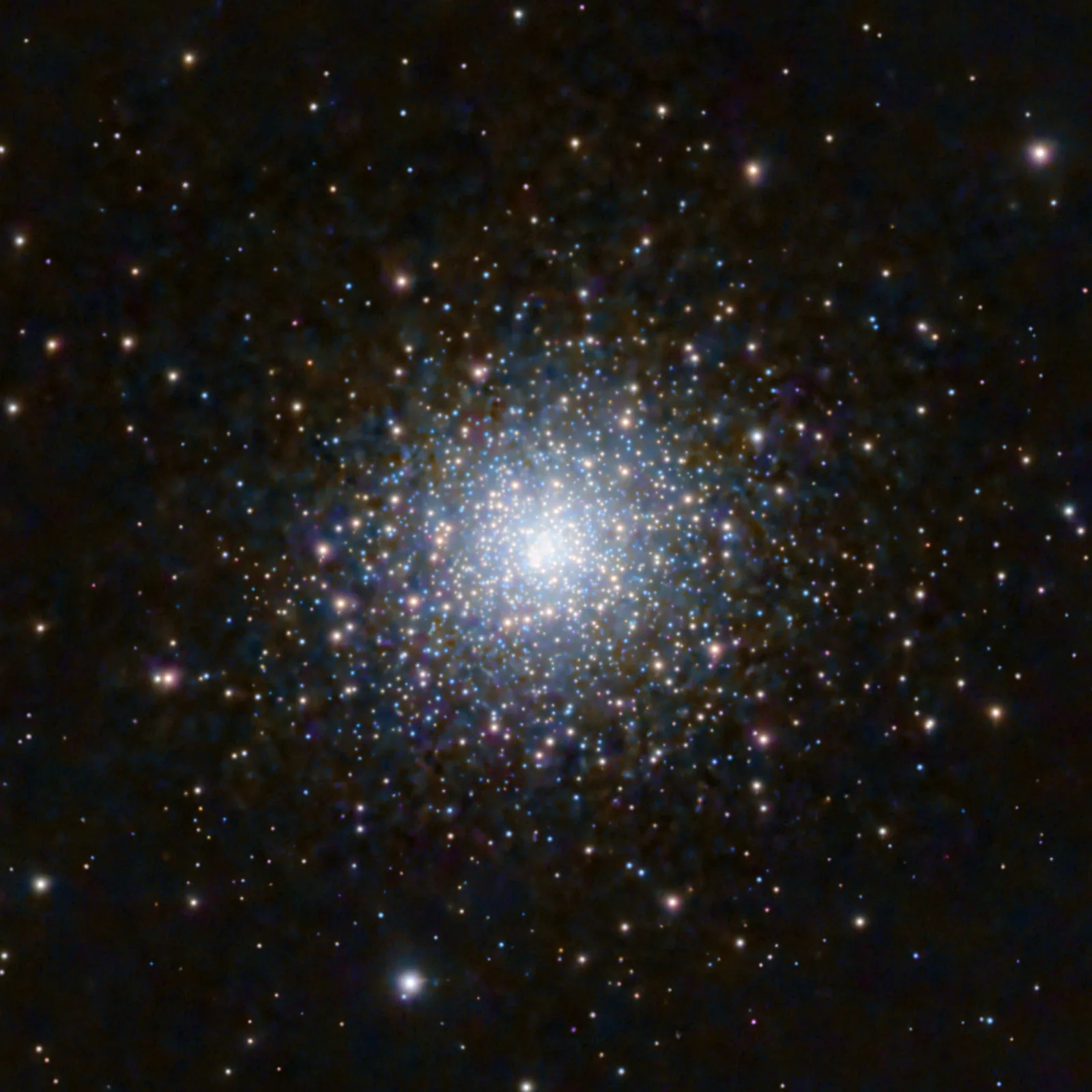
If you have a smart scope, M 92 is an easy target: even a short exposure reveals a surprising amount of information, and therefore much of its “story”. Here’s what to look for:
The Blazing Core
Compare M92’s center to M13’s in similarly-exposed images. M92’s core compresses into a concentrated, almost impenetrable ball of light more abruptly. This isn’t just optical overexposure — it’s structure. Over billions of years, a process called dynamical relaxation caused the heaviest stars to lose energy and sink toward the center, pushing lighter stars outward. The result is an exceptionally compact, luminous core — one of the most concentrated in the northern sky — without ever having undergone a true core collapse.
The Amber Giants
The brightest individual stars you can resolve — scattered across the frame, distinctly orange or yellow — are red giants: aging, low-mass stars swelling in the late stages of their lives. Their abundance, and the absence of brilliant blue stars, is your visual confirmation of M 92’s extreme age. The blue stars burned out billions of years ago. What remains is the patient, cooling remnant of an ancient stellar population. To put that in perspective, a star with the mass of the Sun would’ve expended its core hydrogen several billion years ago.
The Outer Fringe
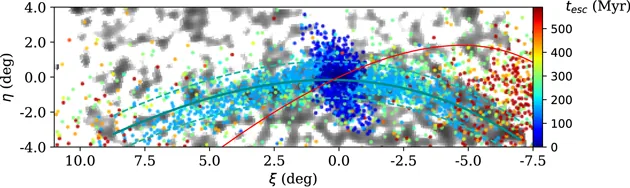
Look at the very edge of the cluster, where stars fade into the background. Rather than a perfectly smooth, uniform taper, the outermost stars show a subtle elongation or asymmetry. This is the Milky Way’s gravity at work — our galaxy’s tidal forces gently tugging at the outer layers of M 92, teasing individual stars away into the galactic halo. You are watching, in the long slow frame of astronomical time, the gradual dismantling of a cluster that outlived its home galaxy.
(Look closely — M 92 is slightly flattened rather than perfectly round. The elongation runs roughly WNW–ESE on the sky, though with north not straight up in the image it takes a moment to find.)
The Blue Stragglers
A Relic Worth a Second Look
M 92 might be in M 13’s shadow in the popular imagination — it has numbers against it, and real estate. But consider what you’re actually looking at: a cluster possibly older than our Milky Way Galaxy itself, born in another galaxy, captured in a collision ten billion years ago, carrying in its ancient stars the full biography of the early universe. It orbits our galaxy like a ghost from the before-times, and if you look at its edges, you can see our own galaxy slowly, patiently taking it apart.
The “North Cluster”
But! It might not always be the “other” Hercules cluster!
About 14,000 years from now, because of precession, the North Celestial Pole will pass within 0.6° of M 92; in 2026, Polaris is also about 0.6° from the NCP. So for some time, we won’t have a “North Star” so much as a “North Cluster” - and maybe M 92 will finally gain some well-deserved renown.
But until then, point your scope a few degrees north of the Keystone. Give the “Other Hercules Cluster” its due.