Introduction
The dizzying orbital motions of the eight primary planets presents a never-ending game of watching them traverse across the sky, watching them disappear behind the Sun and then wondering “when will they come back?”
Say Goodbye! to Venus and Jupiter
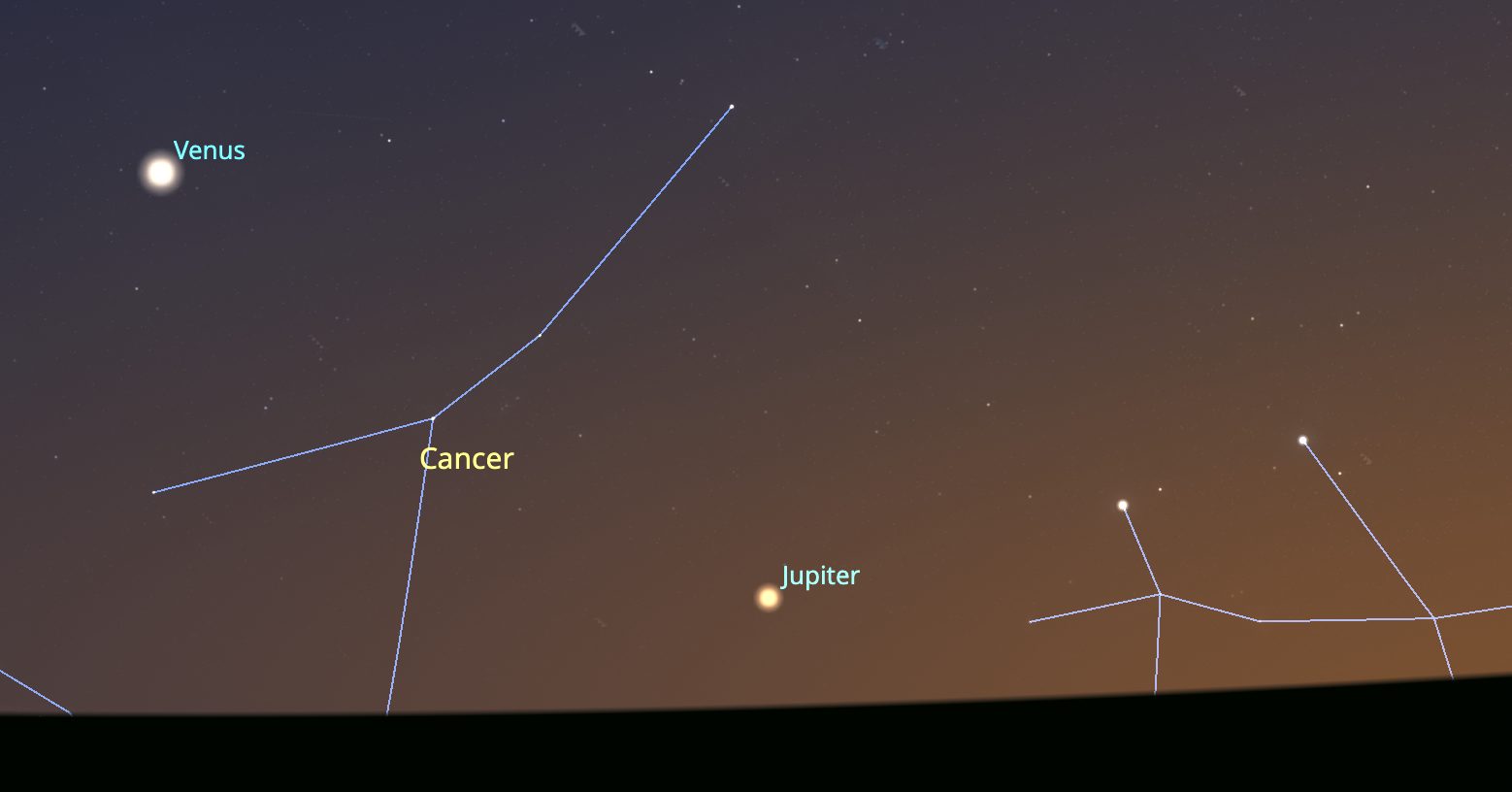
If you’ve been enjoying that brilliant pair hanging in the western sky after sunset, take a good look now — Jupiter is almost gone. By July it disappears behind the Sun entirely, and won’t be back in the evening sky until late in the year. Catch it while you can: on the 29th at 9:30 PM it’s barely above the horizon, already fading into the twilight glow.
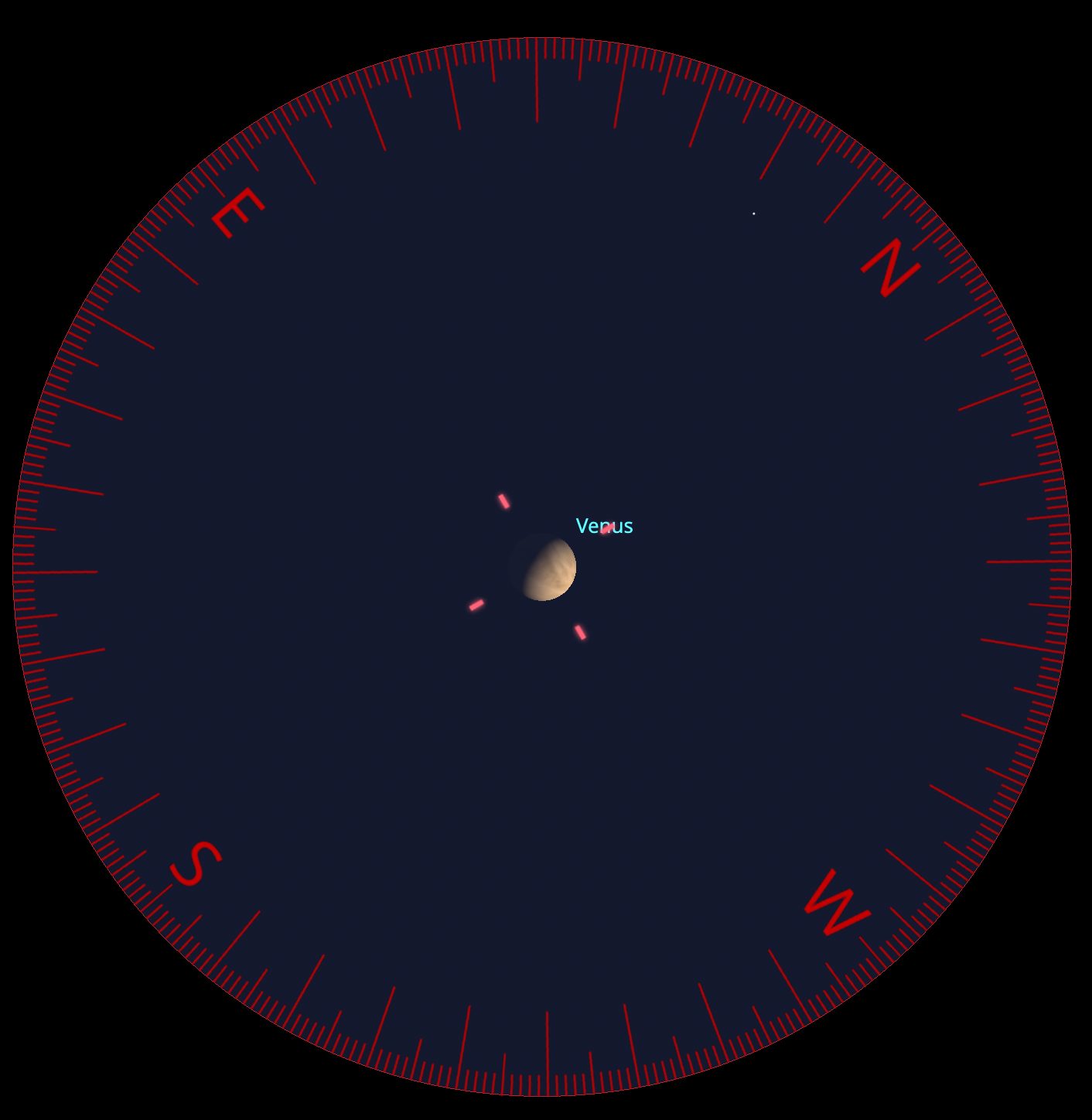
Venus lingers a little longer. It’s still setting after 10:30 PM through early summer, though it too is sinking closer to the horizon each night. In a telescope it’s currently in its gibbous phase — fuller and smaller, like a miniature full moon — but that’ll change as the summer progresses. As Venus swings closer to Earth on its inner orbit, it’ll grow larger and thinner, stretching into a crescent. The trade-off: the view gets more dramatic just as Venus gets harder to observe, dropping lower into the haze each week. Worth checking in on every few nights to watch the transformation.
Say Hello! to Saturn and Neptune
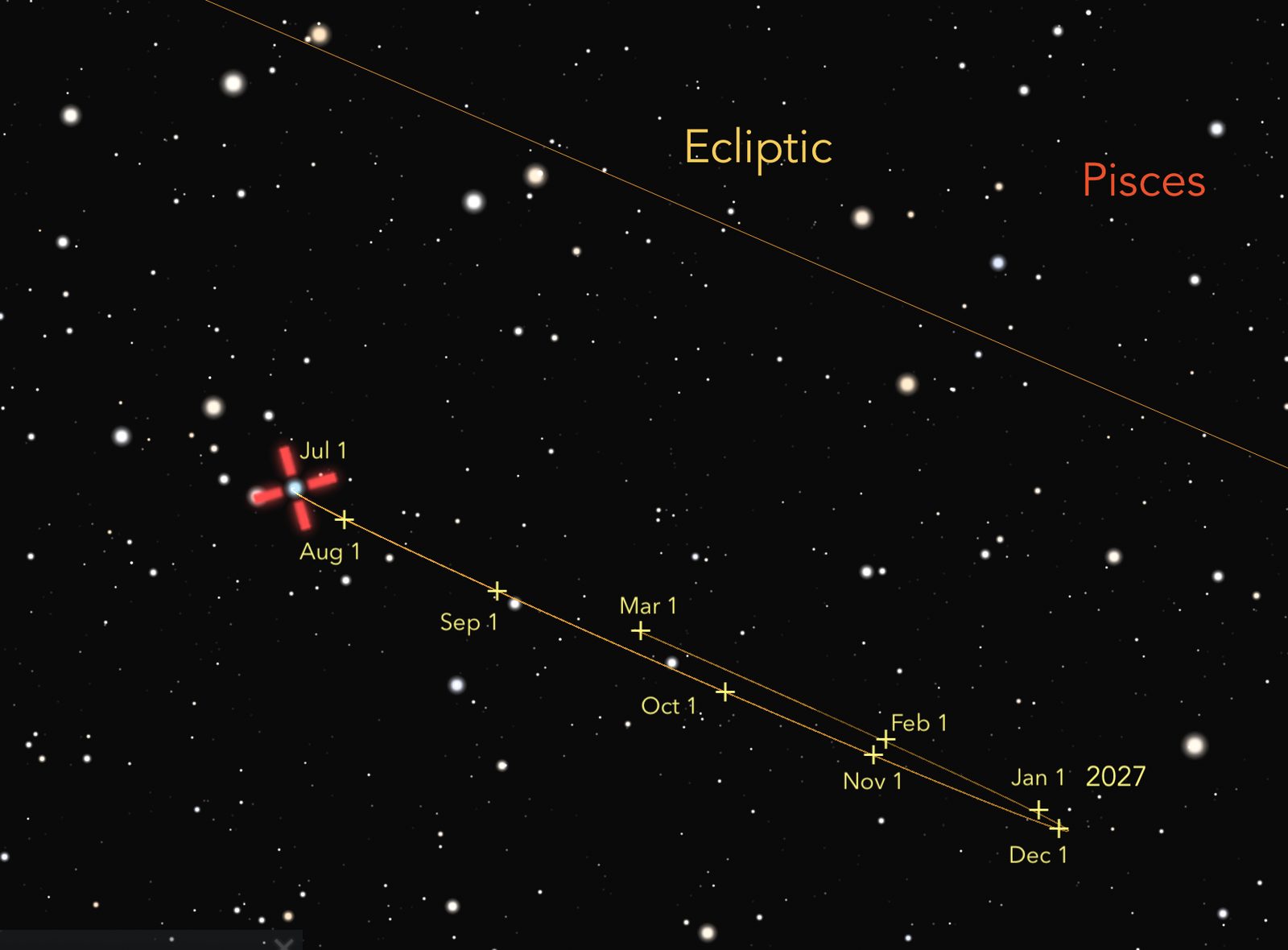
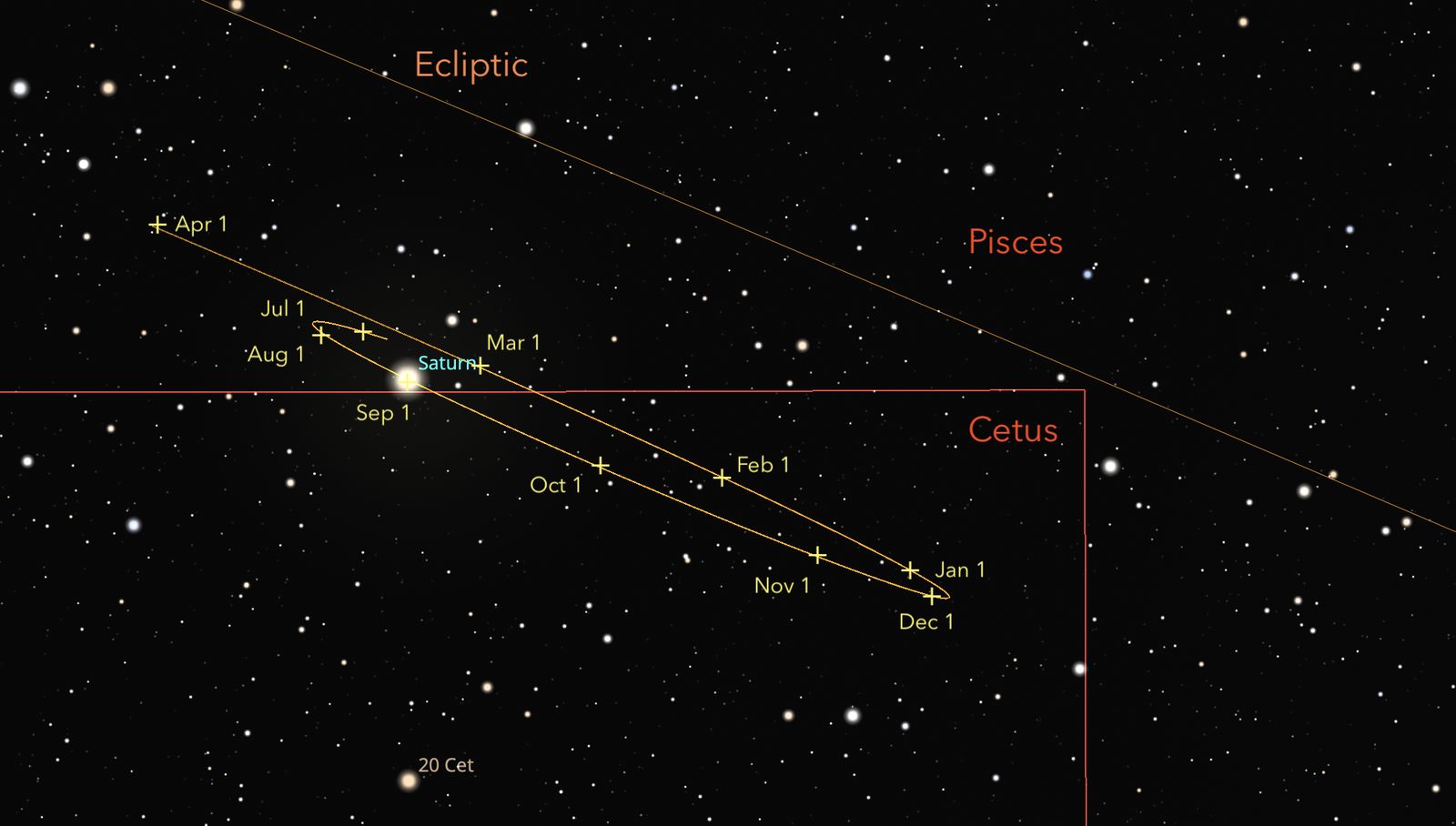
Saturn is back. After spending time as a morning object, it’s now rising earlier each evening and making itself at home in the fall sky. Better still: if you’ve looked at Saturn over the last couple of years and wondered why the famous rings seemed so thin, this year they’re opening back up again, tilted more toward us and unmistakable even in a small telescope. It’s worth pulling out the eyepiece just for that.
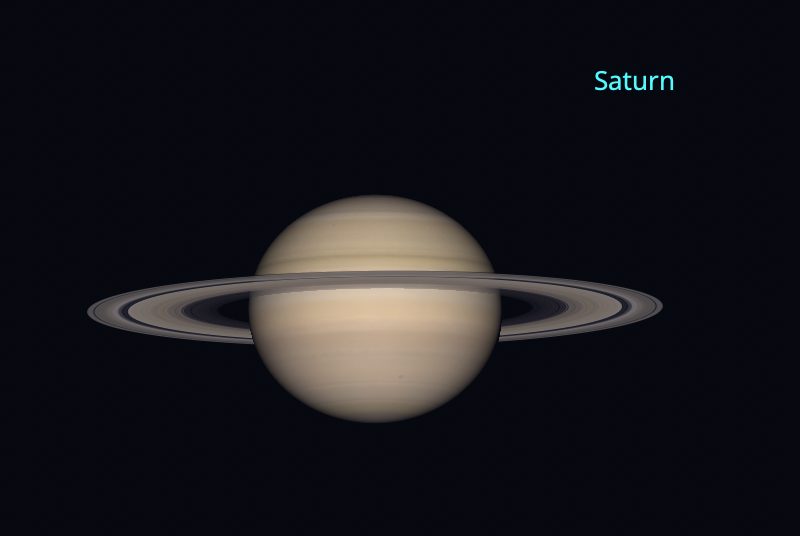
For the rest of this year, Saturn is mostly in Cetus and Pisces. Why Cetus? This is an artifact of the IAU’s definition of constellation boundaries - parts of the sky now ceded to Cetus come really close to the Ecliptic, and since each planet has it’s own orbital inclination they will drift above and below the Ecliptic slightly in their orbits as seen from the Earth.
Nearby — though you’ll need binoculars or a telescope to confirm it — Neptune has been keeping Saturn company through a series of close conjunctions over the past year. The two are now slowly drifting apart as Saturn moves eastward through Pisces. Neptune itself is a tiny blue-gray dot, magnitude 7.8, and won’t reveal a disk without significant magnification. But finding it next to Saturn while you’re already set up is a satisfying double.
Mars Makes a Late Appearance
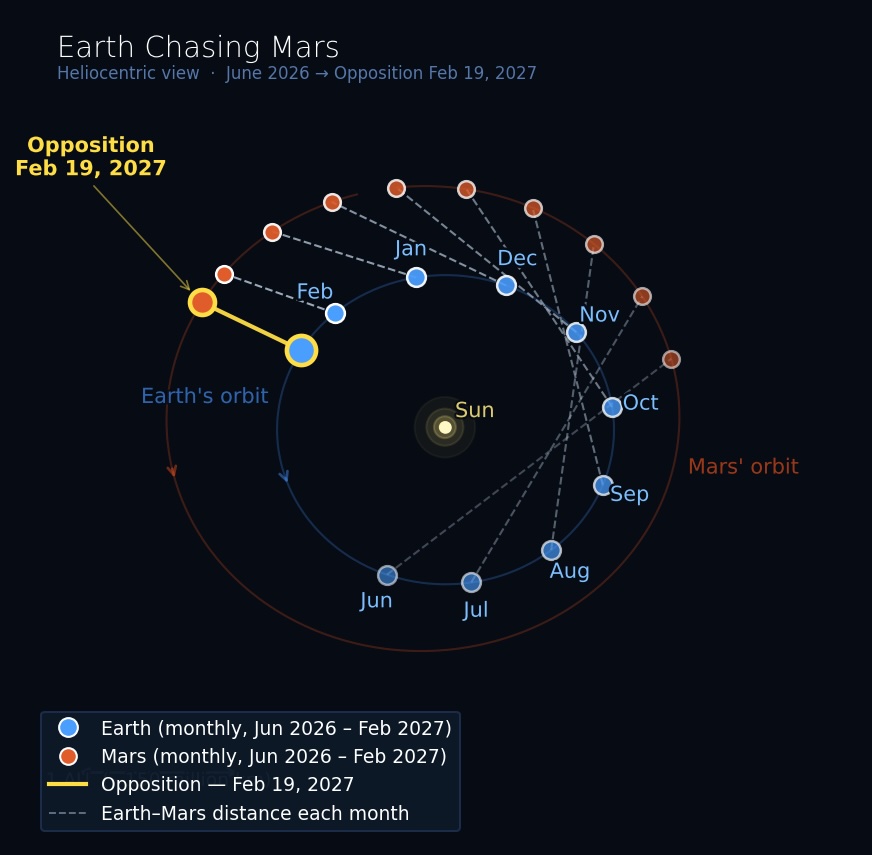
Mars is out there right now, but it’s making you work for it. For the next few months it doesn’t rise until around 4 AM — strictly pre-dawn territory. That’s the nature of where we are in the chase: Earth and Mars are on opposite sides of the Sun, and we’re slowly gaining ground.
Think of it as a footrace on a circular track. Earth laps Mars roughly every 26 months, and the moment we pass it — called an opposition — is when Mars is closest and biggest in the sky. Right now we’re still well behind, but closing. The diagram above shows the geometry month by month, with the gap between the two planets visibly shrinking as we approach February 2027.
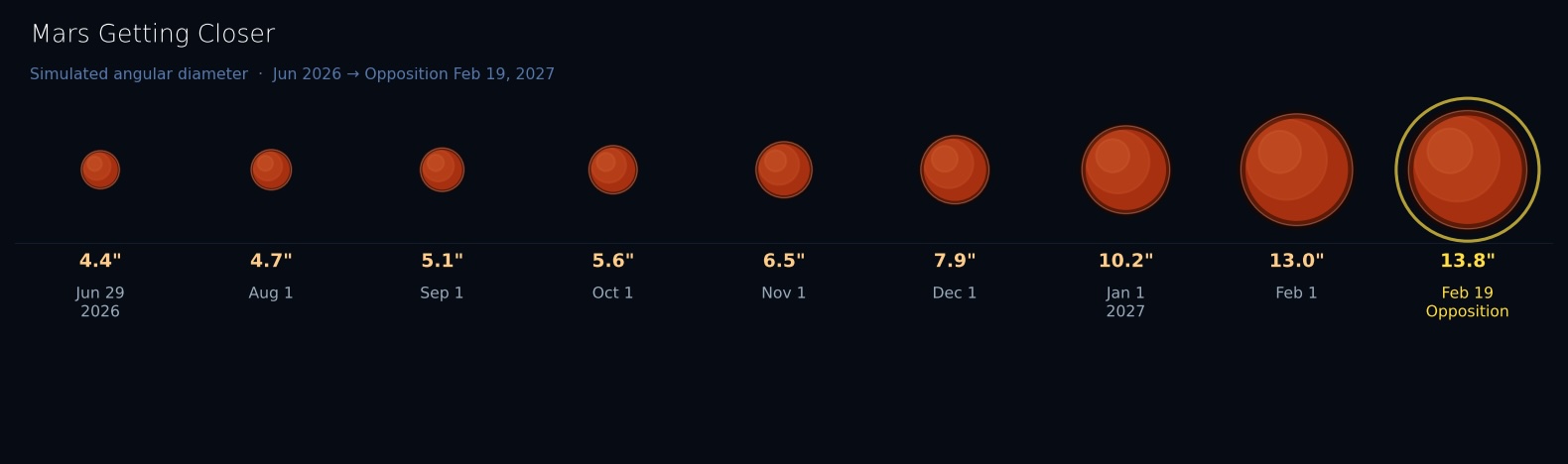
The progression is real and you can see it in a telescope. Mars is only about 4 arcseconds across right now — barely a dot. By opposition on February 19th it’ll be nearly 14 arcseconds, more than three times larger. The simulated disks above show exactly what to expect as the months tick by. It won’t become an evening object until late in the year, but when it does, the timing will be worth it.
One honest caveat: the 2027 opposition isn’t the best Mars has to offer. Because Mars has a noticeably elliptical orbit, some oppositions bring it much closer than others. The next really favorable one isn’t until 2035, when Mars will appear nearly twice as large. But that’s nine years away — and the one in February is still worth every cold morning between now and then.
Uranus — and a Piece of History
Uranus spends most of 2026 as a morning object, but by late fall it transitions to the evening sky — and when it does, it carries an interesting story with it.
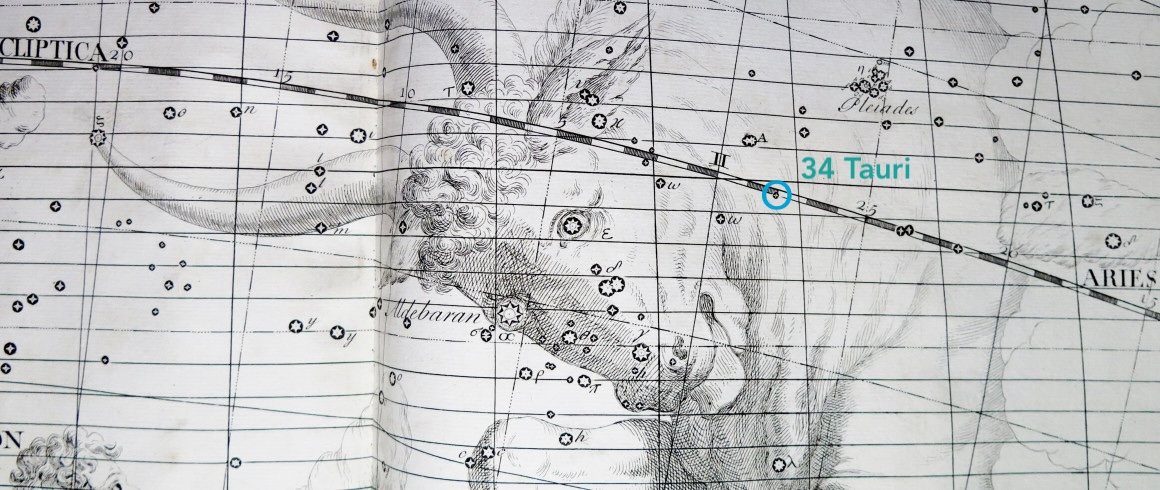
In December of 1690, the English Astronomer Royal John Flamsteed was methodically cataloging faint stars in Taurus, between the Pleiades and the Hyades. He noted a dim point of light and recorded it as “34 Tauri” — a perfectly ordinary entry in an extraordinary catalog. What Flamsteed didn’t know, and couldn’t have known, was that “34 Tauri” was no star. It was Uranus. The planet wouldn’t be formally discovered for another 91 years.
Mars and Uranus
Mars and Uranus - July 4, 4:30 AM
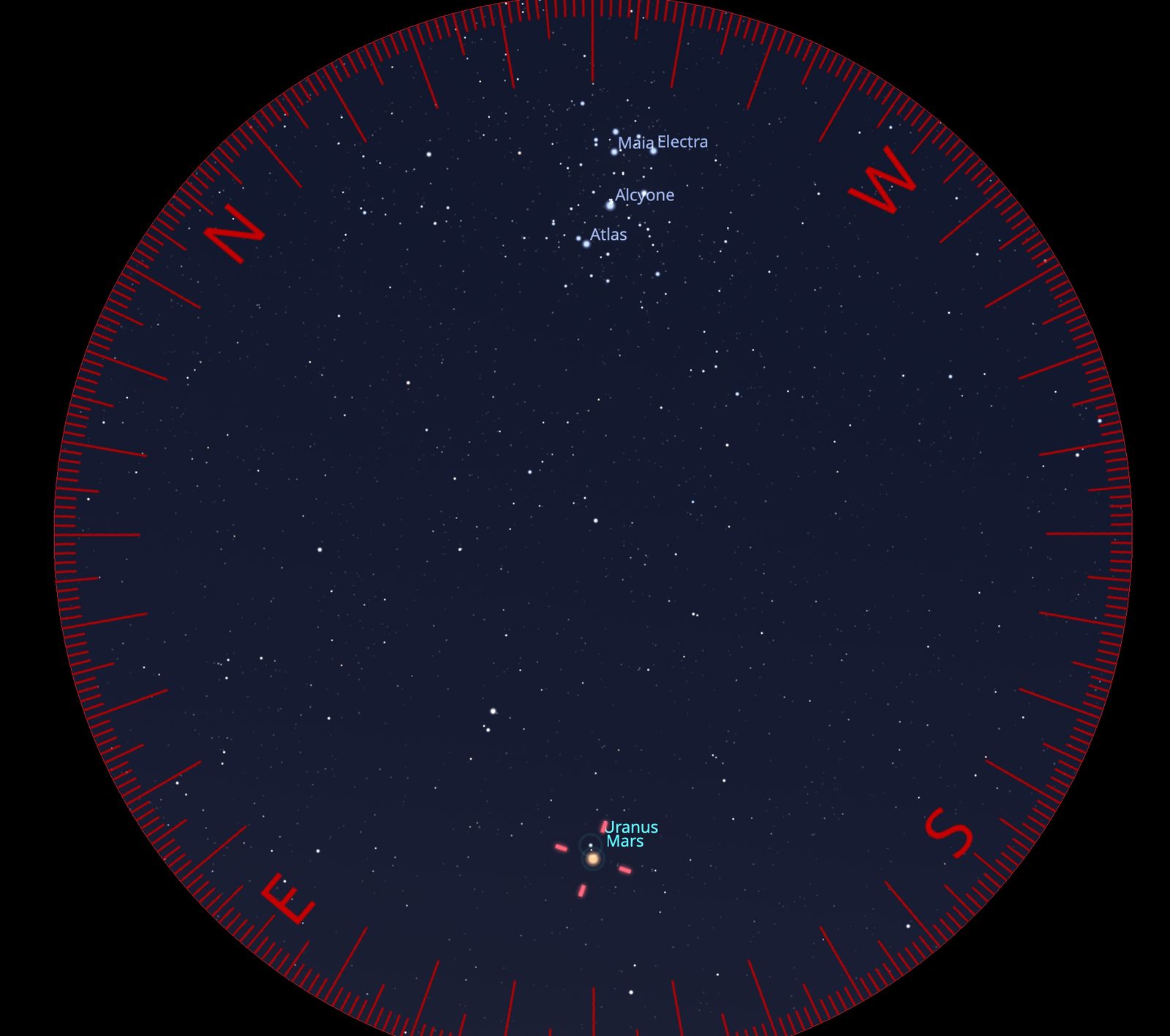
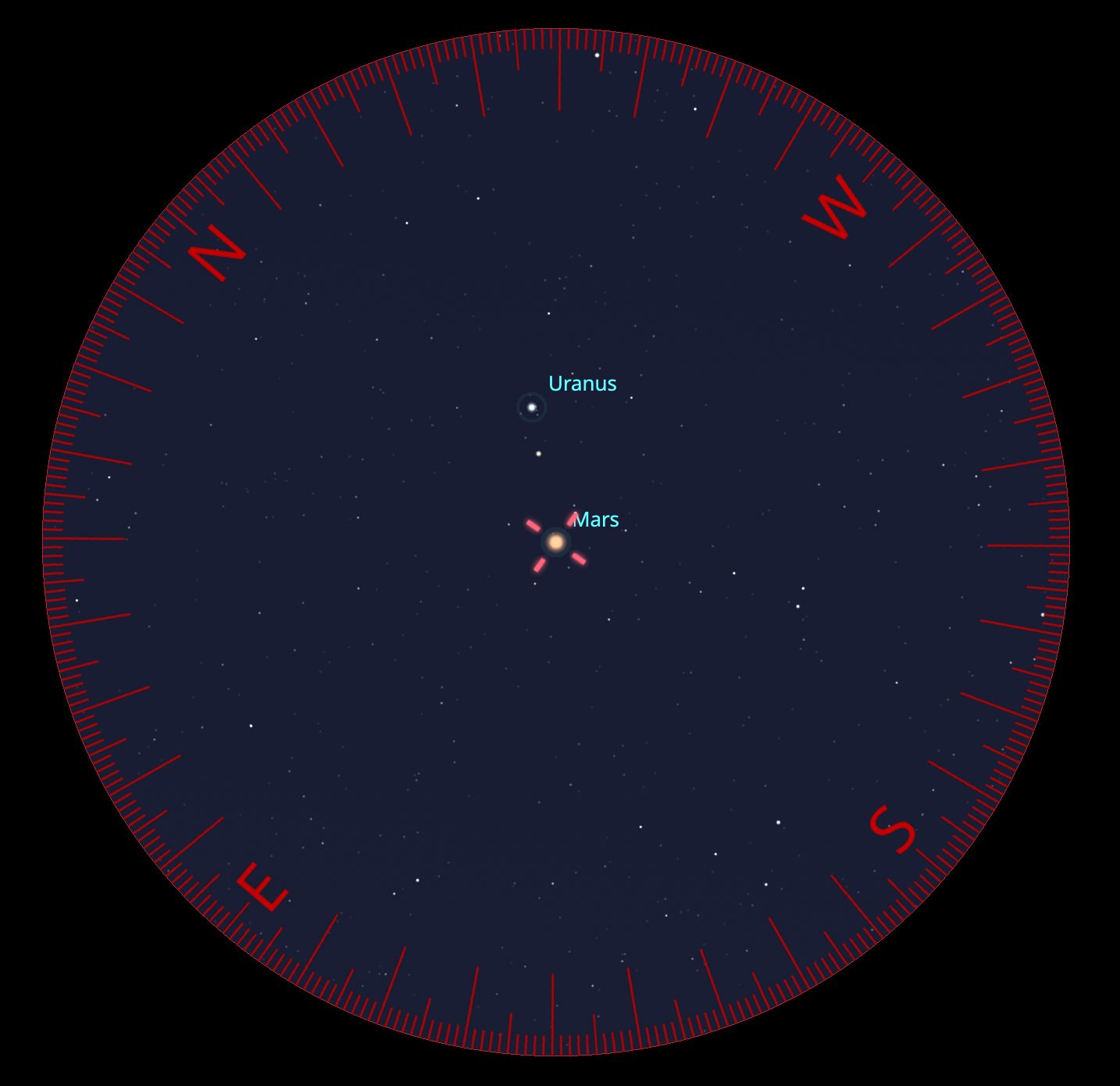
Before Uranus becomes an evening object though, there’s an early-morning opportunity worth the alarm clock. On the morning of July 4th, Mars passes within just 7 arcminutes of Uranus — close enough to fit both planets in the same low-power eyepiece. Mars, considerably brighter, acts as a perfect pointer: find the reddish dot, and the blue-green disk of Uranus is right beside it. The catch, as always with Uranus in summer, is altitude. At 4 AM the pair is only about 8° above the eastern horizon. You’ll need a steady atmosphere and a flat horizon, but if you get it, you’ll have both planets together in one view — with Mars passing through the very neighborhood where Flamsteed made his famous non-discovery 336 years prior.
Mercury - Elusive as Always
Of all the planets, Mercury is the one most likely to make you feel like you imagined it. It never strays far from the Sun, which means it’s always lurking in twilight — either just after sunset in the west or just before sunrise in the east, never fully clear of the glow. You get a narrow window, a low target, and the quiet satisfaction of knowing most people never bother.
Mercury reaches maximum elongation several times a year — alternating between the evening sky (eastern elongation) and the morning sky (western elongation). But not all elongations are equal. The angle of the ecliptic relative to your horizon determines how high Mercury actually gets, even at maximum separation. Some elongations lift it comfortably above the haze; others leave it practically skimming the rooftops. In 2026 there are six elongations in total, and for observers at northern latitudes, the two morning apparitions this summer and fall are the most favorable.
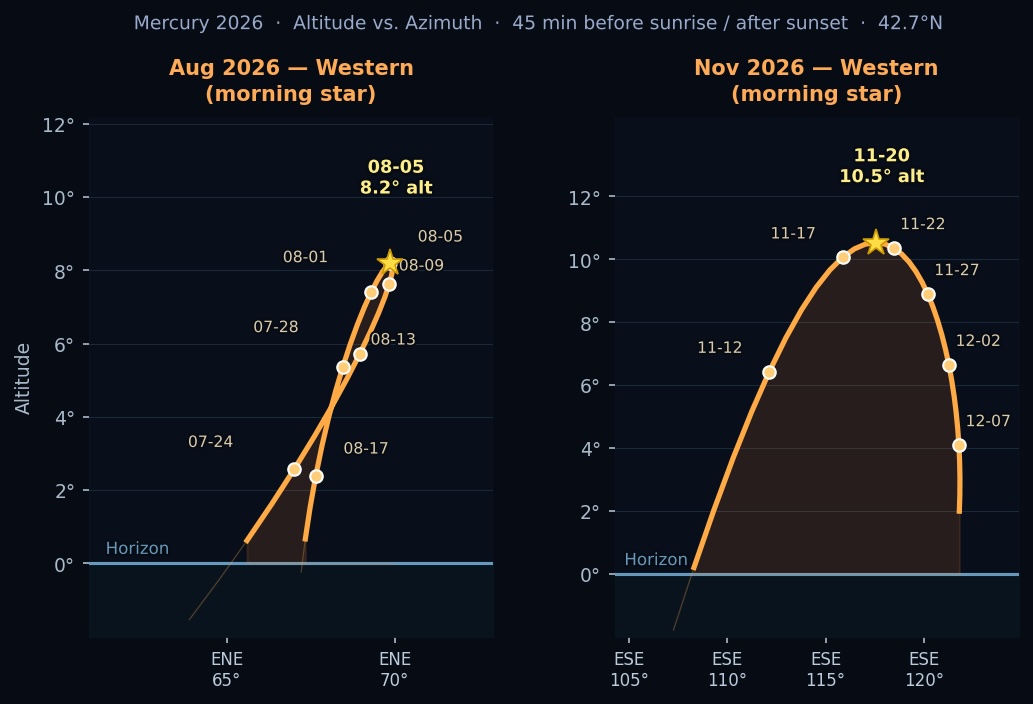
Both apparitions are morning events — set the alarm. The August window is brief and compact, peaking around August 5th at about 8° altitude in the ENE. It’s doable, but you’ll want a flat horizon and steady air. November is the better of the two: a broader arc peaking around November 20th at 10.5° in the ESE, with more time to find it before dawn washes it out.
The unusual shape of the August plot is worth a moment’s attention: Mercury barely drifts sideways during that apparition, rising and falling almost straight up and down. It’s a vivid reminder that maximum elongation and easy visibility aren’t the same thing. Neither apparition will knock your socks off — but that’s Mercury. Finding it at all is the reward.
The Living Sky
The thread running through all of this is motion. Not the static, catalog-it-and-move-on kind of astronomy — but the living kind, where what you see tonight is different from what you saw last month, and what you’ll see next year is different still. The planets are always going somewhere.
That motion, subtle at first and obvious over time, is what builds the connection. The first time you notice Jupiter is sitting a little lower than last week, or that Mars is visibly larger in the eyepiece than it was two months ago, something shifts. You’re not just looking at a bright dot anymore. You’re watching a world move through space in real time — and you’re moving too.
Flamsteed cataloged “34 Tauri” and moved on, not knowing what he’d seen. Three hundred and thirty-six years later, you can stand in your backyard on a November evening, point a pair of binoculars at Taurus, and find that same object — now knowing exactly what it is, watching it complete a journey Flamsteed couldn’t have imagined. That’s what a living sky does: it rewards people who keep showing up.
None of this requires a perfect dark site or an expensive telescope. It requires curiosity, a little patience, and occasionally a willingness to set an alarm. The planets don’t wait for ideal conditions — they just keep moving. Going out to meet them, on their schedule and yours, is what transforms a bright dot in the sky into something personal. Something you remember. Something that, over time, feels like it belongs to you.
Whatever your experience — a lifetime of observing or the first time you’ve thought to look up — you belong under these skies.