Every August, without fail, Earth sweeps through a stream of debris left by Comet 109P/Swift-Tuttle, and for a few nights the sky fills with quick streaks of light. We call it the Perseids, and it is the most reliably satisfying meteor shower of the year. In 2026 the conditions are about as favorable as they ever get: New Moon falls on August 12th — the very peak night — meaning the sky is moonless from dusk to dawn.
But before we get into the details, let’s talk about expectations.
What You’re Actually Going to See
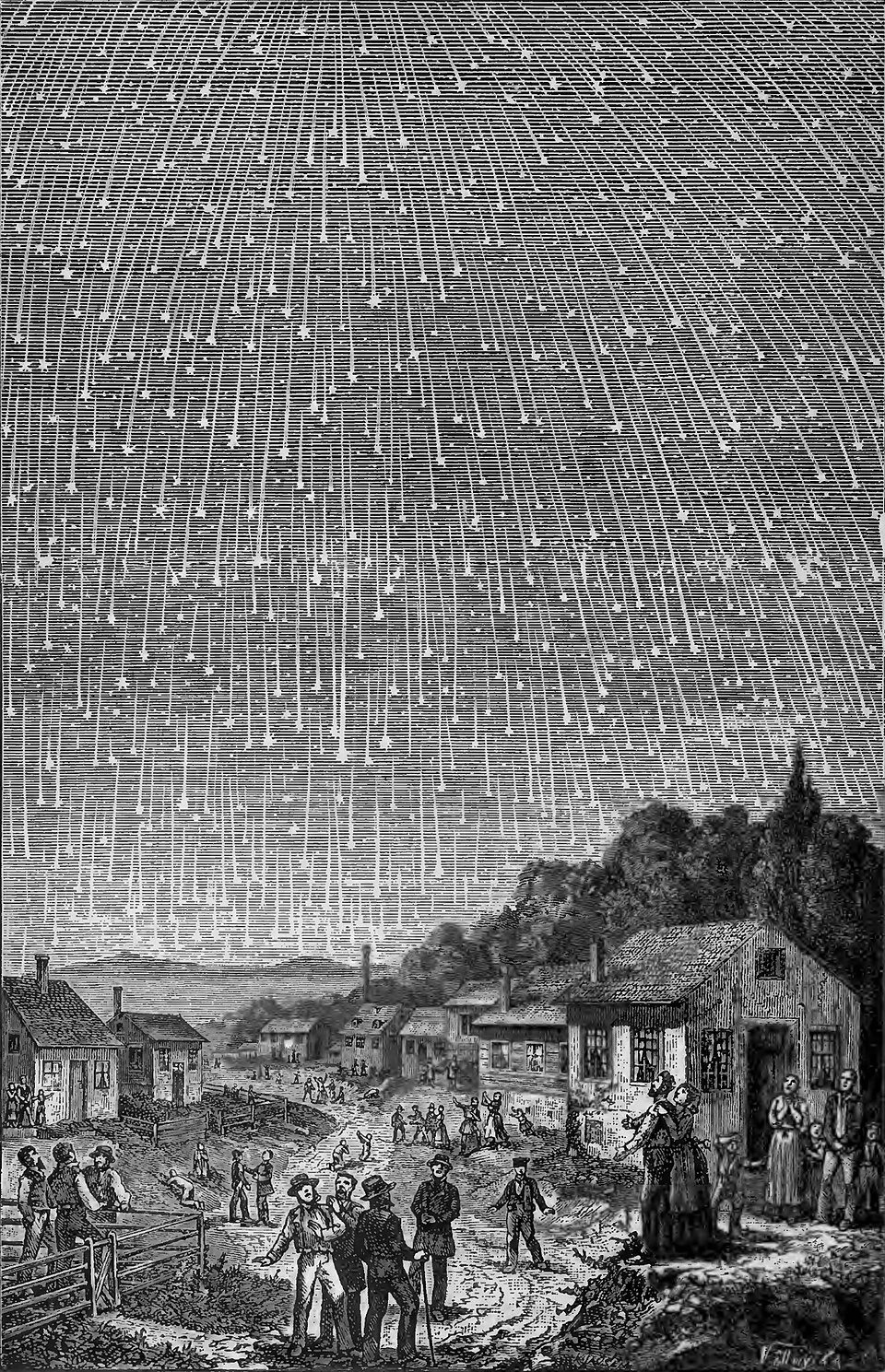
There is a famous engraving from the 1833 Leonids storm: people fleeing in terror from skies absolutely blanketed in meteors, like snow falling upward. That image lives in the cultural memory, and some part of people’s brains associates “meteor shower” with something like that.
The Perseids are not that.
At peak, under a truly dark sky — rural, no Moon, minimal light pollution — you might see around 90 meteors per hour. That sounds like a lot. Do the math: it’s roughly 1.5 meteors per minute. In practice, you’ll have quiet stretches of two or three minutes, then three show up in rapid succession. You’ll spend a lot of time staring at a beautiful, dark, star-filled sky. That is not a bug. The experience of a meteor shower is watching the sky — and occasionally being rewarded by a streak of light, or a fireball that makes everyone around you say whoa.
From a suburban dark site, expect 40–60 per hour. From a city park, maybe 10–20. The most important variable, more than any other, is darkness.
Manage your expectations, then go anyway. Once you’ve seen a bright Perseid fireball leave a glowing smoke trail that drifts and twists in the upper-atmosphere winds for a full minute after the streak has faded — you’ll understand why people come back year after year.
About the Source: Comet 109P/Swift-Tuttle
The Perseids are the oldest reliably recorded meteor shower in history. Chinese astronomers documented the annual “rain of stars” from Perseus as early as 36 BC, and observations appear regularly in Korean and European records across the following two millennia. The shower has been falling every August for as long as people have been writing down what they saw in the sky.
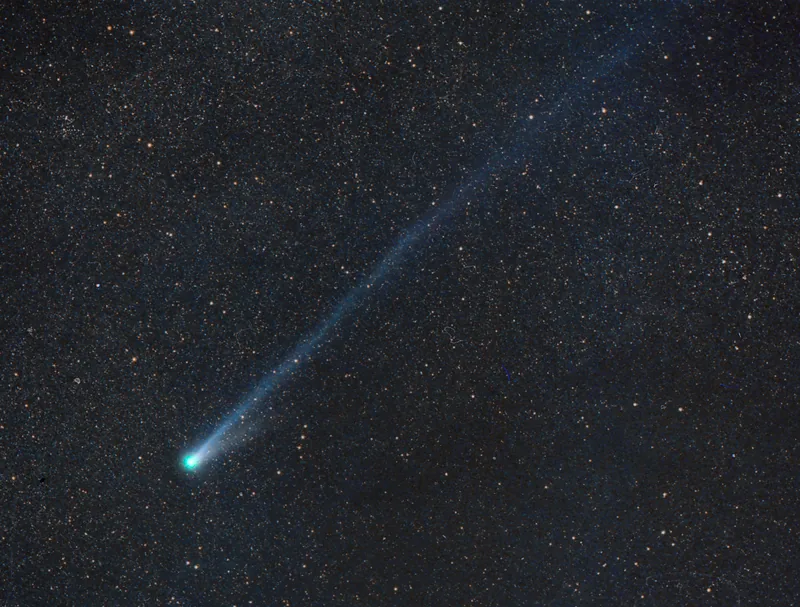

Swift-Tuttle orbits the Sun roughly every 133 years. It last swung through the inner solar system in 1992 — the first return since its discovery — and when orbital calculations came back, there was briefly a concern: it appeared to have a small but real chance of hitting Earth on its 2126 return. Further refinement ruled that out. The 2126 perihelion will be a close pass, not a collision, and the comet will be spectacular. The next Perseid peak after that return will see dramatically elevated rates as fresh material floods the debris stream.
Each time it comes through, it sheds material: dust, ice chunks, and rock fragments of all sizes. Over hundreds of orbits, this debris has spread all along the comet’s path. Earth crosses that path every August, scooping up particles that range from sand grains to pebbles. The particles we see burn up completely about 100 kilometers above the ground. What you see is the air around the particle glowing — like a very brief, very high-altitude lightning bolt.
An Unusual Orbit
What makes Swift-Tuttle remarkable — even among comets — is its orbit. Its eccentricity is 0.96, nearly identical to Halley’s Comet, meaning it follows an extremely elongated path: perihelion just inside Earth’s orbit at 0.96 AU, aphelion around 51 AU — further from the Sun than Pluto spends most of its time. For most of its 133-year journey, the comet is somewhere in the cold, dark outer solar system, invisible and unreachable.
More striking is its inclination: 113 degrees. Any inclination above 90 degrees means the object orbits retrograde — in the opposite direction to the planets. While Earth circles the Sun counterclockwise (as seen from above the ecliptic), Swift-Tuttle’s debris stream flows clockwise through the same region of space. When Earth plows through it every August, the encounter is nearly head-on. That’s why Perseid meteors hit the atmosphere at 59 kilometers per second — one of the highest entry speeds of any annual shower. The debris isn’t falling toward us; we’re colliding with it.
The high inclination also means the comet’s orbit is nearly perpendicular to the plane of the solar system. The standard top-down diagram of the solar system — everything orbiting in a neat flat disk — gives a completely wrong picture of how Swift-Tuttle moves. It barely touches that disk. It spends most of its orbit well above or below the ecliptic plane, crossing through the inner solar system almost like a needle passing through a page.
The interactive below makes the geometry tangible. Drag to rotate, scroll to zoom — tilt the view and the inclination becomes immediately obvious.
109P/Swift-Tuttle orbit viewer. NASA/JPL Small Bodies viewer via WGSBN-IAU.
Where did it come from? Almost certainly the Oort Cloud — the vast, spherical shell of icy bodies in the far outer solar system. Objects there can be nudged inward over millions of years by gravitational interactions: a passing star, the galactic tide, or a close encounter with a giant planet during an earlier pass through the inner solar system. The retrograde inclination is the key clue. Comets that have been repeatedly shaped by Jupiter encounters tend to end up in prograde, low-inclination orbits. A retrograde, steeply inclined orbit like Swift-Tuttle’s suggests something that arrived from the Oort Cloud with its original trajectory largely intact, modified just enough to settle into a regular 133-year period. The exact history isn’t known — and may never be.
Why 2026 Is a Good Year
Meteor showers happen every year, but the Moon doesn’t cooperate every year. In 2025, the Moon was near full during the Perseid peak, washing out all but the brightest meteors. In 2026, New Moon falls on August 12th at 5:37 PM UTC — just hours before the predicted peak. Both prime viewing nights (August 12–13 and 13–14) will have completely dark skies from dusk to dawn.
This is the best Perseid year since 2018, which also had a new moon near the peak. The next equivalent conditions won’t occur until 2029.
When to Watch
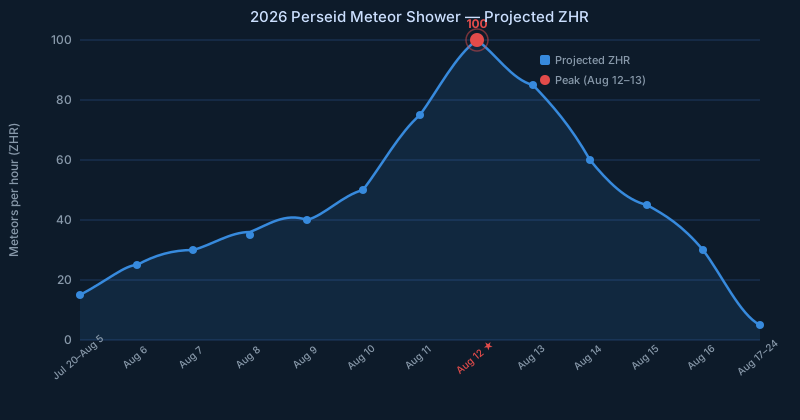
The Perseids are technically active from July 14th through September 1st, but rates are low near the boundaries. You’ll notice a clear uptick beginning around August 10th, building to the peak on the night of August 12–13.
The predicted peak is around 14:53 UTC on August 13th — late night August 12th for North America. But “peak” in meteor showers is a broad plateau, not a sharp spike. The night of August 11–12 will also be excellent, with roughly 50–70% of peak rates.
The best hours any night are from midnight through astronomical dawn (around 4–5 AM local time). Two things happen after midnight that matter enormously.
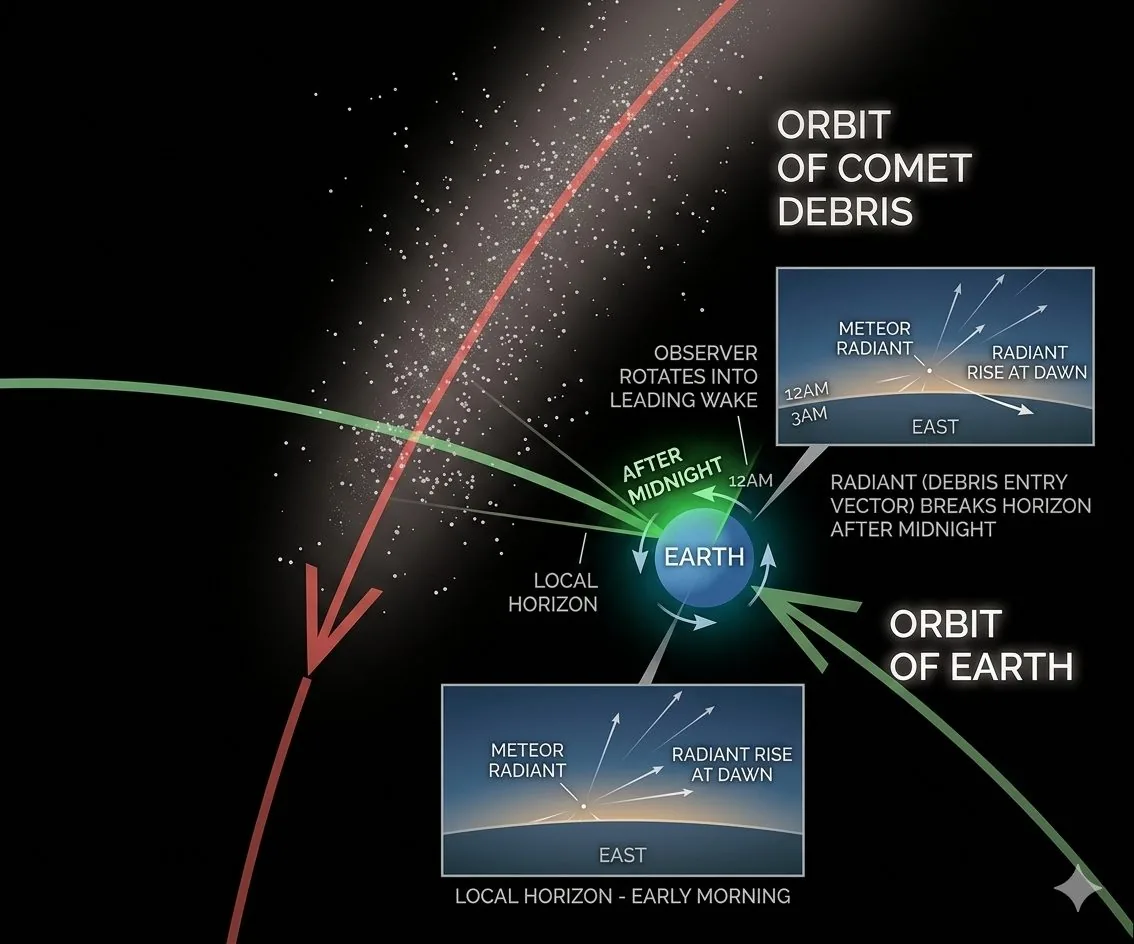
First: the radiant rises higher in the sky, so meteors travel longer paths across your field of view, producing longer, more dramatic trails. Second — and this is the physics that makes the difference — after midnight you’re on the forward-facing side of Earth, sweeping directly into the debris stream rather than letting it catch up to you. It’s the difference between a car driving into rain versus sitting still. Rates from midnight to 4 AM can be two to three times higher than rates at 10 PM. The radiant (the direction the debris is coming from) breaks the horizon after midnight, which is why the Perseids appear highest in the pre-dawn sky.
Where to Look
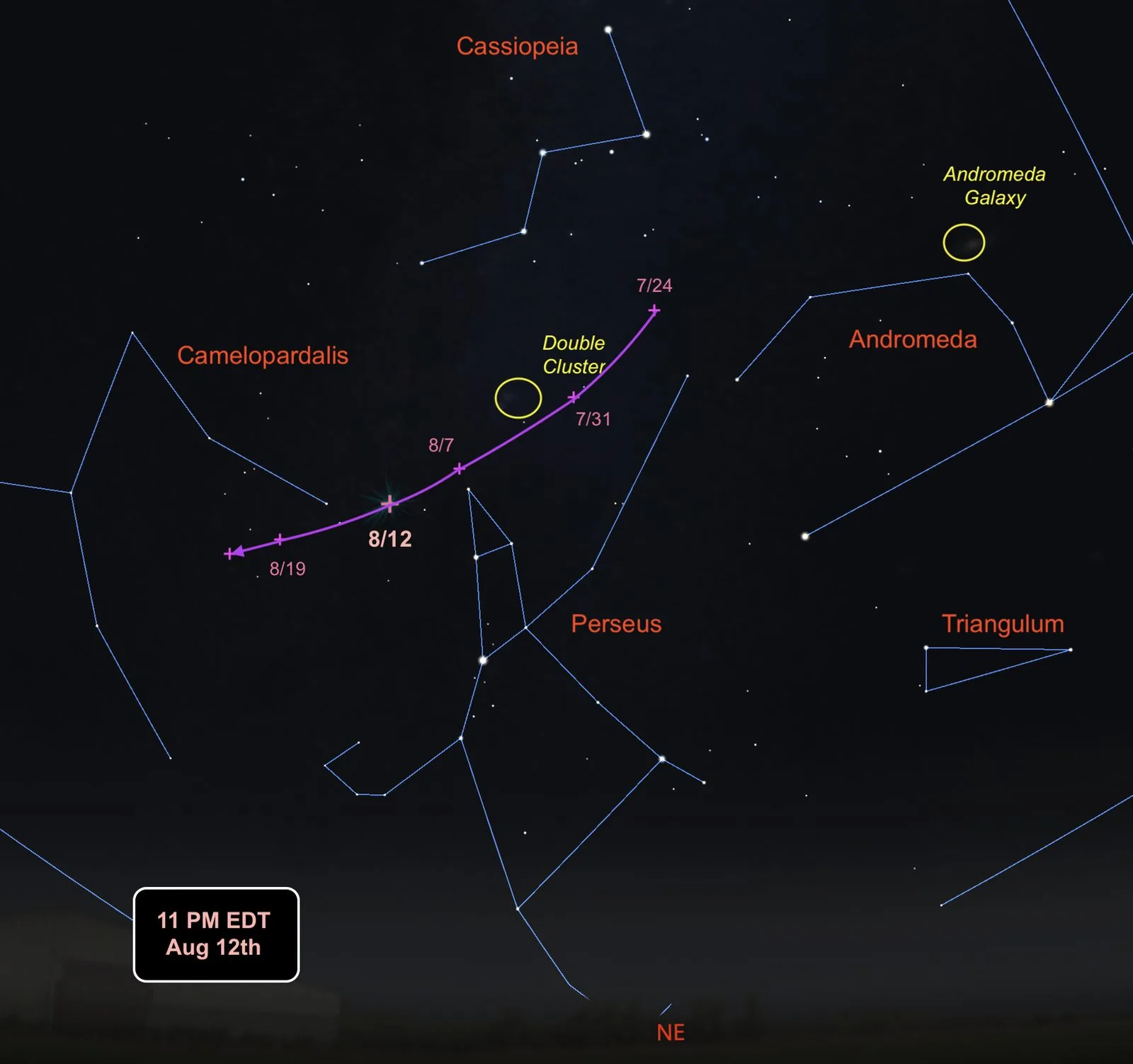
The radiant — the point in Perseus from which all Perseids appear to originate — rises in the northeast around 10–11 PM and climbs toward the top of the sky by dawn. Its exact position is near the famous Double Cluster (h and χ Persei), a pair of open clusters visible to the naked eye from a dark site and striking in binoculars.
The radiant also drifts slowly eastward over the weeks of the shower — you can see this in the chart above. From mid-July to late August, it moves several degrees as Earth crosses different parts of the debris stream. Near the peak (August 12–13), it sits right in the heart of Perseus.
Here’s a counterintuitive piece of advice: don’t stare at Perseus. Meteors very close to the radiant appear short — they’re coming nearly straight at you. The long, dramatic trails happen farther away, where the meteors cross your field of view at an angle. Look roughly 40 to 90 degrees from Perseus, and let the radiant sit at the edge of your peripheral vision.
If you have binoculars and find yourself in a quiet stretch, the map gives you two bonus targets in the same neighborhood. The Double Cluster — the smudgy patch marked just north of the radiant — is two rich open clusters side by side, several hundred stars each; it’s one of the best binocular objects in the northern sky, and it’s already where you’re looking. A few degrees further east, the Andromeda Galaxy (M31) is the most distant thing visible to the naked eye — a faint oval that dark-adapted eyes can pick up directly once the sky is fully dark. Finding it in binoculars, knowing it’s two and a half million light-years away, is one of those moments.
You don’t need to know Perseus at all to enjoy the Perseids. Just face roughly northeast, recline so you can see a wide swath of sky, and wait.
How to Watch — Get Comfortable
This is the part people underestimate: the Perseids are an endurance event. The best viewing is between midnight and 4 AM. You are going to be lying still, in the dark, looking at the sky for two to three hours. Being comfortable is not a luxury — it is the difference between a wonderful memory and a miserable one.
What you need:
A reclining lawn chair or a sleeping pad on the ground. Staring straight up from a regular chair is unsustainable. If you can, lie flat on your back; if not, a lawn chair reclined to roughly 45 degrees is the next best thing.
A sleeping bag or heavy blanket, even in August. The temperature drops significantly after midnight, especially at altitude or in rural areas. What feels like a warm evening at 9 PM becomes genuinely cold by 2 AM. Dress much warmer than you think you need to.
A thermos of something warm. Coffee, tea, hot chocolate — a warm drink at 1 AM, under a dark sky full of meteors, is one of life’s more underrated pleasures.
What you don’t need:
A telescope. Binoculars. A star chart. Any previous astronomy experience. The ability to find Perseus. All of these things are nice but completely optional. The only equipment that makes a real difference is darkness — getting away from city lights.
Dark adaptation:
Your eyes need about 20 minutes to fully adjust to the dark. During that time, resist the urge to look at your phone — even a brief glance at a bright screen resets the adaptation clock. If you need to use your phone, switch it to red-light mode first. After 20 minutes in the dark, you’ll be amazed at how many stars you can see.
The rhythm of the shower:
Meteors don’t come at a steady rate. You’ll have quiet minutes — sometimes three or four in a row — and then two or three will appear in quick succession. This is normal. Don’t get discouraged during the quiet stretches. Sometimes a fireball — a meteor brighter than Jupiter or Venus — will suddenly light up the whole sky, and you’ll be very glad you were still looking.
What You’ll See
At peak rates, most meteors will be quick white or pale yellow streaks crossing a few degrees of sky in a fraction of a second. Faster meteors tend to be brighter and leave more dramatic persistent trains.
The trains are one of the Perseids’ signatures. A bright fireball will often leave a glowing greenish or orange tube along its path — ionized air that persists for seconds or even minutes. If you have binoculars handy (not for meteor-finding, but for this), swinging them to a fresh train can be spectacular: you’ll watch it kink and drift as upper-atmosphere winds pull it apart, sometimes leaving corkscrew spirals before it fades.
Colors in meteors come from two sources: the composition of the particle vaporizing, and the atmospheric gases being excited around it. Most meteors appear white, but bright fireballs often show distinct color — here’s a rough guide:
| Color | Source |
|---|---|
| White | Very high temperature; magnesium and iron burning |
| Yellow / orange | Sodium emission from the particle |
| Green | Magnesium vaporizing; also oxygen at altitude |
| Blue / violet | Ionized calcium and magnesium |
| Red | Nitrogen and oxygen in the lower atmosphere |
| Pink terminal flare | Mixed atmospheric gases at the end of a fireball |
Colors are subtle on faint meteors — most people just see white. But on a bright fireball, especially one that ends in a terminal flare, the color can be unmistakable. The persistent train that lingers after is usually green or orange, from the recombining ions in the meteor’s wake.
Photographing the Perseids
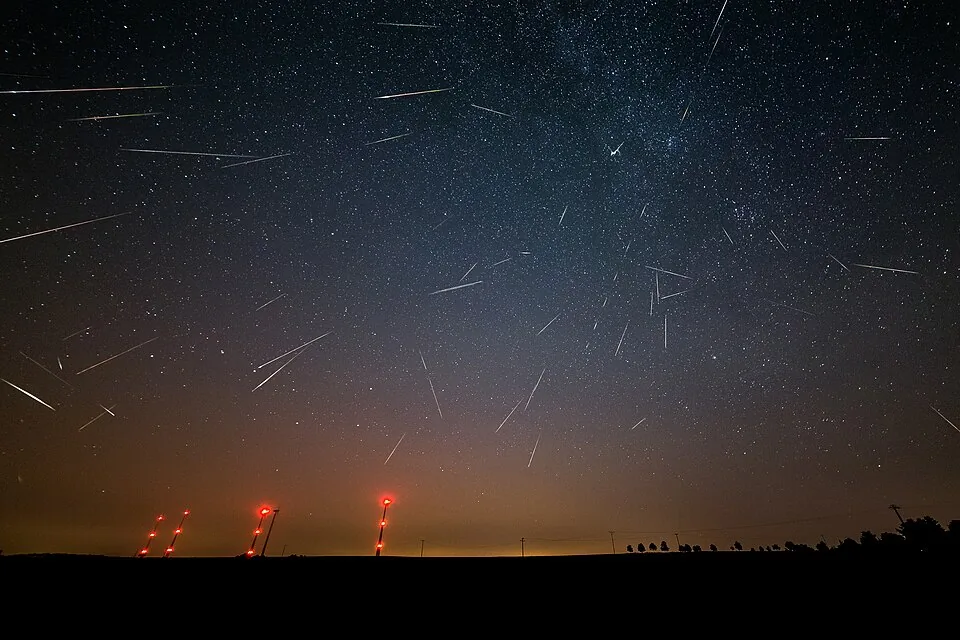
You don’t need to photograph them. Really. Put the camera down and just watch, at least for the first hour. But if you want to try:
DSLR or mirrorless camera:
You need manual controls, a wide-angle lens (14–24 mm is ideal), and a tripod. Set the aperture to f/2.8 or faster — f/1.8 or f/2.0 if you have it. ISO 1600–3200 is a good starting point; push to 6400 on a very dark site if your camera handles noise reasonably. Exposures of 15–25 seconds work well — long enough to catch a meteor, short enough to limit star trailing and sky glow accumulation. Focus manually: use live view, zoom in on a bright star, and dial to the sharpest point. Use a remote shutter release or intervalometer and shoot continuously all night. Most frames will be empty sky. One or two across the night may catch something spectacular. Shoot RAW if you plan to process later. And bring spare batteries — cold air and continuous shooting drain them fast.
Smartphone:
The challenge with phones is that “Night Mode” on most cameras stacks multiple frames to reduce noise — which smooths the background beautifully but completely erases a meteor that only appears in one frame. What you need is a single, long exposure.
On iPhone (12 Pro or later): use the ProRAW format and a manual camera app like Halide or NightCap, which let you set a fixed 15–20 second exposure instead of letting Night Mode stack frames. On Android, use Pro mode in the stock camera (Samsung, Pixel) or an app like Camera FV-5. Settings: widest aperture (most phones are f/1.8), ISO 800–1600, 15–20 seconds. A mini tripod or phone mount is not optional — hand-holding a 20-second exposure in the dark produces nothing useful.
Modern phone sensors have improved dramatically, but they’re still much smaller than a DSLR sensor. Expect more noise and less dynamic range. That said, a phone on a tripod, set correctly, can catch a fireball — especially one bright enough to light up the whole sky.
The new moon in 2026 means no lunar glow to wash out long exposures — ideal conditions for astrophotography of any kind.
If you get a fireball, report it to the American Meteor Society. Reports from multiple observers help triangulate the trajectory and sometimes identify meteorite falls.
Quick Reference
| Peak | Night of August 12–13, 2026 |
| Also excellent | August 10–14 |
| Best hours | Midnight – dawn |
| Moon | New Moon Aug 12 — dark all night |
| Expected rate | ~90/hr ideal; ~50/hr dark site |
| Entry speed | 59 km/s |
| Parent comet | 109P/Swift-Tuttle (next return: 2126) |
| Where to look | NE sky; 40–90° from Perseus |
| Equipment | None needed |
| Wear | Warmer than you think |
Years from now, the people who will say “I was there for the 2026 Perseids” are the ones who grabbed a blanket and went outside. The conditions won’t be this good again for years. Go find a dark field, lie back, and look up.
Clear skies.