
Introduction
Quick: name the second-closest star system to the Sun.
Most people get the first right — Alpha Centauri. The second-closest gets far less attention, and it’s not hard to see why: Barnard’s Star is a faint red dwarf, magnitude 9.5, far too dim to see naked-eye even though it’s just under 6 light years away. You’ll need a telescope and a finder chart.
And yet it may be more famous among astronomers than almost any star you can actually see. It holds a speed record. It sits at the center of one of the great cautionary tales in exoplanet hunting. And it offers a payoff that has nothing to do with the night you observe it, and everything to do with how patient you’re willing to be.
A Star That Doesn’t Sit Still

In 1916, American astronomer E.E. Barnard was comparing photographic plates of the same patch of sky in Ophiuchus, taken decades apart. One faint star had moved — an unmistakable, real shift, season after season. Tracing it back through Harvard College Observatory plates, he found the same drift going back to 1888.
The number he measured was 10.3 arcseconds per year, smashing the previous record of 8.7 arcseconds and still the largest known proper motion of any star in the sky.
Ten arcseconds is invisible on a single night, but add it up over a human lifetime and it comes to about a quarter of a degree — half the width of the full Moon. The reason isn’t that Barnard’s Star is unusually fast through space; plenty of stars move as fast or faster in real terms. It’s simply close. The nearer something is, the more its true motion translates into apparent motion across our sky, the same way a low-flying plane sweeps overhead in seconds while a high-altitude jet barely crawls.
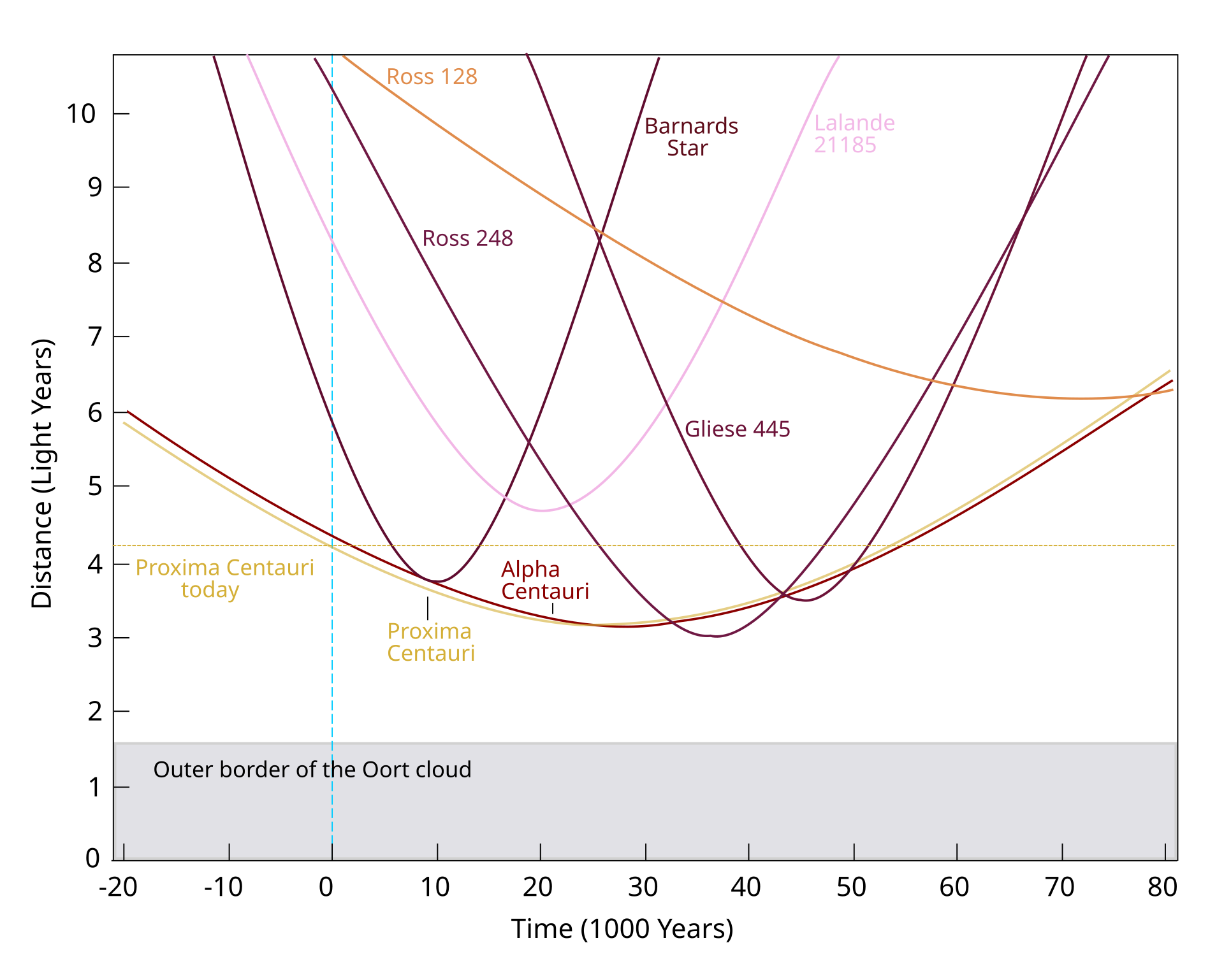
That same motion has one more consequence: Barnard’s Star is genuinely getting closer. Around 11,800 CE it will reach its closest point to the Sun at roughly 3.8 light years — by complete coincidence at almost exactly the same moment Alpha Centauri arrives at that same distance from the opposite direction. For a brief window ten thousand years from now, our two nearest stellar neighbors will be running neck and neck. Proxima, for what it’s worth, holds the title of closest star throughout — it passes even closer, around 3 light years, but not for another 15,000 years beyond that.
A Century of Phantom Planets

A star with that much measurable motion is an obvious place to look for something extra: the subtle wobble a planet’s gravity would impose on top of the star’s drift. Astronomers have been trying for over sixty years, and the story is as good a lesson in scientific humility as you’ll find anywhere in astronomy.
Act One. In the 1960s, Peter van de Kamp, working from decades of his own photographic plates at Sproul Observatory, announced he’d found a Jupiter-sized companion — later revised to two planets. He became something of a celebrity over the claim. The problem: nobody else could reproduce the wobble. Follow-up work in the early 1970s traced it to periodic adjustments made to the observatory’s own telescope lens. Van de Kamp never fully accepted this, but the community moved on.
Act Two. In 2018, a new team using the radial-velocity method announced a candidate super-Earth on a 233-day orbit. This one held up for a few years before a team with the Habitable-Zone Planet Finder concluded the signal was stellar surface activity mimicking a planet.
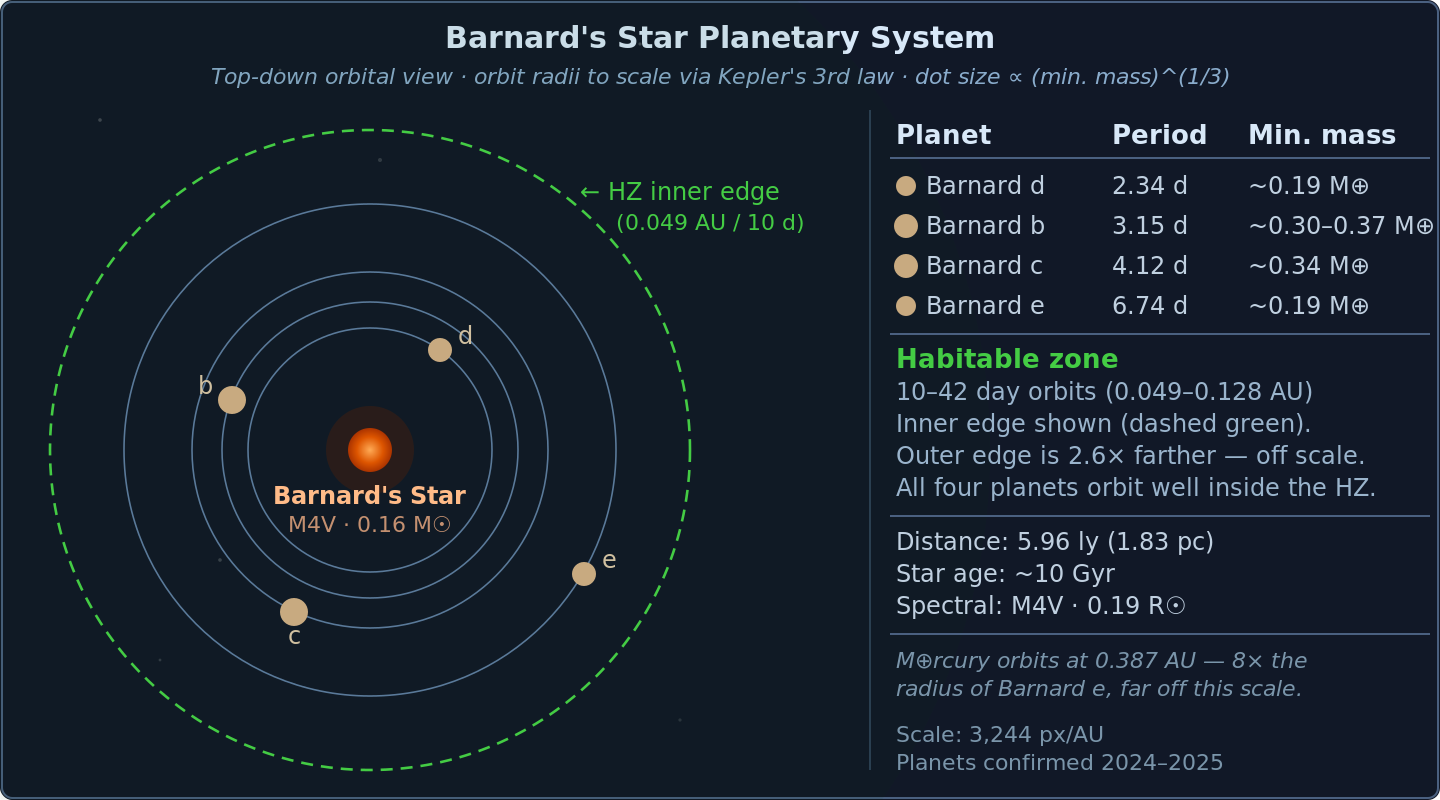
Act Three. In October 2024, ESPRESSO on ESO’s Very Large Telescope detected a real signal: a planet at 3.15 days, roughly a third of Earth’s mass. Months later, a team combining MAROON-X data with ESPRESSO confirmed that planet and found three more — all sub-Earth, all in orbits under a week.
| Planet | Orbital Period | Minimum Mass | Discovery |
|---|---|---|---|
| Barnard d | 2.34 days | ~0.19 M⊕ | 2025 (MAROON-X) |
| Barnard b | 3.15 days | ~0.30–0.37 M⊕ | 2024 (ESPRESSO) |
| Barnard c | 4.12 days | ~0.34 M⊕ | 2025 (MAROON-X) |
| Barnard e | 6.74 days | ~0.19 M⊕ | 2025 (combined) |
None are remotely habitable — the star’s habitable zone corresponds to orbital periods of 10 to 42 days — but they’re real, confirmed, and some of the smallest planets ever found by the radial-velocity method. It took sixty years, two false starts, and four instruments to get there. That’s not a story about this star being uniquely tricky. It’s a story about exoplanet science having to grow up before a signal this small could be trusted.
What Kind of Star Is It, Actually?
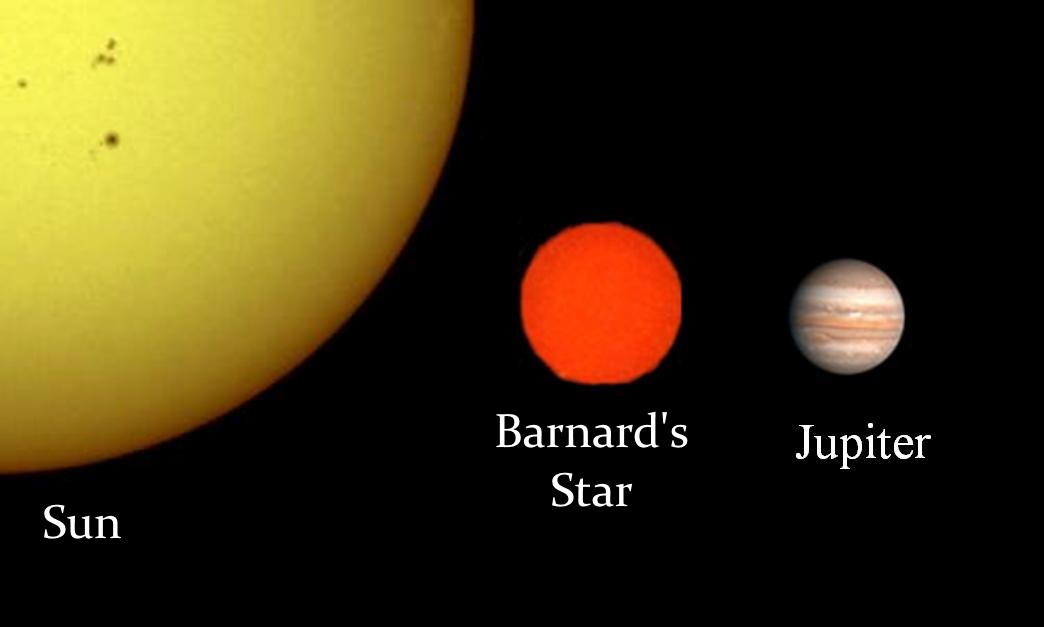
Set the records and drama aside, and Barnard’s Star is almost defiantly unremarkable. A red dwarf of spectral type M4V, with 16% of the Sun’s mass and 19% of its radius — smaller than some gas giants, just vastly denser. At roughly 10 billion years old it was already middle-aged before our Sun formed. It spins once every 130 days, a sign of a star that has had a very long time to wind down. And despite its quiet appearance, it does occasionally flare — it has its own variable star designation, V2500 Ophiuchi.
It’s the calm, ancient counterpoint to almost every other star this site covers — none of the youthful violence of a Vega, none of the dramatic fate of a Deneb. Just an old, dim, slow-spinning star, currently sliding past us quickly only because it happens to be close.
Finding It
Barnard’s Star sits in Ophiuchus with no bright naked-eye star nearby. You’ll want a finder chart and a telescope with at least 6″ aperture under dark skies — or a smart scope, which makes a magnitude 9.5 target far easier than star-hopping by eye. Plate-solving software will put you on the field directly.
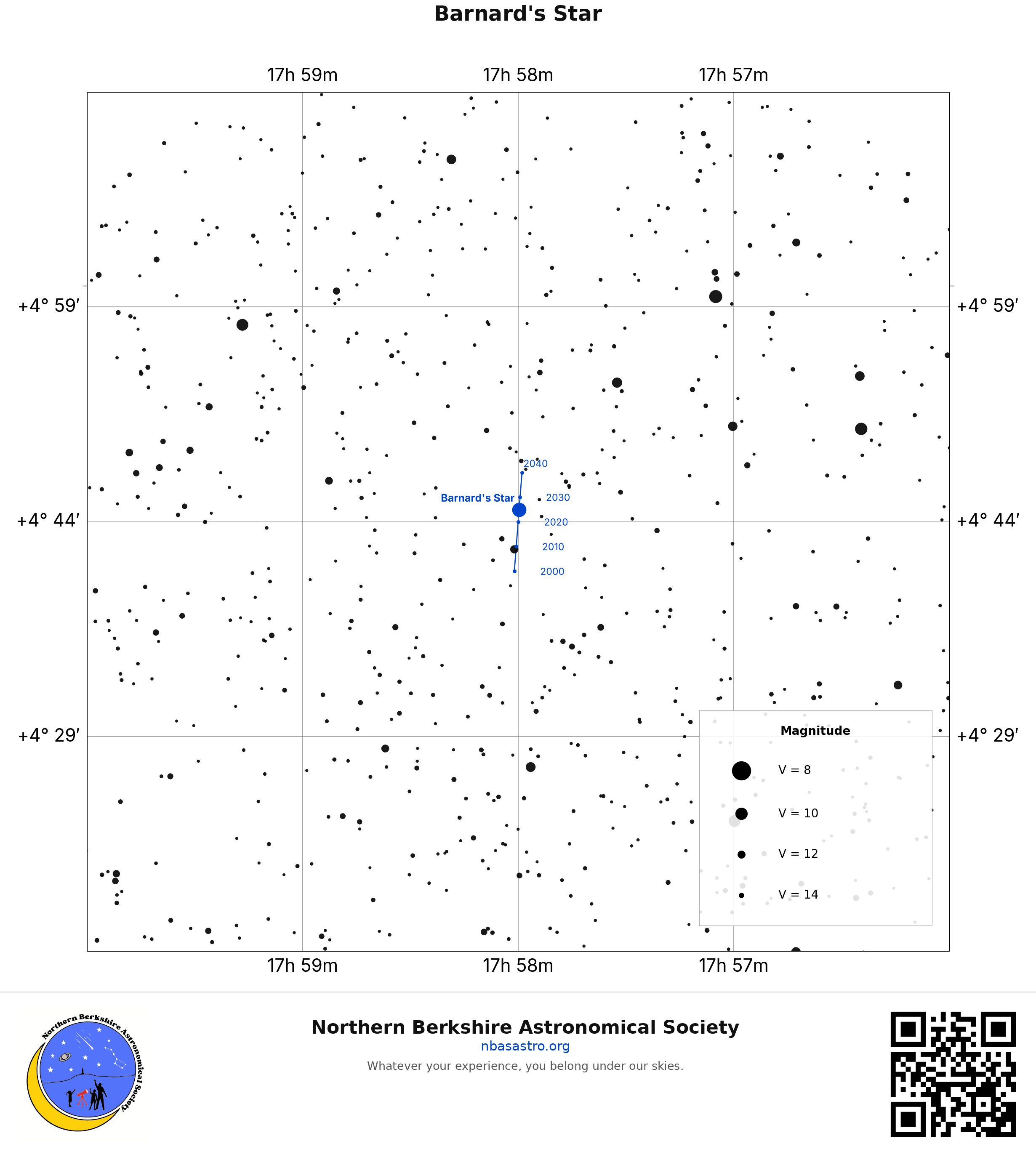
Once you have it framed, there’s nothing dramatic to see — just an unremarkable reddish point among many others. That’s the whole joke: the interesting part isn’t what it looks like tonight. It’s what it will look like compared to tonight.
An Experiment You Can Actually Run
Barnard discovered this star’s defining property by comparing photographs taken decades apart. That’s still exactly how you’d detect it today, but with far better tools. A modern smart scope plate-solves every image automatically, tagging it with precise sky coordinates. An image taken tonight, saved properly, is directly comparable to one taken years from now — without the laborious manual alignment Barnard did on glass plates.
The numbers are genuinely encouraging. At 10.3 arcseconds per year:
| Telescope | Pixel Scale | Shift per Year | Field of View |
|---|---|---|---|
| Unistellar eQuinox 2 | 1.33″/px | ~7.7 px/yr | 45.6′ × 34.2′ |
| Seestar S50 | 2.39″/px | ~4.3 px/yr | 77.1′ × 43.7′ |
| Seestar S30 Pro | 3.74″/px | ~2.8 px/yr | 239.4′ × 134.6′ |
| Seestar S30 | 4.00″/px | ~2.6 px/yr | 128.0′ × 72.0′ |
Even on the coarser end of that table, three or four years should show a real, visible shift — not something you need to squint at or trust to a measurement tool. On the eQuinox 2’s finer plate scale, a single year is already enough. This isn’t a project that requires outliving your equipment.
A Close Call Worth Watching For
There’s an additional reason to keep an eye on this field over the next decade. Around 2035, Barnard’s Star will pass within 335 milliarcseconds of a background star — a precise, long-predicted alignment tracked since the prediction was published in 2018. It’s a calculated event, locked in by Barnard’s Star’s known trajectory and the background star’s measured position, and it will be one of the most scientifically productive moments in the near-term history of nearby stellar astronomy.
The reason it matters comes down to one thing: mass. We’ve never measured Barnard’s Star’s mass directly. Every figure in the literature — including the 0.16 solar masses in this article’s header — comes from theoretical models connecting observable quantities (luminosity, temperature, spectral type) to mass. Those models are good, but they carry real uncertainties for old, low-metallicity red dwarfs, which fall in a part of stellar parameter space where the models are least well-tested.
The 2035 event changes that. As Barnard’s Star sweeps past the background star, its gravity will bend spacetime enough to deflect the background star’s apparent position by 2.43 milliarcseconds — a shift called astrometric microlensing. The size of that deflection is a direct function of the lensing star’s mass. Measure it, and you have a roughly one-percent-precision mass for Barnard’s Star: the most accurate determination of any single M-dwarf mass by a direct method.
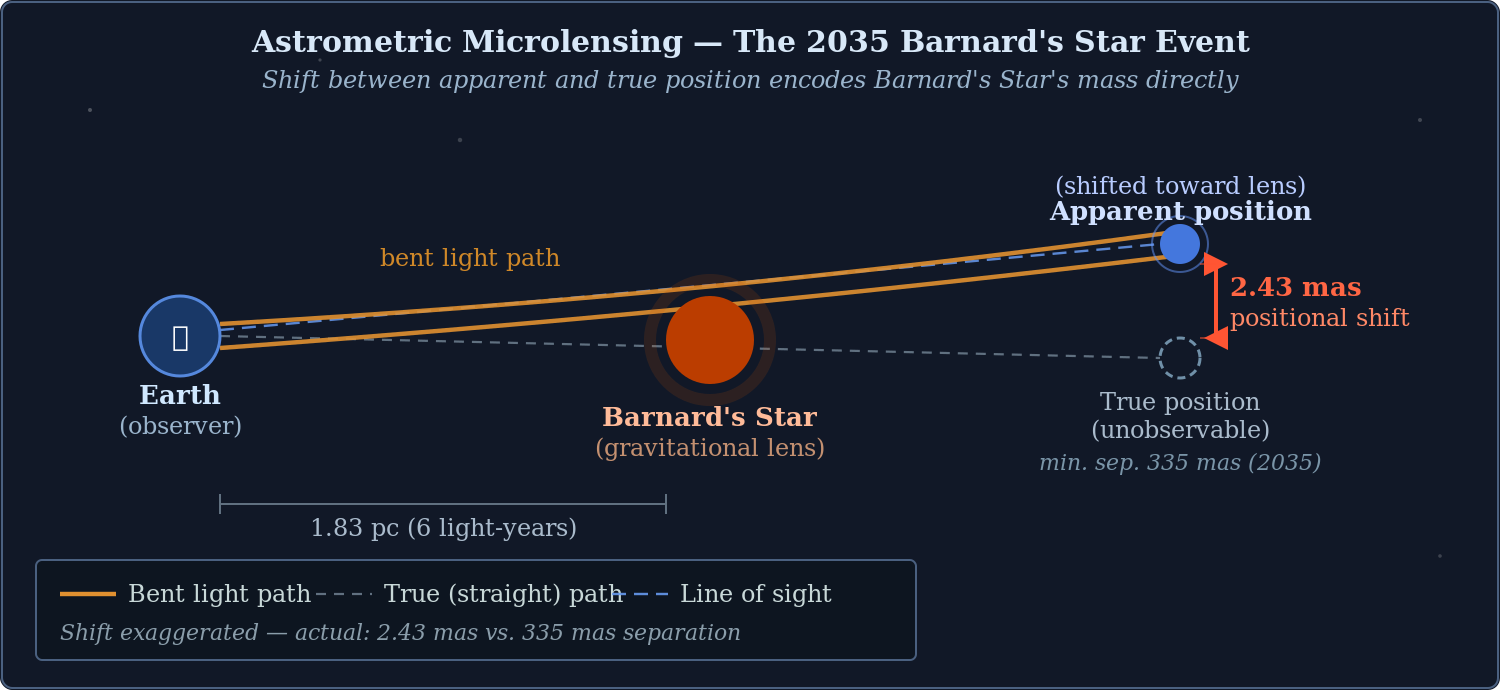
That number will do real work. Red dwarfs are the most common stars in the galaxy, but our mass-luminosity calibrations for them remain poorly constrained at old ages and low metallicities. A model-independent mass for one of the nearest and best-studied examples will tighten those calibrations across the board. It will also sharpen what we know about the four confirmed planets: planetary masses from radial-velocity measurements scale directly with stellar mass, so cutting the uncertainty on the host star cuts the uncertainty on the planets. And if any longer-period bodies exist in the system beyond what ESPRESSO and MAROON-X can see, an undetected companion would leave a subtle asymmetry in how the background star’s position shifts and recovers — a signature that could betray something hidden. The four known planets (all within 7-day orbits, hugging the star) are far too close-in to affect the lensing signal; any perturbation would come from something further out.
The catch is angular resolution. Barnard’s Star shines at magnitude 9.5; the background star is nearly four magnitudes fainter, separated by only 335 mas at closest approach. Cleanly resolving the fainter star in the brighter one’s glare, precisely enough to measure a 2.43 mas positional shift, is at the edge of what current instruments can do — and well within the design specifications of the European Extremely Large Telescope, expected to be operational before the encounter. The 2035 event is already cited as a benchmark test for the E-ELT’s extreme-resolution astrometry capability.
We’ve produced a close-up finder chart for the encounter region showing the background star in its current position, along with Barnard’s Star’s projected track through 2040. If you’re imaging this field over the next few years, you’ll be watching that gap close in real time.
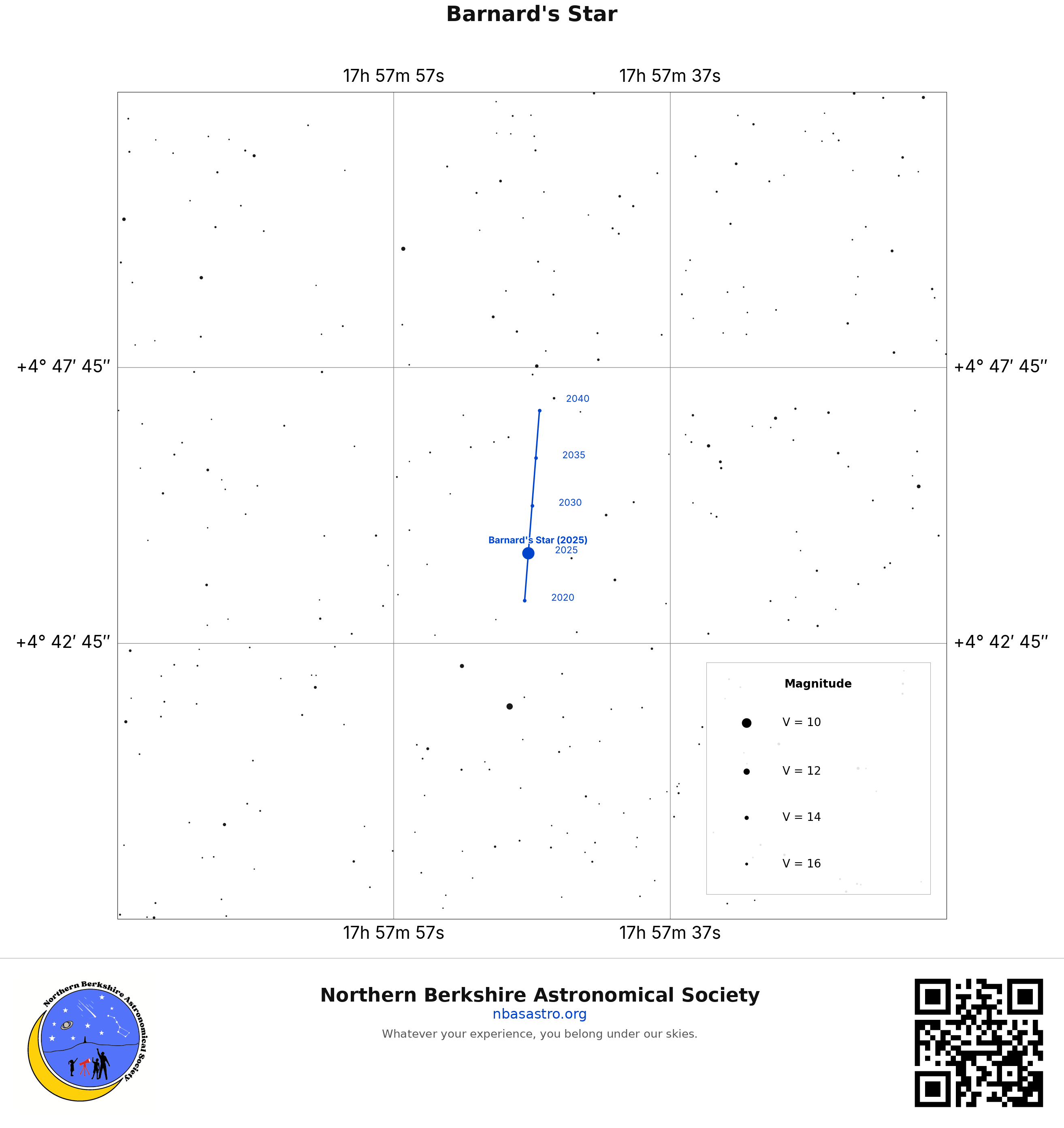
For now, the invitation is simple. Point a telescope at Barnard’s Star, take a plate-solved image, and note the date. You’re not just recording a star in motion. You’re building a baseline for one of the most precisely timed mass measurements in the recent history of nearby stellar astronomy — and watching, frame by frame, as something genuinely rare draws into view.