Introduction
The summer sky has an overabundance of deep-sky objects: star clusters and nebulae of all types (and even a few galaxies if you know where to find them), set against the Milky Way. No matter how you observe — with binoculars, telescopes of all sizes, and imagers — there’s plenty to choose from. It’s within the Milky Way that we find the brightest nebulae, especially in the region from eastern Serpens down into Sagittarius.
In this “A Closer Look” article, we showcase one particular object — Messier 20, the Trifid Nebula. It’s fascinating because here we can see all three kinds of nebulosity in the same view: emission, reflection, and dark nebulae are all prominent. It’s not the only nebula with this characteristic, but it’s the brightest and most famous example, and easy to find.
History

Charles Messier catalogued this nebula in June 1764 — the same productive sweep through Sagittarius that added a dozen entries to his running list of comet impostors. His notes describe a cluster of stars “enveloped in nebulosity,” which was accurate enough for what was visible through 18th-century optics: a glow, a bright center, and not much structure beyond that.
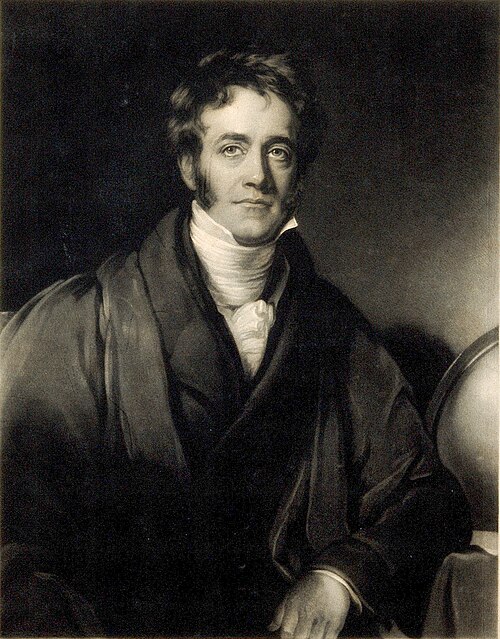
The name came later. John Herschel, observing in the 1830s, noted that the nebula appeared divided by “three obscure divisions, or dark vacancies” running through its center. He coined the word trifid — from the Latin trifidus, divided into three — and it has been the Trifid Nebula ever since. What he was seeing, though he could not have known it, were not vacancies at all, but something far more interesting: cold columns of dust threading across the face of a glowing cloud.
A Nebula of Three Faces
Most nebulae are one thing. The Orion Nebula is an emission nebula. The Pleiades are wrapped in a reflection nebula. The Coalsack is a dark nebula. You go, you observe, you understand the single mechanism at work.
The Trifid is all three at once — and not subtly. In any decent image, a pink lobe and a blue one sit side by side, divided by dark lanes that cross through the center like cracks in old plaster. Each of those three features — the red glow, the blue haze, the dark structure — is produced by a completely different physical process. The same nebula, in the same eyepiece, is running three separate stories simultaneously.
That is unusual. It is worth understanding why.
What You’re Actually Seeing
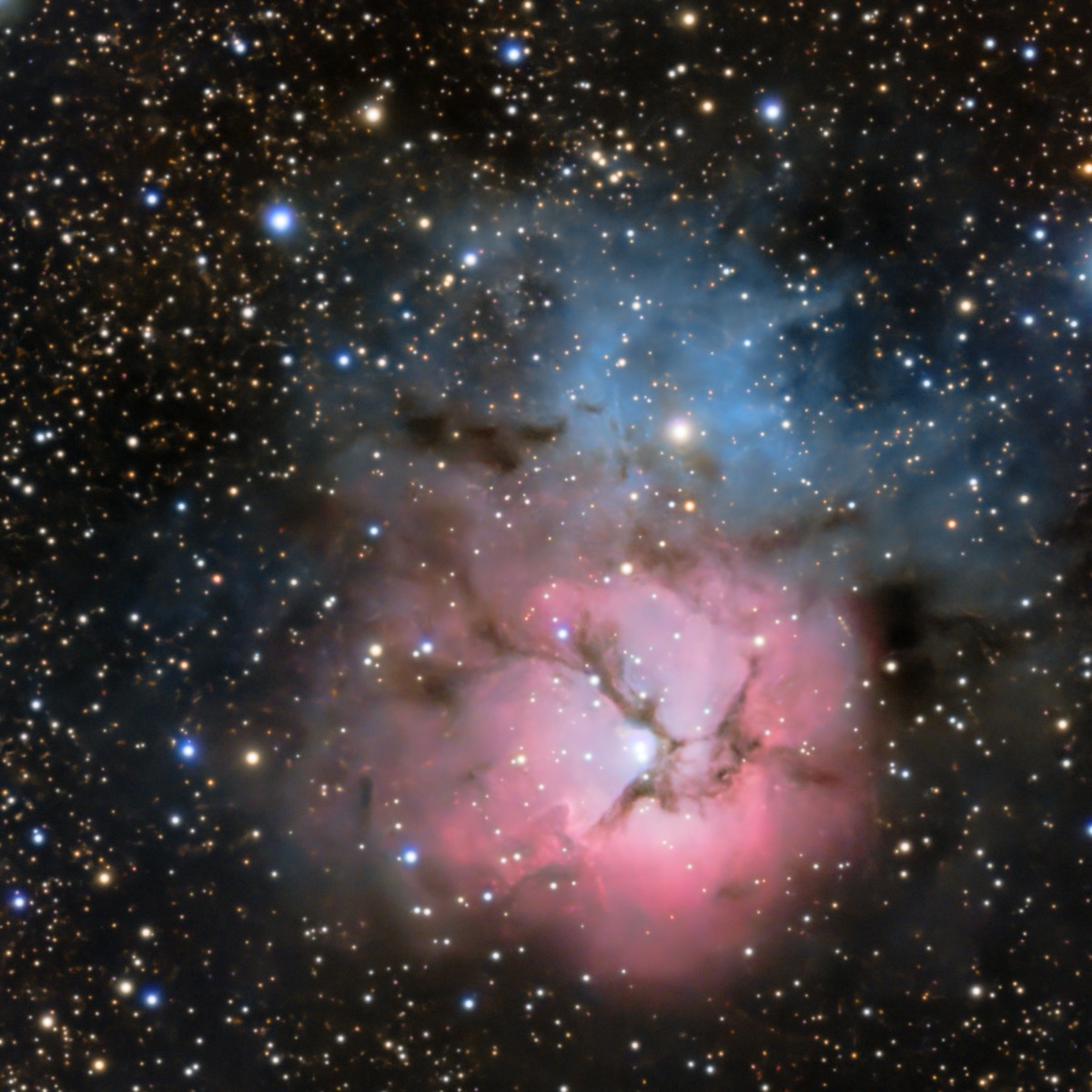
This image holds all three components at once. The pink lobe filling the lower portion is the emission nebula — ionized hydrogen glowing in H-alpha, lit from within by the central star system HD 164492A. The dark lanes cross through it in a roughly Y-shaped pattern; a bright cluster blazes at their intersection, the apparent origin point of all three divisions. Those divisions are not gaps: they are cold filaments of dust threading in front of the glowing gas.
The blue haze dominating the upper portion — and in faint traces, curving partly around the rest of the complex — is the reflection nebula: the outer envelope of the same molecular cloud, scattering starlight preferentially into blue wavelengths. In very long exposures that blue component extends further than is visible here.
The sections below unpack each component. One of them — the dark lanes — hides more than is immediately visible, and a Hubble image later in this article reveals something inside that no ordinary telescope can detect.
The Red Glow: Emission Nebula
At the heart of the Trifid sits a young, massive star designated HD 164492A — a multiple star system, but the dominant component drives the physics. It is an O-type giant with a surface temperature above 35,000 K and a mass exceeding twenty times the Sun’s. A star like this does not simply shine: it floods its neighborhood with ultraviolet radiation energetic enough to strip electrons completely off surrounding hydrogen atoms.
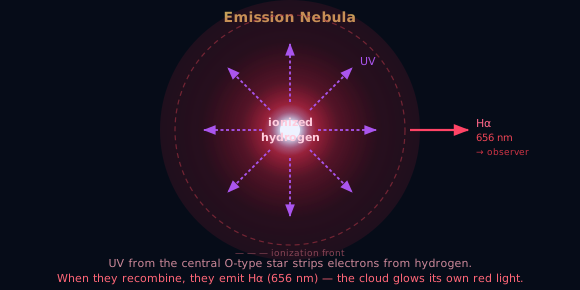
The gas cloud is mostly hydrogen. When the UV hits it, the hydrogen ionizes — each atom loses its electron. The electrons do not stay free for long; the gas is dense enough that electrons and protons recombine almost immediately. And when they recombine, they emit light at specific wavelengths. The dominant one in the visible spectrum is hydrogen-alpha: 656 nanometers, deep red, the wavelength that turns every astrophotograph of an emission nebula pink.
What you see in the red portion of the Trifid is not reflected starlight. It is light generated by the gas itself — a byproduct of electrons being stripped from atoms and working their way back. The cloud glows on its own, in the literal sense. The ionized zone forms a roughly spherical shell around the central star, a bubble of hot plasma about 18 light-years across being driven outward into the surrounding molecular cloud.
The Blue Haze: Reflection Nebula
Surrounding the emission region — with its brightest concentration to the north, though in very deep imaging it partially envelops the whole complex — is a zone that appears distinctly blue. There is no ionizing star hidden there, no source of UV turning hydrogen to plasma. The blue comes from an entirely different mechanism, and the reason it’s here rather than elsewhere in the cloud comes down to geometry.
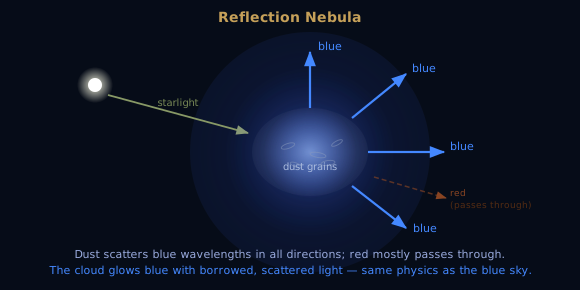
There is dust in this part of the nebula. Not the dense, opaque kind that forms the dark lanes, but finer grains distributed through the outer envelope of the same molecular cloud that produced HD 164492A. Here, the UV from the central star has either weakened with distance or been absorbed by intervening dust before it can ionize hydrogen. But visible starlight still reaches this dust and scatters off it — and dust grains do not scatter all wavelengths equally. Short wavelengths — blue and violet — scatter far more efficiently than long ones. The same physics produces the blue daytime sky and red sunsets.
The reflection nebula is therefore not a separate cloud that happens to be in the same line of sight as the emission region. It is the outer layer of the same molecular complex, illuminated by the same star, but positioned and shielded such that its dust scatters rather than its gas ionizes. The result is a nebula glowing not by generating its own light but by redirecting and recoloring someone else’s — sitting immediately adjacent to a nebula doing exactly the opposite.
What is visible in amateur images is the brightest, most concentrated part of the reflection component. The full extent, revealed only in very long exposures, wraps more completely around the emission region: the dust responsible for the scattering is distributed through a larger volume than the bright northern patch alone suggests.
The Dark Lanes: Absorption Nebula — and What Lives Inside
The three dark lanes that give the Trifid its name are not holes. They are dense, cold filaments of dust and molecular gas — unilluminated, opaque, cold enough that almost no visible light passes through them. Herschel’s “obscure divisions” are foreground structure: tendrils of material threading across the face of the emission nebula in roughly radial directions from the center, blocking whatever lies behind. Each lane is roughly one to two light-years wide and several light-years long — distances comparable to the gap between the Sun and its nearest stellar neighbors.
But the lanes are not passive.
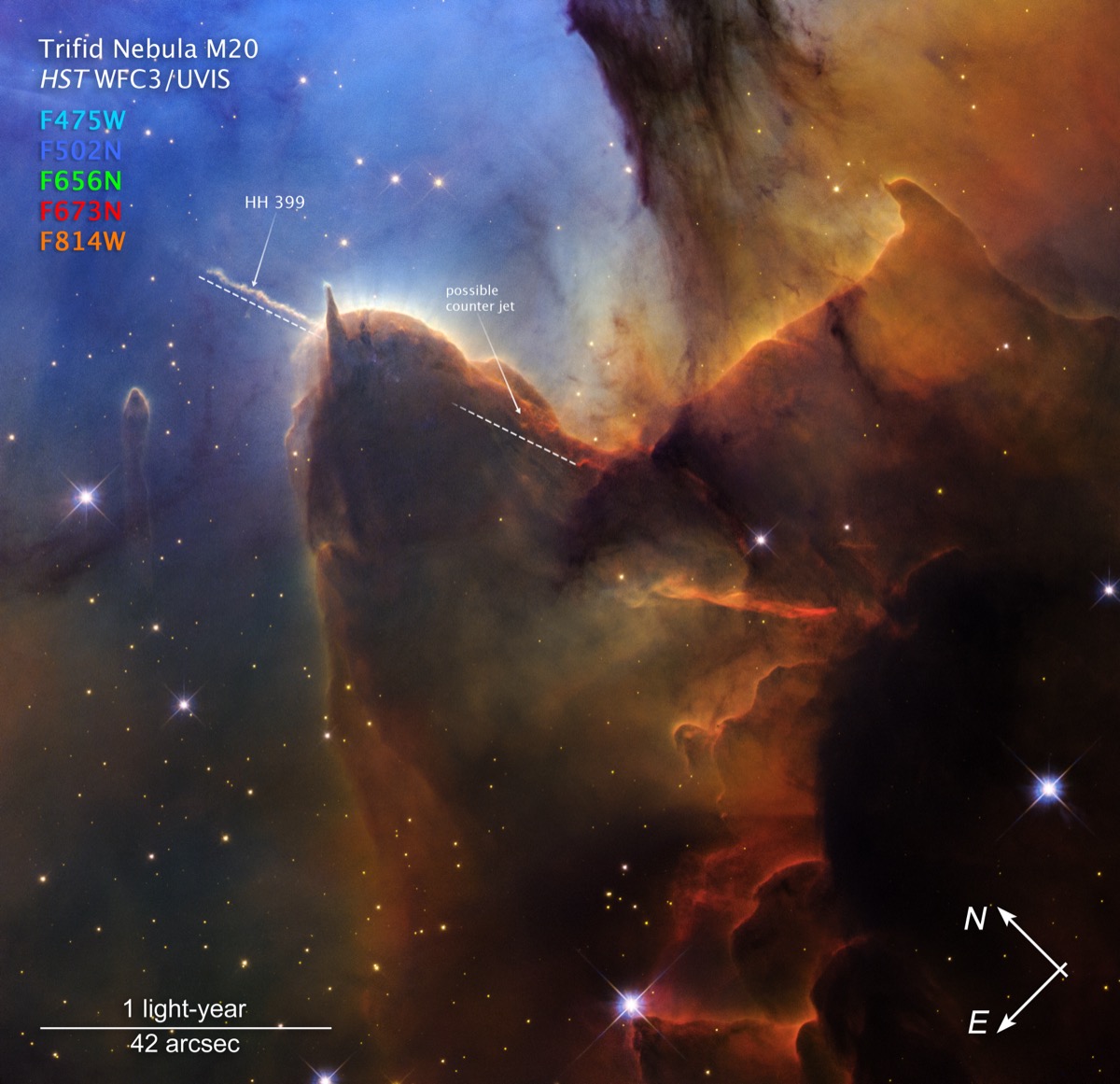
Embedded within one of those dark pillars is a forming star — completely hidden behind the same dust that makes the lane look dark, invisible in ordinary light. What gives it away is a jet. Young stars in the early stages of formation often produce bipolar jets: narrow beams of material launched outward at hundreds of kilometers per second, perpendicular to the disk of gas surrounding the protostar. When those jets collide with surrounding material, they create glowing bow shocks — Herbig-Haro objects — detectable in specific emission lines.
The structure labeled HH 399 in the Hubble image is exactly that: the glowing shock front of a jet from a protostar embedded in the dark lane. A possible counter-jet in the opposite direction is also marked. Neither the protostar nor its disk is visible; only the jet’s downstream impact is bright enough to detect, and only in the narrow-band filters Hubble used. What looks in any ordinary image like a simple dark lane is simultaneously a stellar nursery with a star already underway — announcing its existence only by what it is shooting into the gas around it.
How It All Fits Together
The Trifid looks flat in any image — it isn’t. The whole complex spans roughly 33 light-years, with the dark lanes and reflection nebula extending in three dimensions around and in front of the glowing emission shell, not lying flat across its surface. The emission region, the reflection nebula, and the dark lanes are all parts of the same molecular complex that gave birth to HD 164492A. Where the UV reaches tenuous gas directly, it ionizes hydrogen — the emission nebula. Where the gas is dense enough to resist ionization, it stays cold and opaque — the dark lanes. In the outer regions, where the UV has diluted or been absorbed before it can ionize anything, visible starlight still scatters off the dust — the blue glow. One cloud; one star; three different outcomes depending on where in the cloud you are and how much UV reaches you there.
The European Southern Observatory produced a short three-dimensional visualization that makes these spatial relationships visible in a way no static image can.
The Neighborhood
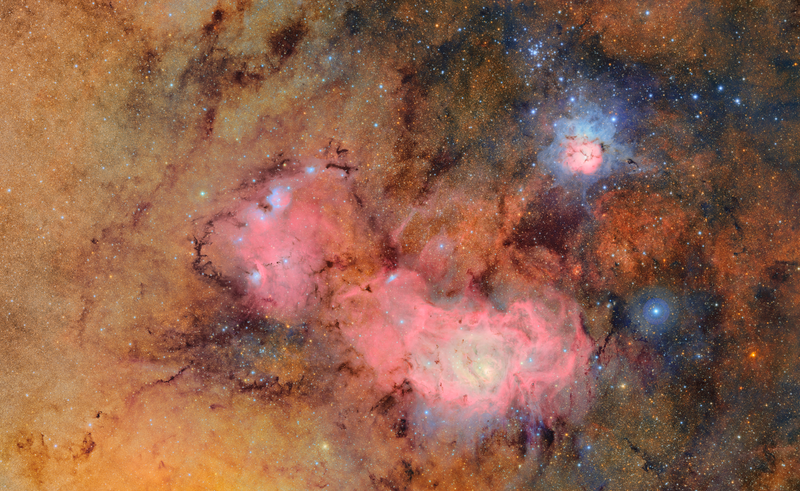
The Trifid does not sit in isolation. M8 — the Lagoon Nebula, one of the showpieces of the summer sky — lies only 1.5° to the south. M21, a loose open cluster, is barely 40 arcminutes to the northeast. And the distances tell the same story as the positions: M8 and the cluster embedded within it (NGC 6530) sit at roughly 4,000–4,350 light-years; M20 at about 4,100 light-years; M21 at around 4,250 light-years. These are not independent objects at different distances that happen to line up along our line of sight. They are lit corners of the same enormous molecular cloud — the Sagittarius OB1 star-forming complex — and the orange-brown haze threading between the bright nebulae in the Rubin image above is that cloud: cold, dark, and connecting everything in the frame.
This is the same situation as Orion. The Trapezium cluster, M42, M43, the Horsehead Nebula, the Flame Nebula, and dozens of other objects distributed across more than 10° of sky are all part of the Orion Molecular Cloud at ~1,300 light-years — a single enormous structure, appearing spread across the sky simply because we are close enough to see into it. The Sagittarius complex is the same thing, three times farther away. What looks like a rich but unrelated scattering of summer showpieces is actually one connected web of star formation, in which M8 and M20 are simply the brightest patches currently lit.
Observing M20
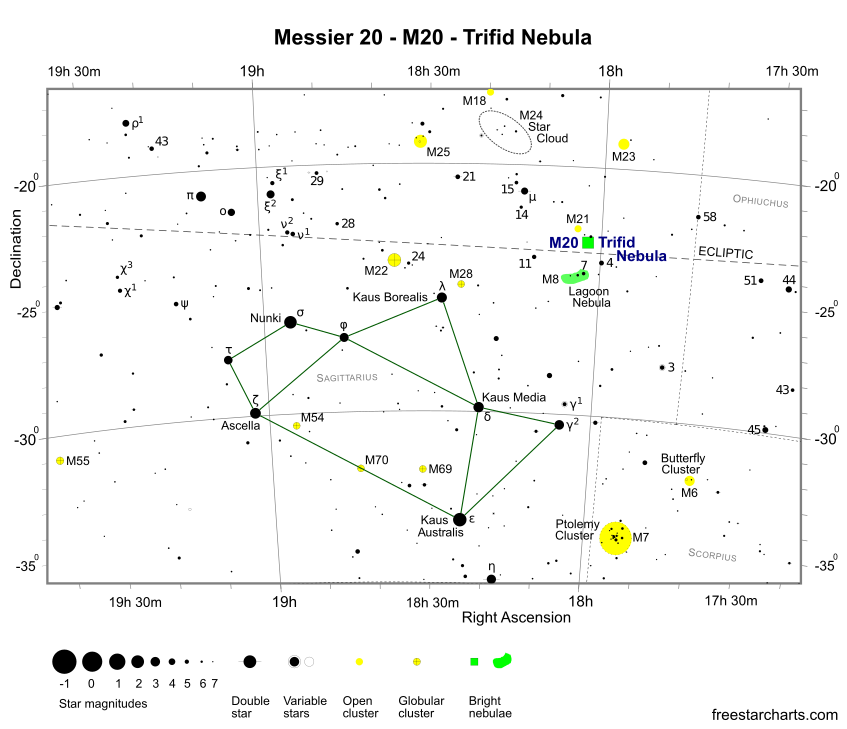
At magnitude 6.3 and 28 arcminutes across, M20 is accessible on any dark summer night. It rides low for northern observers — at declination −23°, it barely clears 30° altitude at culmination from mid-northern latitudes — but it is bright enough to work through moderate atmospheric extinction when the sky is steady.
Binoculars will show a diffuse glow with a brighter core. A small telescope at moderate power begins to reveal the nebulosity clearly and hints at structure. The emission lobe is the prominent part; the reflection component is more diffuse and favors darker skies.
The dark lanes are the visual challenge and the reward. In a 6-inch or larger scope under good conditions, the three-pronged pattern becomes legible — Herschel’s “obscure divisions” as texture rather than as blankness, gaps in a glow where something is clearly in the way. The lanes do not read as black so much as absent.
The reflection nebula, at visual magnifications, tends to appear as a grayish extension to the north rather than distinctly blue — the dark-adapted eye has poor color discrimination at low light levels. Photographs reveal the color; the eye gets the form. Both are worth having.
M8 fits in the same wide binocular field as M20, and a slow sweep between them on a dark night is one of the better ways to spend fifteen minutes in Sagittarius.
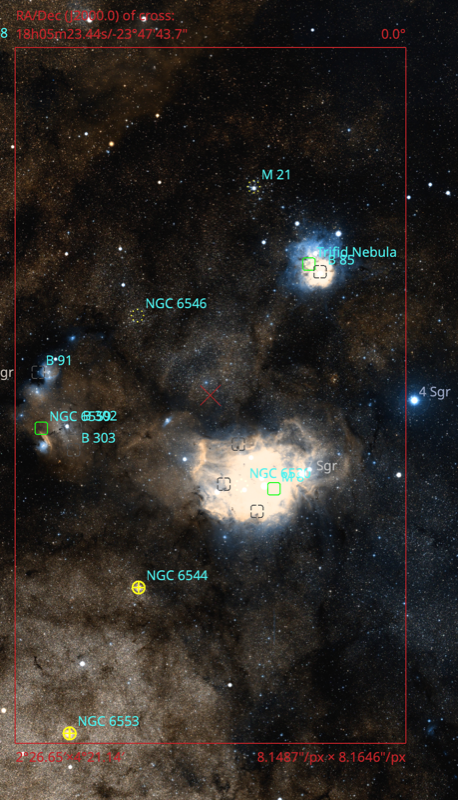
M20 is also an excellent smart scope target. At 28 arcminutes it fills the field comfortably in any current instrument — the image above was taken with a Seestar S50, and the S30 or Pro produce comparable results, just slightly smaller in scale. Brightness is not the limiting factor here: even a few minutes of integration is enough to record the emission lobe, the dark lane Y-pattern, and the blue reflection component. Longer sessions — 30 to 60 minutes or more — start to pull in the surrounding molecular cloud, the same orange-brown haze visible in the Rubin image above, and the object begins to reveal its larger context. On an S30 or similar scope with mosaic mode, a 2×2 panel can capture M20, M8, M21, and NGC 6559 in a single stitched frame: the whole Sagittarius OB1 complex in one shot, with the connecting dust threading between all of them.
Worth the Low Altitude
The Trifid rewards knowing what you are looking at. A star so massive it is reshaping several cubic light-years of gas around it; inside that structure, other stars forming in the dark, one of them already shooting jets. The pink half generates its own light. The blue half borrows light and changes its color. The dark lanes block everything behind them while concealing, within them, the beginnings of new solar systems.
That is a lot to fit into 28 arcminutes. But it is all there, in the same field, on any clear night in July.