
Introduction
Point a telescope into Sagittarius, a few degrees east of the galactic center, and you’ll find two objects sitting close enough together that they’re almost always described as a pair: NGC 6520, a small, bright open cluster nicknamed “Dead Man’s Chest,” and right beside it, a dense black smudge with no name of its own beyond a catalog number — Barnard 86, “the Ink Spot.”
For decades, the obvious assumption was that these two are related: the cluster’s leftover birth cloud, still hanging nearby. That assumption is in the textbooks, on observing guides, even on ESO’s own press materials. It might also be wrong. A more recent measurement says the two objects are moving at different speeds — different enough that they may simply happen to share the same patch of sky.
Either way, you’re looking at something genuinely strange: a hole in the galaxy that isn’t a hole at all.
Two Names, One Field
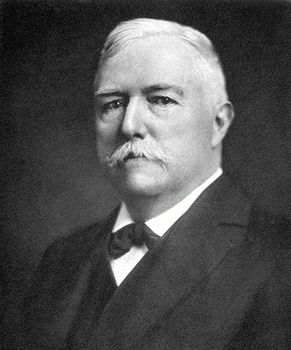
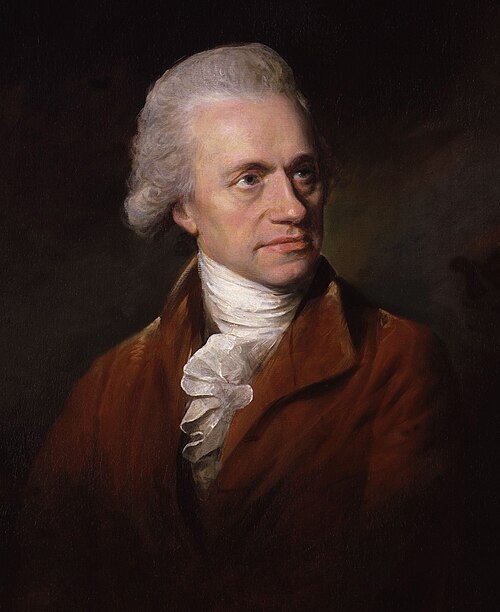
NGC 6520 was catalogued by William Herschel in 1784 — a modest, compact gathering of a few hundred stars, easy to dismiss at a glance. Barnard 86 came later: E.E. Barnard, surveying the Milky Way photographically in the early 20th century, found it dense and dark enough to earn its own number in his 1919 catalog of “dark markings of the sky.” He described it simply: “Diameter 5′; several small stars in it.”
The nicknames came later still — “Dead Man’s Chest” for the cluster’s loose, vaguely angular shape, and “the Ink Spot” for the nebula, after Barnard’s own description of similar objects as a “drop of ink on the luminous sky.” Neither name is official. Both have stuck.
Finding the Pair
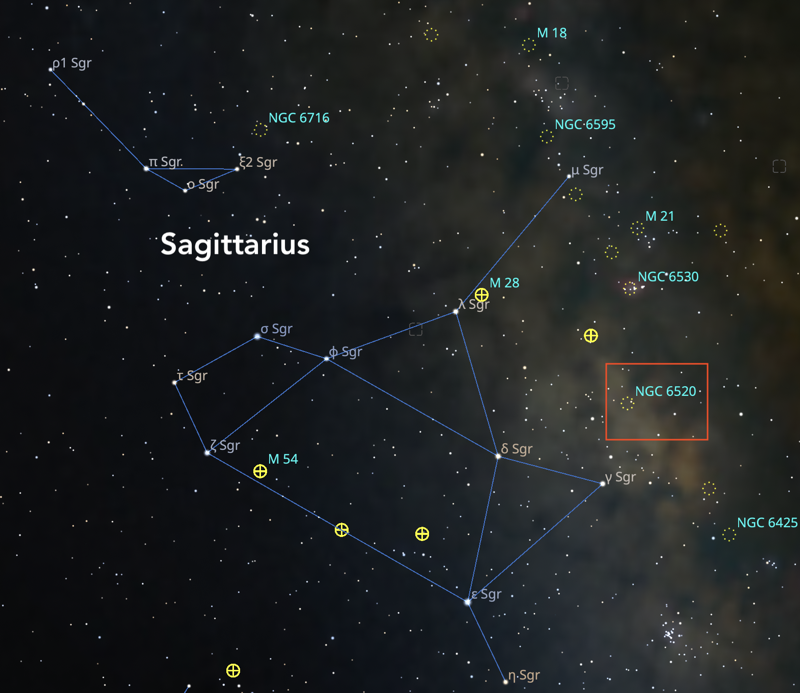
It’s easy to pinpoint the rough location of these two objects: they’re located just above the “spout” of the Teapot asterism of Sagittarius. (For reference, the direction of the Galactic center is just below the center of the red box in the image: where the “tea” is pouring out of the “Teapot”.)
NGC 6520 sits at magnitude 7.6, an easy target for binoculars or any small telescope under a reasonably dark sky — though at only 4° from the galactic center, you’ll be hunting for it inside one of the richest star fields visible from Earth. This is a young cluster, with several hot massive stars: they stand out especially blue against the reddened background Milky Way.
Once you’ve found the cluster, Barnard 86 is impossible to miss: a compact, sharply-edged dark patch sitting just to its northeast, standing out precisely because of how much starlight surrounds it. In a small scope it reads as a void — a gap where the rest of the field’s stars simply aren’t. In binoculars under dark skies it’s still obvious, though less crisp.
What You’re Actually Seeing
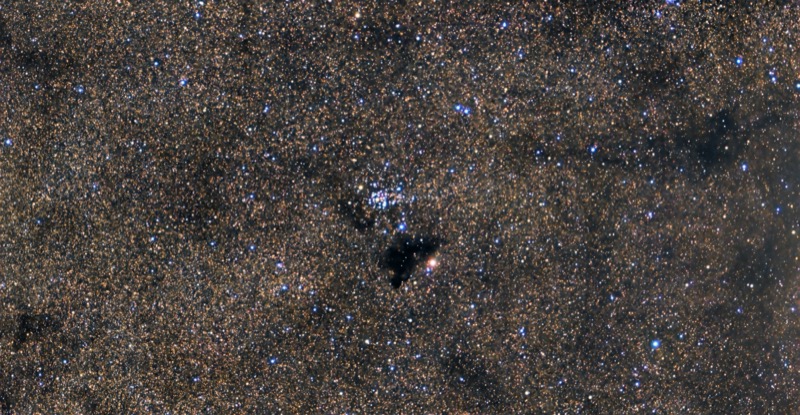
That “gap” is the whole point of this object, and it’s worth being precise about what it actually is.
Barnard 86 is not empty space, and it isn’t a hole in the galaxy’s disk where stars happen not to exist. It’s a dense, cold cloud of gas and dust — what astronomers call a Bok globule — sitting in the foreground, between us and the rich background star field of the Sagittarius Star Cloud. The stars that appear to be scattered “inside” it, when you look closely, are actually in front of it: nearer to us than the cloud itself, just happening to fall along the same line of sight. The cloud blocks everything behind it and lets through only what’s in front.
This is a useful corrective to a very old, very natural mistake. Early photographic surveys of the Milky Way are full of objects like this one that 19th-century astronomers assumed were genuine voids — gaps in the star field itself. Barnard’s own photographic work helped settle the question: these are clouds, not holes. The galaxy isn’t missing stars in that direction. Something is simply in the way.
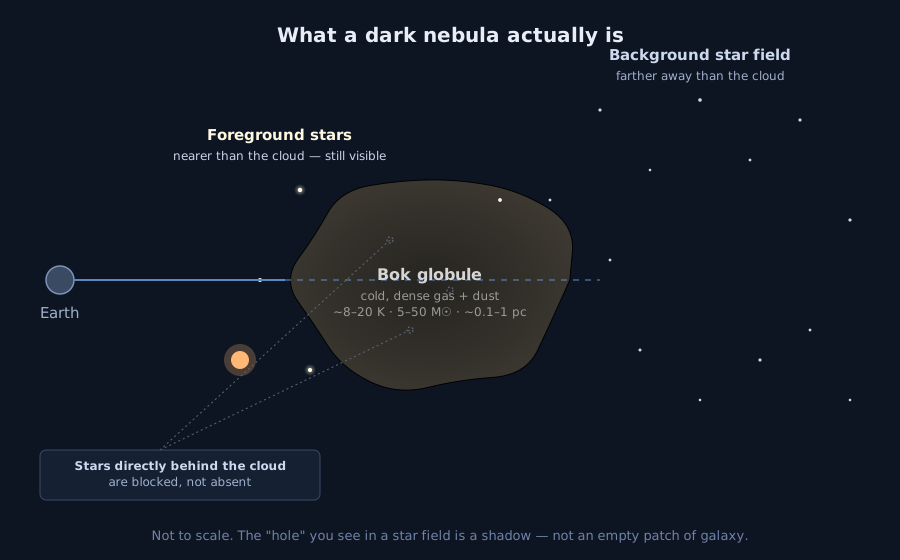
The specific kind of cloud Barnard 86 represents has a name of its own. Astronomer Bart Bok identified objects like this in the 1940s — small, strikingly round dark clouds, distinct from the sprawling dust lanes that run through the rest of the Milky Way — and proposed something bold for the time: that they weren’t just sitting quietly in the dark, but actively collapsing under their own gravity, on their way to becoming stars. The name Bok globule stuck well before anyone could prove the idea.

Whether Barnard 86 itself is forming a star right now isn’t something anyone has confirmed. Most Bok globules eventually do, and any young star inside this one would be hidden exactly the way everything else behind it is — invisible until you look in infrared. So the honest answer, staring into that dark patch in the eyepiece, is that you can’t rule it out: somewhere in there, completely unseen, a star might already be forming.
A Birth Cloud? Maybe Not.
Here’s where it gets genuinely uncertain — and worth sitting with the uncertainty rather than smoothing it over.
The natural assumption, repeated across observing guides and even in ESO’s own public materials, is that Barnard 86 is the leftover remnant of the molecular cloud that formed NGC 6520 — a relic still sitting beside its own stellar nursery. The two objects appear to be at almost exactly the same distance, around 6,000 light years, which seems to support the idea.
But the timeline doesn’t sit comfortably. NGC 6520 is estimated at roughly 150 million years old. Molecular clouds — the raw material clouds collapse out of and clusters form within — are thought to survive only about 10 million years before dissipating. If Barnard 86 really were NGC 6520’s birth cloud, it would have outlived the kind of cloud it’s supposed to be by a factor of fifteen. That’s the sort of mismatch that should make you suspicious of the tidy story, not paper over it.
A more recent measurement adds real doubt. Looking at the radial velocities of stars in NGC 6520 versus the velocity of the nebula itself, one study found a difference of about 30 kilometers per second — enough relative drift, accumulated since the cluster’s formation, to put real distance between them despite their similar line-of-sight position. The conclusion: it’s “extremely doubtful” the two are actually related. They may simply be a chance alignment — a cluster and a cloud that happen to sit along the same direction from Earth, at close to the same distance, with no shared history at all.
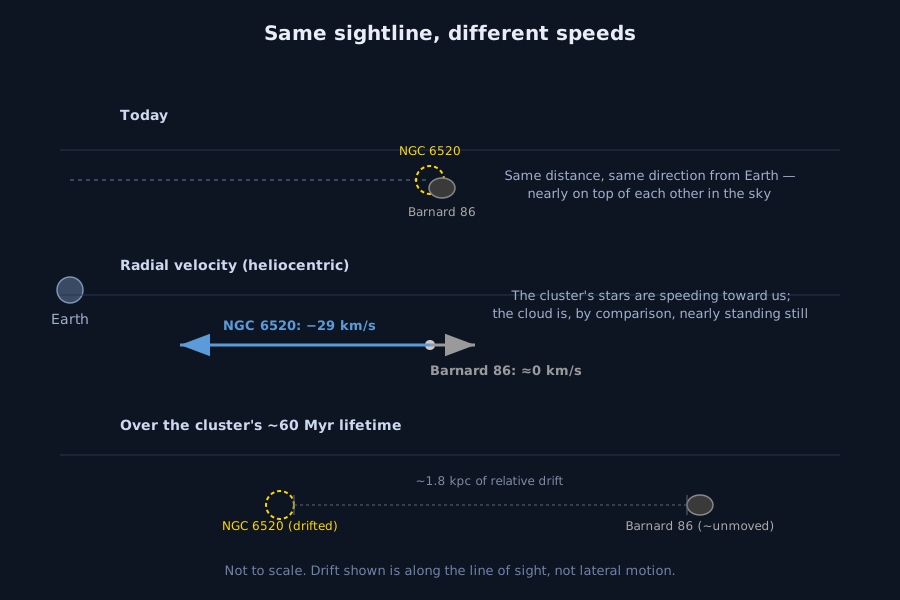
Nobody has fully closed the book on this. It’s a live disagreement, not settled science, and that’s part of what makes this pair worth a second look: sometimes the universe really is more orderly than your first glance suggests. Sometimes it’s just two unrelated things, lined up by coincidence, looking for all the world like family.
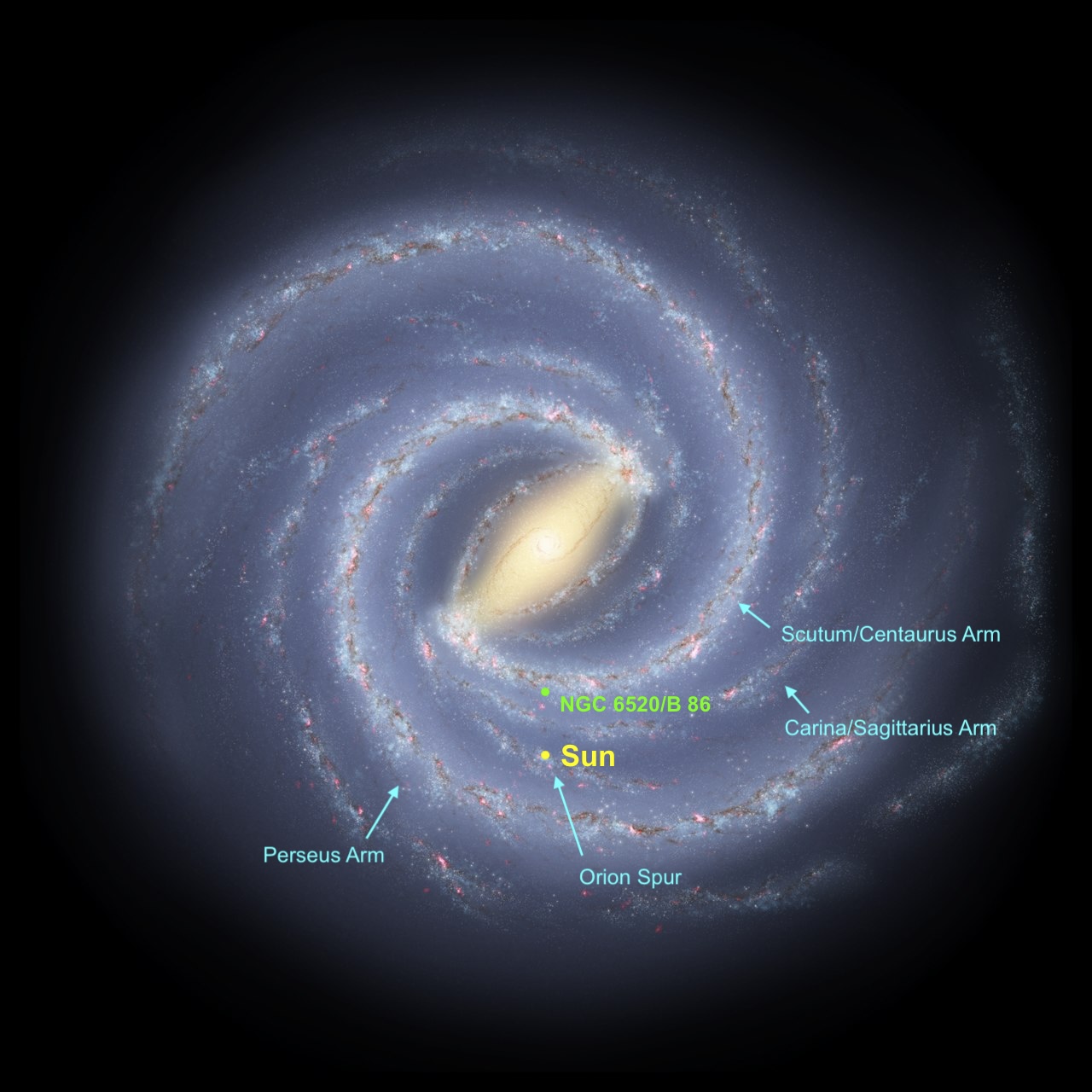
Whatever the relationship between the cluster and the cloud, both sit in a specific, real place in the galaxy — and it’s worth seeing where. At a distance of about 2 kiloparsecs and only 4–5° off the line to the galactic center, the pair lands roughly 6 kiloparsecs out from the center itself, compared to the Sun’s 8. We’re both inside the galaxy’s main disk, just in different neighborhoods: Odell’s own analysis places the cluster near the outer edge of the Scutum–Centaurus Arm, one of the Milky Way’s two major spiral arms, while the Sun sits in the Orion Spur, a minor structure tucked between the Sagittarius and Perseus arms. Looking toward this pair, you’re looking past our own local neighborhood and into a different, more substantial piece of the galaxy’s architecture.
Hiding in Plain Sight
There’s one more thing worth knowing before you go looking for this pair yourself: you are not looking at empty sky in any direction near here. NGC 6520 and Barnard 86 sit against the Large Sagittarius Star Cloud, deep in the direction of the galactic bulge — one of the densest star fields visible from Earth. It’s precisely that density that makes Barnard 86 so striking. A dark cloud against an ordinary star field is merely dim. A dark cloud against a field this packed reads as a wound.
There’s a layer to this worth spelling out. Since the pair sits near the outer edge of the Scutum–Centaurus Arm, your line of sight to get there has to pass through the Carina–Sagittarius Arm first — the next arm in, sitting between the Sun and the pair. You’re not just looking into one crowded region; you’re looking through one spiral arm’s worth of stars and dust to reach another.
One more honest caveat about the map itself. Look closely at the illustration above near the direction of the galactic center, and the Carina–Sagittarius Arm appears to thin out or nearly break — it doesn’t look like a single, continuous lane the way the other arms do. That’s not necessarily just an artist’s brushstroke. Where the Sagittarius Arm connects in near the galactic bar is a genuinely unsettled piece of galactic structure: observed tracers there don’t line up cleanly with where models predict the arm’s middle should sit, and researchers have noted there’s no obvious reason for a spiral arm to start that abruptly so close to the bar. Whether this particular illustration was drawn to reflect that specific complexity or just happened to land near it, the underlying uncertainty is real.
Worth a Second Look
These two are genuinely worth tracking down. NGC 6520 is bright enough for binoculars, Barnard 86 is unmissable once you’re on target, and the pair gives you a real “wow” moment the first time the contrast registers — a black wound in the brightest part of the sky.
They’re also a bit of a hidden gem precisely because of where they sit. Buried in the densest, richest part of the Sagittarius star cloud, this pair tends to get passed over for the showpiece objects nearby — but that same crowded backdrop is what makes Barnard 86 read as dramatically as it does. Most observers never slow down long enough to notice it.
When you do find them, take a second look at what you’re actually deciding between. Is this a before-and-after — a cluster and the cloud that built it, still lingering nearby billions of years on? Or are you watching two complete strangers, a star cluster and a dark cloud on entirely separate paths around the galaxy, caught for a cosmic moment in the same line of sight? Nobody has fully settled which. Looking at the field yourself won’t settle it either — but it’ll put you in the middle of a real, open question in galactic astronomy, rather than just another object checked off a list.
Finder Chart for NGC 6520 & Barnard 86
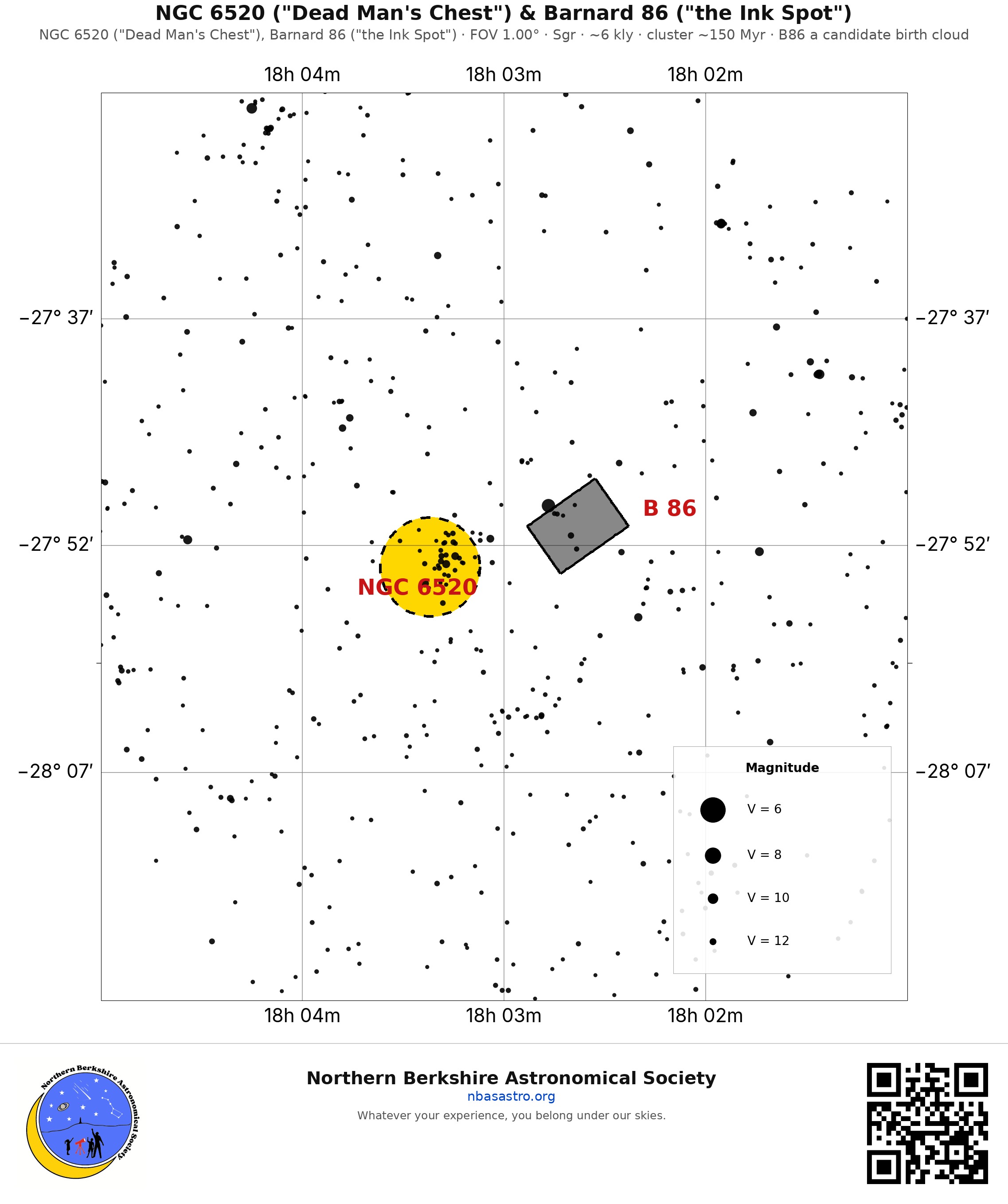
The chart below shows stars to V ≤ 12 on a 1° field, with NGC 6520 marked by the dashed yellow circle (the standard open-cluster convention on these charts) and Barnard 86 marked by the grey outline (the standard dark-nebula convention). Click the thumbnail to open the full branded chart; download the PDF for a print-ready version.
Sources
- Carraro, G., Méndez, R. A., May, M., et al. 2005, “The open cluster NGC 6520 and the nearby dark molecular cloud Barnard 86,” ApJ, 130, 635.
- Odell, A. P. 2014, “A New Look at Open Cluster NGC 6520,” ApJ, 147, 7.
- Vallée, J. P. 2016, “The Start of the Sagittarius Spiral Arm (Sagittarius Origin) and the Start of the Norma Spiral Arm (Norma Origin),” AJ, 151, 55.