
Introduction
Point your telescope at the border between Cygnus and Cepheus on any clear summer night and you’ll find a face-on spiral galaxy glowing at around magnitude 9. It doesn’t look especially dramatic at first — a soft, mottled glow with hints of structure. But NGC 6946 has a record that no other galaxy in the sky can match.
Since 1917, ten confirmed supernovae have been observed within it. Ten. The next most supernova-productive galaxy on record isn’t close. Astronomers have taken to calling it “The Fireworks Galaxy,” and the nickname is earned.
One of those stars didn’t explode at all. It was catalogued, measured, and watched — and then it simply wasn’t there anymore. What happened to it is one of the most intriguing unsolved questions in stellar physics.
Discovery — and Why Messier Missed It
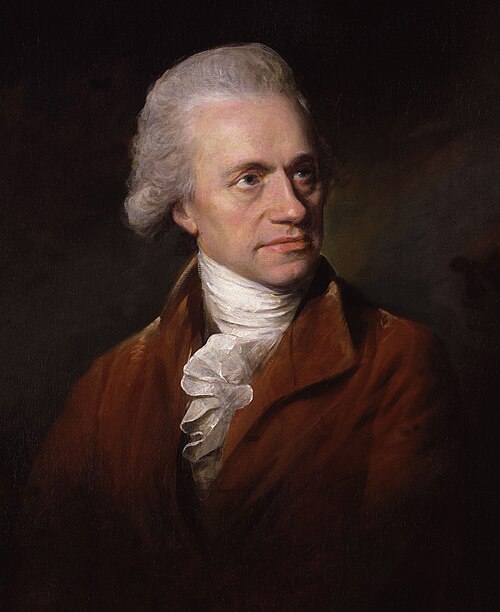
NGC 6946 was discovered by William Herschel on September 9, 1798 — fourteen years after Messier had effectively stopped adding objects to his catalog. Messier’s final entries were made in 1784; by 1798 he was in his late seventies and no longer active. Had Herschel’s discovery come a decade earlier, this galaxy would almost certainly have earned a Messier number. At magnitude 9 it would have been a plausible comet mimic through the telescopes of that era, which is precisely the criterion Messier used.
Instead it sits in the Caldwell catalog as C 12, one of the more spectacular omissions from the Messier list — not because it isn’t worth cataloguing, but simply because of when it was found.
Herschel saw what every visual observer since has seen: a faint, diffuse glow, slightly brighter at the center, with no obvious structure. That’s still what you’ll see through a small telescope tonight. What’s changed is everything we now know about what that glow contains.
A Star-Forming Machine
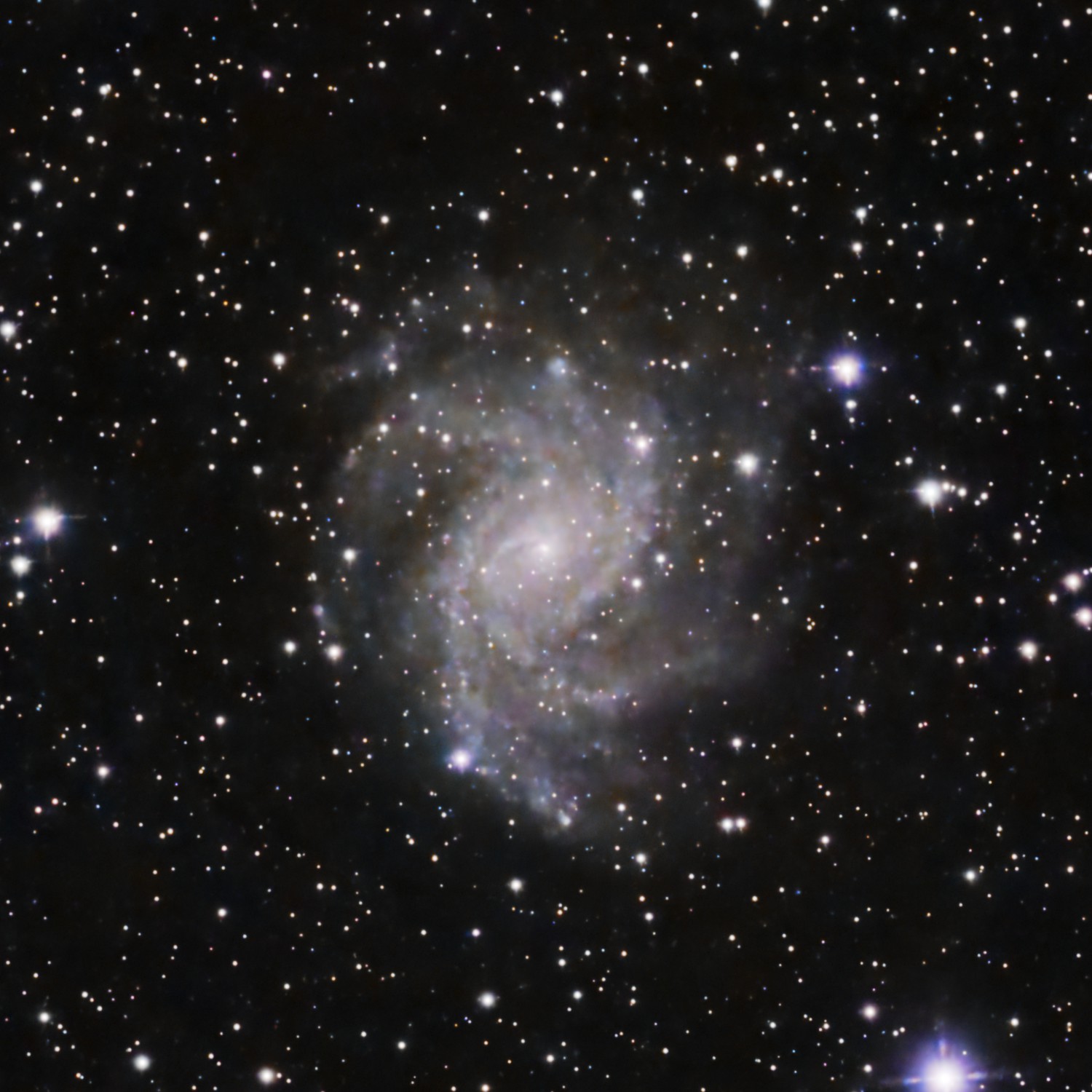
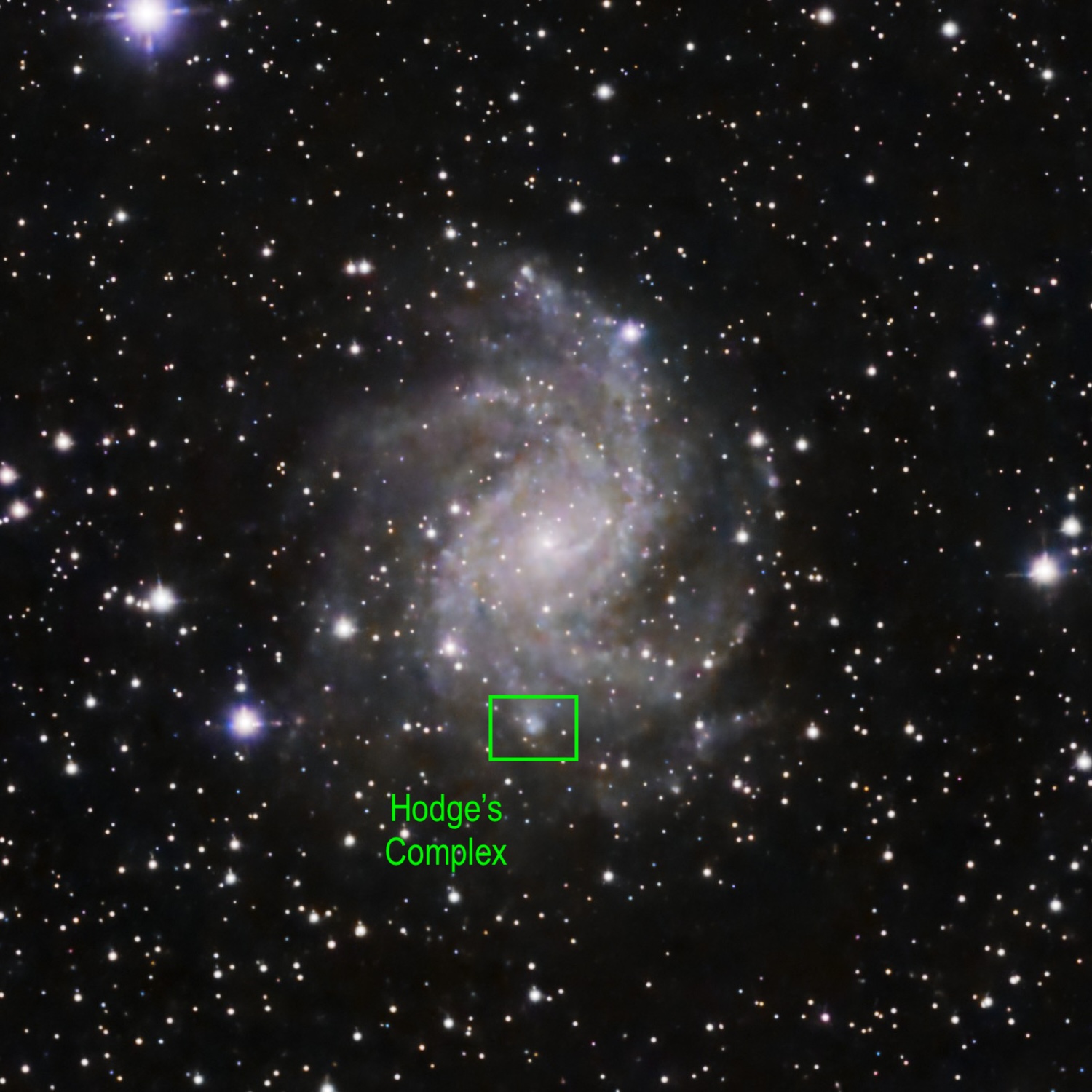
Even in a 40-minute exposure like the one above, the structure of NGC 6946 is striking: a bright core surrounded by a disk speckled with brighter, slightly blue-white knots. Those knots are not individual stars — they’re HII regions, vast clouds of hydrogen gas energized by newly-formed massive stars burning at temperatures many times hotter than the Sun. Each one is a stellar nursery, a place where stars are actively being born.
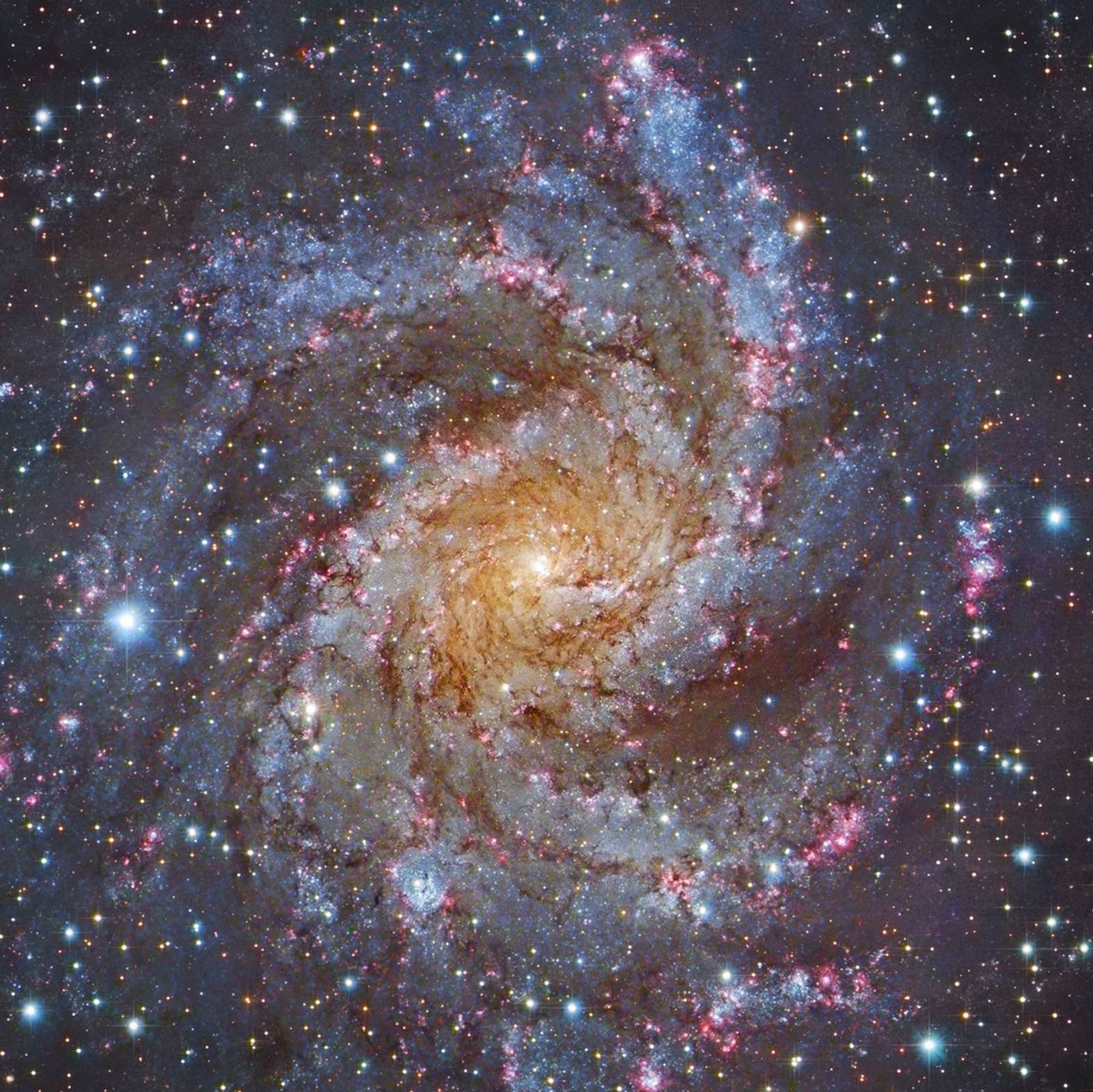
The professional composite at right makes the scale of the activity impossible to miss. The pink and red amorphous patches are the same HII regions shown at far greater depth and in narrowband light that isolates hydrogen-alpha emission — the characteristic glow of ionized gas. Features that appear as subtle knots in a broadband amateur image become unmistakable here. The spiral arms are not smooth; they’re almost continuously studded with these regions, one after another, for tens of thousands of light years.
NGC 6946 is forming stars at a rate several times higher than the Milky Way — and that is the direct cause of its supernova record. Massive stars — the ones that end in supernovae — live fast and die young. A star of 20 or 25 solar masses will burn through its fuel in only a few million years, then detonate. A galaxy that produces more massive stars produces more supernovae, as reliably as cause produces effect. The Milky Way manages roughly one supernova per century. NGC 6946 has averaged one per decade since we’ve been watching.
The Scoreboard
Ten supernovae in one galaxy across one century of observation is a number that sounds almost impossible. Here they are:
| Designation | Year | Type | Notes |
|---|---|---|---|
| SN 1917A | 1917 | Unknown | First recorded; photographic plates |
| SN 1939C | 1939 | Type II | |
| SN 1948B | 1948 | Type II | |
| SN 1968D | 1968 | Type II | |
| SN 1969P | 1969 | Type II | |
| SN 1980K | 1980 | Type IIL | Extensively studied; still visible in radio |
| SN 2002hh | 2002 | Type IIP | Heavily dust-obscured; likely others missed similarly |
| SN 2004et | 2004 | Type IIP | Brightest of the modern era in this galaxy |
| SN 2008S | 2008 | Uncertain | Possibly not a true supernova — an intermediate luminosity transient |
| SN 2017eaw | 2017 | Type IIP | Discovered by amateur Patrick Wiggins; extensively observed |
A few things stand out in this list. First, the gap between 1980 and 2002: twenty-two years with nothing detected. SN 2002hh was heavily obscured by dust in the galaxy’s disk — its intrinsic brightness was reduced by about 3.5 magnitudes, roughly 25 times fainter than it would otherwise have appeared. It’s a reasonable bet that other supernovae occurred in that window and were hidden entirely. The true count may be higher than ten.
Second: SN 2017eaw was discovered by Patrick Wiggins, an amateur astronomer in Utah, just two days after the explosion. This galaxy rewards watching.
The Star That Vanished
In the outer reaches of one of NGC 6946’s spiral arms sat a red supergiant catalogued as N6946-BH1. It was a massive star — roughly 25 times the mass of the Sun — which made it a prime supernova candidate. Astronomers monitoring it with Hubble watched its luminosity increase dramatically in early 2009, then fade. By 2015, it was gone. Not dimmed — gone. Optical observations found nothing where the star had been, replaced only by a faint infrared glow.
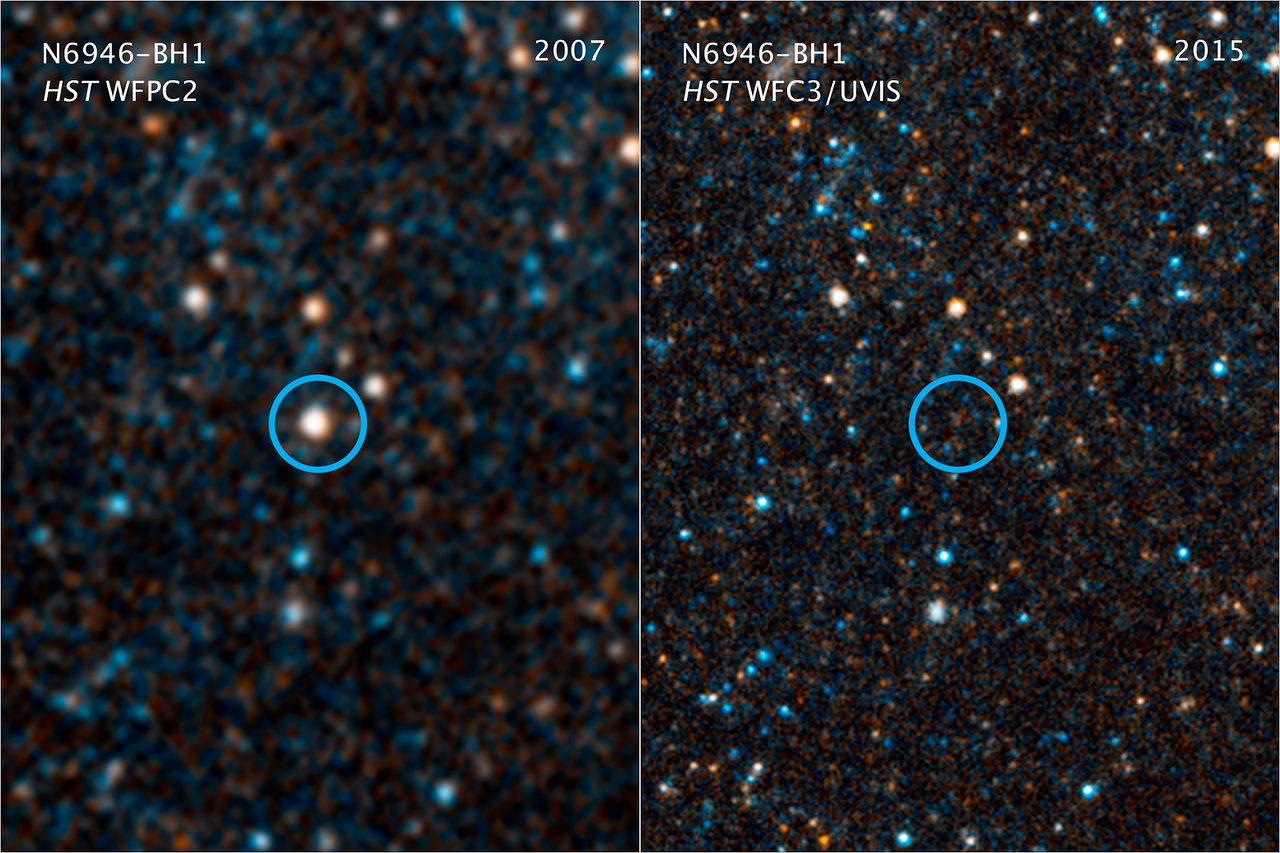
The leading explanation is a failed supernova: a stellar collapse so rapid and complete that the star fell directly into a black hole without producing the shock wave that drives a normal supernova explosion. In the standard picture, when a massive star’s iron core collapses, the resulting supernova explosion is driven by a flood of neutrinos. In some cases — particularly for very massive stars — the core may collapse too quickly for that mechanism to launch the envelope outward. The star simply implodes. The energy that would have powered the explosion is instead carried away by neutrinos, and the outer layers of the star fall in behind, leaving nothing but a black hole and a brief, fading infrared glow from the disrupted envelope.
This had been predicted theoretically. N6946-BH1 is one of the best observational candidates ever found for the phenomenon. It isn’t confirmed — alternative explanations have been proposed, including the possibility that the star merged with a companion and is now hidden inside a dust shell — but the failed supernova interpretation remains the leading one.
Whether or not this specific case is confirmed, the broader implication stands: not every massive star explodes. Some fraction of them simply disappear. We may be missing a population of black holes in galaxies across the universe, formed in silence rather than fire.
What You’re Looking At
The following features are revealed by imaging rather than visual observation — but knowing they’re there changes what you’re seeing when you look.
The Red Ellipse
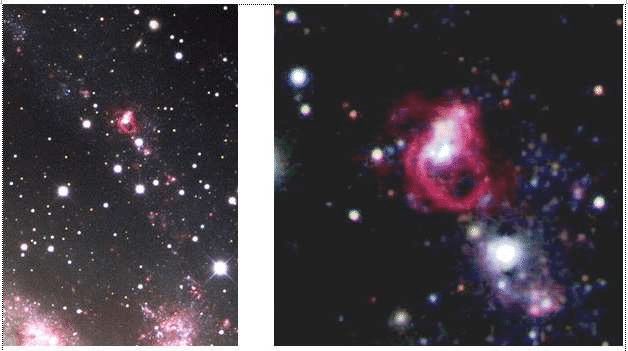
At the outer periphery of the galaxy’s disk — beyond where the main spiral structure fades — lies an object called the Red Ellipse. It’s a large bubble roughly 300 parsecs (nearly 1,000 light years) across, distinctly elliptical in shape. It was originally thought to be a supernova remnant, and at that scale it would be among the largest ever identified. More recent analysis suggests it may instead be a super-bubble: a cavity carved out by the combined stellar winds and multiple supernova explosions from a massive open cluster. Either way, it is itself evidence of the same furious stellar activity responsible for the galaxy’s supernova record. This one is for the narrowband imager — it won’t show in a standard broadband exposure.
Hodge’s Complex
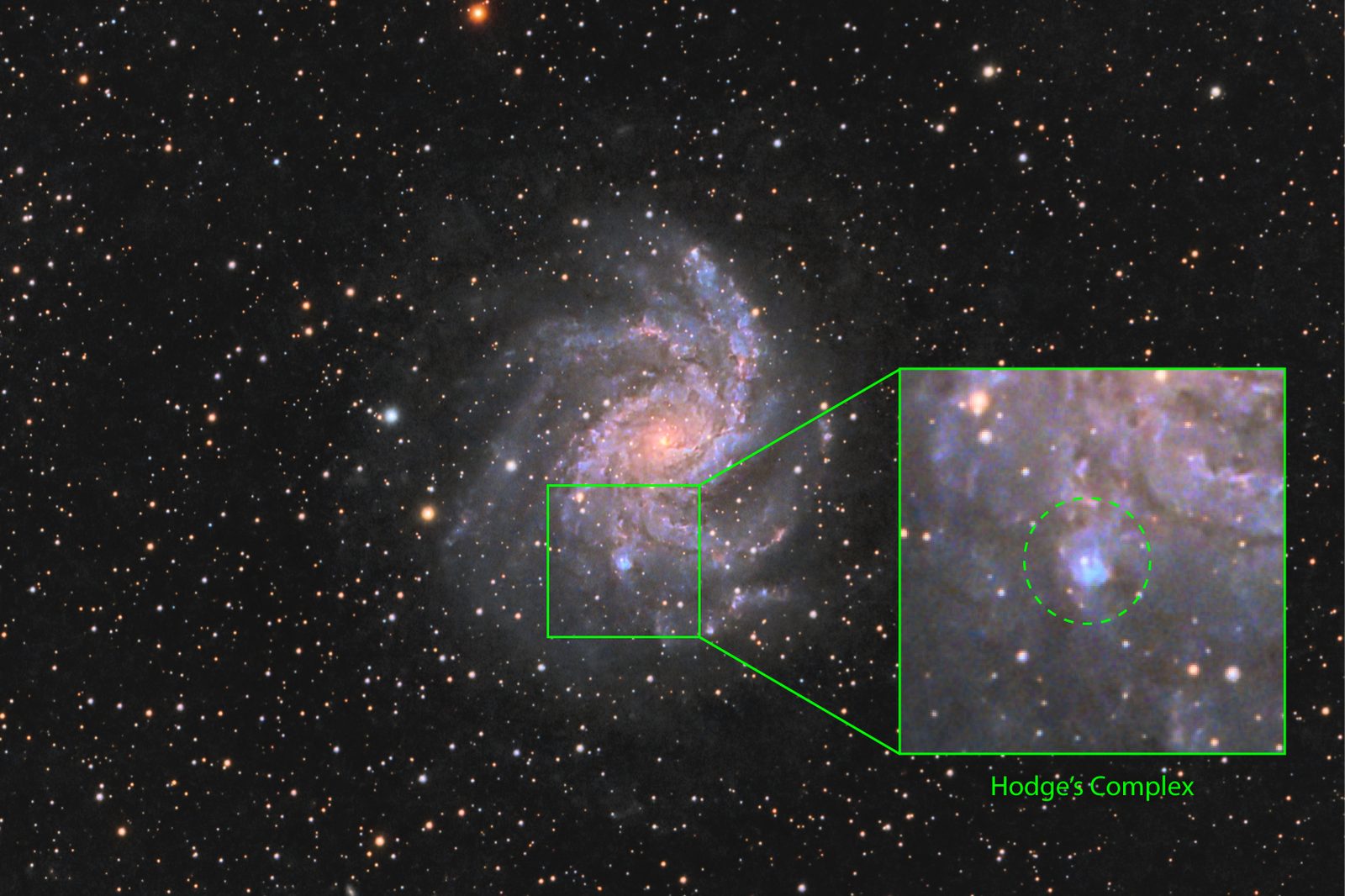
About 5 kiloparsecs (roughly 16,000 light years) south of the galaxy’s nucleus sits a peculiar structure first identified by astronomer Paul Hodge in 1967. For decades it was classified as an unusually large, young stellar complex — a supercluster containing about two dozen smaller clusters and many exceptionally luminous young stars. In 2017 it was reconsidered: the current interpretation is that it may be a small dwarf galaxy interacting with NGC 6946, its stars superimposed on the outer disk rather than embedded within it. If so, that gravitational interaction could itself be a contributor to the elevated star-formation rate in the southwestern regions of the disk — a small cosmic collision slowly turning up the star-formation dial. This remains an open question.
Finding and Observing It
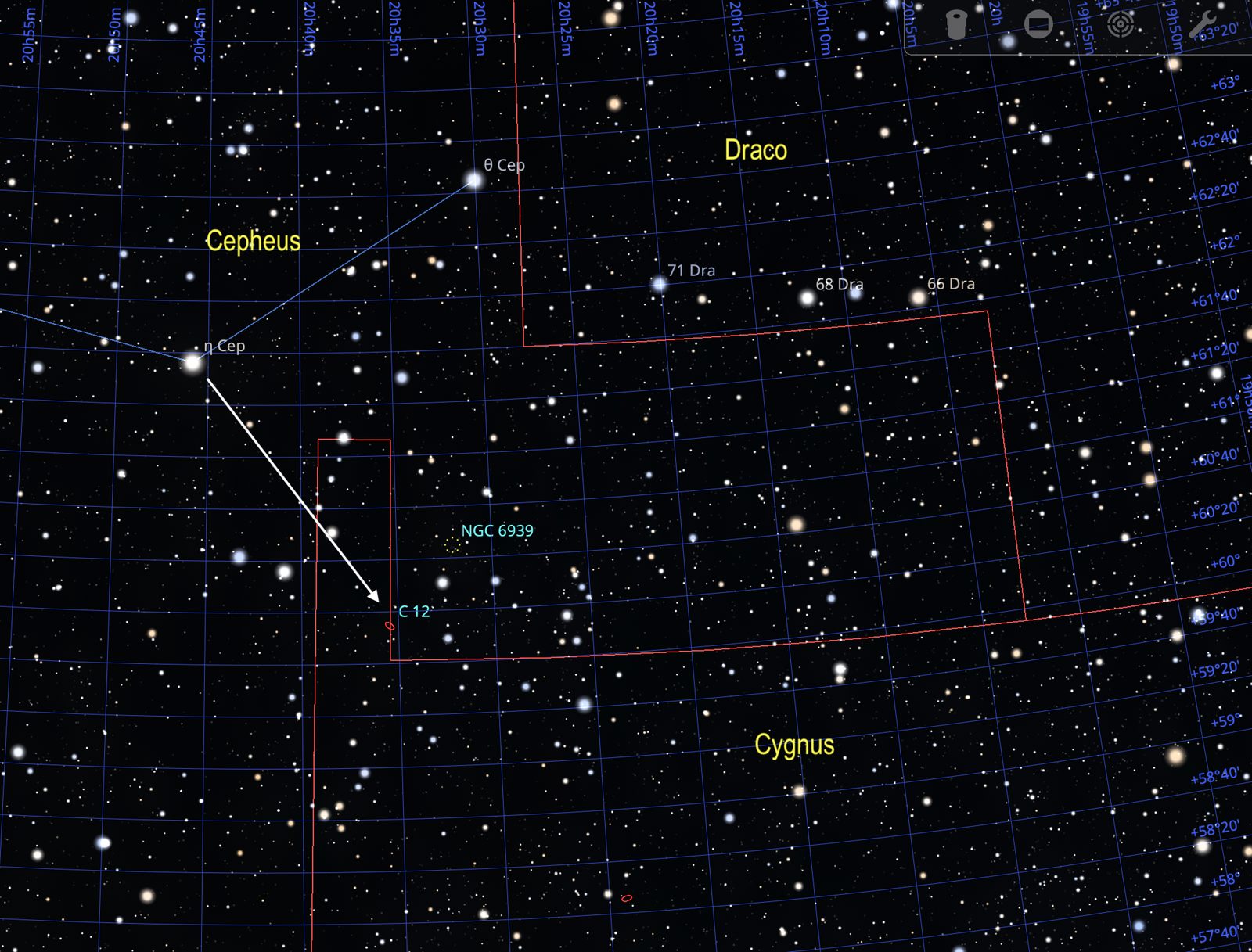
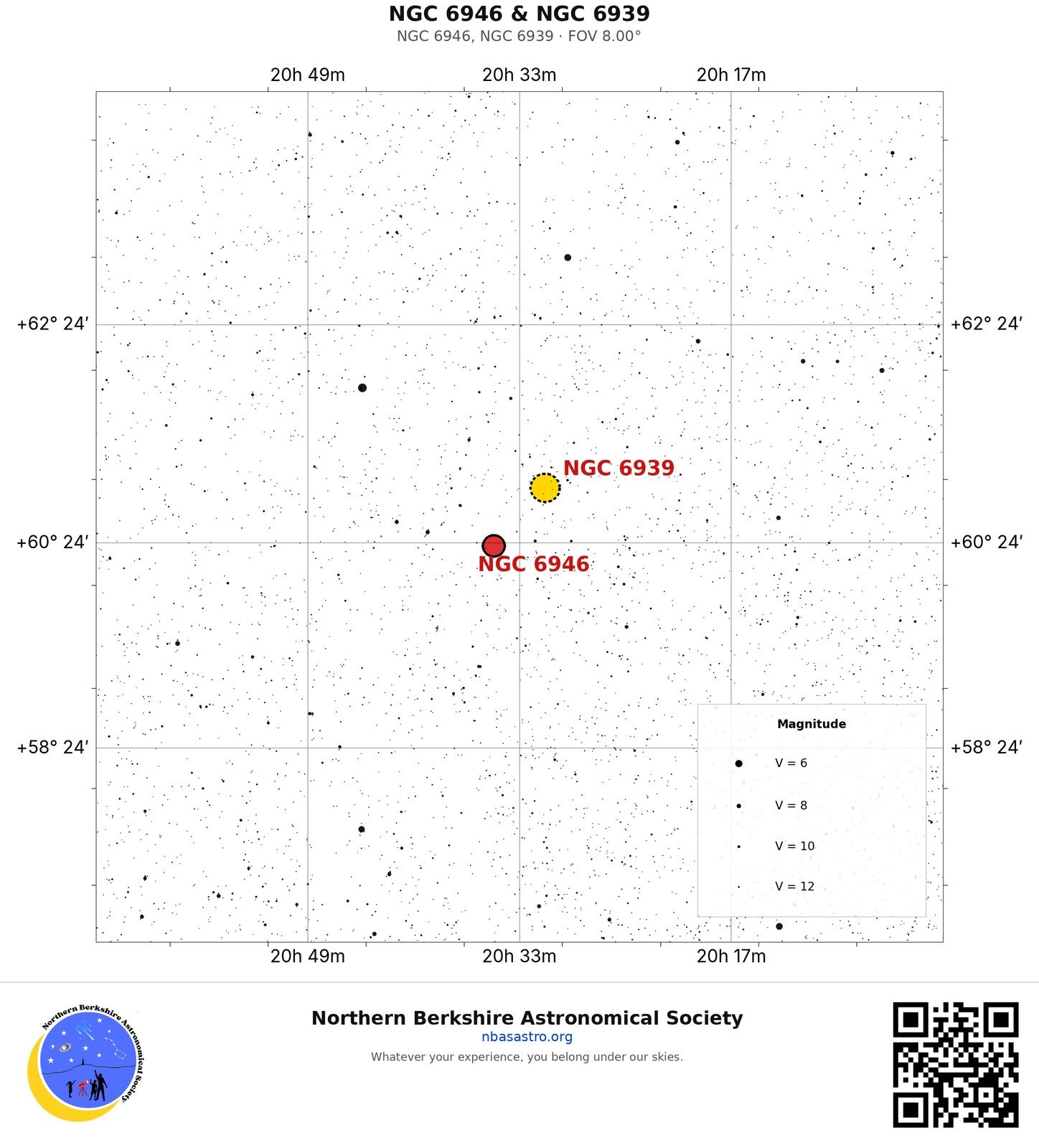
NGC 6946 sits almost exactly on the Cygnus/Cepheus border, about 2.5° southwest of the open cluster NGC 6939. A convenient starting point is η Cephei (Eta Cephei), a 3rd-magnitude star roughly 2–3° to the north. Drop southwest from η Cep and both NGC 6939 and NGC 6946 come into view — they fit comfortably in a low-power eyepiece field, which makes the cluster a natural stepping-stone to the galaxy.
A note on NGC 6939: the two objects share a line of sight, not a location. The cluster lies roughly 4,000 light years away, entirely within our own Milky Way. NGC 6946 is some 22 million light years beyond it. The apparent proximity is coincidental — NGC 6939 is a foreground object, unrelated to the galaxy in every physical sense. That said, it’s a fine target in its own right: a rich, well-resolved cluster of around 80 stars, roughly 1.3 billion years old. Seeing both in the same field makes the depth of the universe briefly concrete — one object is a nearby neighborhood of stars; the other is an entire galaxy sitting behind it.
NGC 6946 is best placed in late summer and autumn in the northern hemisphere, transiting high in the northeast. Note that it lies only about 10–20° from the galactic plane, which means you’re looking through a dense layer of Milky Way stars to reach it — that crowded foreground is not part of the galaxy. It also contributes to the distance uncertainty: dust in our own galaxy complicates the measurement, which is why published distances range from around 10 to 22 million light years.
Through a small telescope (3–4"), NGC 6946 appears as a soft, slightly oval glow, noticeably brighter at the center. Low surface brightness is the defining observing challenge — dark skies matter considerably more than aperture here. An 8" telescope under good conditions will begin to show the mottled texture of the disk. Larger Dobsonians reveal the spiral arm structure directly, and the brighter HII knots begin to stand out. Those knots, faint as they are at the eyepiece, are the same stellar nurseries driving the galaxy’s supernova rate.
In a smart scope, this is a genuinely rewarding target. Even short exposures reveal the blue star-forming regions and hint at the spiral structure. Longer sessions of 30–60 minutes will show the asymmetry in the arms and some of the brighter complexes in the disk. It’s not as immediately dramatic as M101 — the arms are less symmetric and the surface brightness less uniform — but it rewards attention precisely because there’s so much going on beneath the surface.
You Could Be Next
SN 2017eaw was discovered by an amateur two days after it exploded. SN 2004et was caught early by a systematic monitoring program. This galaxy produces supernovae at a rate that makes it worth watching regularly — not just imaging for its inherent beauty, but monitoring. Any image of NGC 6946 taken tonight is a potential baseline measurement. Any image taken this time next year is a comparison frame.
The tools available to an amateur today — plate-solved images, automatic stacking, citizen science networks like the Unistellar Citizen Science program — mean that the next supernova in the Fireworks Galaxy could be caught in its first hours by someone who thought they were just doing a routine imaging run.
Whatever your equipment: point at it. Save your images with dates. And keep coming back.
Ten supernovae confirmed in a century of watching. And one star that had the audacity to die in silence.