Born in Groups
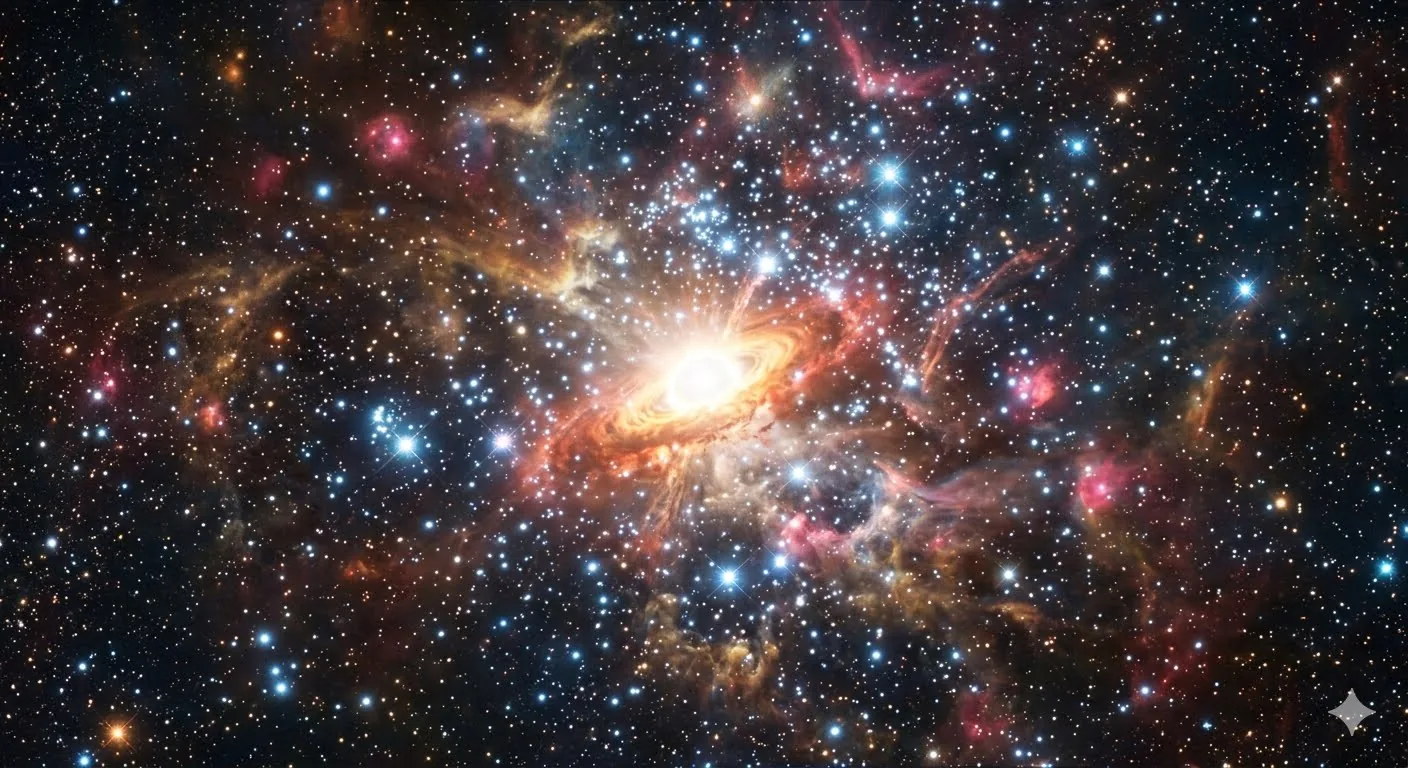
The Sun didn’t form alone. When the cloud of gas and dust that became our solar system collapsed about 4.6 billion years ago, it collapsed alongside hundreds or thousands of other clouds doing the same thing in the same region of the galaxy. The Sun was born into a cluster — a loose, gravitationally connected family of sibling stars, all roughly the same age, sharing similar chemistry.
That cluster is long gone. The stars in it drifted apart over millions of years, pulled away by the gravity of passing clouds and the slow tide of the galactic disk. Today, the Sun’s birth siblings are scattered across the Milky Way, lost in the crowd. We don’t know which stars they are. We may never know.
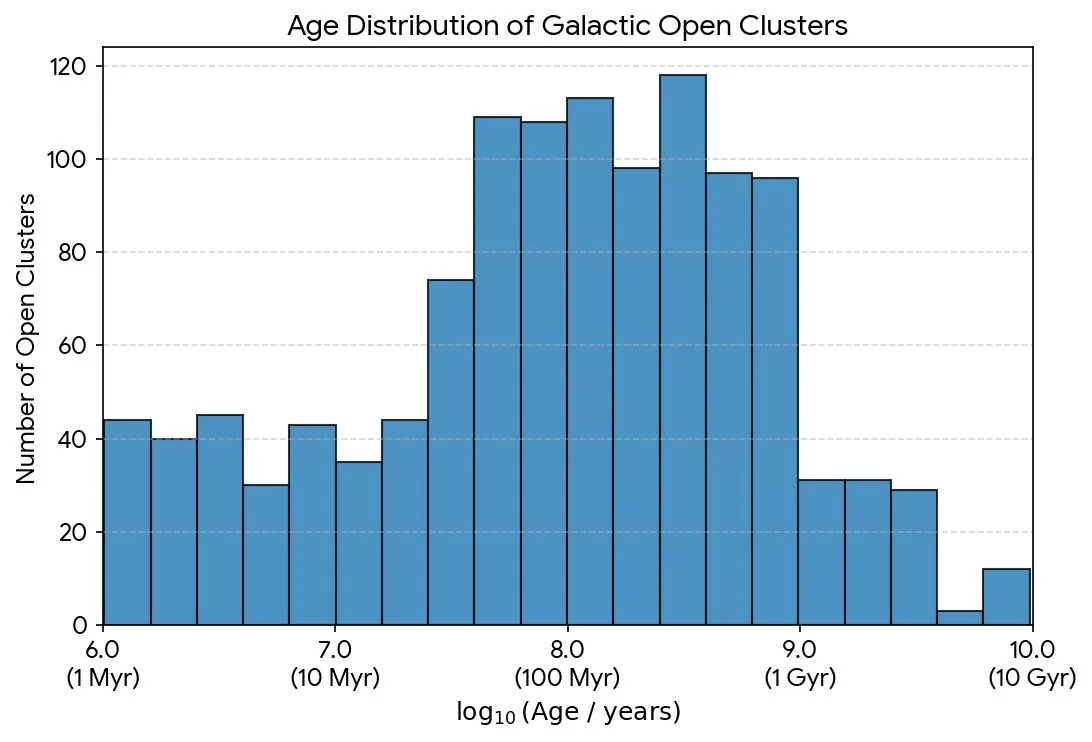
This is the normal fate of an open cluster. Most open star clusters — the loose, irregular groupings that form within the disk of the galaxy — don’t last. Of the roughly 1,000 open clusters with measured ages in our galaxy, only about 180 are older than one billion years. Barely 2% survive past four billion years. The galaxy makes clusters easily, and dissolves them almost as easily.
A handful, though, have beaten the odds. Seven clusters in particular stand out: ancient objects ranging from three to twelve billion years old, each surviving through a combination of mass, position, chemistry, and what may simply amount to luck. They are among the most interesting objects in the night sky — not for their appearance, which is generally modest, but for what they represent.
Why Clusters Don’t Last
An open cluster is not a stable structure in the way a globular star cluster is. Globular clusters are massive, dense, gravitationally tightly bound objects containing hundreds of thousands to millions of stars, orbiting the galaxy far above and below the disk where the environment is relatively calm. Open clusters are disk objects: smaller, looser, far more exposed to the chaos of the galactic plane.
Three forces work against them.
The first is encounters with giant molecular clouds — the vast, cold, dense nebulae scattered throughout the disk where new stars form. When a cluster passes close to one of these clouds, the cloud’s gravity tugs unevenly on the cluster, heating its internal motions and pulling stars away. These encounters are the single most efficient cluster-killer. Statistical estimates suggest that they disrupt a typical open cluster in roughly 200 million years.
The second is the tidal field of the galaxy itself. The disk and bulge exert a stretching force on any orbiting object: stars on the side of the cluster closer to the galactic center feel a slightly stronger pull than stars on the far side. Over time, this slowly unravels a cluster from the outside in. Clusters orbiting closer to the galactic center — where the tidal field is stronger and GMC encounters are more frequent — face this pressure most severely.
The third is internal: a slow process called evaporation. In any cluster, individual stars move at a range of speeds due to random gravitational jostling. Stars that gain enough energy in these encounters can escape the cluster entirely, like water molecules evaporating from a puddle. Massive clusters resist this longer because their deeper gravity well requires more energy to escape. Small clusters evaporate relatively quickly.
The survivors among old open clusters share a common profile: they tend to be massive, they tend to orbit far from the galactic center where conditions are calmer, or they occupy orbits that carry them above and below the galactic plane, away from the dense layer of gas and molecular clouds.
Most open clusters are young — hundreds of millions of years old at most. This histogram shows the age distribution of known open clusters. The drop-off is steep. Surviving to a billion years is an achievement. The clusters on this page are, by any measure, extraordinary outliers.
The Oldest Known Clusters
| Name | Coordinates | Con | Dist. (kly) | Ang. Size | Diam (ly) | Mag | Age (Gyr) | Stars | Mass (M☉) |
|---|---|---|---|---|---|---|---|---|---|
| Berkeley 17 | 05h20m +30°34' | Aur | ~13 | 8.5' | ~32 | 14.6 | 10 – 12.6 | >500 | ~536 |
| NGC 6791 | 19h20m +37°47' | Lyr | ~17 | 8.2' | ~62 | 9.5 | 8.0 – 9.5 | few thou | ~5,000 |
| Berkeley 32 | 06h58m +06°26' | Mon | ~10 | 7.6' | ~16 | 13.5 | 7.2 | >500 | ~500 |
| NGC 188 | 00h47m +85°15' | Cep | ~5.4 | 32.6' | ~23 | 8.1 | 6.4 – 7.2 | ~5,000 | ~1,400 |
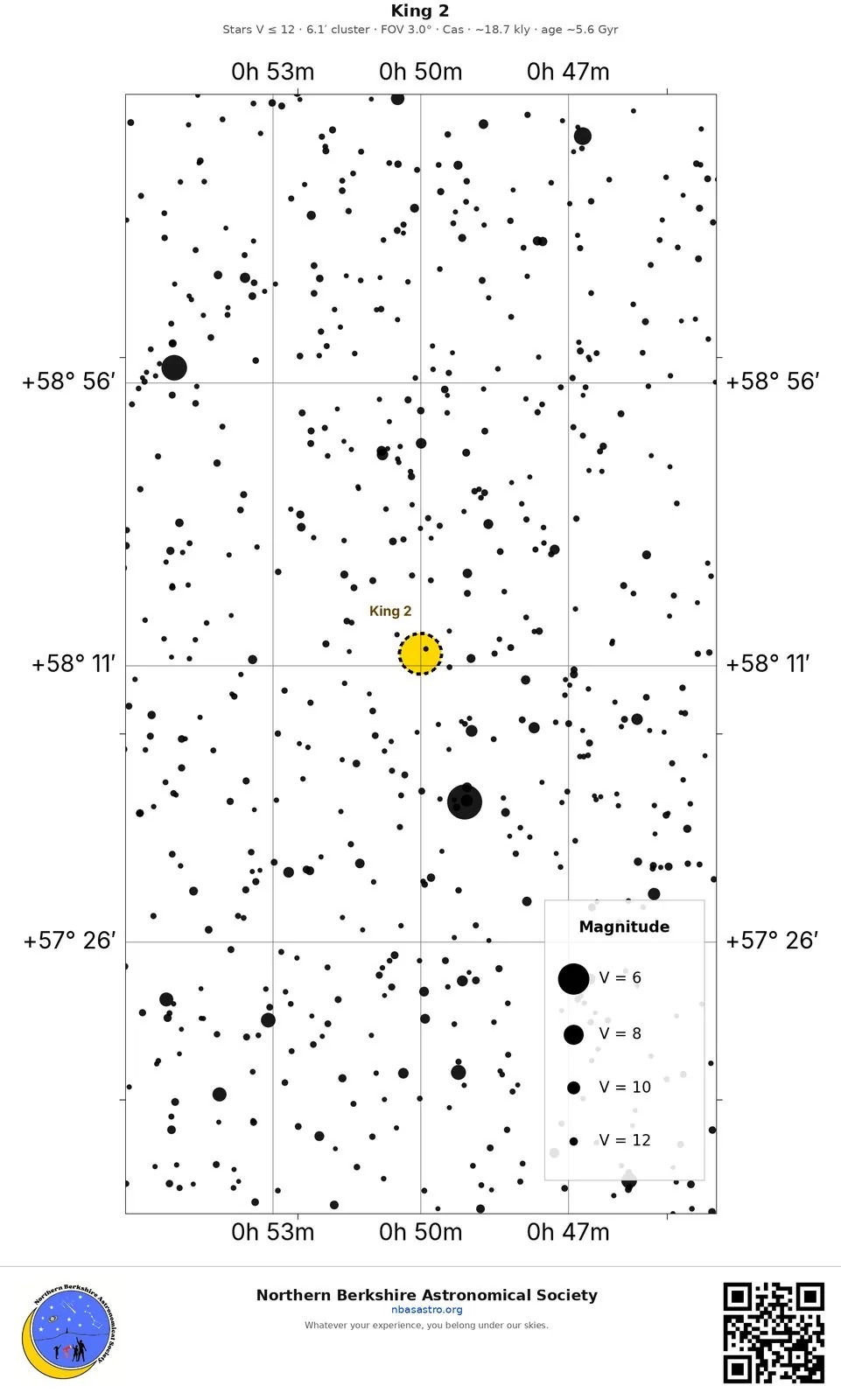
| King 2 | 00h50m +58°11' | Cas | ~18.7 | 6.1' | ~85 | 13.0 | 5.6 | >350 | ~350 |
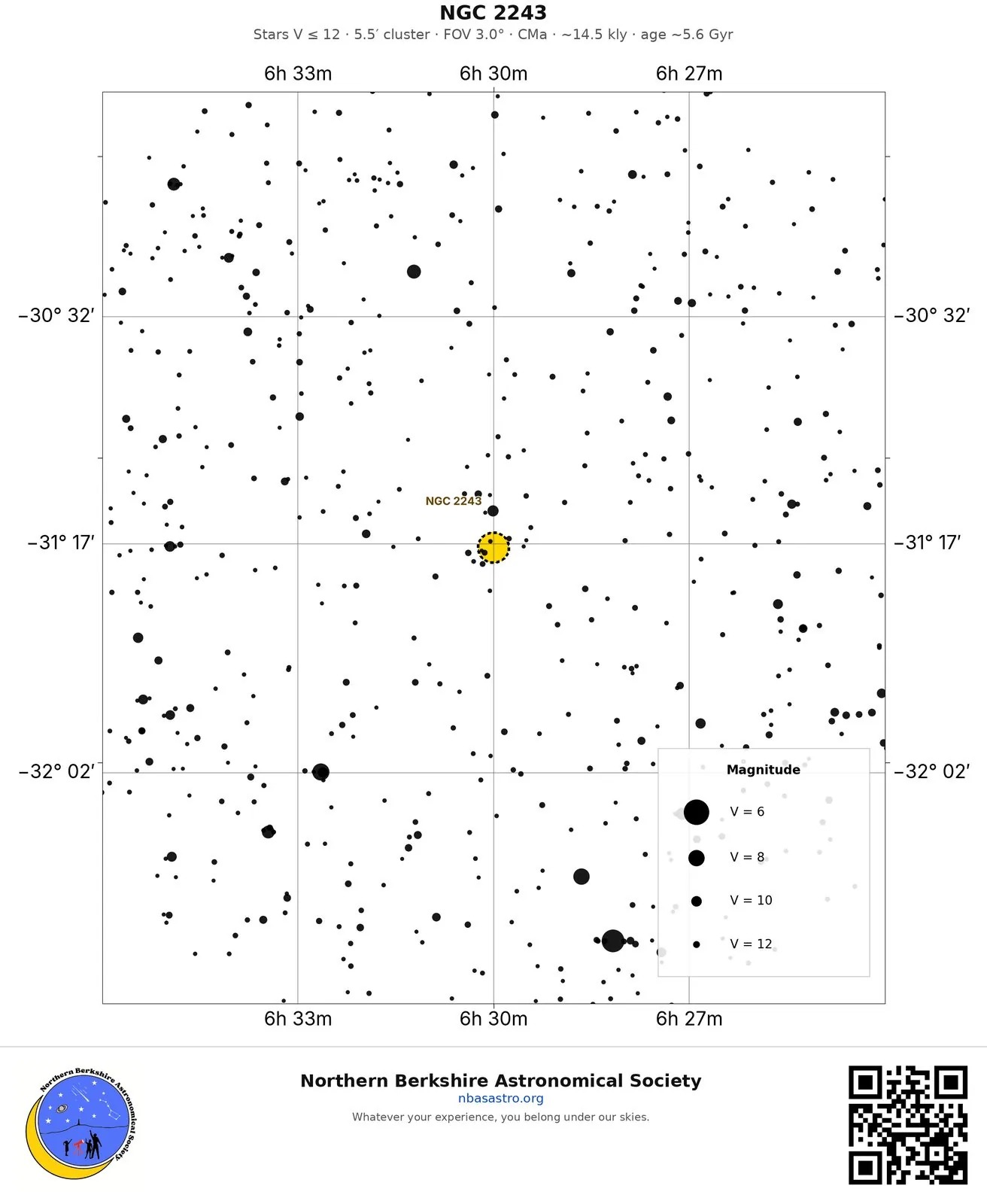
| NGC 2243 | 06h30m -31°17' | CMa | ~14.5 | 5.5' | ~20 | 11.2 | 5.6 | >350 | ~500 |
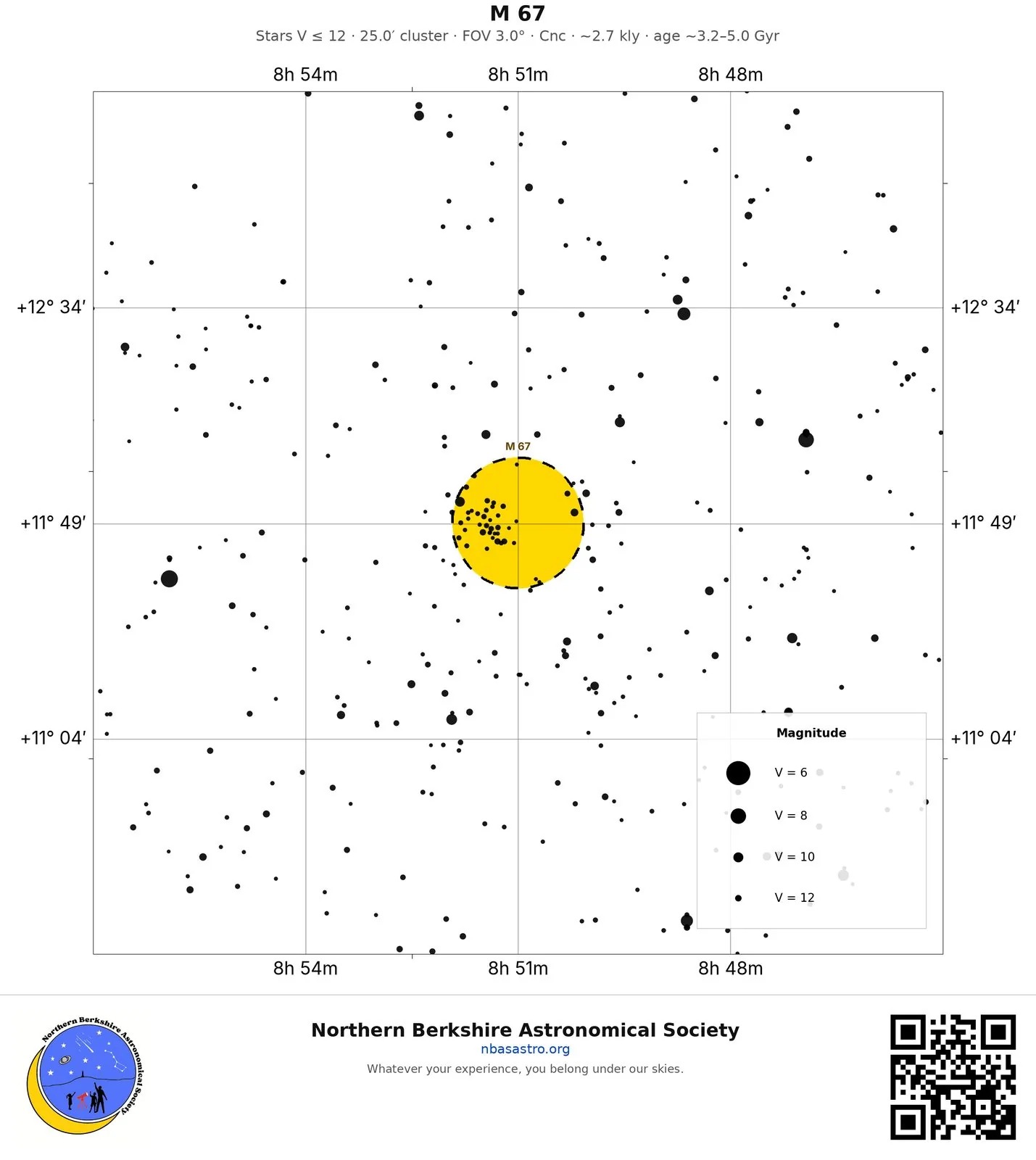
| M 67 | 08h51m +11°49' | Cnc | ~2.7 | 25.0' | ~20 | 6.1 | 3.2–5.0 | ~1,000 | ~1,200 |
How Cluster Ages are Determined
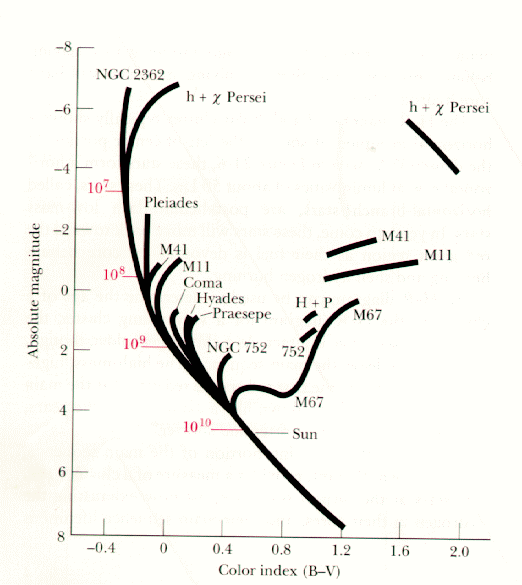
To determine a cluster’s age we measure the brightness and color of the stars in the cluster. Since we can assume that the stars are all at about the same distance, their observed magnitudes will line up showing the cluster’s evolutionary sequence:
- More-massive stars evolve into red giants first, and then become white dwarfs;
- Intermediate-mass stars evolve into red giants later;
- Stars the mass of the Sun or smaller evolve last.
Seeing where the “turn-off” point is in the color-magnitude diagram (CMD) tells us the age of the cluster. Some astrophysical factors can complicate this assessment: the average metal content of the stars, and the presence of gas and dust in the vast expanse between us and the cluster itself, but it’s clear from the color-magnitude diagrams these clusters are old.
Young clusters, like the Double Cluster in Perseus (about 15 Myr = 0.015 Gyr) or the Pleiades (about 100 Myr = 0.1 Gyr), still have hot blue stars, and maybe a few of the most-massive stars have burned through their core hydrogen and have begun developing into red giants. In slightly older clusters, like Praesepe (M 44) and the Hyades, all the hot blue stars that formed with the cluster: they’ve become red giants. The turn-off point proceeds down the Main Sequence with increasing age: for the oldest clusters (like Berkeley 17), even stars like the Sun have evolved into red giants.
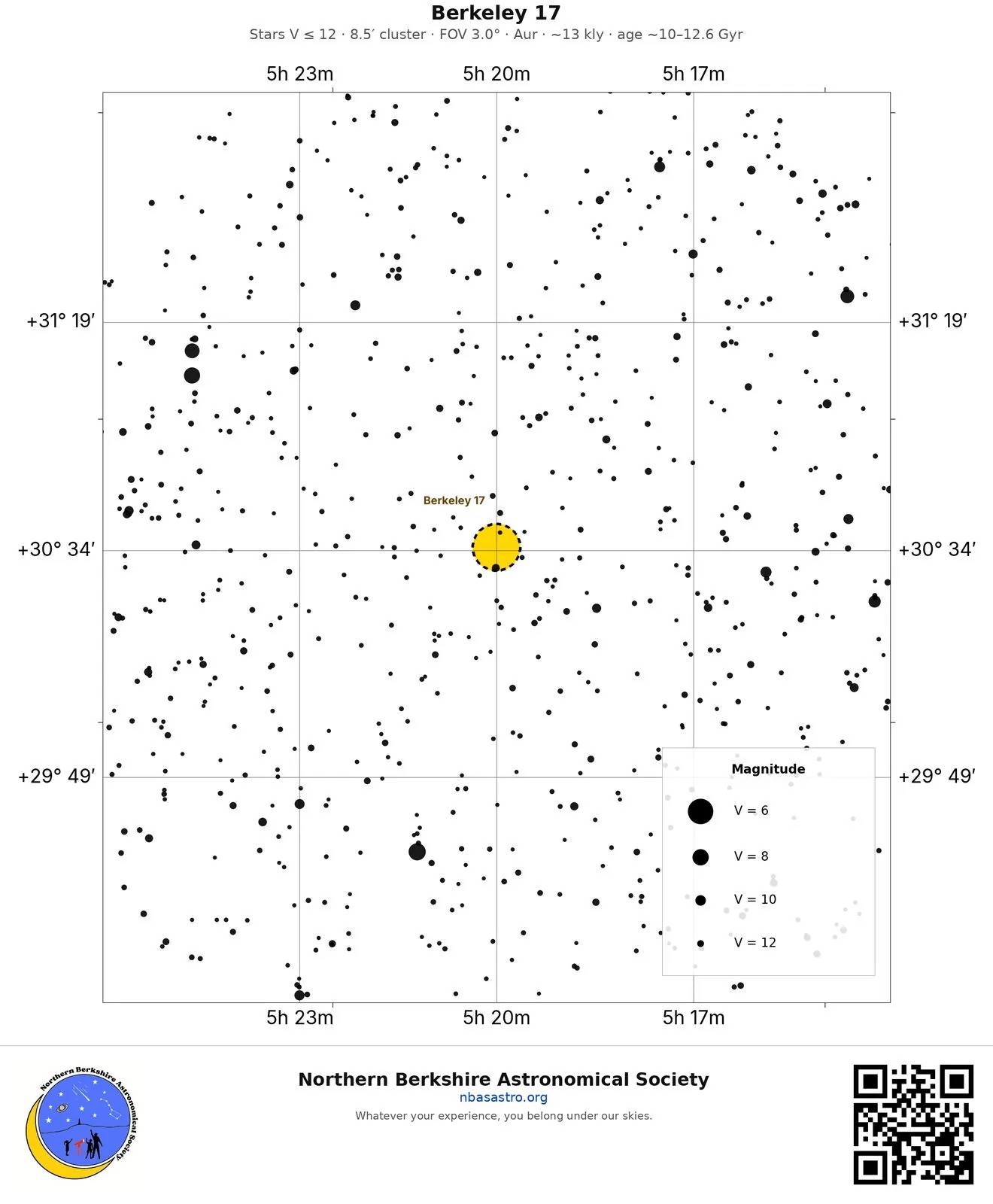
Berkeley 17
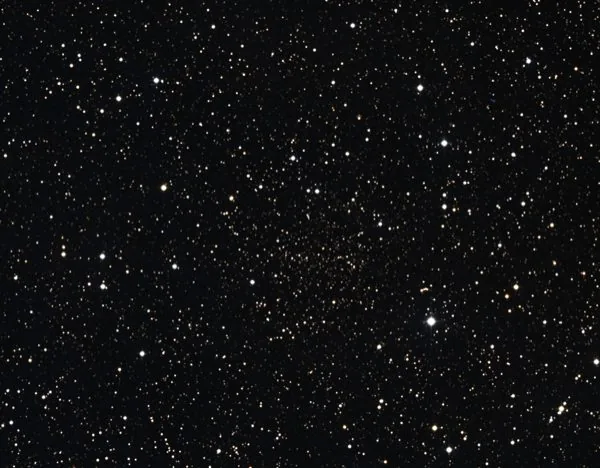
Berkeley 17 is located in a place you wouldn’t expect: it’s located in the constellation Auriga, close to the location of the galactic anticenter - the direction opposite the galactic core (in Sagittarius). While it’s about 13,000 light years from the Sun, it’s also about 10,000 ly further out from the center of the Milky Way than the Sun. And - so far - it holds the likely title of oldest surviving open cluster in the Milky Way.
Age estimates range from about 10 to 12.6 billion years, with the uncertainty reflecting genuine difficulty in pinning down stellar ages at this extreme. If the higher estimates are right, Berkeley 17 formed when the galaxy itself was still very young: only a few billion years old, before the Sun existed, before Earth existed, before the solar system’s raw materials had been through enough stellar generations to acquire the chemistry life would eventually require.
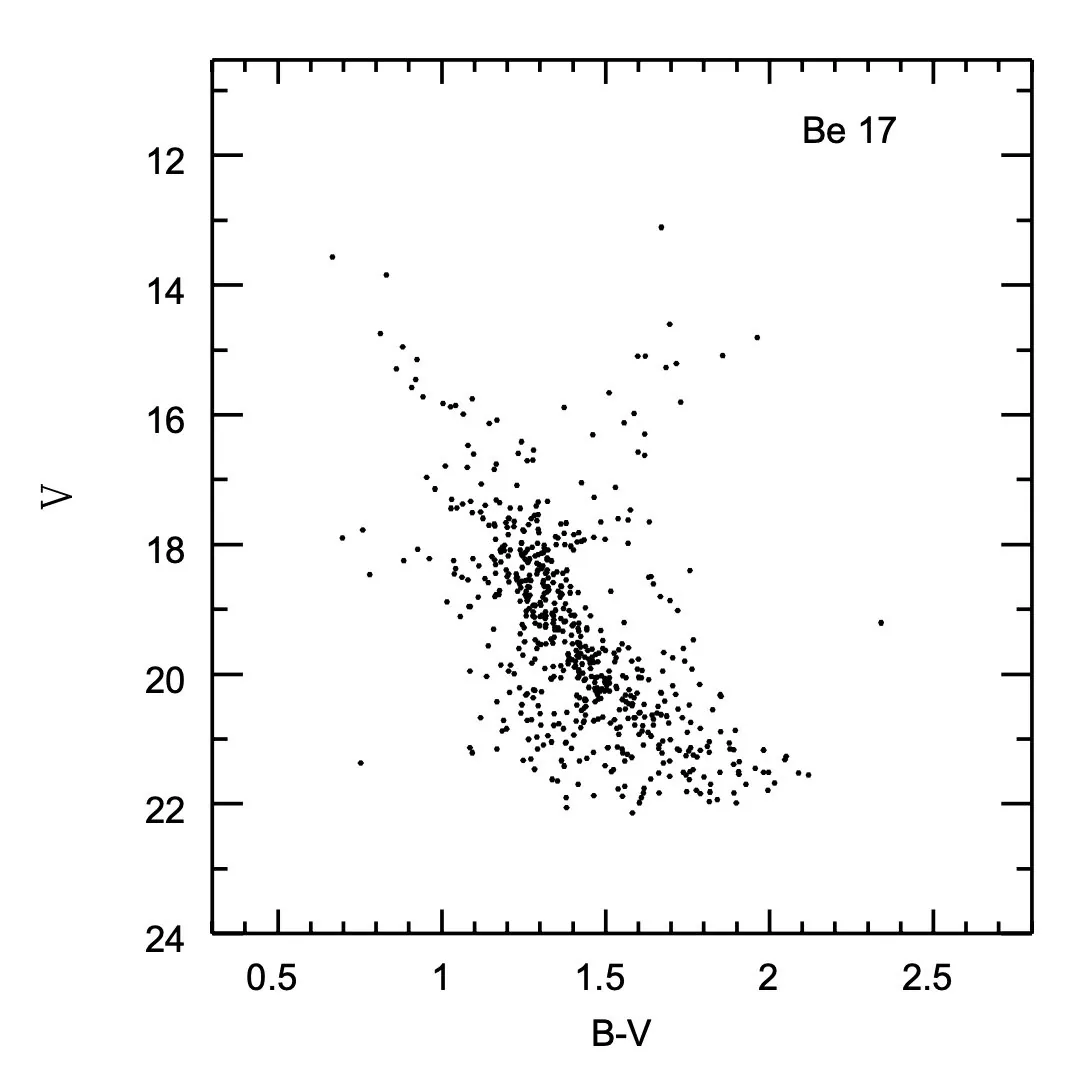
It survives, almost certainly, because of where it lives. Berkeley 17 sits at the outer edge of the disk, far from the galaxy’s crowded interior, in a region with relatively few giant molecular clouds to disrupt it. Its stars are slightly metal-poor — they formed early, from gas that hadn’t yet been seeded with as many heavy elements by earlier generations of dying stars.
At magnitude 14.6, this is not a cluster for casual observing. You will need a large/imaging telescope and good skies - and even then you might only be able to see the brightest red giant stars. But knowing it is there — that faint smudge of ancient light — changes something about looking in that direction.
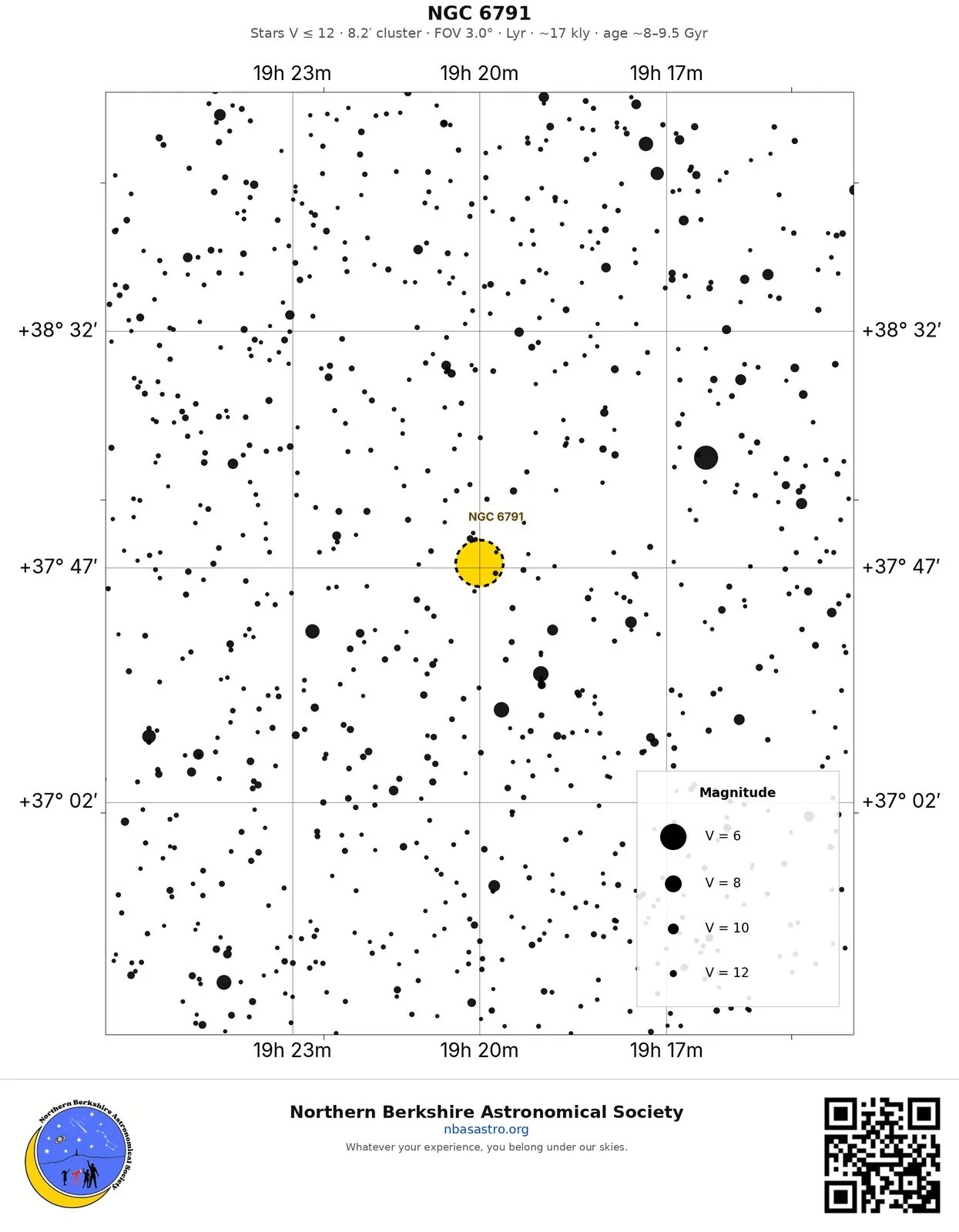
NGC 6791
Everything about NGC 6791 in Lyra seems to contradict itself, and that is precisely what makes it remarkable.
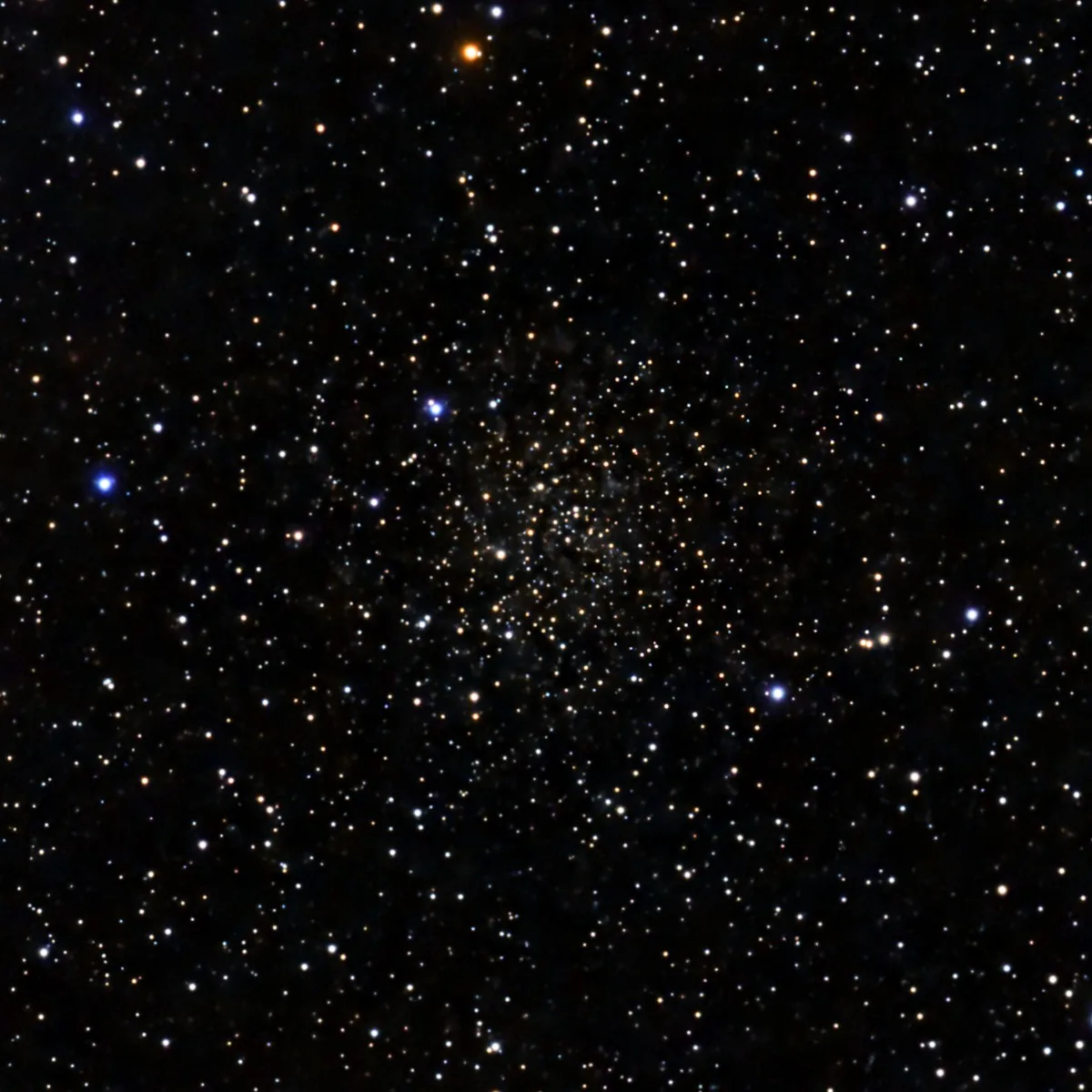
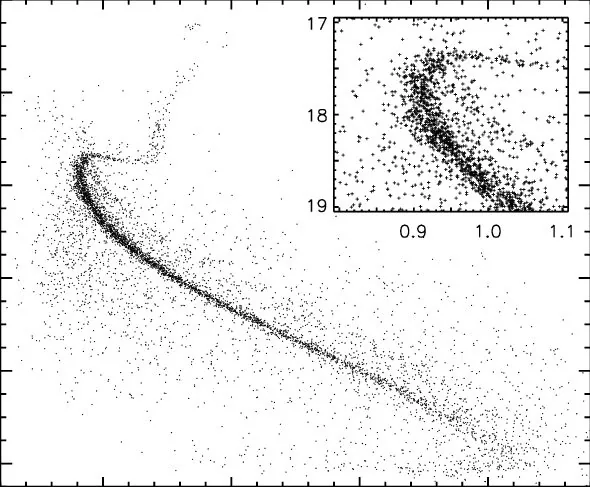
It is one of the oldest known open clusters, somewhere between 8.0 and 9.5 billion years old. And yet it is also one of the most metal-rich clusters known anywhere in the galaxy — containing more than twice the Sun’s iron content. This is deeply unusual. The standard story of stellar chemistry is that older stars are more metal-poor, because they formed before successive generations of supernovae had enriched the interstellar medium. NGC 6791 didn’t get that memo.
What happened? One compelling hypothesis is that NGC 6791 formed much closer to the galactic center, where star formation has always been more vigorous and heavy elements accumulate faster — and that over billions of years it migrated outward to its present position. If so, it carries within its stars a chemical fingerprint of a very different environment.
NGC 6791 also generated a genuine scientific puzzle when astronomers tried to measure its age using its white dwarfs. The white dwarf cooling sequence — essentially measuring how long those dead stars have been cooling — gave an age billions of years younger than the cluster’s main-sequence turn-off age. It took careful modeling of the physics of white dwarf interiors (involving the settling of neon-22 through the cooling white dwarf’s interior, and the subsequent crystallization and phase separation of the core) to reconcile the two clocks. NGC 6791 turned out to be, among other things, a testbed for stellar physics.
At magnitude 9.5, it is reachable with a small telescope under dark skies when it’s nearly overhead — a rich, compact patch of stars worth the attention.
NGC 188 (Caldwell 1)

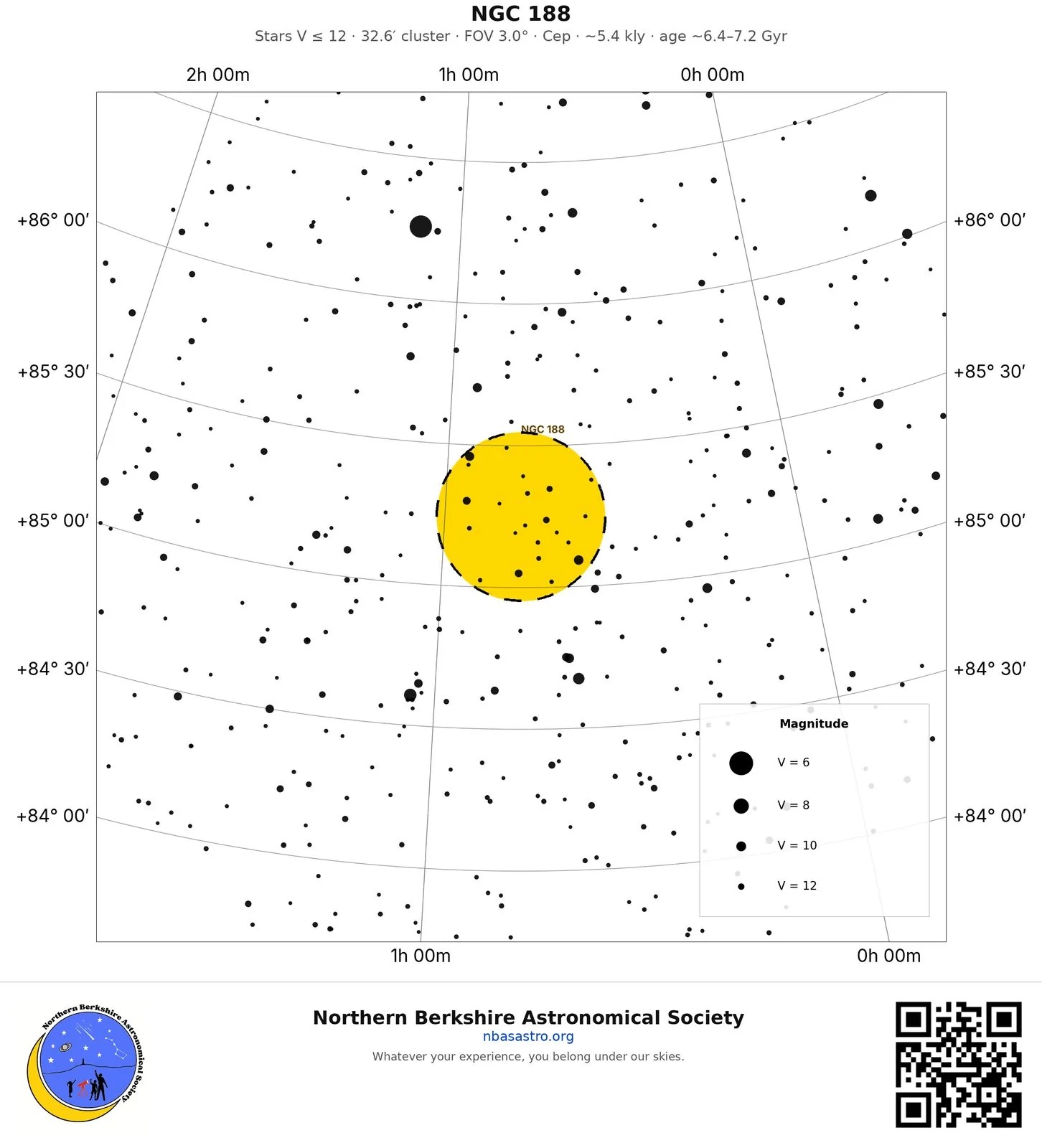
NGC 188 has a designation in the Caldwell catalog for good reason: Patrick Caldwell-Moore chose it as the very first entry, and he picked well. At declination +85°, the cluster sits just 2.8° from the north celestial pole — it is technically in Cepheus, though it barely belongs to any constellation in the usual sense. From mid-northern latitudes, it is circumpolar: it never sets. You can find it on any clear night of the year.
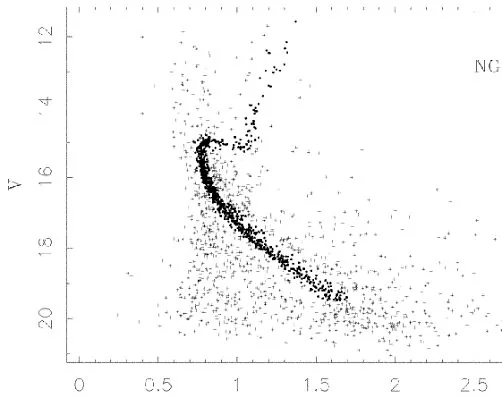
Its age is estimated at around 6.4 to 7 billion years, making it one of the oldest clusters we can observe with modest equipment. The reason it has survived is instructive: NGC 188 orbits the galaxy in an elongated path that repeatedly carries it above and below the plane of the disk. Time spent above the plane is time spent away from the zone of dangerous encounters with giant molecular clouds. The cluster has, in effect, spent much of its long life in a calmer environment than most disk clusters ever experience.
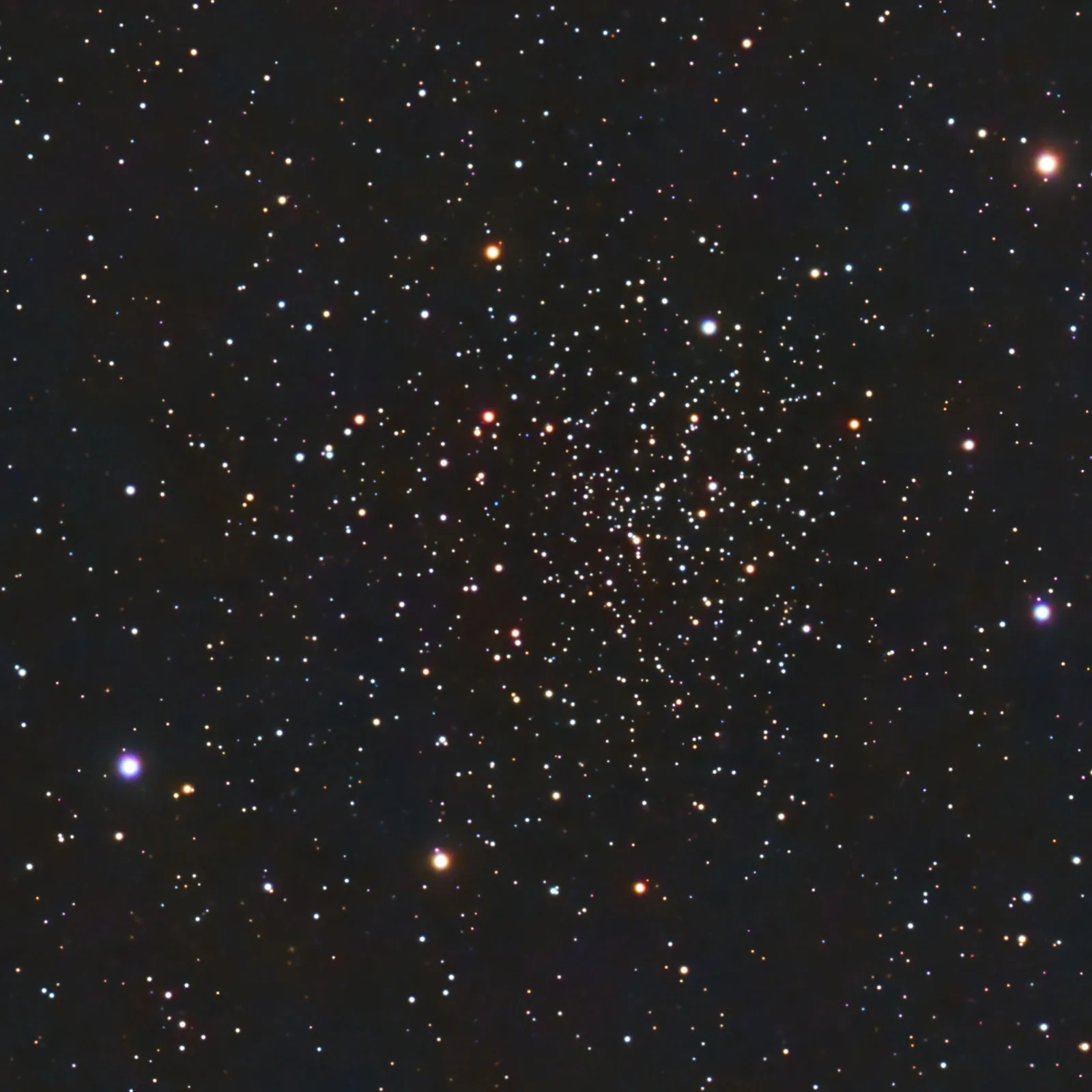
At magnitude 8.1 with an angular diameter of about 33 arcminutes (slightly larger than the full Moon), it is visible in binoculars as a soft glow, and a 6-inch telescope resolves it into a rich scatter of faint stars. It is one of the more accessible old clusters for northern hemisphere observers, and its position near the pole makes it findable almost any night of the year.
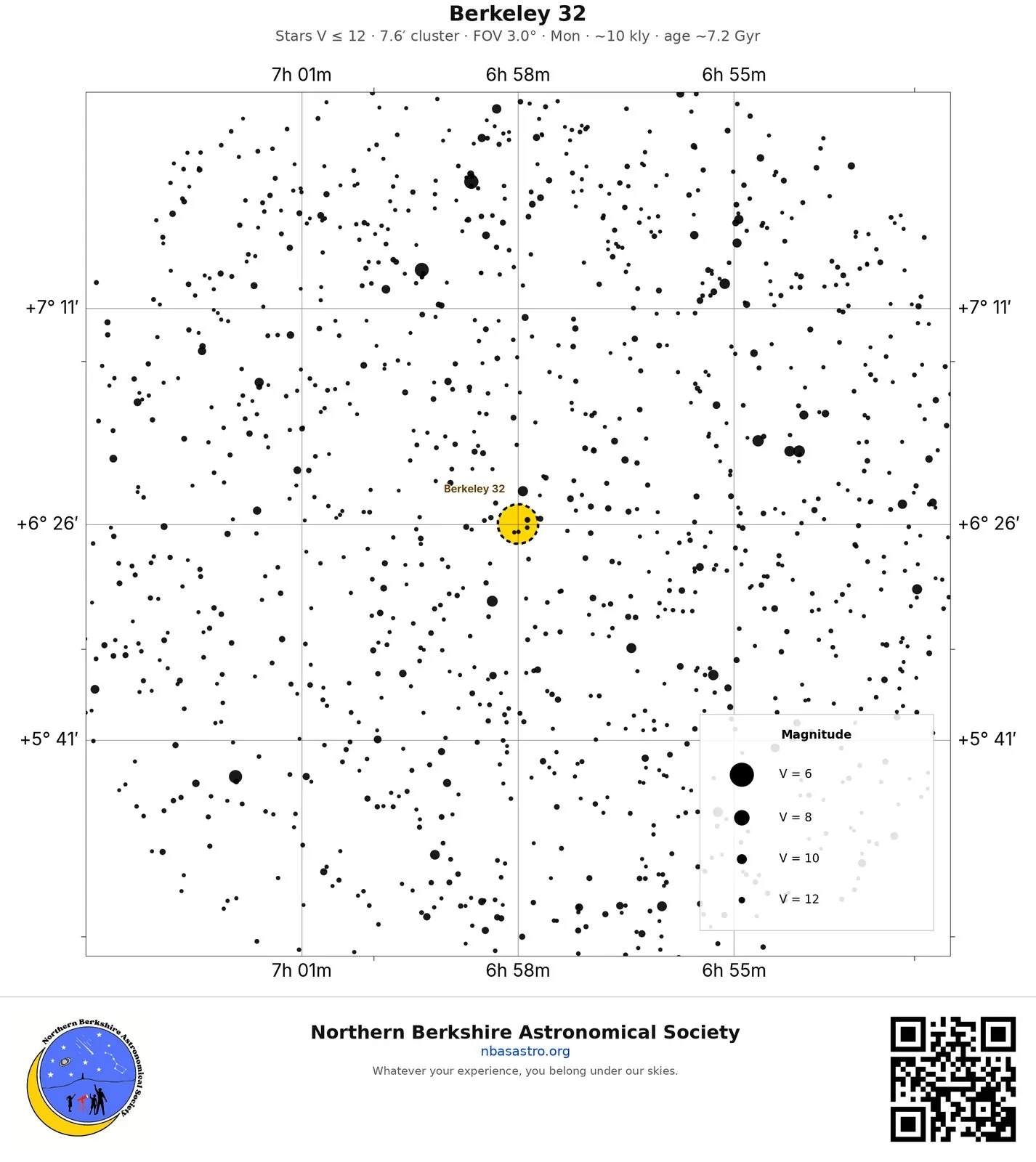
Berkeley 32
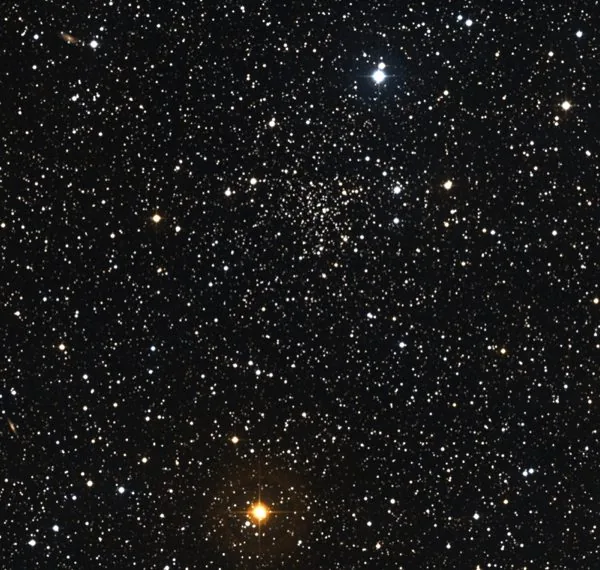
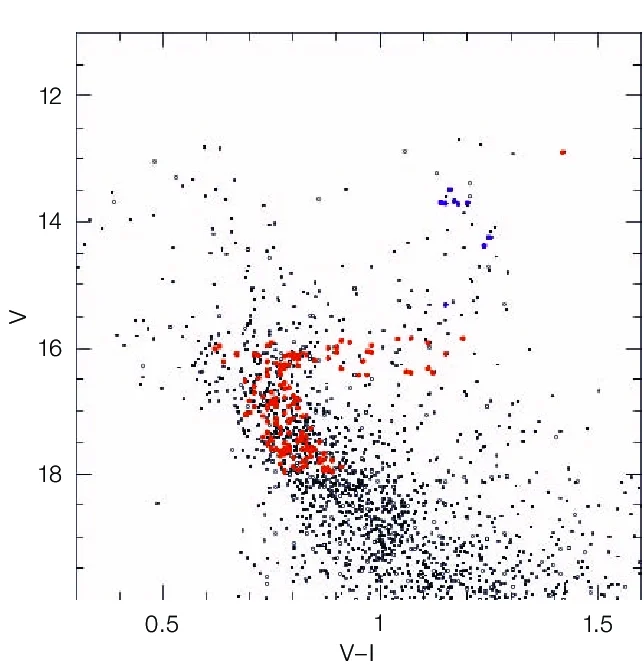
Berkeley 32 is not a showpiece — at magnitude 13.5 in Monoceros, it requires a moderately large telescope to see at all, or very long imaging exposures. But it represents the quiet, outer-disk survival strategy in its purest form. At roughly 10,000 light-years from Earth and even farther from the galactic center, it orbits in a part of the galaxy where giant molecular clouds are sparse and tidal forces are gentler. Age estimates put it at about 7.2 billion years. It has survived, in all likelihood, by simply staying out of trouble — spending billions of years in a galactic neighborhood that didn’t much bother it.
King 2
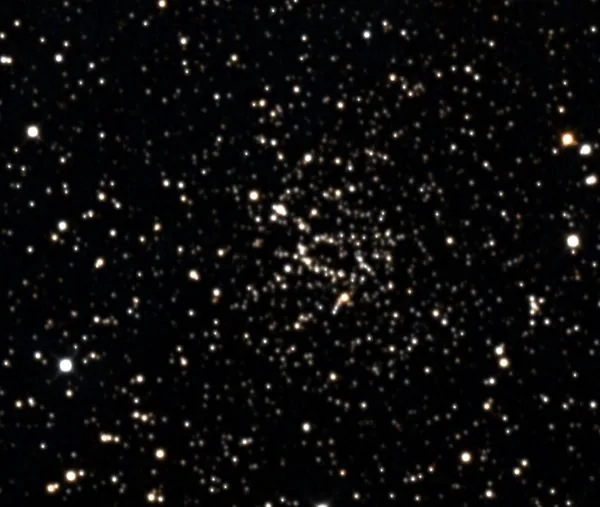
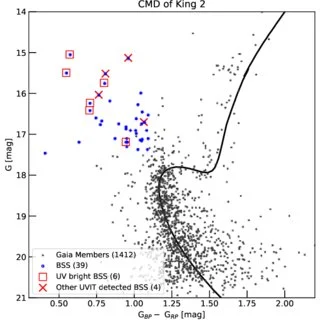
King 2, in Cassiopeia, is the most distant cluster on this list at nearly 19,000 light-years. It is also one of the most compact — its angular diameter of just over 6 arcminutes belies a true size of around 85 light-years across. That compactness, combined with its mass of several hundred solar masses, has helped it hang together. At 5.6 billion years old, it is slightly younger than the Sun, though far older than most open clusters ever get. It is faint (magnitude 13) and far, accessible only in a substantial instrument, but its position in the outer galaxy is another data point in the same story: old clusters live at the edges.
NGC 2243
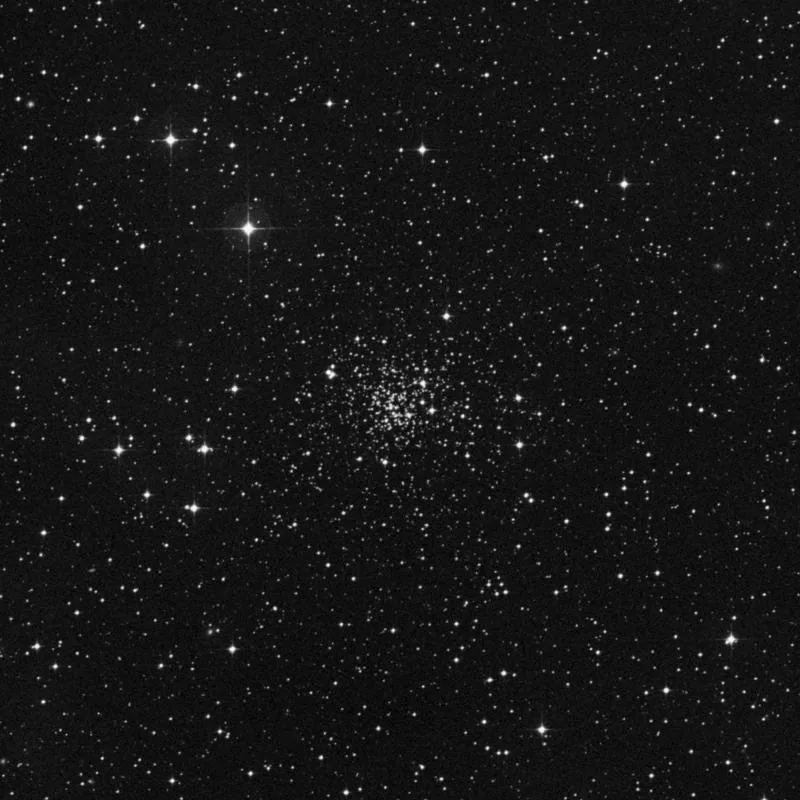
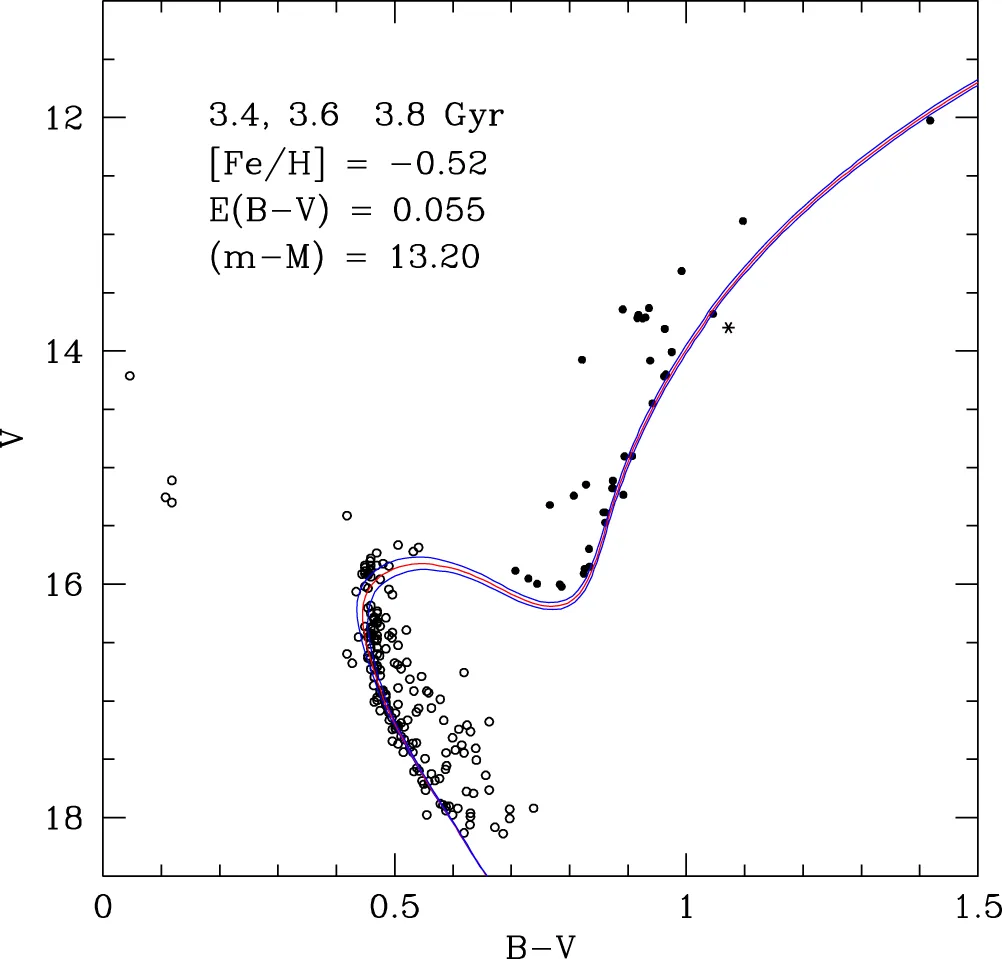
NGC 2243, in Canis Major, breaks the outer-disk pattern in an interesting way. It doesn’t just orbit far from the galactic center — it also orbits well below the galactic plane, currently sitting about 1,700 light-years below the midline of the disk. Like NGC 188, time spent away from the plane is time spent away from the densest populations of disrupting clouds.
It is also notably metal-poor. Its iron abundance is roughly one-fifth of the Sun’s, consistent with formation from chemically primitive material far from the galaxy’s metal-enriching star-formation activity in the inner disk. NGC 2243 is one of the few old open clusters that falls well outside the typical disk metallicity gradient — a chemical outlier as well as a positional one.
At magnitude 11.2, it is reachable with a medium telescope from a dark southern site. This would be a great mid-winter challenge to image from the Berkshires: its location in southern Canis Major (on the Columba border) gives it a maximum altitude of only 16° just slightly better than the summer clusters of M 6 and M 7 in Scorpius, though this cluster is quite a bit fainter!
M 67
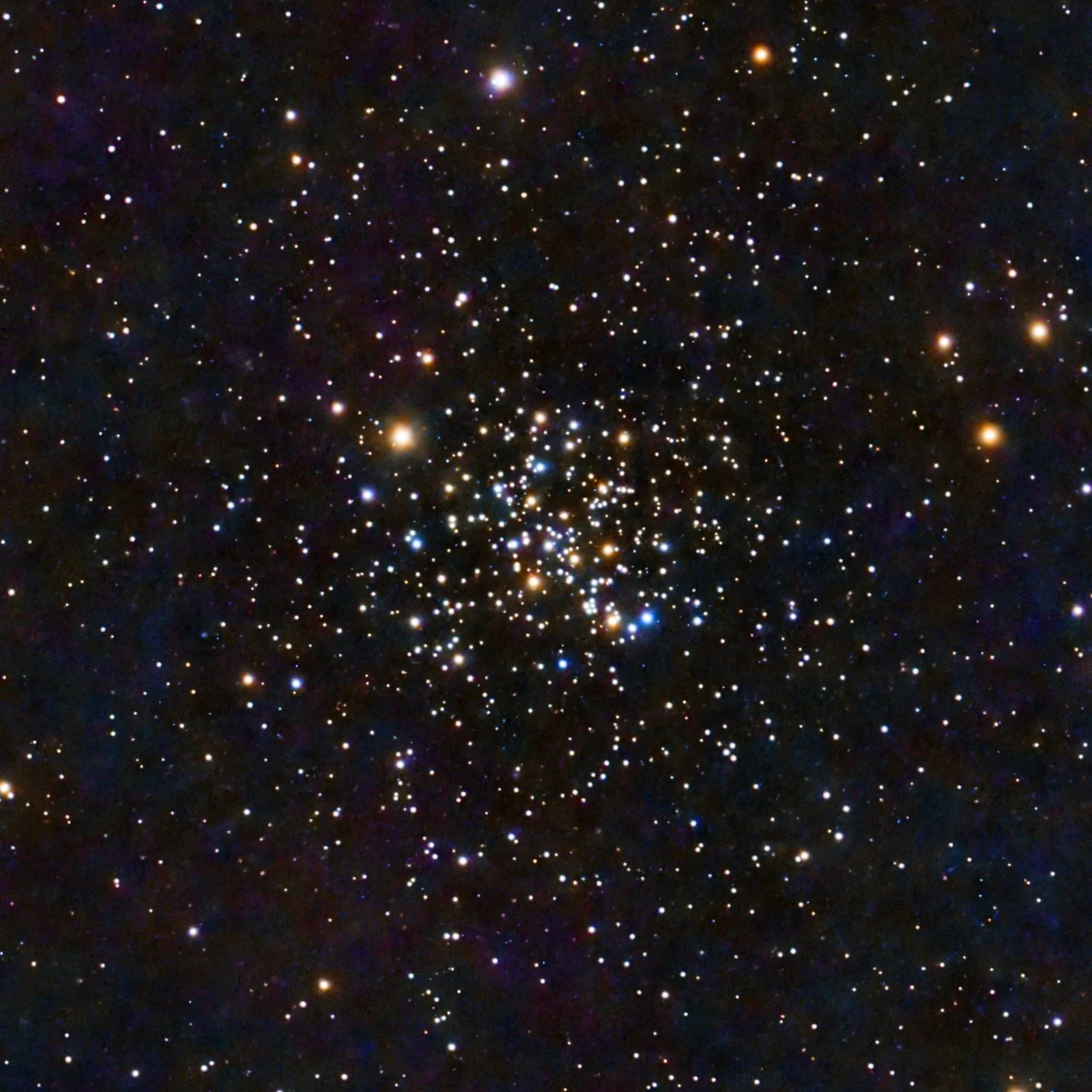
Messier 67 is the most accessible old open cluster in the sky and, in several ways, the most scientifically significant.
At roughly 2,700 light-years in Cancer, it is the closest of these ancient clusters to Earth. Its magnitude of 6.1 puts it within naked-eye reach from a truly dark site, and binoculars show it clearly. A small telescope resolves it into a genuinely beautiful object — a rich, condensed population of stars spread across about 25 arcminutes of sky. It has been on the observing lists of serious and casual astronomers alike for centuries.
What makes M 67 remarkable isn’t its age alone — somewhere between 3.2 and 5.0 billion years, estimates vary — but its chemistry. The stars in M 67 have a metal content strikingly similar to the Sun’s. In a cluster of roughly a thousand stars, more than a hundred have been identified as genuine solar analogs: stars so close in mass, temperature, and composition to our own Sun that they serve as natural control samples for understanding solar evolution. Studying them tells us what the Sun should look like at various ages, and what the Sun was likely doing when it was slightly younger.
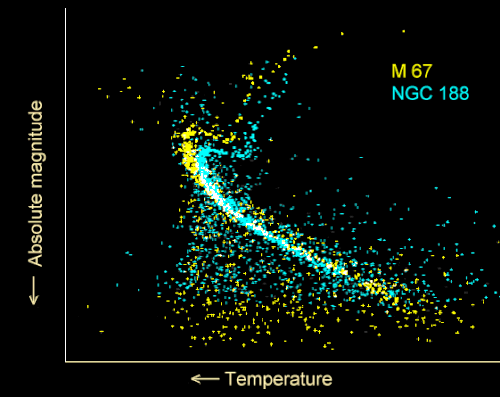
This similarity also generated a theory: could M 67 be the Sun’s birth cluster? Simulations have explored the possibility. For the Sun to have originated in M 67 and then been ejected to its current position some 28,000 light-years away would have required an improbable dynamical history, and most models suggest the outer solar system wouldn’t have survived the process intact. The theory is probably wrong, but it put into sharp relief something true: whatever cluster the Sun formed in, it likely looked a great deal like M 67 does today. M 67 may be the closest thing we have to a window into the Sun’s early neighborhood.
What These Clusters Have in Common
Laid side by side, these clusters confirm the pattern from earlier — mass, distance from the center, and excursions above and below the plane all show up here, usually in combination. What the lineup adds is the chemistry: most of these clusters are slightly to significantly metal-poor, reflecting formation in eras or locations where heavy elements were less abundant. NGC 6791 is the loud exception, and its anomaly is itself a clue — a sign that it likely formed somewhere else entirely and migrated to where we find it today.
There’s also a factor that doesn’t show up in any catalog column: luck. By the standards of galactic dynamics, every cluster on this list has had some. Surviving billions of years isn’t just about being well-built and well-positioned — it’s about not wandering too close to the wrong molecular cloud at the wrong moment, over and over, for that entire span. The galaxy’s environment stays turbulent over these timescales regardless of where a cluster sits. The selection we’re looking at isn’t just the best-suited clusters. It’s also the luckiest.
A Note on Globular Clusters
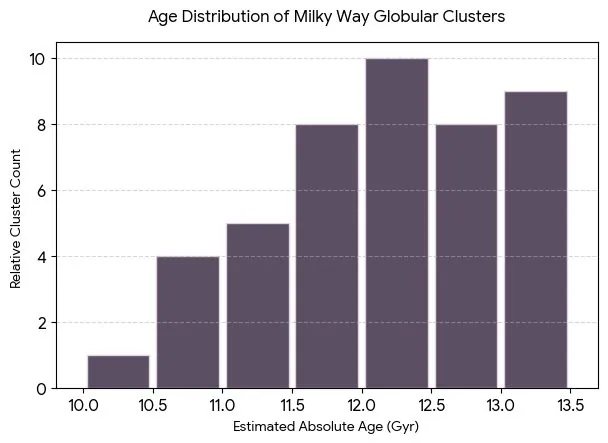
The oldest open clusters on this list — Berkeley 17 at perhaps 10 to 12 billion years, NGC 6791 at 8 to 9 — approach the ages of globular clusters, the galaxy’s other kind of star cluster. Globulars typically range from 10 to 13 billion years old. So why don’t old open clusters count as globulars?
The distinction matters. Globular clusters formed in a different epoch and in a different environment: they are relic structures from the very early universe, formed in the galaxy’s halo before most of the disk even existed. They contain hundreds of thousands to millions of stars bound into a compact sphere by their own gravity. Their very mass is what has kept them intact for so long.
Interestingly, globular clusters fall into two distinct age populations. The older group — the true galactic natives — formed alongside the Milky Way itself, roughly 12 to 13 billion years ago. The younger group, running about 10 to 11 billion years old, are thought to be immigrants: clusters that belonged to smaller galaxies the Milky Way consumed through mergers over its long history. Several often-observed globular clusters (M 13 and M 92 in Hercules, M 54 in Sagittarius, and M 79 in Lepus) fall into this category — they formed around an entirely different galaxy and “ended up” here.
Old open clusters occupy a different category entirely. They formed in the disk, among the galaxy’s ongoing star formation, from gas enriched by earlier stellar generations. They are disk objects that have stubbornly refused to disperse. The age overlap with younger globulars doesn’t blur the distinction — it sharpens it, because it underscores how improbable it is for a disk cluster, in a far more hostile environment, to reach comparable ages.
Finding These Clusters
Of the clusters on this list, two are genuinely accessible to observers with modest equipment.
M 67 is the obvious starting point. In a dark sky it is a naked-eye blur in Cancer, about 2° west of Acubens (alpha Cancri). Binoculars show it immediately. A 4-inch telescope at moderate power reveals a beautiful, rich cluster with a distinctly granular texture — you’re resolving individual stars at the edge of the cluster while the core remains dense. It is not spectacular in the way that young, bright clusters like the Pleiades are, but knowing you’re looking at stars born five billion years ago — before Earth existed — adds a dimension that doesn’t appear in the eyepiece.
NGC 188 is the other. It is fainter and less resolved than M 67, but its position near the north celestial pole means it is available to northern observers every night of the year. In binoculars it’s a soft, circular glow. A medium telescope picks out individual members. Finding it requires care — at 85° north declination it sits in a relatively sparse field — but once you’ve got it, you’ve got a cluster that has been circling the pole since before the Solar System formed.
For the others — NGC 6791, Berkeley 17, Berkeley 32, King 2, NGC 2243 — you’re looking at targets for larger instruments (or imaging/“smart” scopes) and darker skies. NGC 6791 is the most rewarding of these: at magnitude 9.5 it is within range of an intermediate-aperture scope, and its compactness makes it stand out. The Berkeley clusters and King 2 are faint enough to require genuine effort, but they reward the effort with context: these are objects that most observers have never heard of, yet they’re important chapters in a compelling story: they have been there, quietly orbiting, for longer than the Earth has existed.
So if you add any of these to your observing program, and are comparing them to some of the more-popular younger clusters, take a moment to reflect on what makes them different - not just in how they “look” - but also in their very different situations. It’s another way to add to your own astronomical journey and experience.
Finder Charts for these Clusters
All charts show stars to V ≤ 12 on a 3° field with the cluster’s published angular boundary marked. Click a thumbnail to open the full branded chart; download the PDF for a print-ready version.