
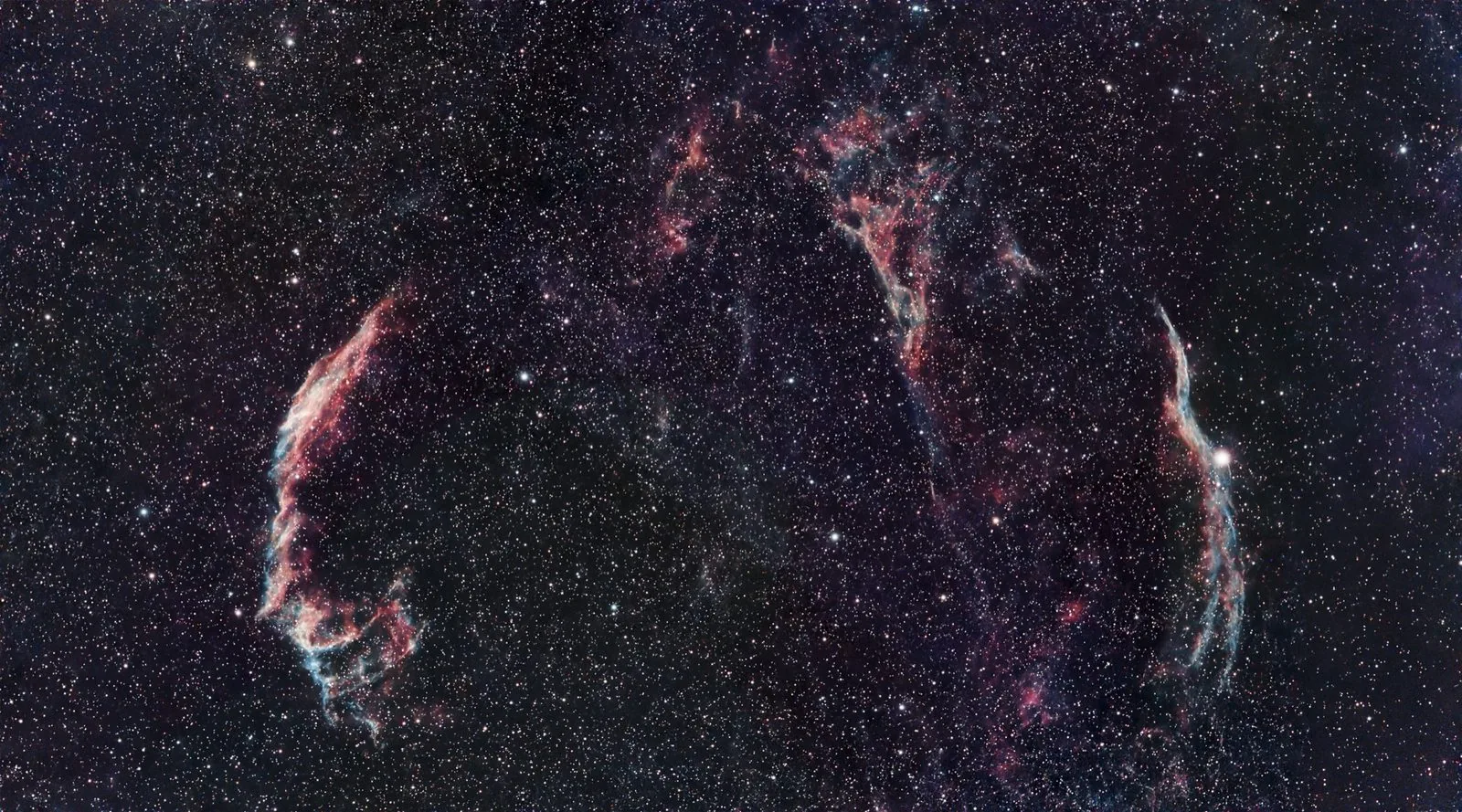
The summer sky’s most-imaged objects have earned their reputation. M 13, M 57, the Lagoon, the Eagle — these are genuinely spectacular, and smart telescopes handle them beautifully. But the same swath of sky from Sagittarius to Cygnus contains dozens of targets that get less attention than they deserve, whether because they sit in overlooked constellations, carry unfamiliar catalog numbers, or simply lack the name recognition of their famous neighbors.
What follows is a collection of eleven summer objects organized by type. All were captured with smart telescopes — Unistellar eQuinox 2, Seestar S50, or Seestar S30 — and represent what these instruments can produce with a reasonable amount of integration time.
Galaxies
Observing in the Northern Hemisphere summer skies, one doesn’t tend to think much about galaxies: with the Milky Way stretching from overhead to the horizon, your observing lists tend to be filled with nebulae and clusters. But there are a few that poke through and reward the observer.
NGC 6217 — Barred Spiral in Ursa Minor
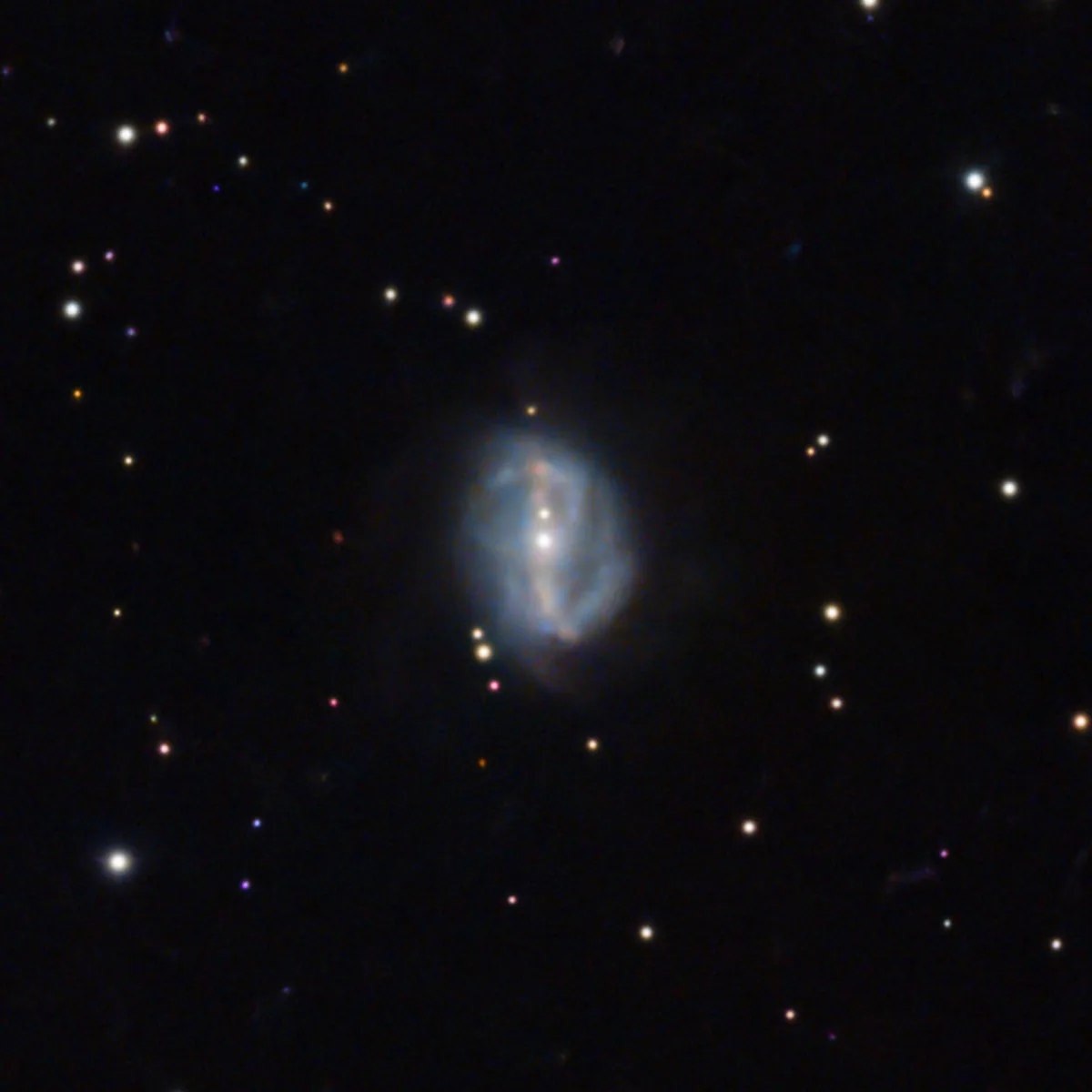
Nobody thinks to swing a smart scope toward Ursa Minor. It’s the circumpolar little bear — high overhead all year from northern latitudes, and not an obvious hunting ground for deep-sky objects. NGC 6217 makes the trip worthwhile: a barred spiral with well-defined arms and a bright, compact nucleus. Its high declination (+78°) means it never sets from mid-northern latitudes, making it one of the few galaxies you can return to across multiple sessions without losing it to the horizon — useful when you want to accumulate serious integration time.
| Object type | Barred spiral galaxy (SBbc) |
| Constellation | Ursa Minor |
| RA / Dec | 16h 32m 39s / +78° 11′ |
| Angular size | 3.0′ × 2.5′ |
| Magnitude | 11.2 |
NGC 6814 — Face-On Spiral in Aquila
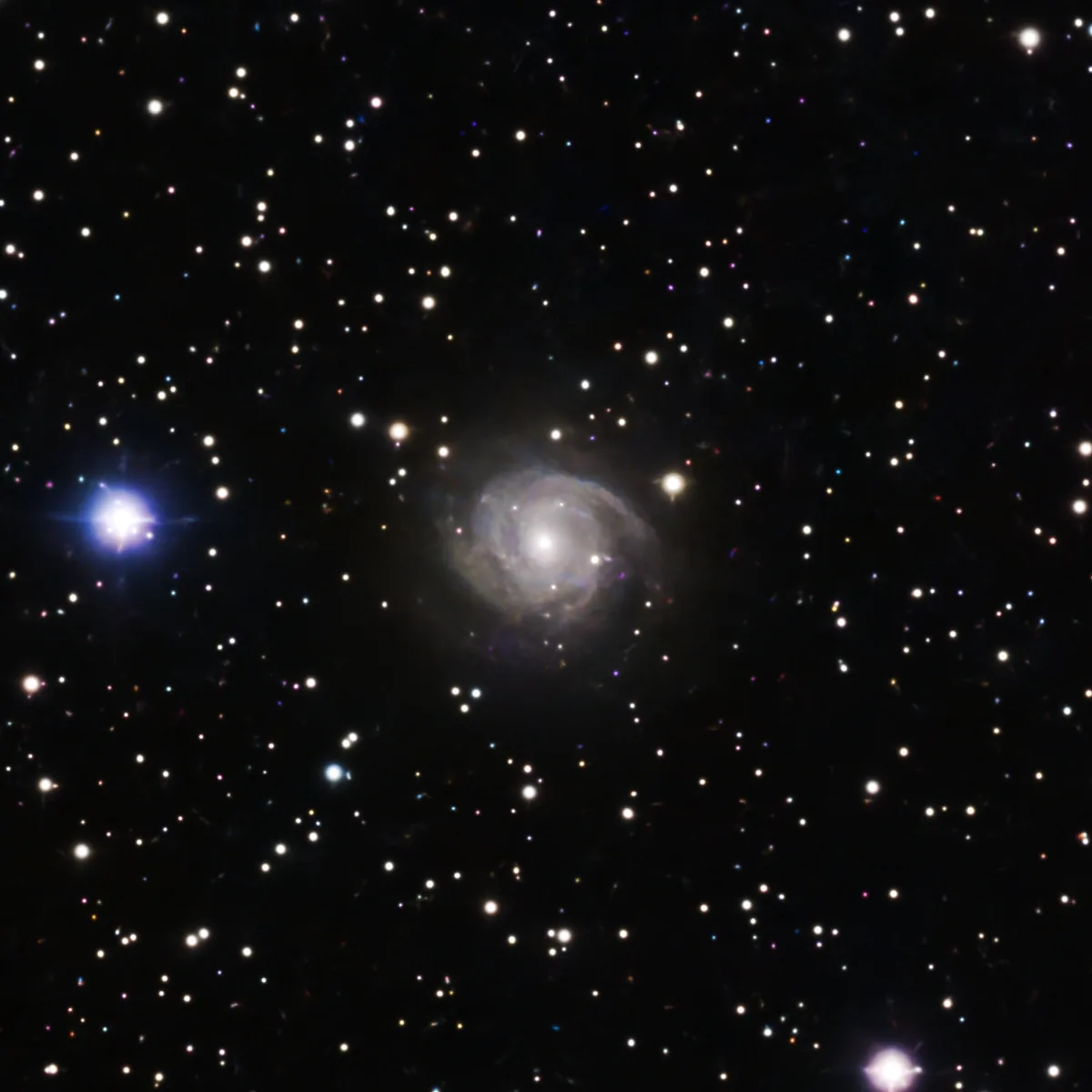
Aquila is one of the summer sky’s more neglected constellations for deep-sky imaging — it lacks the showpiece nebulae of Cygnus and the dense star fields of Sagittarius. NGC 6814 is one of its better-kept secrets: a nearly face-on barred spiral that presents its full structure cleanly to the camera. It’s also a Seyfert 1.5 galaxy, meaning its core harbors an actively feeding supermassive black hole — one that fluctuates in brightness across optical and X-ray wavelengths. The bar and faint outer spiral arms emerge with longer integrations.
| Object type | Barred spiral galaxy / Seyfert 1.5 (SABbc) |
| Constellation | Aquila |
| RA / Dec | 19h 42m 40s / −10° 19′ |
| Angular size | 3.2′ × 2.8′ |
| Magnitude | 11.7 |
Barnard’s Galaxy — NGC 6822 / C 57
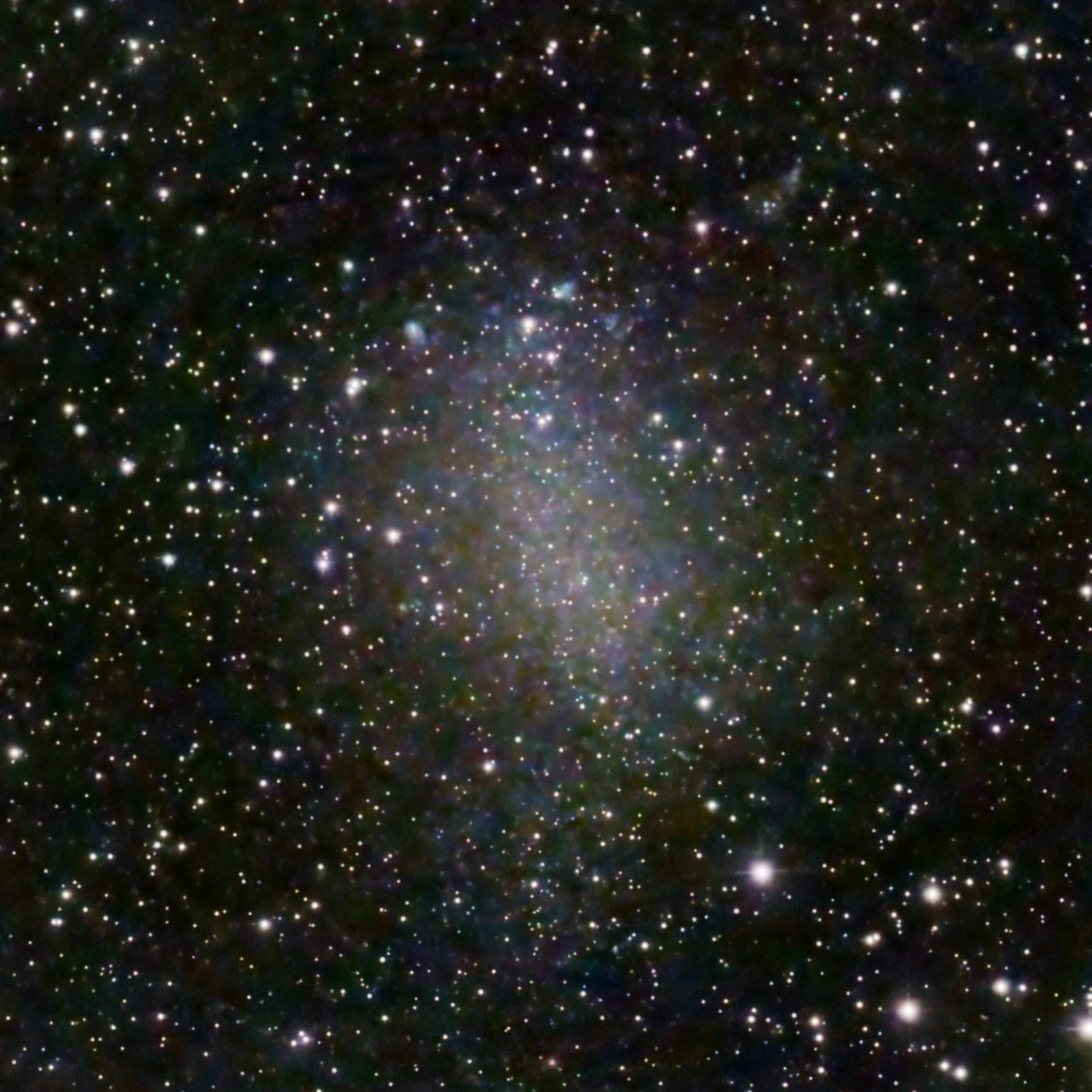
Barnard’s Galaxy is one of our nearest galactic neighbors — a dwarf irregular in the Local Group — bound to neither the Milky Way nor Andromeda — roughly 1.6 million light-years away, discovered visually by E. E. Barnard in 1884. There are no spiral arms, no central bar, no organized structure: just a loose sprawl of star-forming regions and ionized hydrogen clouds. Its angular size is large — nearly 15 arcminutes — but its low surface brightness demands patience. The payoff is a genuinely unusual-looking object: the same cosmic neighborhood as the Milky Way and Andromeda, seen from the inside, in a completely different morphological flavor.
| Object type | Dwarf irregular galaxy (IBm) |
| Constellation | Sagittarius |
| RA / Dec | 19h 44m 57s / −14° 47′ |
| Angular size | 15.5′ × 13.5′ |
| Magnitude | 9.3 |
| Also known as | C 57, IC 4895 |
Nebulae
Nebulae are where smart scopes — particularly those with built-in emission filters — have the most to offer. The five objects below span three distinct physical categories: emission nebulae powered by hot stars, a supernova remnant, and a planetary nebula. Integrated visual magnitude isn’t a useful metric for extended, diffuse objects, so those entries are omitted where they don’t apply.
NGC 6559 — The Lagoon’s Overlooked Neighbor
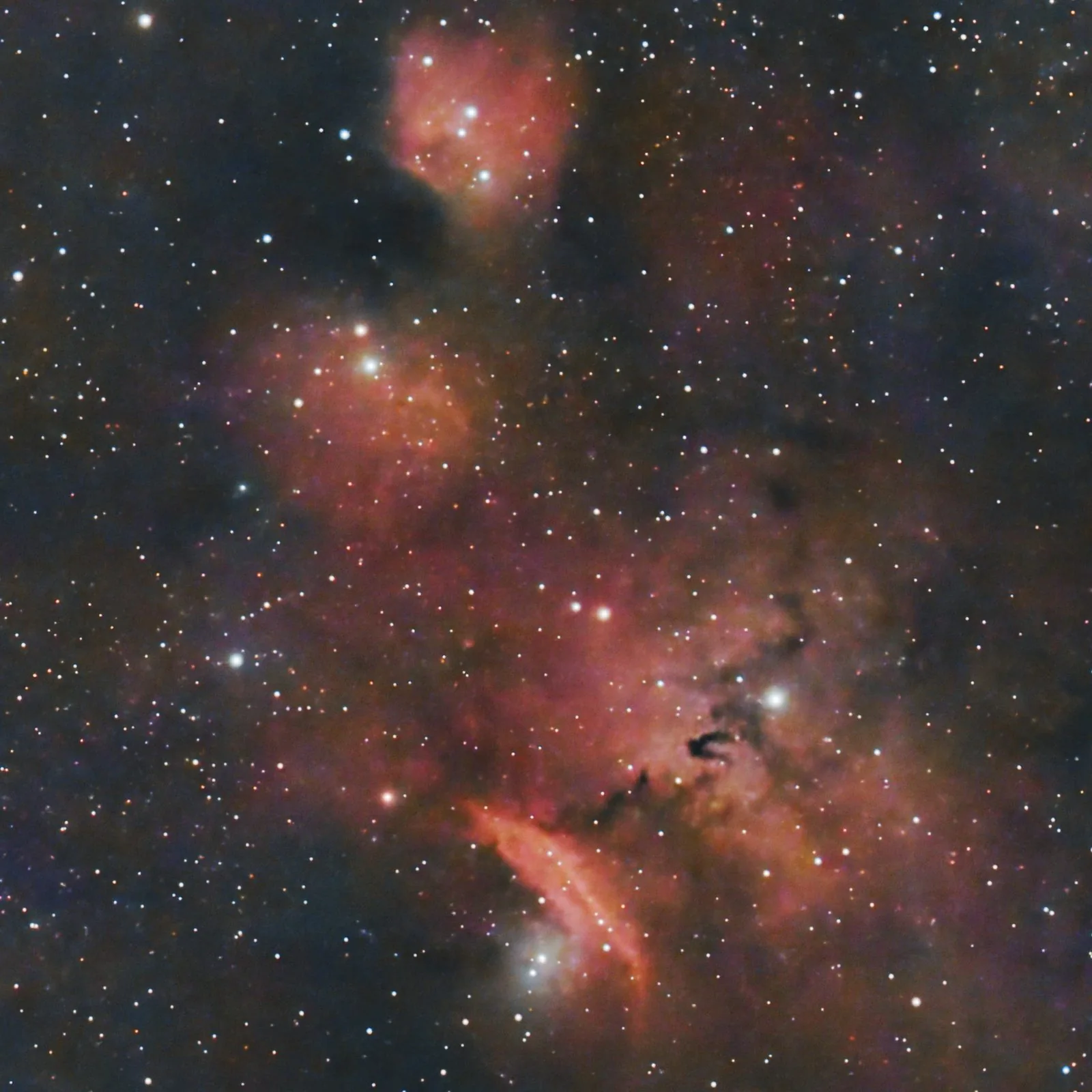
NGC 6559 — the “Chinese Dragon Nebula” — lies about 2° east of the Lagoon Nebula (M 8) and is physically part of the same giant star-forming complex in Sagittarius — but it’s rarely in the same frame, and far less frequently targeted on its own. The region combines emission nebulosity (the red-pink glow of ionized hydrogen), reflection nebulosity (blue starlight scattered off dust grains), and prominent dark lanes of obscuring material, all packed into a compact area. It’s one of the most photogenic targets in the summer sky, but tends to be passed over in favor of the nearby Lagoon (M 8) and Trifid (M 20) Nebulae.
Captured with LP filter.
| Object type | Emission / reflection nebula |
| Constellation | Sagittarius |
| RA / Dec | 18h 10m 05s / −24° 06′ |
| Angular size | ~8′ × 5′ |
| Magnitude | — |
The Crescent Nebula — NGC 6888 / C 27
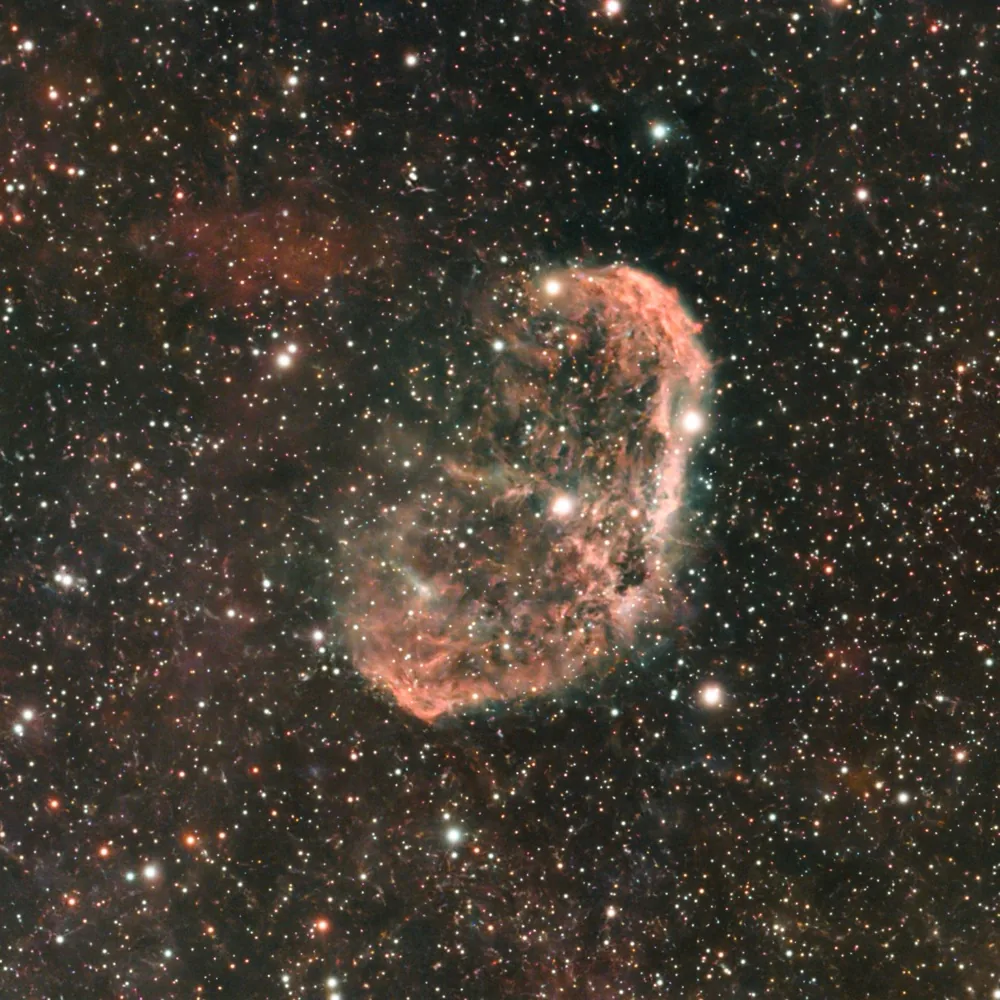
The Crescent Nebula is a Wolf-Rayet bubble: a shell of gas being driven outward by the fierce stellar wind of WR 136, a massive star racing through the final stages of its life. The distinctive crescent shape comes from that fast wind colliding with a slower shell of material expelled earlier. While the Crescent turns up frequently in smart scope image galleries, shorter captures tend to show only the main arc. Longer integrations reveal filamentary structure throughout the bubble walls and faint extensions beyond the obvious shell — considerably more structure than most images suggest. This is one of those targets that rewards the extra time.
Captured with LP filter.
| Object type | Emission nebula (Wolf-Rayet bubble) |
| Constellation | Cygnus |
| RA / Dec | 20h 12m 07s / +38° 21′ |
| Angular size | 20′ × 10′ |
| Magnitude | — |
| Also known as | NGC 6888, Caldwell 27 |
The Propeller Nebula — DWB 111
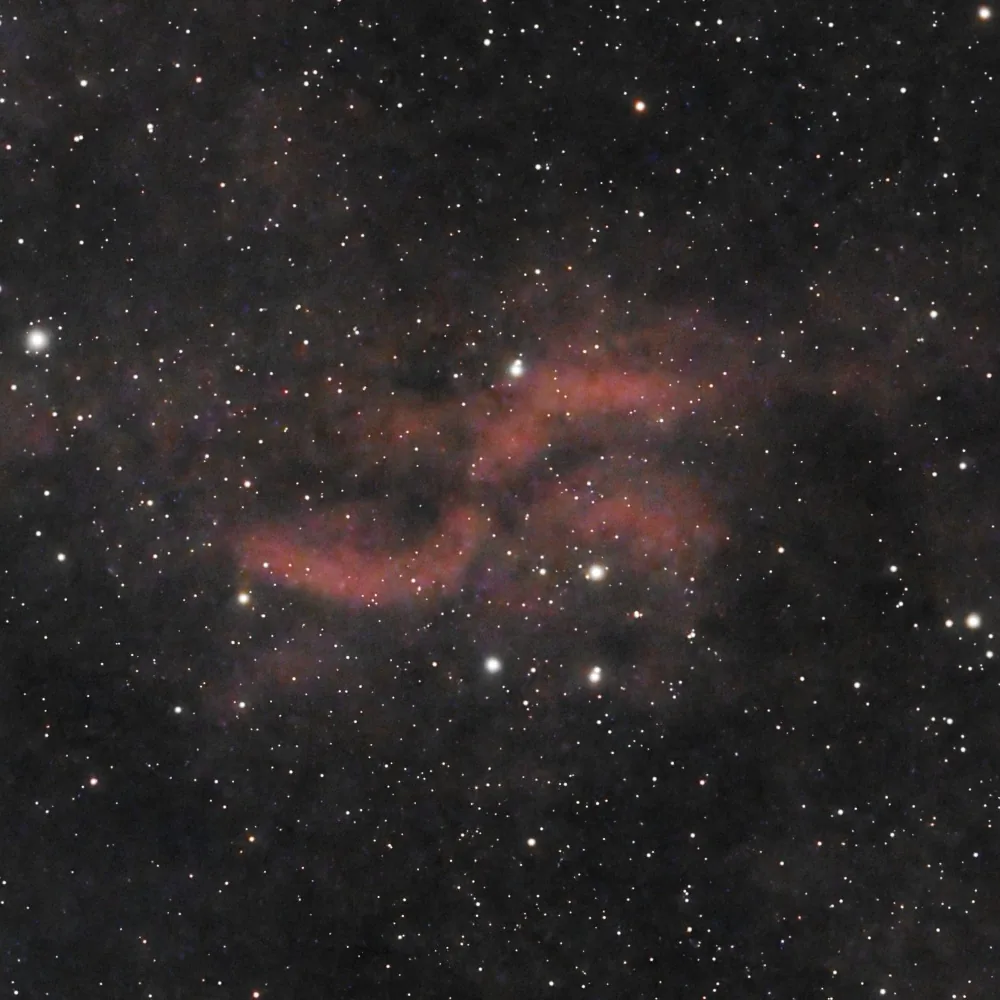
DWB 111 comes from the Dickel, Wendker, and Bieritz catalog of radio emission regions in Cygnus — not exactly a household reference, which is part of the point. The two-lobed structure that gives it the common name “Propeller Nebula” is part of the larger Cygnus OB1 association, shaped by the ionizing radiation and stellar winds of embedded hot stars. It is an imaging target, not a visual one, and one of the more satisfying objects in the Cygnus complex precisely because almost nobody images it.
Catalog note: DWB 111 may not appear in your smart scope’s onboard catalog. Try searching for Simeis 57 (its alternate designation), or enter coordinates manually.
Captured with LP filter.
| Object type | Emission nebula (HII region) |
| Constellation | Cygnus |
| RA / Dec | 20h 16m 02s / +43° 40′ |
| Angular size | ~30′ (diffuse, irregular) |
| Magnitude | — |
| Also known as | Simeis 57 |
The Veil Nebula — C 33 & C 34
The Veil Nebula is the expanding shell of a supernova that detonated somewhere between 10,000 and 20,000 years ago. What remains is a tangle of shocked filaments spread across nearly three degrees of sky — six times the diameter of the full Moon. Caldwell 33 (NGC 6992/6995) is the Eastern Veil; Caldwell 34 (NGC 6960) is the Western Veil, passing through the bright star 52 Cygni; NGC 6979 (Pickering’s Triangle) fills the space between them. Together they form the Cygnus Loop.
Including the Veil in a “lesser-known gems” article requires some honesty: it is popular. It earns its place here because it genuinely demonstrates what smart scope imaging can do — the filamentary structure that emerges from longer integrations goes well beyond what visual observation or quick captures reveal, and many newer smart scope owners haven’t yet pushed a session long enough to see what the Veil really looks like.
| Object type | Supernova remnant |
| Constellation | Cygnus |
| RA / Dec (C 33) | 20h 56m 24s / +31° 43′ |
| RA / Dec (C 34) | 20h 45m 38s / +30° 43′ |
| Angular size | C 33: ~60′ × 8′ · C 34: ~70′ × 6′ · Full complex: ~3° |
| Magnitude | — |
| Also known as | C 33 = NGC 6992/6995 · C 34 = NGC 6960 · Cygnus Loop |
NGC 6781 — The Snowglobe Nebula
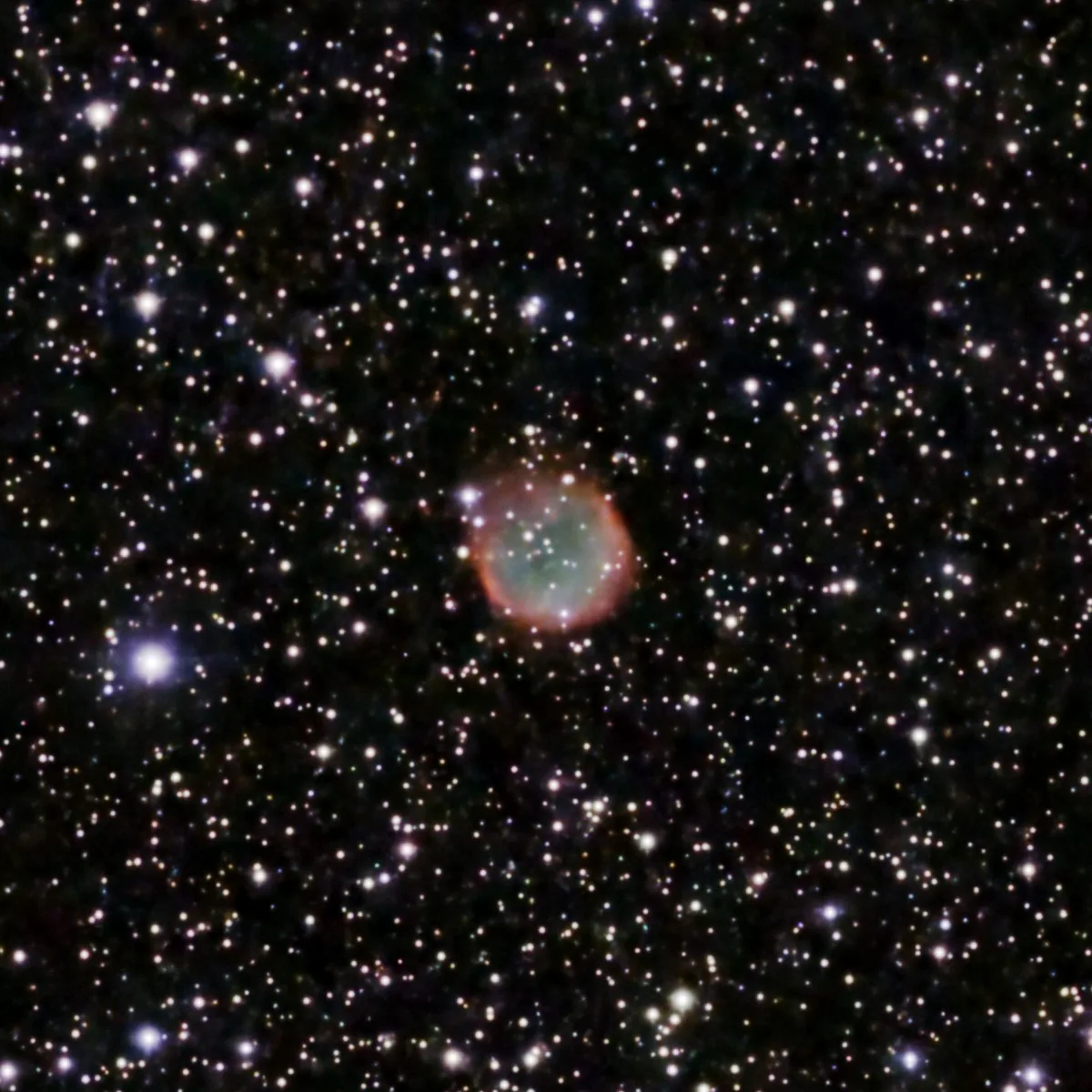
NGC 6781 is a large, nearly circular planetary nebula in Aquila — the expanding shell of gas cast off by a dying Sun-like star. At roughly 109 arcseconds across, it is actually larger than M 57 (the Ring Nebula), but it doesn’t appear on most planetary nebula highlight lists, which is one of the better arguments for including it here. The soft, round appearance that earned it the informal name “Snowglobe Nebula” comes from a relatively uniform shell with subtle limb brightening at the edges. The faint central white dwarf is detectable in longer exposures.
| Object type | Planetary nebula |
| Constellation | Aquila |
| RA / Dec | 19h 18m 28s / +06° 32′ |
| Angular size | ~109″ (~1.8′) |
| Magnitude | 11.4 |
Star Clusters
NGC 6819 — The Foxhead Cluster
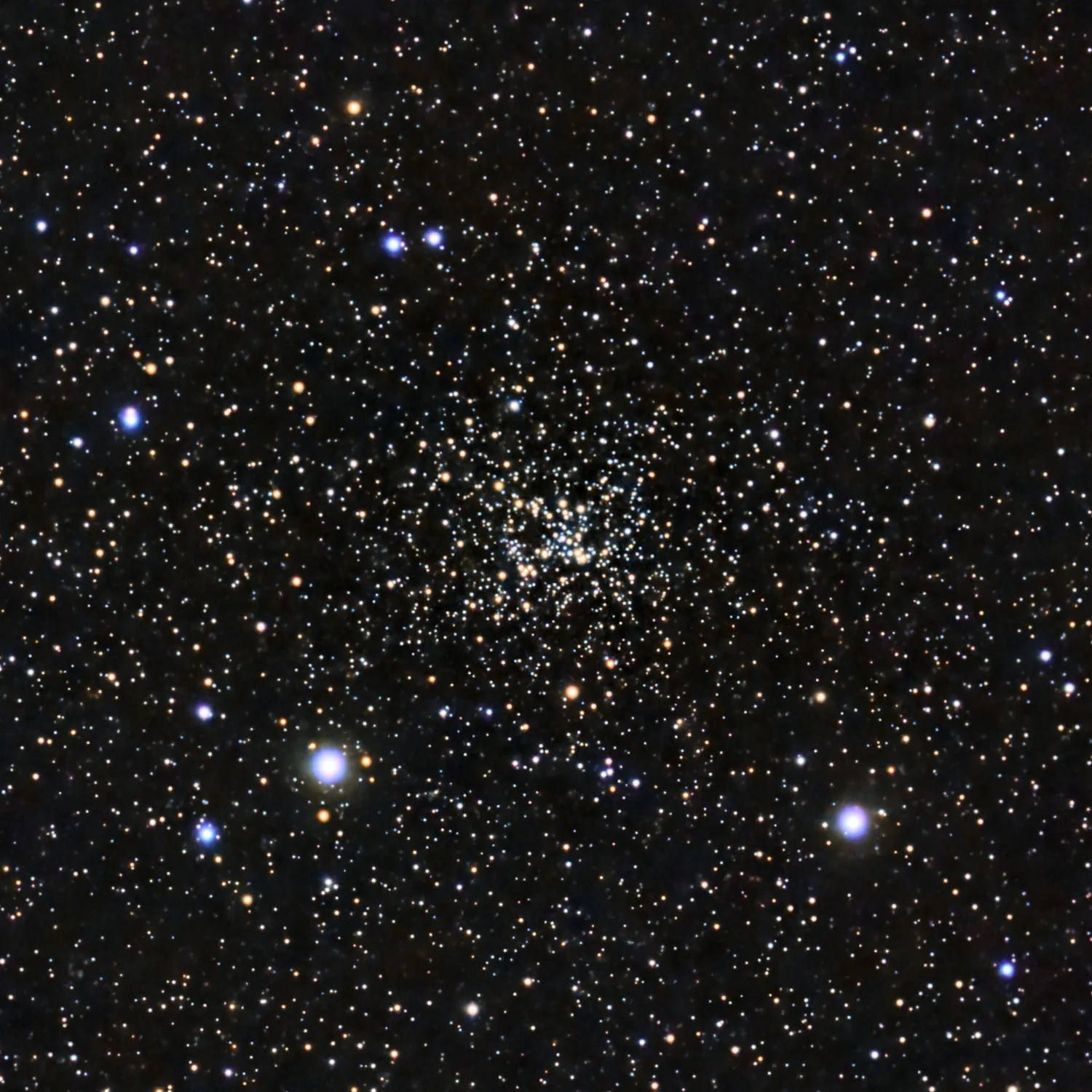
NGC 6819 is one of the oldest open clusters in Cygnus, estimated at around 2.4 billion years — ancient for an open cluster, which typically disperse over far shorter timescales. The rich, compact appearance that gives it the informal name “Foxhead Cluster” is in part a product of that age: gravitational dynamics over billions of years have drawn the surviving members into a tighter configuration than younger, more scattered clusters. It was also one of the original Kepler mission fields, making it among the best-studied open clusters in the galaxy from an asteroseismology standpoint.
| Object type | Open cluster |
| Constellation | Cygnus |
| RA / Dec | 19h 41m 18s / +40° 11′ |
| Angular size | ~5′ |
| Magnitude | 7.3 |
(See our recent article on old open clusters!)
M 55 — NGC 6809
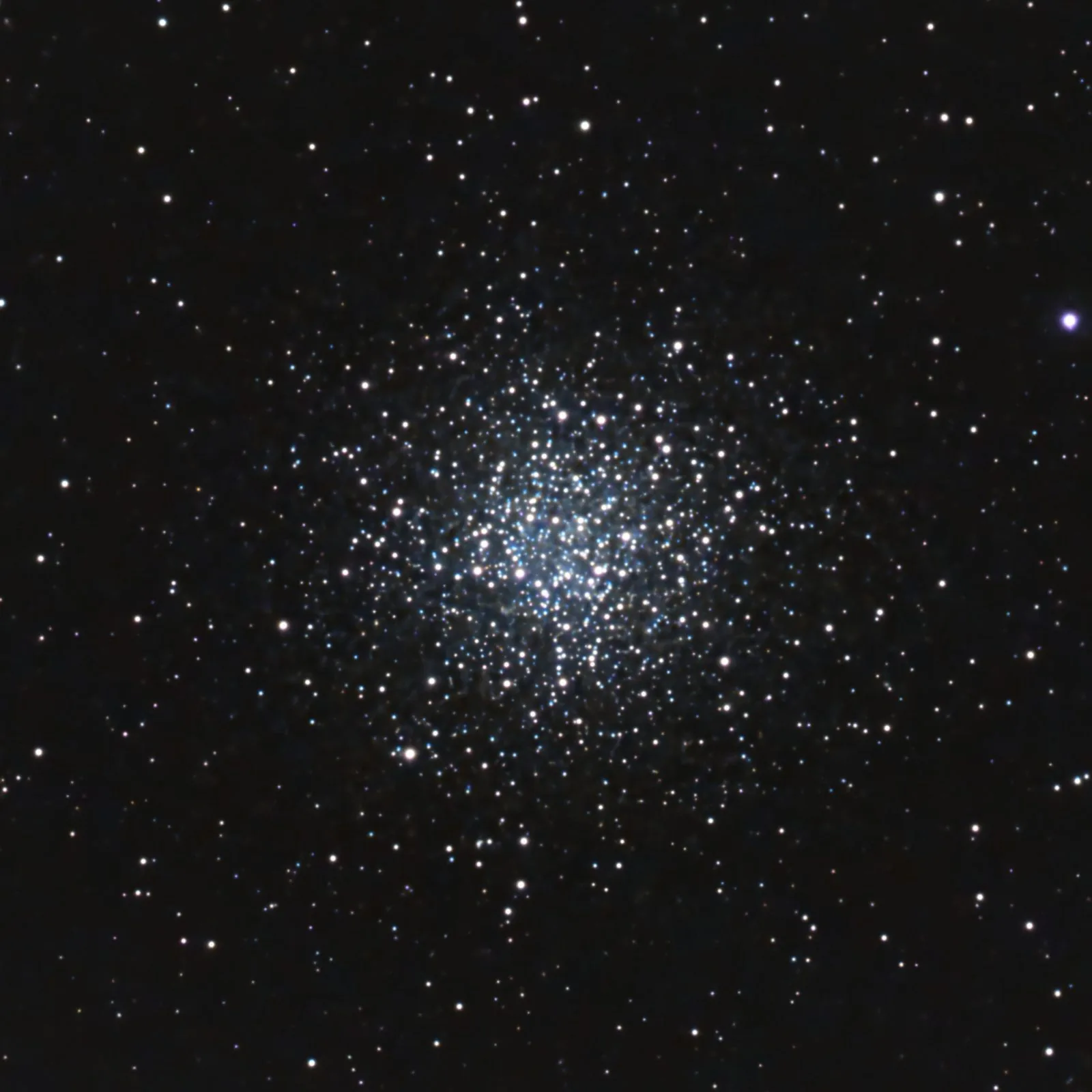
M 55 is one of the loosest globular clusters in the Messier catalog — Shapley concentration class XI, the lowest end of the scale. Unlike the tightly compressed globulars of M 13 or M 3, M 55 looks almost open-cluster-like at first glance: stars resolved across its full 19-arcminute diameter with no dramatic central concentration. From northern latitudes it’s always low, making image quality sensitive to conditions and timing. When the sky cooperates, the sheer spread of resolved stars across the field is striking — and a useful reminder that globular clusters come in considerably more variety than the classic “fuzzy ball with dense core” archetype.
| Object type | Globular cluster (class XI) |
| Constellation | Sagittarius |
| RA / Dec | 19h 39m 59s / −30° 57′ |
| Angular size | ~19′ |
| Magnitude | 7.0 |
| Also known as | NGC 6809 |
M 75 — NGC 6864
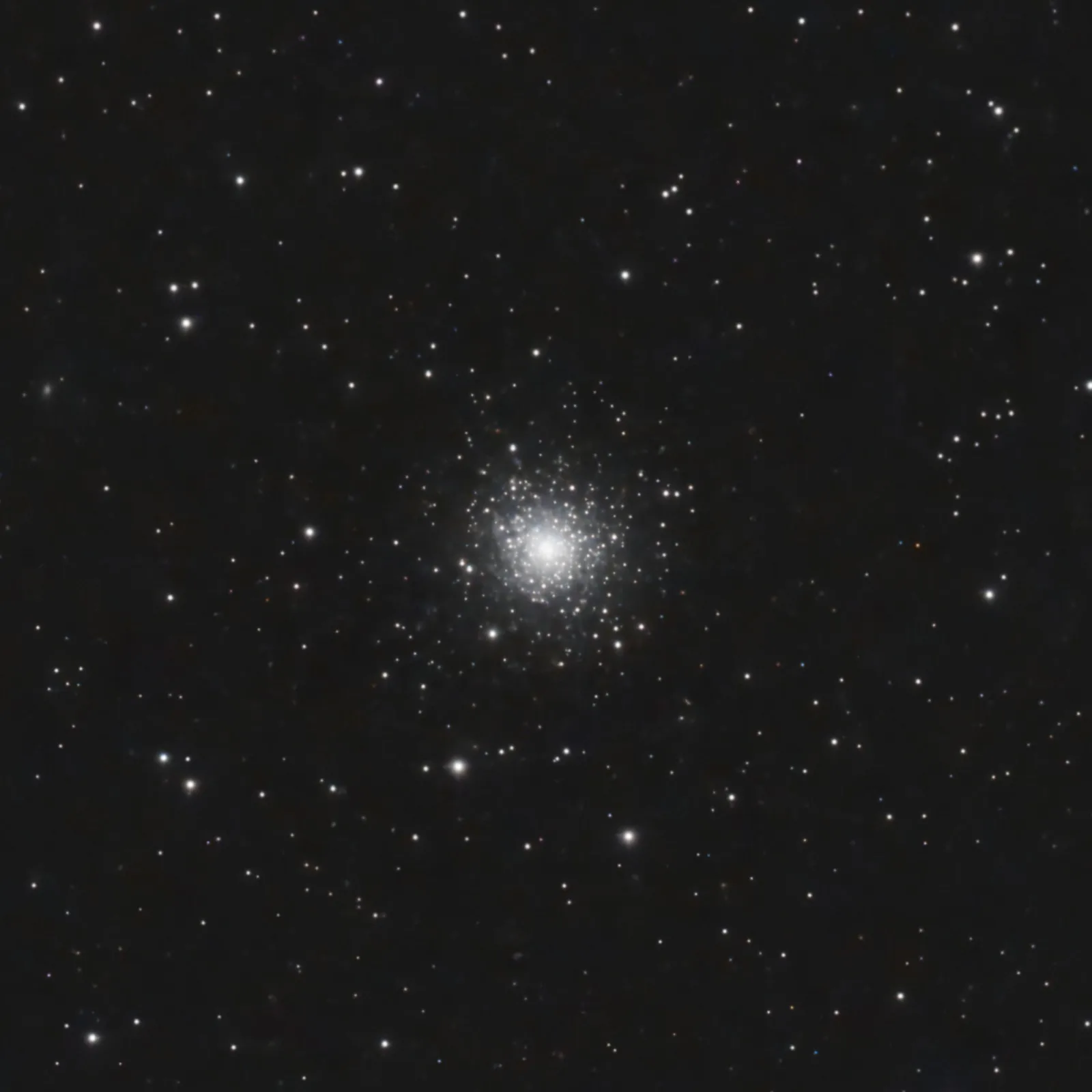
M 75 is a study in contrasts with M 55. Where M 55 sprawls loosely across the field, M 75 is one of the most concentrated globulars in the Messier catalog (class I) and one of the most distant, at roughly 67,500 light-years. The core is so compressed that even significant integration time leaves it difficult to resolve into individual stars — what you’re chasing is the halo, the fainter outer population surrounding the blazing center. It’s a different kind of globular target than the showpiece objects, and a good argument that “harder to image” and “worth imaging” aren’t mutually exclusive.
There’s a piece of geometry behind M 75 that’s worth pausing on. At galactic longitude l = 20.3°, we’re looking almost directly through the galactic bulge — and at 67,500 light-years, well out the other side.
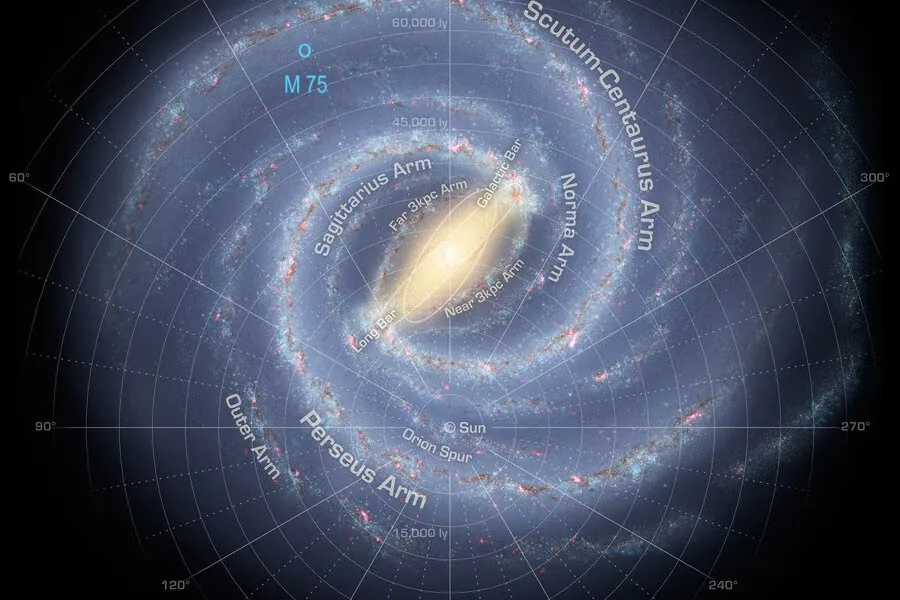
Its galactic latitude of b = −25.7° means the line of sight passes roughly 29,000 light-years below the galactic plane, which is why we can see it at all: the dusty disk that would otherwise obscure anything this distant lies mostly above our sightline. We are effectively looking across the full width of the Milky Way to reach it.
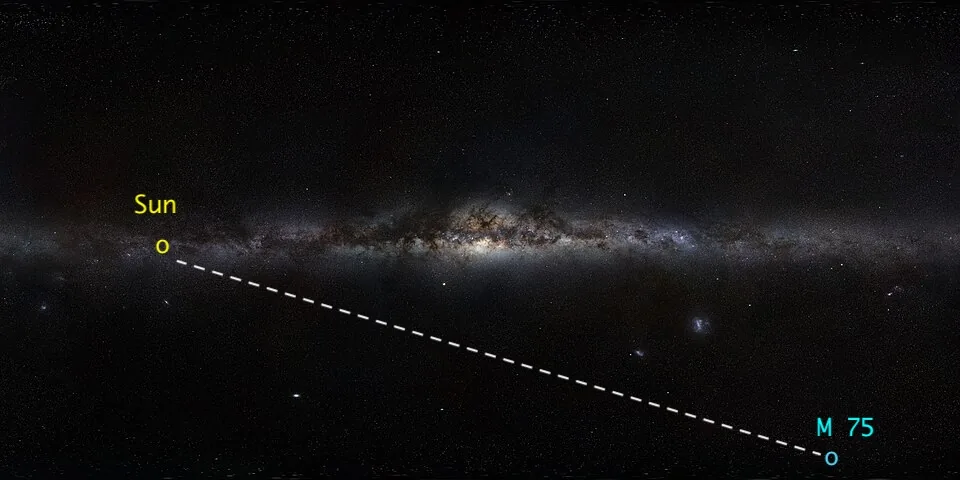
Taken all together, we’re looking at an object that is truly on the other side of the Galaxy, just far enough away from the disk and spiral arms to see.
| Object type | Globular cluster (class I) |
| Constellation | Sagittarius |
| RA / Dec | 20h 06m 04s / −21° 55′ |
| Angular size | ~6.8′ |
| Magnitude | 8.6 |
| Also known as | NGC 6864 |
A Note on Post-Processing
Every image in this article has been post-processed. The smart scope apps do a good job of stacking frames and delivering a result you can take away from the field — for many targets and many users, that result is plenty. But post-processing with dedicated software can meaningfully improve color, contrast, noise, and fine detail, particularly on fainter targets. We’ll cover the full workflow in an upcoming guide; for now, consider these images a demonstration of what’s achievable when you take the in-app stack further.
One feature worth calling out: the Seestar S50 and S30’s built-in dual-band LP filter makes a significant difference on emission nebulae by isolating the hydrogen-alpha and oxygen-III wavelengths that define most of their structure. Three of the nebulae below were captured with it, and the results speak for themselves.