Step outside on a clear summer evening, let your eyes adjust, and look roughly overhead after the sky gets properly dark. You’ll find three bright stars arranged in a long triangle, the brightest points in the overhead sky. This is the Summer Triangle, and it’s one of the most reliable landmarks of the season — easy to find, easy to show a friend, and easy to take for granted.
It might be tempting to treat the Summer Triangle as nothing extraordinary - three bright dots, always in the same place, with nothing more to say. But Vega, Deneb, and Altair are not three versions of the same star. They are three completely different kinds of stars that happen, by cosmic coincidence, to appear close together and roughly equally brilliant in our sky. One is nearby and young, wrapped in the raw material of planets; one is so far away and so violently luminous that astronomers still argue about exactly how far away it is, and one is spinning so fast it has stretched itself into an egg shape.
You don’t need a telescope, a degree, or much more than five minutes and a dark-ish yard to start noticing that these stars have personalities. Let’s meet them.
Finding the Triangle
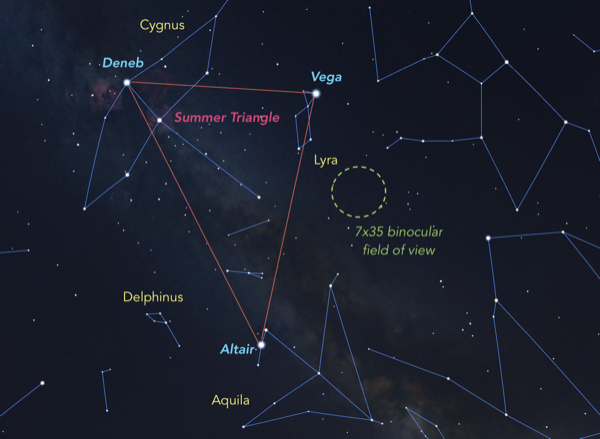
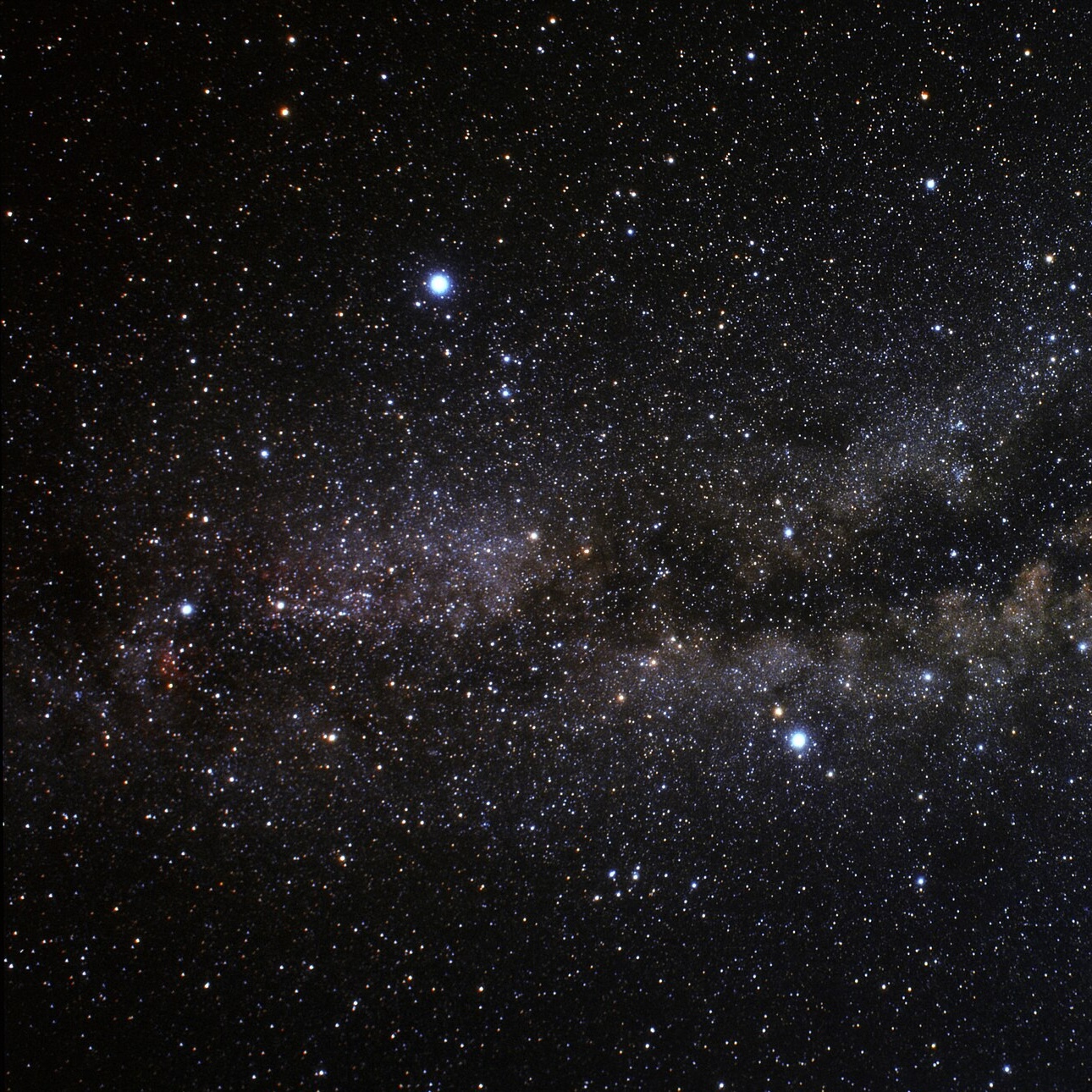
The Summer Triangle isn’t a constellation — it’s an asterism, an easy-to-recognize pattern made of stars from three different constellations. In June, look toward the east after dark; by August, the triangle has climbed high and sits nearly overhead in the evening, which is the best time to start. Vega, the brightest of the three, is unmistakable: a brilliant blue-white star almost straight up. Below and to its left, Deneb forms the tail of Cygnus, the Swan. Below and to the right of Vega, Altair completes the triangle as the brightest star in Aquila, the Eagle.
No binoculars required for any of this. A pair of 7x50s or 10x50s will deepen the experience — Vega in particular has a lovely steely-blue color through even modest optics — but the triangle itself is a naked-eye object, visible from cities, suburbs, and dark countryside alike.
A Trio of Arabic Names
Before getting into the science, it’s worth a quick pause on the names themselves, since they tell their own small story. None of these three appear by name in Ptolemy’s Almagest, the 2nd-century Greek catalog that’s the ancestor of most Western constellation lore — Ptolemy listed the constellations Cygnus, Lyra, and Aquila, but, oddly, the Greeks never got around to naming Cygnus’s brightest star at all. The names we actually use today all came later, from medieval Arabic astronomers, and were Latinized into roughly their current forms centuries afterward, through works like the 13th-century Alfonsine Tables.
All three names are descriptions. Altair comes from the Arabic an-nasr al-ṭā’ir, “the flying eagle,” fittingly describing the brightest star in Aquila, the Eagle. Deneb is simply Arabic for “tail” (dhanab), shorthand for “tail of the hen” — Arab astronomers pictured Cygnus as a hen rather than a swan, and the name marks the bird’s tail feathers. Vega’s case is the most interesting twist: it’s often mistaken for Latin because of its short, vowel-heavy sound, but it’s actually a worn-down transliteration of the Arabic an-nasr al-wāqi’, “the falling eagle” (or, in some readings, “alighting vulture”) — Vega and Altair were originally a matched pair, the “two vultures” or “two eagles” of pre-Islamic Arabian astronomy, one diving and one swooping. The name eventually got clipped down through medieval Latin to the “Wega” and then “Vega” we use now.
The Three at a Glance
| Vega | Altair | Deneb | |
|---|---|---|---|
| Constellation | Lyra | Aquila | Cygnus |
| Distance | ~25 ly | ~17 ly | ~1,500 ly (disputed; 1,300–2,600 ly) |
| Apparent magnitude | 0.03 | 0.76 | 1.25 |
| Spectral type | A0 V | A7 V | A2 Ia |
| Evolutionary stage | Main sequence | Main sequence | Supergiant (post–main sequence) |
| Mass | ~2.1 M☉ | ~1.8–1.9 M☉ | ~19 M☉ (was ~20–23 M☉ before evolving) |
| Radius | ~2.3–2.8 R☉ (varies pole to equator) | ~1.6–2.0 R☉ (varies pole to equator) | ~200 R☉ |
| Luminosity | ~40 L☉ (true average); appears brighter face-on | ~10.6 L☉ | ~55,000–200,000 L☉ depending on distance estimate |
| Surface temperature | ~9,600 K (varies 8,150–10,060 K pole to equator) | ~7,600 K (varies 6,900–8,500 K pole to equator) | ~8,500 K |
| Rotation period | ~16.5–17 hours | ~7h 46m | ~tens of days (slow, typical for a supergiant) |
| Age | ~450–700 Myr (estimates vary) | Recent studies suggest ~100 Myr | A few million years since leaving the main sequence |
| Main-sequence lifetime | ~1 billion years total | ~2–3 billion years total | Already over — Deneb left the main sequence after only a few million years as a massive O-type star |
| Notable feature | Smooth disk with 60 AU gap; near pole-on viewing geometry | ~20–24% oblate from rapid rotation; first star besides the Sun to be directly imaged | Extreme luminosity at extreme distance; uncertain next evolutionary step |
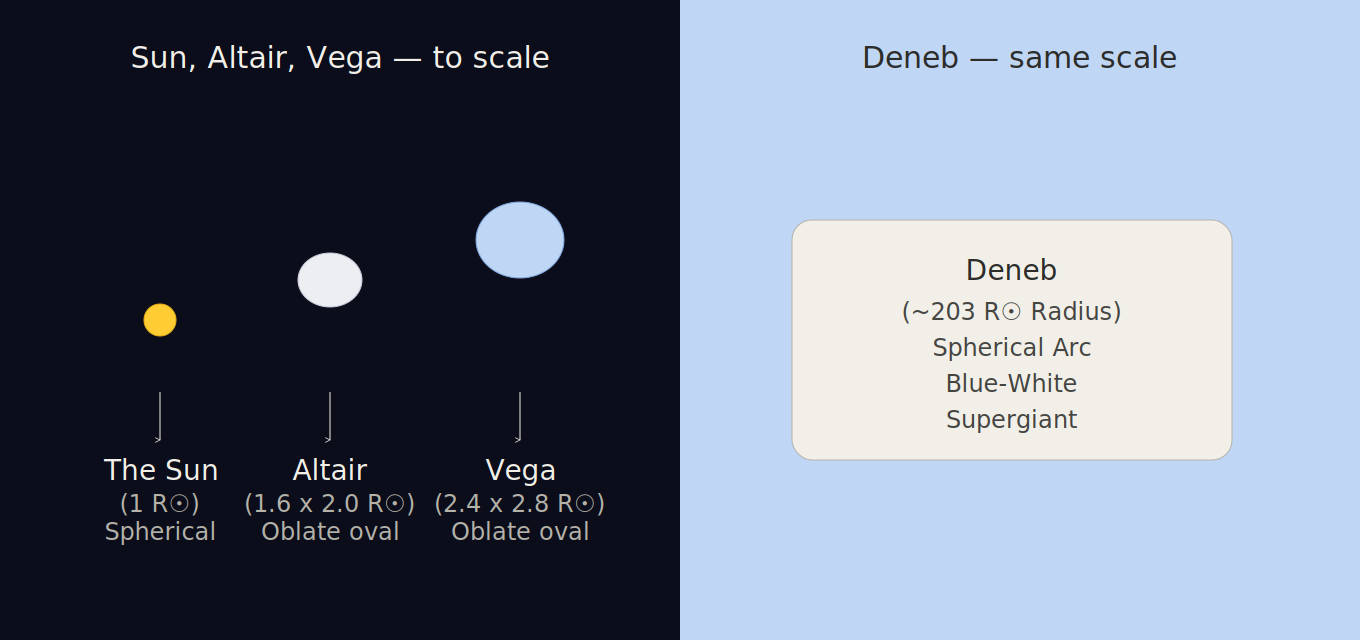
A few things the numbers don’t say outright but are worth sitting with: Vega and Altair are both still comfortably mid-life, on a main-sequence path not unlike a scaled-up version of the Sun’s, just compressed onto a shorter, hotter timeline because of their extra mass. Deneb isn’t on that path at all anymore — both its distance and its remaining lifetime are open questions in active astronomical literature, which is unusual for a star this bright and this famous. And while spectral type can make Altair and Deneb look similar on paper (both intermediate-temperature A-type stars), the luminosity class tells the real story: the “V” after Altair’s type marks it as an ordinary main-sequence dwarf, while the “Ia” after Deneb’s marks it as a supergiant — the same letter-grade star at a wildly different stage of life, the kind of distinction the HR diagram exists to capture.
Vega: The Nearby One, Still Surrounded by Construction Debris
At about 25 light-years away, Vega is practically a neighbor — the fifth-brightest star in the night sky, and for most of human history simply “the bright blue star.” It’s a fixture in mythologies from the Chinese Weaver Girl story to its modern role as the historical zero-point for the magnitude scale astronomers still use to rank stellar brightness.
Every star spins on an axis, like a top — and depending on the luck of geometry, that axis can point in any direction relative to us: side-on, so we’d watch the star’s equator sweep past, pole-on, so we’re looking straight down at one end, or anywhere in between. In the case of Vega, we’re looking “down” at it from above - at one of its poles. (As an aside, this would make Vega a very poor target for searching for exoplanets using the transit method - that only works for stars whose orientation is with the equator pointing towards us.)
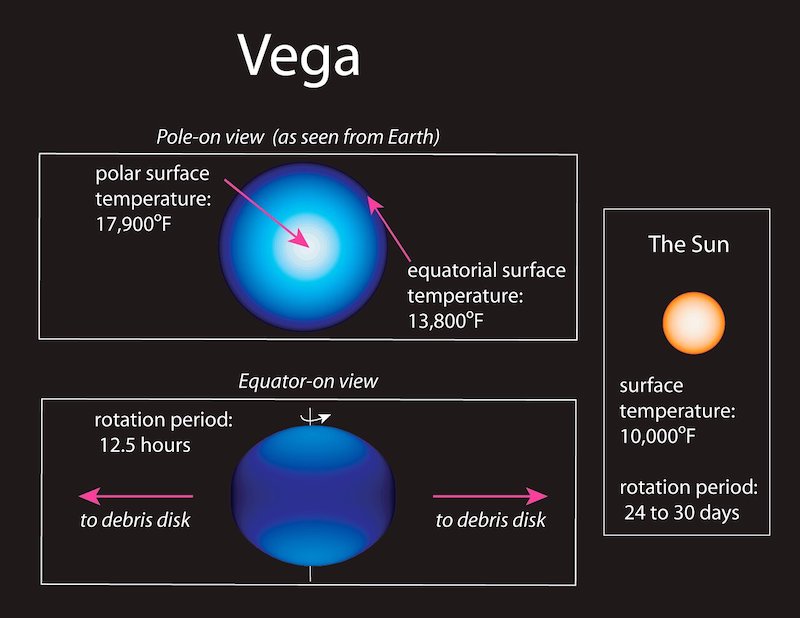
A common trait among hot young stars like Vega is rapid rotation: Vega itself is spinning so fast — close to 90% of the speed at which it would fly apart — that we don’t actually see it the way you’d expect. Rapid rotation flings a star’s equator outward and cools it relative to the poles, a real effect called gravity darkening, which means the Vega we observe is brighter and hotter than its true average surface. Earlier estimates of its overall luminosity and age had to be revised once interferometers finally resolved its shape and confirmed this geometry directly.
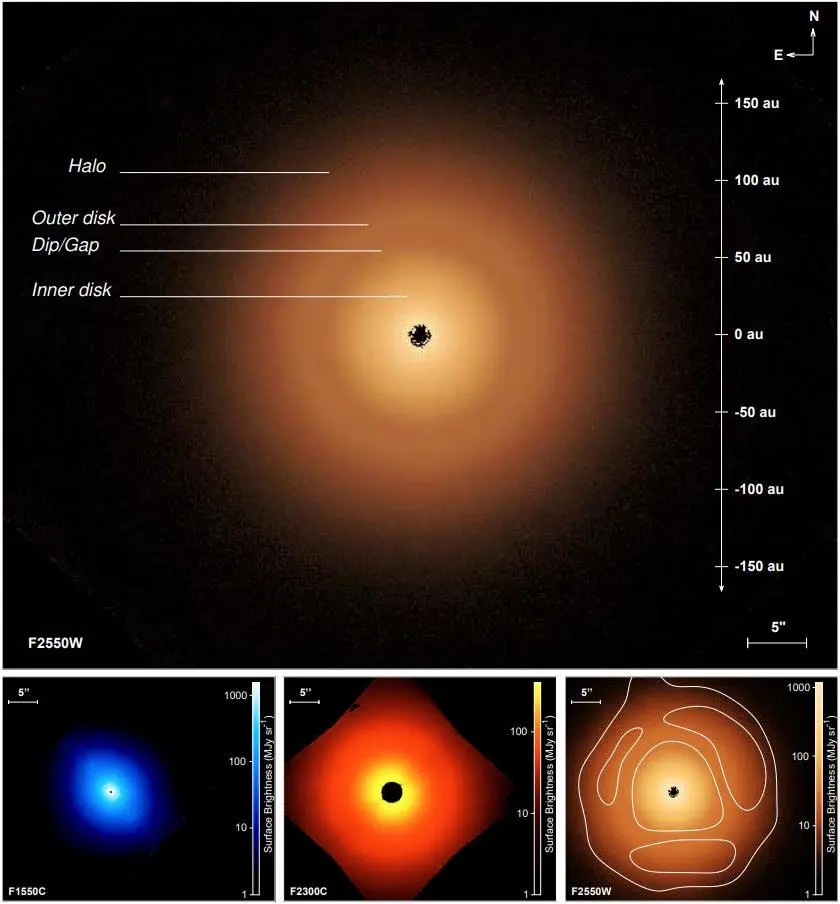
What makes Vega genuinely interesting is something you can’t see directly but that quietly upended assumptions about planet formation. In 1983, the IRAS satellite detected far more infrared light coming from Vega than a star should produce on its own. The explanation: a ring of leftover rock and dust, essentially Vega’s own Kuiper Belt — what astronomers now call a debris disk. The dust itself isn’t primordial material left over from Vega’s birth; it’s “second-generation” debris, continuously ground up by collisions between larger, unseen bodies out in that belt, then shaped by the push and pull of the star’s own light.
For years, the best available images suggested the disk was lopsided — an off-center clump of dust that looked like the gravitational fingerprint of a hidden planet, the same kind of clue that helped astronomers confirm a real planet around the nearby star β (beta) Pictoris. But sharper, more recent images from the James Webb and Hubble Space Telescopes told a different story: Vega’s disk turns out to be remarkably smooth and almost perfectly centered on the star, with just one subtle, genuine feature — a faint gap in the dust at around 60 AU (twice Neptune’s distance from our Sun). Rather than pointing to a hidden world, that smoothness is itself the evidence: a planet of any real size out there would leave the disk looking lumpy or off-kilter, and Vega’s doesn’t. So instead of confirming a planet, the data quietly ruled large ones out, at least at Neptune-mass and above — a good reminder that even settled- looking pictures of the universe keep getting redrawn as the instruments improve.
So: a familiar, nearby, brilliant star — and also a 700-million-year-old natural laboratory for how solar systems get built.
Deneb: So Far Away We Genuinely Don’t Know How Far
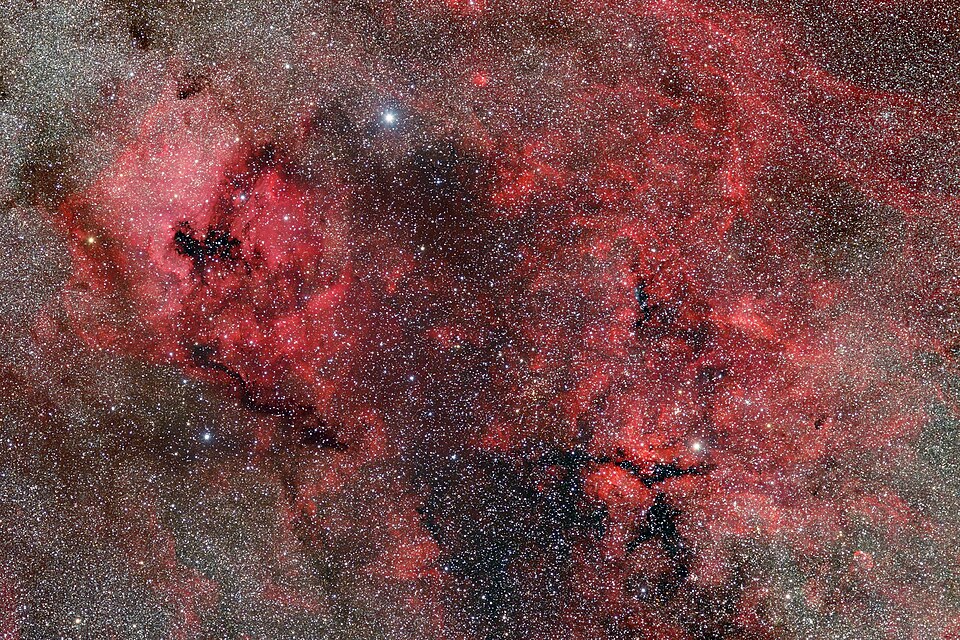
Now contrast that with Deneb. Where Vega is bright because it’s close, Deneb is bright purely on raw power, because it is almost unfathomably far away. Most stars visible to the naked eye sit tens to hundreds of light-years off; Deneb is somewhere around 1,500 light-years away by one widely cited reanalysis of satellite data, with a plausible range between roughly 1,336 and 1,841 light-years — while the original analysis of the same Hipparcos satellite data put it as far as 2,600 light-years. Even modern instruments struggle with it: Deneb is so bright that Gaia, the successor mission built to map a billion stars, can only observe it through specially programmed sequences, since its automatic systems aren’t built to handle something that brilliant.
That’s a genuinely fun thing to sit with: one of the most recognizable stars in the summer sky, and professional astronomers still can’t pin down its distance to better than a factor of two. The culprit is the same parallax technique used to measure distances to nearer stars — the gentle shift in a star’s apparent position as Earth orbits the Sun. Beyond a certain distance, that shift becomes too small to read reliably, forcing astronomers to lean on indirect methods instead, each with its own assumptions and its own error bars.
Whichever distance turns out to be right, Deneb’s underlying nature isn’t in question: a blue-white supergiant roughly 19 times the Sun’s mass and about 200 times its radius, blazing at somewhere near 200,000 times the Sun’s luminosity. It has already burned through its core hydrogen and is living fast — astronomers aren’t sure whether its next act is to cool and swell into a red supergiant or transform into a rare, violently unstable luminous blue variable, possibly within the next few million years. That sounds distant on a human timescale, but for a star this massive, a few million years is the blink of an eye. Stars like Deneb don’t get the Sun’s leisurely ten-billion-year lifespan; they burn hot, burn fast, and are headed for a supernova on a geological eyeblink.
So when you spot Deneb in the tail of the Swan, you’re looking at light that, depending on whose estimate you trust, left that star sometime between the fall of Rome and the founding of ancient Mesopotamian cities — emitted by a star living so fast and so dramatically that we’re still not sure exactly how its story ends.
Deneb has one more claim to fame that has nothing to do with its size or its fate: Earth’s axis doesn’t point at the same patch of sky forever. Like a slowly wobbling top, our planet’s axis traces a wide circle across the heavens over about 26,000 years, an effect called precession — and as it does, the title of “North Star” passes from one star to another. Around the year 9,800 CE, that slow wobble will carry the celestial pole close to Deneb, though not exactly onto it; Deneb will only ever get within about seven degrees, too far off to make a sharp, reliable pole star the way Polaris does today. Keep watching the slow creep of that circle, though, and a few thousand years later it lands almost exactly on Vega — by around 13,000 to 14,000 years from now, Vega will sit right at the celestial pole, as close and as precise a North Star as Polaris is now. It’s a small extra irony that the very star we’re looking at nearly pole-on today is also, eventually, the star that will mark the pole itself.
Altair: The Star Spinning Itself Into an Egg
Altair is the closest of the three, at roughly 17 light-years, and the least exotic-sounding at first glance — an ordinary white main-sequence star, the kind that’s still calmly fusing hydrogen the way the Sun does. But “ordinary” stops being the right word the moment you look at how fast it’s spinning.
Altair completes one full rotation in roughly 7 hours and 46 minutes; the Sun takes about a month. Altair is spinning so close to its breakup speed — the point at which centrifugal force would fling material off the star entirely — that it has visibly deformed itself. Interferometers powerful enough to resolve the star’s actual shape found its equatorial radius to be roughly 20-24% larger than its polar radius, a long way from spherical. Picture an egg, gently squashed at the poles and bulging at the equator, and you have a reasonable mental model of Altair’s true shape.
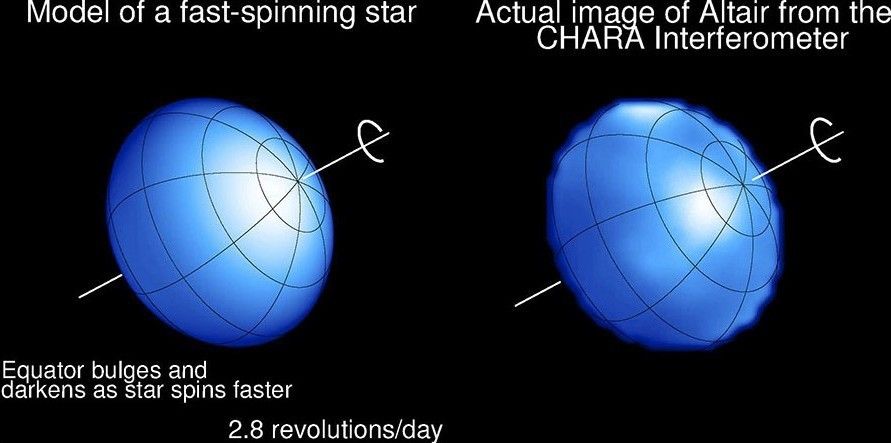
That distortion has a second visible consequence: gravity darkening, the same effect at work in Vega, but here we can see it directly because Altair’s pole is tilted toward us rather than pointed straight at us. Surface temperatures range from around 6,900 K at the equator up to roughly 8,500 K at the poles — the equator of this star is measurably cooler and dimmer than its poles, purely because rapid spin has pulled that material farther from the stellar core. The CHARA interferometer array on Mount Wilson eventually produced actual surface images of Altair confirming this, making it one of only a handful of stars besides the Sun whose surface we’ve ever directly resolved — and the dark band across its equator turned out to be even darker than standard models predicted, suggesting there’s still more to learn about exactly how fast rotation reshapes a star’s atmosphere.
There’s one more thing Altair shares with Vega and Deneb, and it’s easy to overlook: all three are solo acts. That’s actually the less common situation among bright stars. Look around the rest of the night sky and pairs and small groups are everywhere — Sirius has a faint white dwarf companion orbiting it, Procyon has one too, Capella is really two pairs of stars locked together, and Alpha Centauri is a trio. Even the supergiants Antares and Betelgeuse, similar in size and fate to Deneb, turn out to have companions of their own — Betelgeuse’s was only confirmed in 2025, found tucked close in its glare after centuries of suspicion. Vega, Altair, and Deneb don’t have any of that. As far as anyone has been able to tell, each one is simply a single star, on its own, doing whatever it’s doing without a companion’s gravity pulling on it.
None of this is visible to the eye, of course — Altair still just looks like a bright white point. But that’s exactly what rewards a little curiosity: every one of these stars holds an entire research subfield’s worth of strangeness just beneath an ordinary-looking surface.
Why This Matters More Than the Trivia
It would be easy to read all of this as a collection of fun facts and stop there. But step back and notice the pattern: three stars, similar in brightness, similar in our sky, and almost nothing else alike. One is close and young, gift-wrapped in the literal building blocks of planets. One is so far and extreme that we can’t agree on its distance, hurtling toward a dramatic and uncertain end. One is an ordinary star turned strange by nothing more exotic than spinning very, very fast.
That’s the real lesson the Summer Triangle has to offer, and it has nothing to do with owning expensive equipment or holding a physics degree. The same three points of light that anyone can find in thirty seconds are also, simultaneously, an active site of exoplanet research, an unsolved distance puzzle, and a natural experiment in extreme stellar rotation. You don’t have to choose between admiring the view and understanding the science — the whole point is that both belong to everyone who looks up.
Observing Notes for This Summer
You can find all three Summer Triangle stars with nothing but your eyes, which makes this a perfect target whether you’re brand new to stargazing or you’ve been doing this for decades.
When to look: The triangle becomes a convenient after-dinner target by mid-June, rising in the east as twilight fades. By late July and August, it’s high overhead by 10 p.m. and stays prominent most of the night. It’s a great “first constellation” to teach someone, since once you’ve found it, you won’t lose it again all summer.
Where to look: Find a spot with a reasonably open view toward the east and overhead — you don’t need a perfectly dark sky, since all three stars are bright enough to punch through a fair amount of light pollution. Vega is the brightest and highest, your anchor point. Deneb sits to its lower left, Altair to its lower right, forming a long, slightly lopsided triangle that’s hard to mistake for anything else once you’ve seen it.
With binoculars: A modest pair will show Vega’s blue-white tint more vividly than the naked eye can. It’s also worth scanning slowly along the Milky Way, which runs right through this part of the sky between Deneb and Altair — on a dark night, this stretch is rich with star clusters and nebulae worth sweeping through.
With a telescope: Even a small scope reveals Albireo, the lovely gold-and-blue double star marking the head of Cygnus, just a short hop from Deneb — a perennial favorite at NBAS public observing nights and a nice complement to a triangle tour.
Whatever gear you have, or don’t have, the invitation is the same: go outside, find the triangle, and remember that you’re looking at three completely different stories that happen to share the same patch of sky. Whatever your experience, you belong under our skies — and the Summer Triangle is as good a place as any to start looking up.