History

There is nothing in the appearance of Gliese 710 to suggest it deserves special attention. It takes its designation from the 1969 edition of Wilhelm Gliese’s Catalogue of Nearby Stars — though the star had already appeared in Gliese’s earlier 1957 catalog under a different number. The 1969 edition is the one most astronomers reach for, and “Gliese 710” is the name that stuck. The catalog’s purpose was simply to gather stars within roughly 20 parsecs (about 65 light-years) into one reference. Gliese 710 made the list. So did hundreds of others. It is a dim orange dwarf in Serpens, visible only with binoculars, and for most of astronomical history it was precisely as interesting as that sounds.
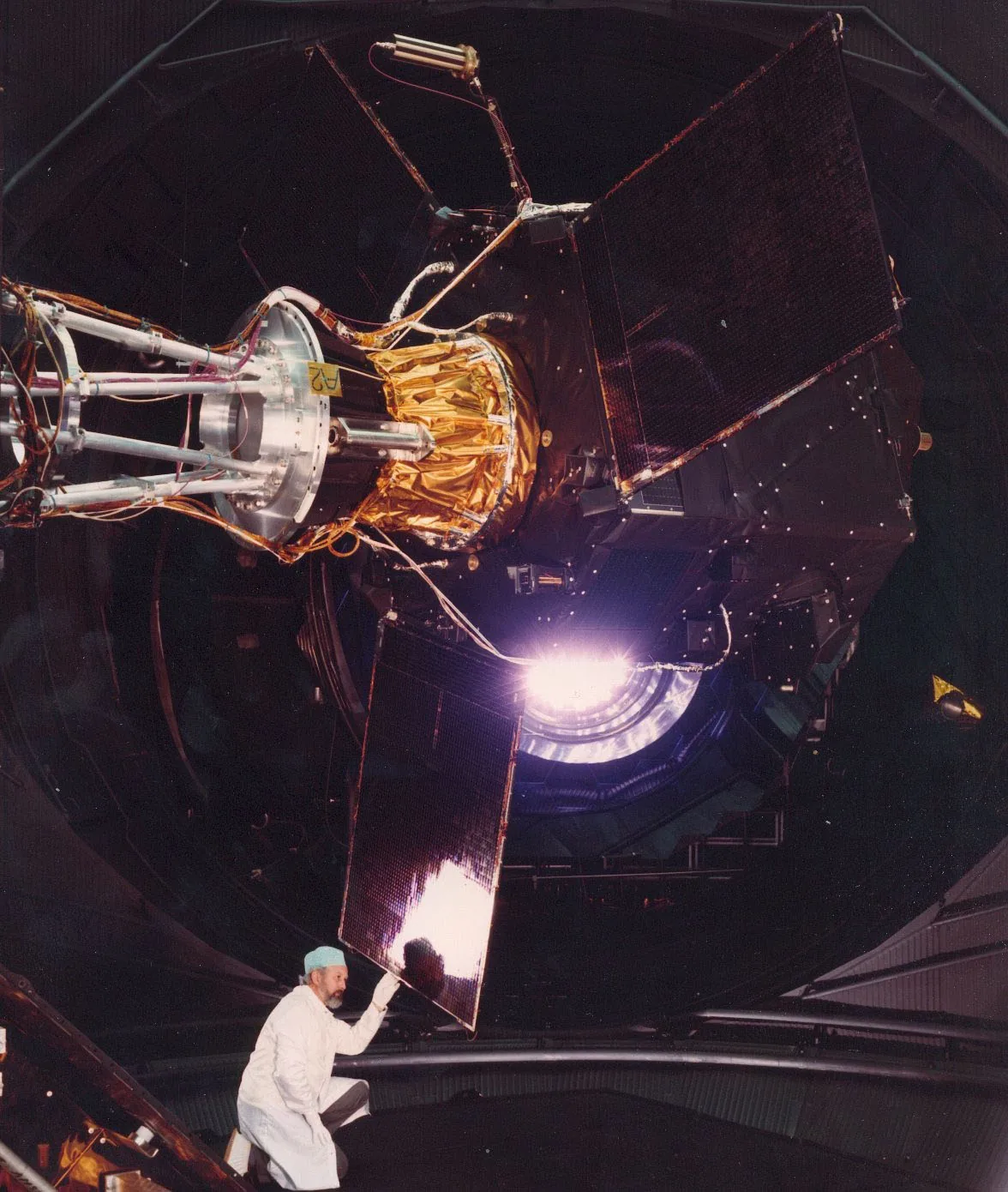
When astronomers examined Gliese 710 using the Hipparcos data, something unusual stood out: it had almost no proper motion. It wasn’t drifting sideways across the sky the way most nearby stars do. That can mean only one thing — it is moving almost directly along our line of sight. And its radial velocity confirmed that it is approaching us at roughly 14.5 kilometers per second. In 1999, García-Sánchez and colleagues published a study of stellar close approaches using Hipparcos data and identified Gliese 710 as the most significant encounter expected in the next few million years.
The Gaia Refinement
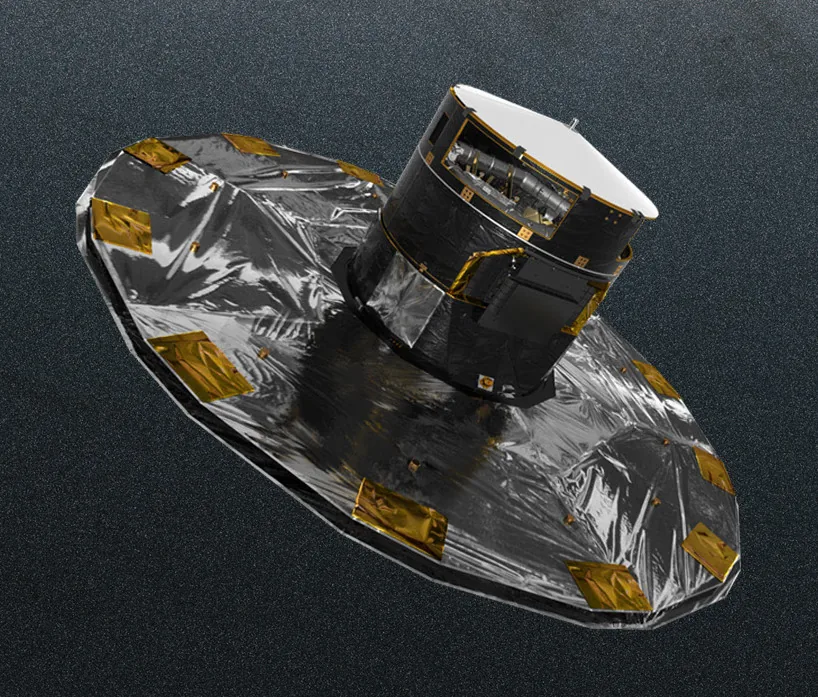
The Hipparcos measurements were good, but Gaia is extraordinary. The European Space Agency’s Gaia mission has measured the positions, parallaxes, and proper motions of over a billion stars with a precision that makes Hipparcos look coarse. When the Gaia Data Release 2 catalog became available in 2018, Coryn Bailer-Jones and colleagues ran the numbers on 7.5 million stars with complete three-dimensional velocity data. Gliese 710 came out on top.
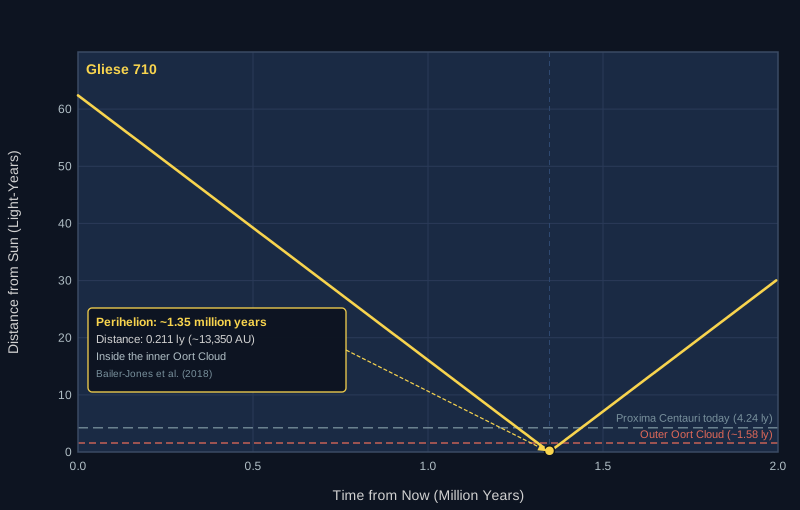
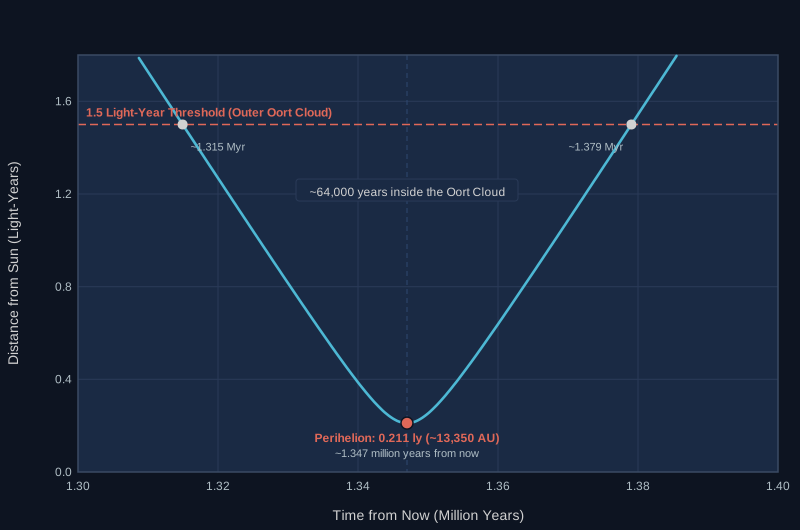
Their result, published in The Astrophysical Journal in 2018: Gliese 710 will pass within 0.0621 ± 0.002 parsecs of the Sun — about 0.203 light-years, or roughly 12,800 AU — in approximately 1.35 million years. The uncertainty shrank dramatically from the Hipparcos estimate.
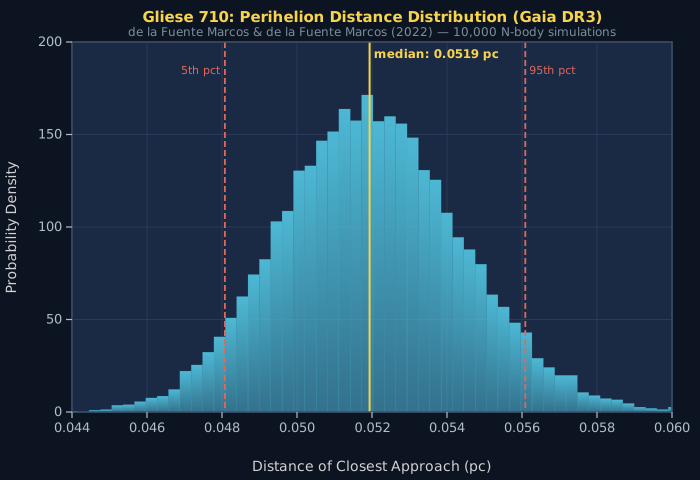
When the even more precise Gaia Data Release 3 catalog became available, Carlos and Raúl de la Fuente Marcos ran 10,000 Monte Carlo N-body simulations using the updated astrometry. The DR3 result tightens the prediction further: a median closest approach of 0.052 ± 0.002 parsecs (~10,635 AU, or 0.170 light-years) in approximately 1.29 million years, with a 90% probability of coming within 0.048–0.056 pc (de la Fuente Marcos & de la Fuente Marcos 2022). This is not a rough prediction. It is about as precise a forecast of a stellar trajectory as we know how to make.
All About Gliese 710
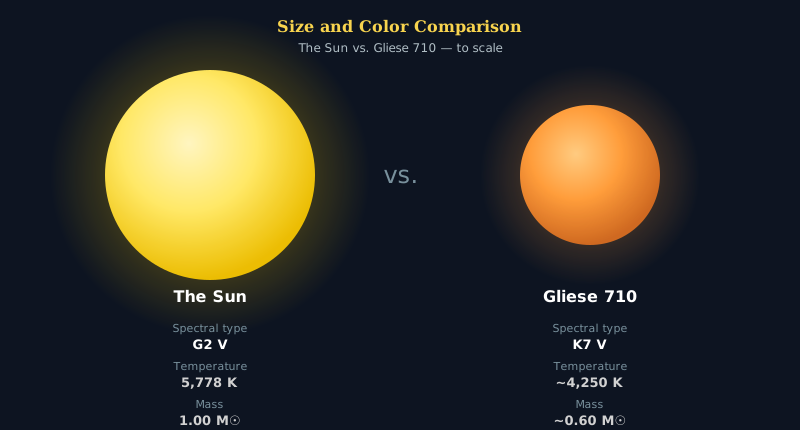
Gliese 710 is a K7 V star — an orange dwarf, cooler and dimmer than the Sun but more massive and luminous than the familiar M-type red dwarfs that dominate the solar neighborhood by sheer numbers. Its surface temperature is around 4,250 K (the Sun is 5,778 K), its mass is roughly 0.6 times that of the Sun, and it emits only about 3.7% of the Sun’s luminosity. At its current distance of 63.8 light-years, it shines at apparent magnitude 9.65 — far too faint to see with the naked eye, but well within reach of binoculars or a small telescope.
In the HR diagram, K-type stars occupy a comfortable middle ground. They are stable, long-lived, and common. The Alpha Centauri system — our nearest stellar neighbor — includes a K1 V star (Alpha Centauri B), so the type is familiar. Gliese 710 is not exotic. It probably has a fairly quiet magnetic life compared to younger, more active stars, and it is old enough to have settled into a predictable routine.
What makes Gliese 710 unusual is not what it is but where it is going. It is currently 63.8 light-years away and closing at about 14.5 km/s — roughly 52,000 kilometers per hour. That sounds fast. On galactic scales, it is not, but it is fast enough that over the next million years or so, the geometry will change in ways that matter.
Moving Around the Galaxy
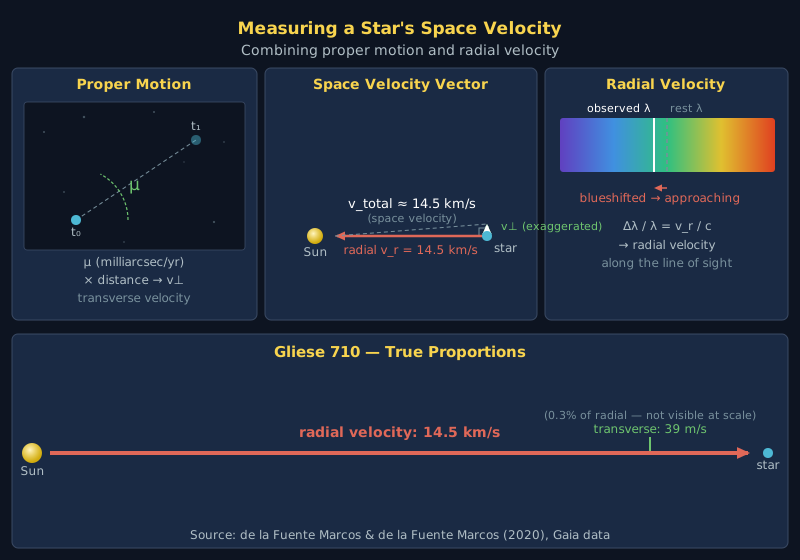
Most stars have at least some measurable proper motion. Barnard’s Star holds the record for the fastest in the sky, at about 10 arcseconds per year. Sirius drifts at around 1.3. Gaia measurements put Gliese 710’s total proper motion at just 0.429 milliarcseconds per year — roughly 23,000 times smaller than Barnard’s Star, among the smallest proper motions Gaia has measured for any star within 100 light-years. That translates to a transverse velocity of only 39 meters per second. This is the first clue that it is coming almost straight at us.
To fully characterize a star’s motion, you need both proper motion (transverse velocity on the plane of the sky) and radial velocity (the component along the line of sight). Gaia measured Gliese 710’s radial velocity at −14.5 km/s — the negative sign indicating approach (de la Fuente Marcos & de la Fuente Marcos 2020). The contrast is stark: 14,500 m/s inbound, 39 m/s sideways. The transverse component is 0.3% of the radial. For all practical purposes, Gliese 710 is coming straight at us, and that near-perfect alignment is precisely why the trajectory can be predicted with such confidence.
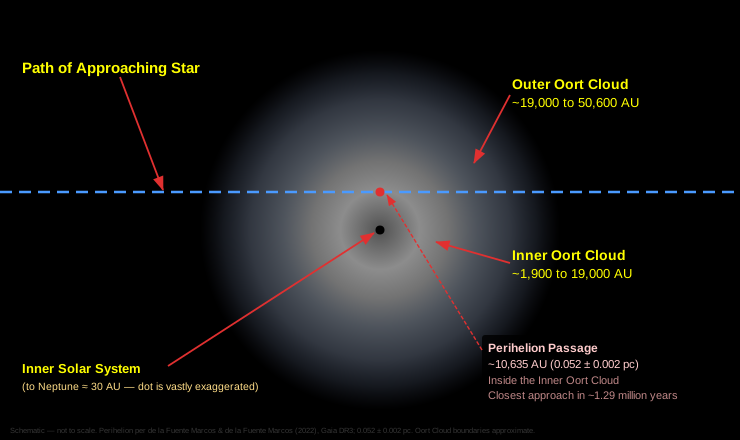
The gravitational two-body problem gives us the tool to make that prediction: knowing the current position, velocity, and the mass of the Sun, you can integrate the trajectory forward through time. The path Gliese 710 will follow is a hyperbola — it will curve slightly as it falls toward the Sun’s gravity well, reach closest approach, and then continue outward, never to return. The two charts below trace that trajectory at different scales.
The Closest Stellar Approach — Ever?
The short answer is: of all the stellar close approaches we have been able to document — past or future — Gliese 710’s predicted perihelion of 0.170 light-years (~10,635 AU) is the deepest penetration of the solar system on record.
The comparison requires some care. Astronomer Coryn Bailer-Jones and his team searched the Gaia DR2 catalog for all stars with known positions and three-dimensional velocities, then integrated their trajectories both forward and backward in time to identify close encounters. In that catalog of 7.5 million stars, no other encounter comes close to Gliese 710’s. The runner-up approaches are measured in light-years — several times more distant.
A notable comparison is Scholz’s Star, which passed through the outer Oort Cloud roughly 70,000 years ago at a closest distance of about 0.82 light-years. That is genuinely close by cosmic standards — it may have perturbed comets in the outer Oort Cloud — but 0.82 light-years is still nearly five times farther than Gliese 710 will reach. Gliese 710 will not merely clip the outer fringes.
The honest caveat is that “ever” is limited by what we can see. The Gaia catalog is comprehensive for stars bright enough to detect — but there are dim red dwarfs, brown dwarfs, and rogue planets that have no entries in any catalog. Some of them may have threaded through the solar system closer than Gliese 710 ever will, and we simply would not know. What we can say with confidence is that among the stellar encounters we have been able to reconstruct, Gliese 710 is the record holder.
Impact on the Solar System
Gliese 710’s perihelion of 0.170 light-years — about 10,635 AU — places it well inside the inner Oort Cloud, which is thought to extend from roughly 2,000 to 20,000 AU. It will not come close to the planetary system; Neptune orbits at 30 AU, and Gliese 710 will not get within 350 times that distance. The planets are safe.
The Oort Cloud is not.
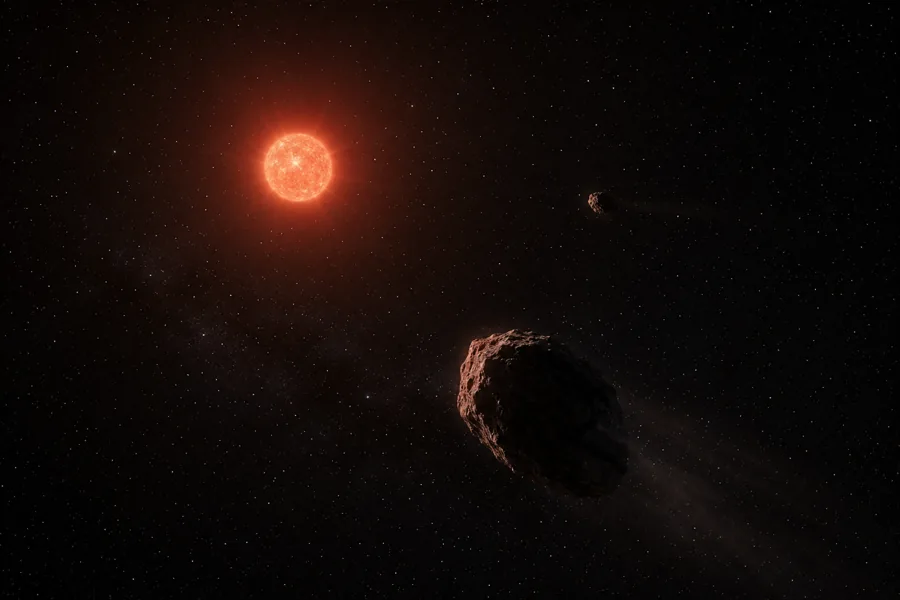
Models of the encounter suggest that the gravitational tidal force from Gliese 710 will significantly increase the flux of comets entering the inner solar system, but not immediately. Comets perturbed during the flyby take millions of years to work their way inward on their new orbits. The comet shower, if it can be called that, would arrive roughly two to three million years after the encounter — not something that future observers of the Earth (should any exist) will see in real-time as a sudden spike, but a slow, extended increase in long-period comet activity spread over millions of years.
Whether this poses any meaningful danger to life on Earth at that future date is speculative. Impact events are improbable under the best of circumstances, and a modest increase in long-period comet flux over millions of years is not the asteroid-impact-style catastrophe that science fiction might suggest. The more interesting consequence may be observational: future astronomers, if any are watching from Earth at that time, will have an unusually rich supply of long-period comets to study.
Observing Gliese 710
At magnitude 9.65, Gliese 710 is within reach of binoculars under a reasonably dark sky, and trivial to see in any telescope. What you will see is a point of light — orange in a telescope that gathers enough light to show color, nondescript in binoculars. Nothing about its appearance distinguishes it from the hundreds of other faint stars in the field.
That, in a way, is the point. The story of Gliese 710 is entirely in what we know about it, not in what we see. The light arriving at your eye has been traveling for 63.8 years. The source of that light — a thoroughly ordinary orange dwarf — is 603 trillion kilometers away and closing. Nothing about the view tells you any of this.
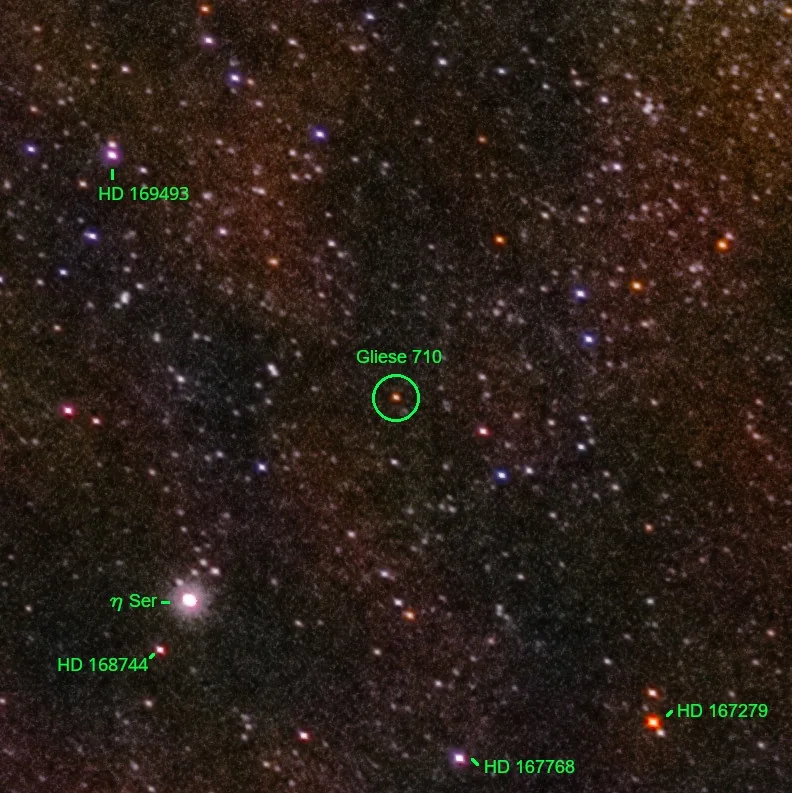
Gliese 710 sits in Serpens — in the Cauda (tail) section, which hangs in the southern summer sky after dark. The finder chart below will get you there.
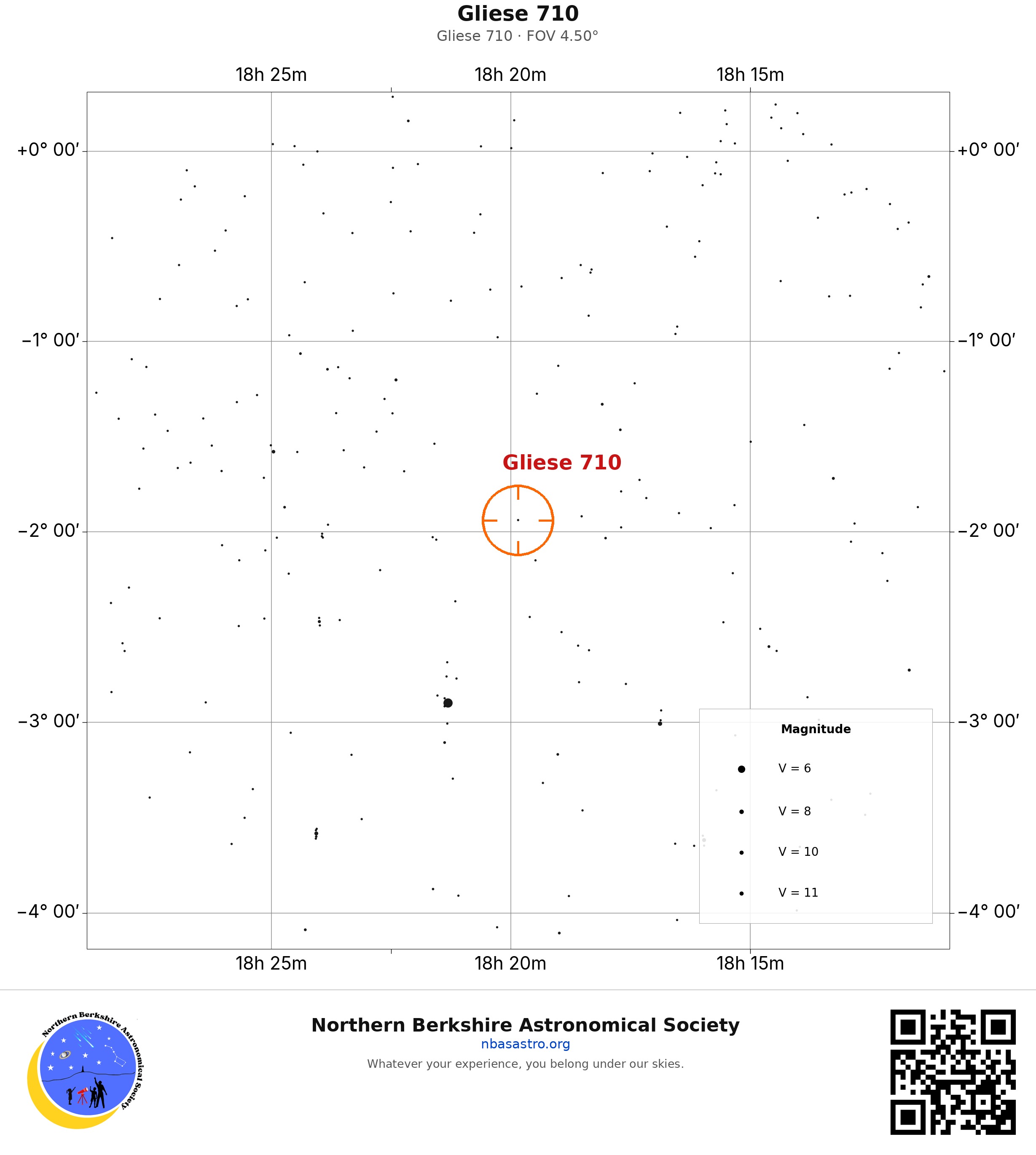
A low-power eyepiece that gives you a wide, star-filled field is the right choice. There is no high-magnification object here — just a star. But knowing which one it is, and what it is doing, is its own reward. Somewhere in that field of view, one point of light is on the most remarkable trajectory of any star we have ever identified. Find it, and you are looking at the future of the solar system.