
Introduction
Point a telescope low in Sagittarius, near the base of the Teapot’s handle, and you’ll find Messier 54 — a bright, compact ball of stars that looks, at first glance, exactly like every other globular cluster in this part of the sky. Nothing about it stands out at the eyepiece. That’s precisely what makes it interesting.
For over two centuries, M 54 was filed as just another Milky Way globular. In 1994, that turned out to be wrong. M 54 doesn’t belong to the Milky Way at all — it belongs to a small satellite galaxy that our galaxy is, right now, in the process of tearing apart and absorbing. It was the first globular cluster anyone reassigned from the Milky Way to another galaxy entirely.
Discovery

Charles Messier catalogued M 54 on July 24, 1778, one more entry in his running list of fuzzy, comet-like objects. There was no way for him to know it was anything other than an ordinary star cluster — the tools to tell the difference didn’t exist yet, and wouldn’t for another two hundred years. It sat quietly in the catalog, unremarkable, for generations.
The Galaxy Behind the Bulge
That quiet catalog entry held for 216 years. In 1994, astronomers Rodrigo Ibata, Gerry Gilmore, and Mike Irwin announced they’d found something hiding almost directly behind the Milky Way’s own bulge: a previously unknown dwarf galaxy, now called the Sagittarius Dwarf Spheroidal Galaxy (Sgr dSph) — caught in the act of being pulled apart by the Milky Way’s gravity. It had gone unnoticed for so long precisely because of where it sits, nearly behind the crowded, dust-choked galactic core from our point of view, despite being one of the Milky Way’s nearest satellite galaxies. It’s small, too — roughly 10,000 light-years across, compared to the Milky Way’s 100,000, and by now its stars number only a small fraction of what they once did.
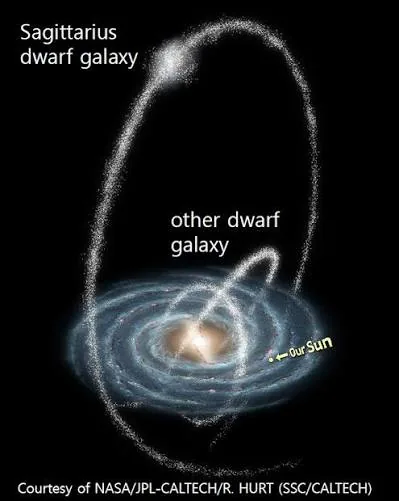
The orbit is the key to the whole story. Sgr dSph travels on a steep, nearly polar path around the Milky Way — swinging up over one galactic pole and down under the other rather than staying in a single flat lane the way a disk star does. That orbit carries it through the Milky Way’s disk itself, repeatedly, roughly every 550–750 million years. Each disk passage, and each close approach to the galactic center, strips away more of its stars to the Milky Way’s gravity. What’s left behind is the Sagittarius Stream: a long ribbon of stripped stars that, by now, wraps essentially all the way around the sky. Sgr dSph has been making this loop, losing a little more of itself each time, for billions of years, and current models give it perhaps another billion before it’s fully absorbed.
Sgr dSph didn’t arrive alone, either — or rather, it didn’t stay alone once it got here. In that same 1994 paper, Ibata’s team flagged four already-catalogued globular clusters — M 54, Arp 2, Terzan 7, and Terzan 8 — as having roughly the right distance, sky position, and velocity to belong to this newly-found galaxy rather than to the Milky Way itself. Several more clusters, including Palomar 12 and Whiting 1, have since turned up further out, already pulled loose into the trailing stream. A handful of more distant Milky Way globulars are suspected of having arrived the same way, from earlier, older wraps of the same disintegrating galaxy. M 54 is simply the brightest and most massive of the family — which is exactly why it was the one already sitting in Messier’s catalog, waiting to be reassigned.
Two disambiguations worth making explicitly, since the names genuinely invite confusion. First: Sgr dSph is not Caldwell 57. That designation belongs to NGC 6822, Barnard’s Galaxy — a genuine Local Group member roughly 1.6 million light-years away, unrelated to Sgr dSph aside from both happening to sit in the constellation Sagittarius. Second, and easier to actually mix up: Sgr dSph (also called SagDEG, the Sagittarius Dwarf Elliptical Galaxy) is not the same object as the Sagittarius Dwarf Irregular Galaxy (SagDIG) — a third, unrelated dwarf galaxy roughly 3.4 million light-years away. The names differ by a single word, but the objects have nothing to do with each other. Sgr dSph itself doesn’t carry a Caldwell number.
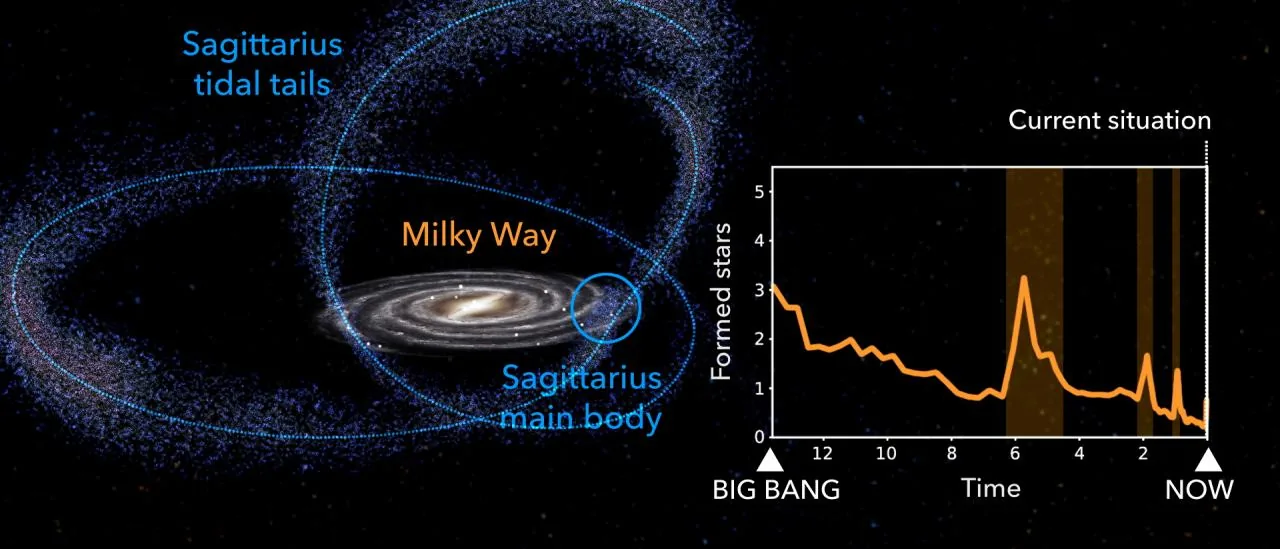
Galaxy encounters like this one don’t just strip stars away — they also make new ones. Tidal compression from a close passage squeezes gas clouds in both galaxies, and squeezed gas collapses into stars more readily than gas left alone. It’s a general rule in galaxy interactions, not something unique to Sgr dSph. What makes this particular case worth a second look is a 2020 study of the Milky Way’s own star-formation history, reconstructed from Gaia data, which found three distinct bursts of enhanced star formation in the Milky Way disk — timed to roughly 5.7, 1.9, and 1.0 billion years ago — that line up with Sgr dSph’s past close passages by the galactic center. The oldest of those bursts spans the same general era, around 4.6 billion years ago, in which the Sun itself formed. That doesn’t mean Sgr dSph caused the Sun to exist — the timing overlap is suggestive, not proof of cause and effect — but it’s a genuinely researched, published possibility: the star-forming cloud that became our solar system may have been compressed into collapsing in the first place by the same small galaxy that, billions of years later, would hand the Milky Way the cluster you’re looking at tonight.
Not From Around Here
That 1994 flag on M 54 turned out to be right, and follow-up work raised a more interesting question, one that’s still not fully settled: is M 54 the galaxy’s actual nucleus, or a genuine globular cluster that happened to sink into the center afterward? The current best picture, from studies comparing the stellar populations and motions in that crowded core, favors the second option. M 54 appears to be an ordinary cluster that formed elsewhere in Sgr dSph and spiraled inward over billions of years — a process called dynamical friction, where a massive object loses orbital energy to its surroundings and slowly settles toward the center of whatever it’s orbiting. Sitting right alongside it, coincident in position but moving differently, is a separate, genuine nucleus of the dwarf galaxy. Two dense stellar cores, superimposed on the sky, with two different histories.
Just how coincident is worth putting a number on, because it settles a natural follow-up question: is M 54 sitting at the galaxy’s actual core, or just happening to lie along one of its tidal tails? A 2024 study modeling Gaia and APOGEE data across the crowded center measured the offset directly: about 0.3° on the sky, corresponding to a real physical separation of only around 400 light-years, plus a small but measurable difference in the two objects’ motion through space. Four hundred light-years sounds like a lot until you compare it to Sgr dSph’s own size — roughly 10,000 light-years across. M 54 isn’t out on a tidal tail; those stretch for tens of thousands of light-years. It’s sitting almost exactly at the core, offset just enough to show it’s a distinct object from the true nucleus, not merged with it.
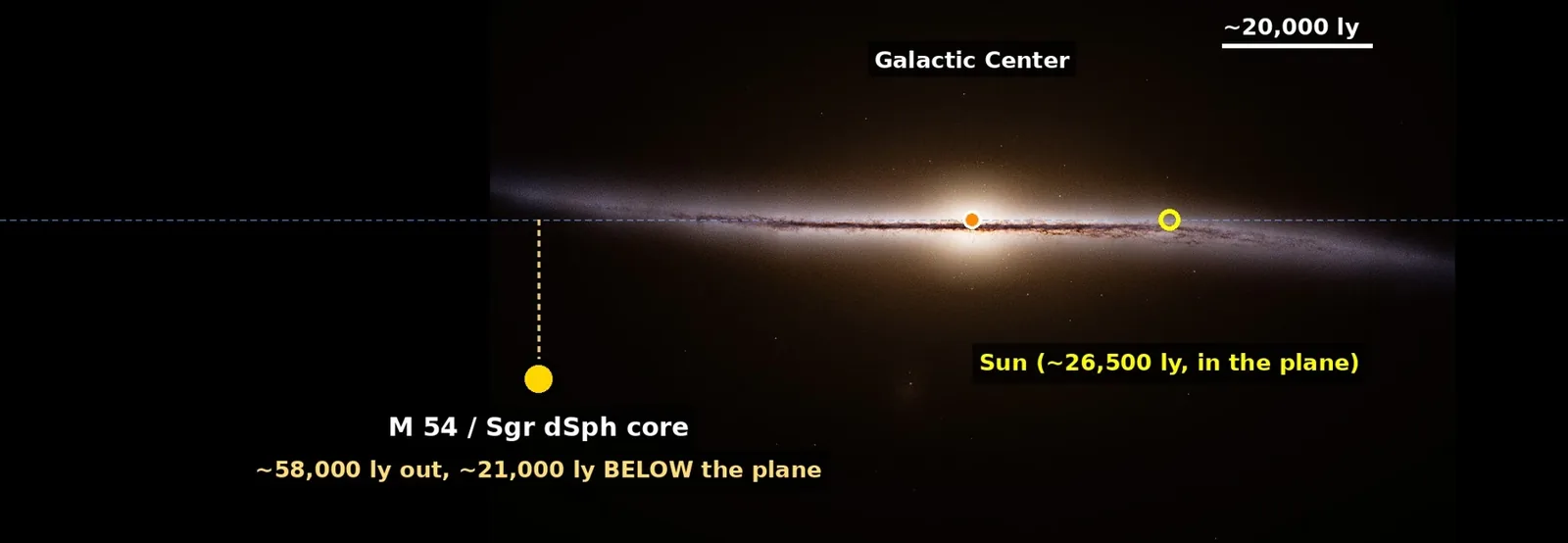
Seen edge-on, the point makes itself: M 54’s galactic coordinates are l = 5.6°, b = −14.1°, and at its distance of roughly 87,000 light-years that latitude works out to sitting about 21,000 light-years below the plane of the Milky Way – not embedded within it, and not even close. Converted to real galactocentric terms, M 54 sits about 58,000 light-years from the galaxy’s center, more than twice the Sun’s own 26,500 light-year distance, and on very nearly the opposite side of the galaxy.
That vertical distance is not a minor detail. If M 54 actually sat in the disk itself, at the disk’s own gas and dust density, it likely wouldn’t have survived as a coherent cluster this long – and we may not have as clean a view of it, either. The fact that it’s tucked far below the plane is exactly why it reads as a clean, isolated, undisturbed ball of stars rather than something torn apart or choked with foreground dust.
Two Open Questions
M 54 has produced two genuine, still-unresolved research puzzles.
The first: in 2009, a study of the motions of stars near M 54’s center found evidence consistent with a single intermediate-mass black hole of roughly 9,400 solar masses — a size class in between ordinary stellar-mass black holes and the supermassive ones at galaxy centers. That specific claim, one massive black hole sitting at the center, hasn’t held up: later X-ray and radio observations failed to find the signal such an object should produce, and pushed the allowed mass down well below the original estimate.
Black holes in globular clusters are real – that part isn’t in doubt. Two have been directly detected, via their radio and X-ray emission, in the Milky Way’s own M 22. But M 54 is part of a recurring pattern: claims of one single massive black hole anchoring a cluster’s core keep not surviving closer scrutiny. The Milky Way’s NGC 6397 got the same treatment Omega Centauri and M 54 did – an initial claim of a central intermediate-mass black hole – until a 2021 study using Hubble and Gaia data found the mass was there, but spread across a dense swarm of ordinary stellar-mass black holes rather than concentrated in one. The honest state of the science for M 54 specifically: an intriguing hint, increasingly disfavored by follow-up observations, not a discovery.
The second: M 54’s oldest stars carry noticeably less lithium than the Big Bang should have produced — the same “cosmological lithium problem” long seen in the Milky Way’s own ancient stars. A 2014 study was the first to check whether that shortfall was a Milky Way quirk or something universal. It’s universal: stars in a completely different galaxy show the identical gap.
Finding and Observing M 54
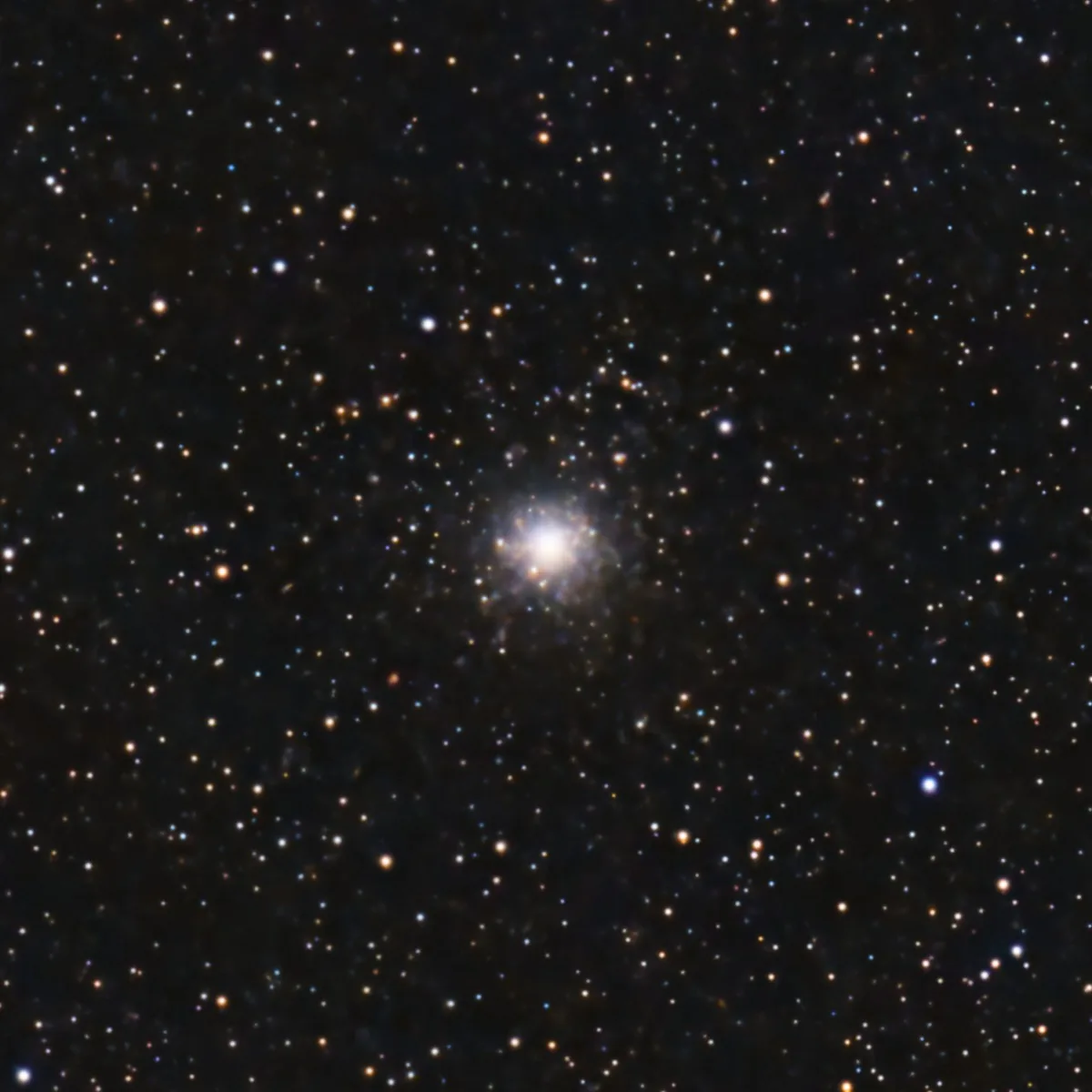
At magnitude 7.6, M 54 is an easy target for almost any telescope, and even binoculars under a dark sky. The catch is declination: at −30°28′, it never climbs high for mid-northern observers, and it’s best placed in the evening sky in mid-to-late summer before it starts sinking toward the horizon. Look for it about 1.7° west of ζ Sagittarii (Ascella), the star marking the base of the Teapot’s handle.
Like M 92 in Hercules, M 54 is a case where the eyepiece undersells the object. Even in a large amateur scope, it stays an unresolved, dense fuzzy ball — it’s simply too far away, and too tightly packed, for backyard equipment to break it into individual stars. What you’re actually looking at is the seed of a small galaxy the Milky Way is quietly finishing off, sitting in nearly the same spot in the sky as it has for the two and a half centuries since Messier logged it.
That’s worth sitting with for a second at the eyepiece, because nothing in the view will tell you any of it. No structure, no color, no hint of scale — just a tight, bright, faintly compressed ball of light, the same as a dozen other globulars you may have already logged this summer. There’s no equipment upgrade that unlocks the difference. The only thing that changes what you’re seeing is knowing the story: that this particular smudge is the core of another galaxy, still being pulled apart a few thousand light-years at a time, sitting almost exactly where its true nucleus does, carrying the same primordial lithium puzzle as our own galaxy’s oldest stars.
That’s the real takeaway, and it’s worth remembering the next time an object looks “ordinary” through the eyepiece. M 54 looked ordinary to Messier for two centuries. It took better instruments, not better eyes, to find out otherwise. Point your scope at it, see the plain little ball of light it actually shows you — and then enjoy knowing you’re looking at a piece of a whole separate galaxy, however unremarkable it chooses to look tonight.