Introduction
On the night of August 27 into the early morning of August 28, 2026, the Full Moon spends more than five and a half hours sliding through Earth’s shadow. At its deepest, about 96% of the Moon’s disk will be sitting in the dark part of that shadow — officially still a “partial” lunar eclipse, but close enough to total that almost the whole Moon should take on the deep orange-red color usually reserved for the real thing.
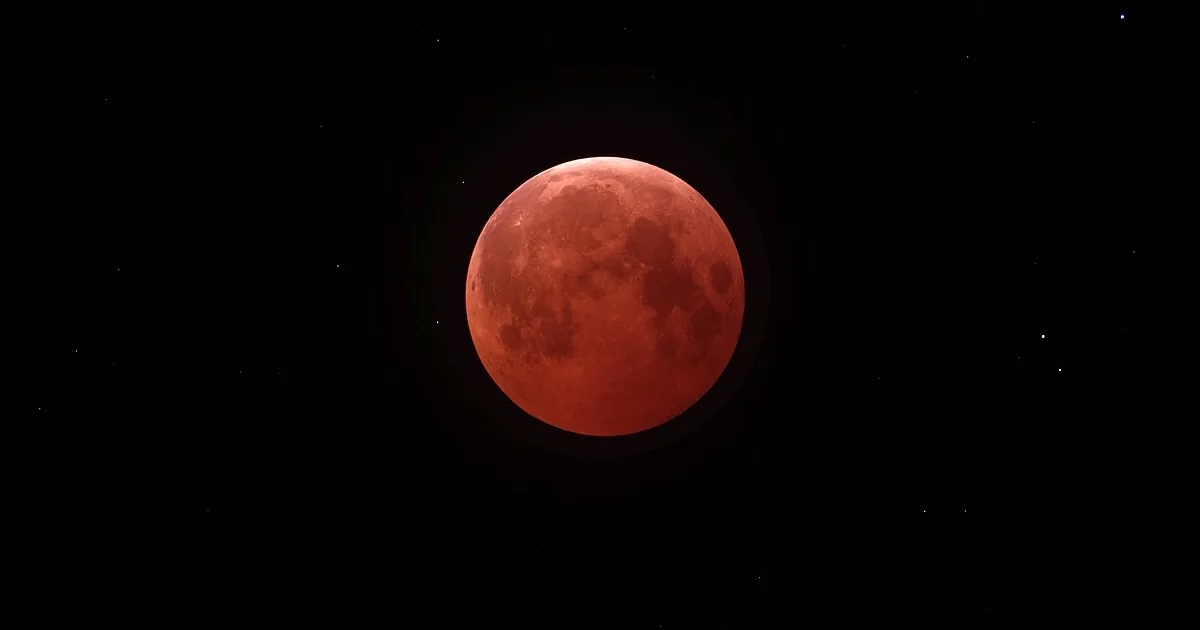
This event needs no equipment, no travel, and no special timing beyond staying up a bit late. From North Adams, the Moon is comfortably up in the SE-S sky the entire time, so it’s a genuine backyard event — eyes alone will show you real change happening, and binoculars or a small scope will only add to it.
Lunar Eclipses: Earth and other Planets
A lunar eclipse can only happen at Full Moon, for a simple reason: it’s the one point in the month when the Moon sits opposite the Sun in the sky, with Earth in between — the exact geometry a shadow requires. It doesn’t happen at every Full Moon, though, because the Moon’s orbit is tilted about 5.1° relative to Earth’s path around the Sun. Most months, the Full Moon passes above or below Earth’s shadow entirely. An eclipse only happens when Full Moon lines up with one of the two points where the Moon’s tilted orbit crosses Earth’s orbital plane — the “nodes” — which is a narrower coincidence than it sounds.
Earth isn’t the only planet that eclipses its own moons. Mars’s two small moons, Phobos and Deimos, pass through Mars’s shadow routinely — Phobos orbits so close and so fast (about 7 hours 39 minutes per lap) that it’s eclipsed for a large fraction of its orbits. The outer planets do it constantly: Jupiter’s four large moons slip into Jupiter’s shadow so predictably that in 1676, the Danish astronomer Ole Rømer used the timing of those eclipses on Io to make the first real estimate of the speed of light — Io’s eclipses arrived late when Earth was farther from Jupiter and early when it was closer, and the size of that delay was the clue.
How Lunar Eclipses Work
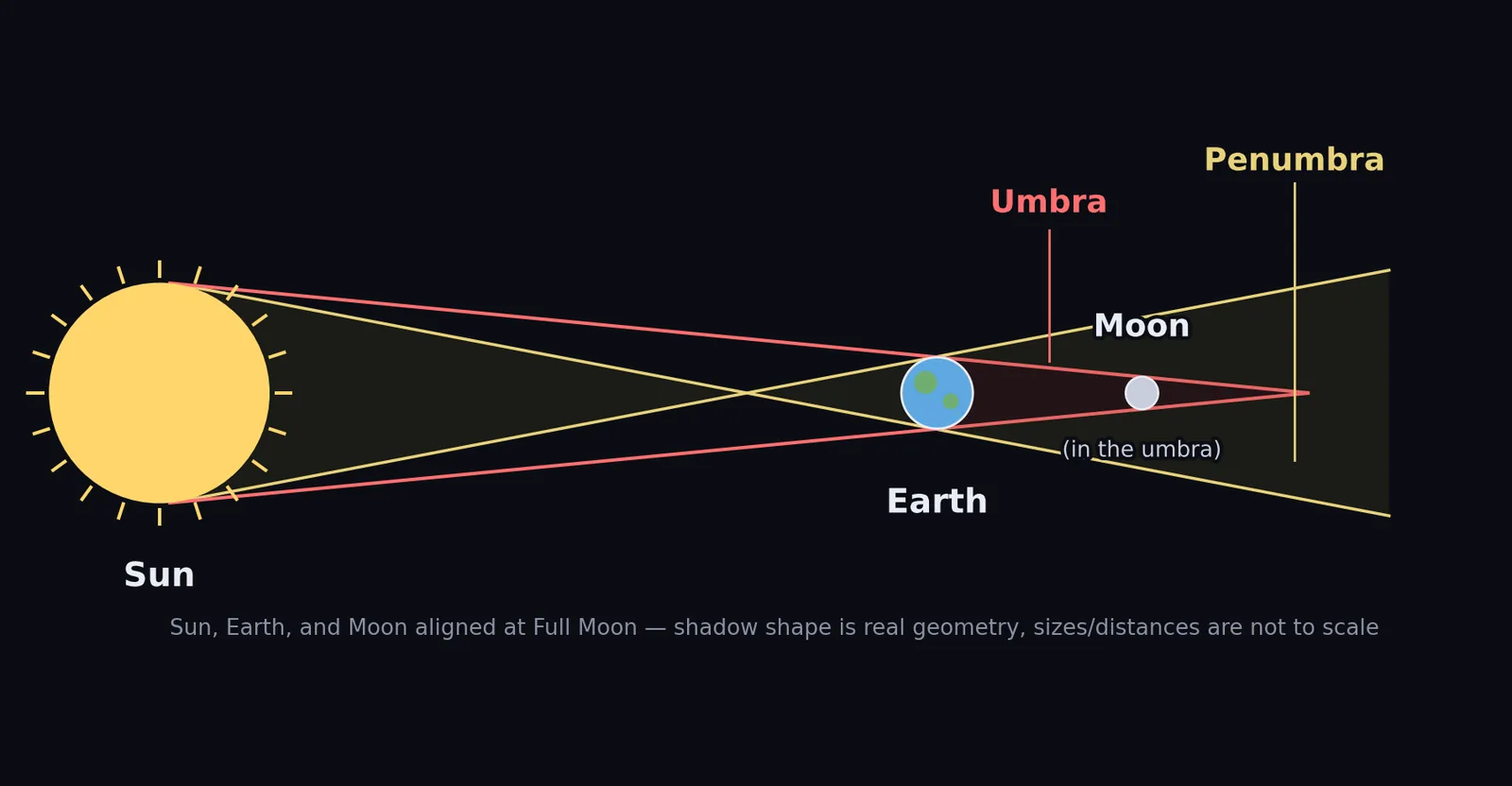
A lunar eclipse is just Earth getting in the Sun’s way, from the Moon’s point of view. Sun, Earth, and Moon line up — Earth in the middle — and Earth’s shadow falls across the Moon instead of empty space. Everything that follows is really just a description of what that shadow looks like up close.
What Are the Umbra and Penumbra?
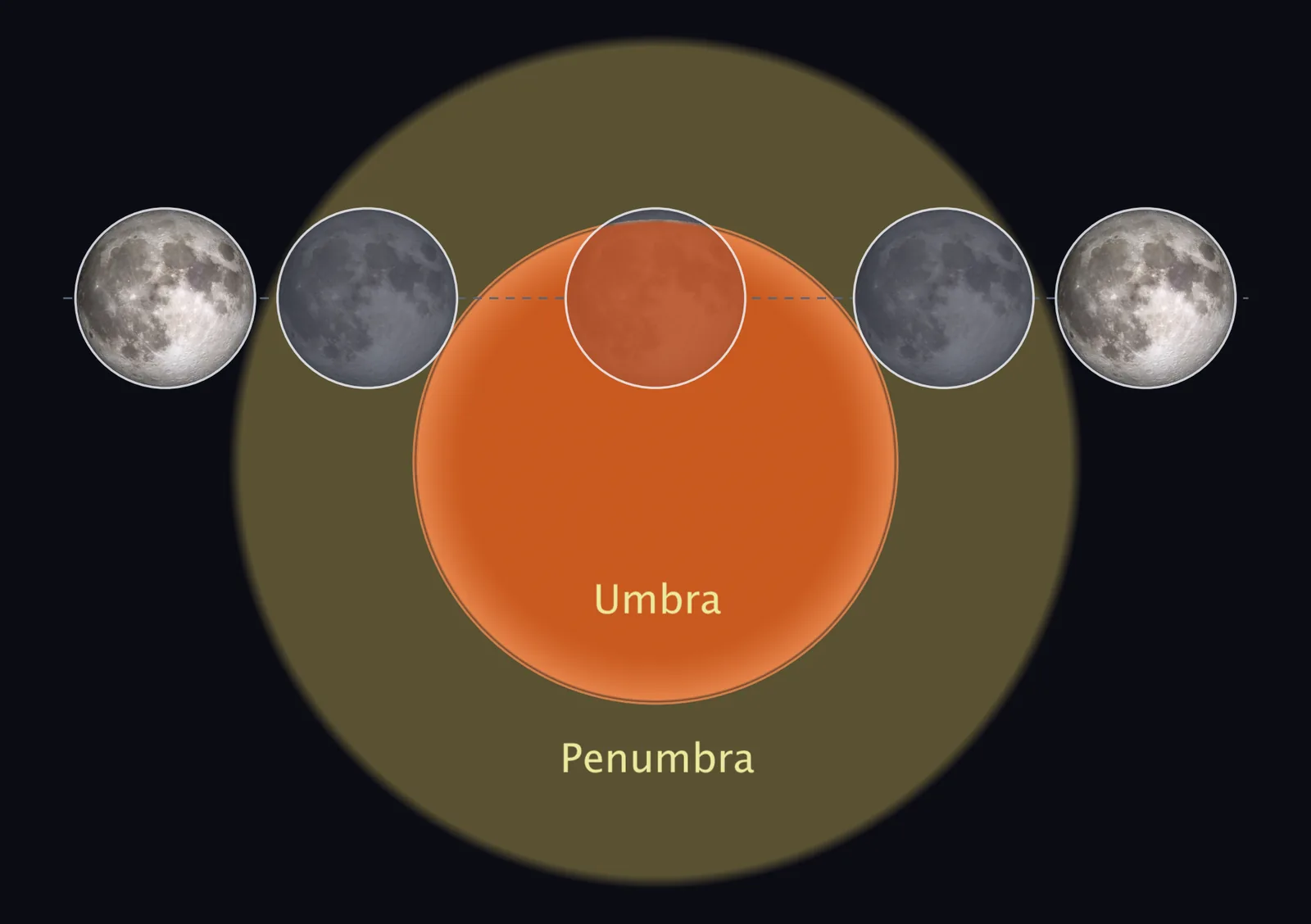
Earth’s shadow, like the shadow of anything lit by a source bigger than a point of light, has two distinct parts.
The penumbra is the pale outer fringe, where Earth only blocks part of the Sun. Sunlight is dimmed here, not cut off, and the effect on the Moon is genuinely subtle — a faint gray shading that’s easy to miss unless you know to look for it, slightly more evident in the 15–20 minutes right before the Moon reaches the umbra.
The umbra is the dark inner core of the shadow. Stand inside it — or in this case, have the Moon pass through it — and Earth blocks the Sun completely. This is the part that does the visible darkening and the reddening.
Why a “Blood” Moon?
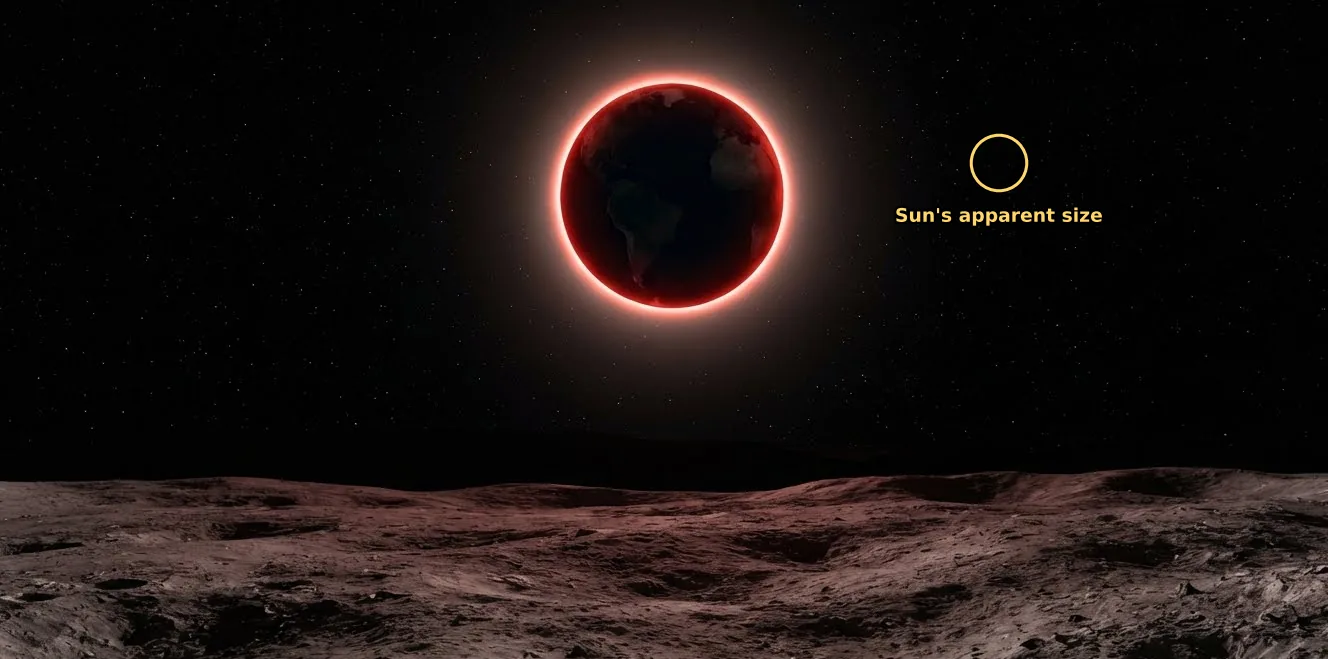
None of this would look black from the Moon, though. Point a camera at Earth from inside the umbra and you wouldn’t see just a dark disk — you’d see a thin, brilliant red ring around it: every sunrise and sunset happening on Earth at that exact moment, bent inward by our atmosphere and colored red for the same reason sunsets are red (air scatters away the blue end of sunlight and lets the red end pass through at a low angle). That ring is what actually lights up the Moon during the deep part of an eclipse — not the absence of light, but the combined glow of every sunrise and sunset on Earth, all at once, projected onto the Moon.
Unlike a solar eclipse — where totality lasts minutes — the size of the Earth eclipsing the Sun (from the point of view of the Moon) is much larger. So here, the time it takes for the Moon to cross the umbral shadow is typically an hour or more. You don’t have to worry about blinking and missing anything; you can take a break and come back and see how things have progressed (but do check the time table below).
Some Parameters
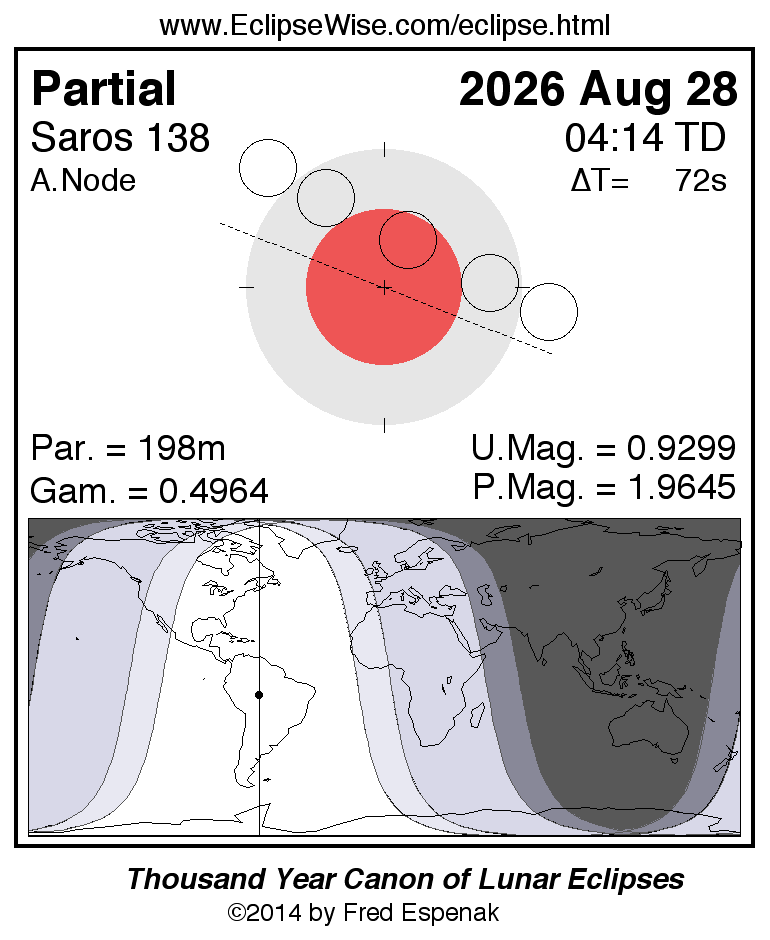
This eclipse has an umbral magnitude of 0.932 per Fred Espenak’s EclipseWise.com predictions. Here, magnitude, by definition, has nothing to do with the magnitude system used for the brightness of other objects like planets or stars: it’s the fraction of the Moon’s diameter that’s inside a given shadow at maximum — so 0.932 means 93.2% of the Moon’s diameter sits inside the umbra at greatest eclipse. The penumbral magnitude (1.966), is defined similarly: you can think of it as “how many Moons can fit inside the penumbral shadow?”
You’ll also see this eclipse described as covering 96% of the Moon’s disk. That’s not a typo or a different eclipse — it’s a different measurement of the same event: the fraction of the Moon’s visible area that’s in shadow, rather than its diameter — and 96% is very near total.
The Moon reached apogee — the farthest point in its orbit from Earth — on August 22, just under six days before this eclipse. That timing matters: near apogee, the Moon looks slightly smaller and moves slightly slower against the sky, and both effects stretch out how long it takes to cross the umbra. That’s part of why the partial phase of this “merely partial” eclipse still lasts a full 3 hours and 19 minutes.
Eclipse Seasons
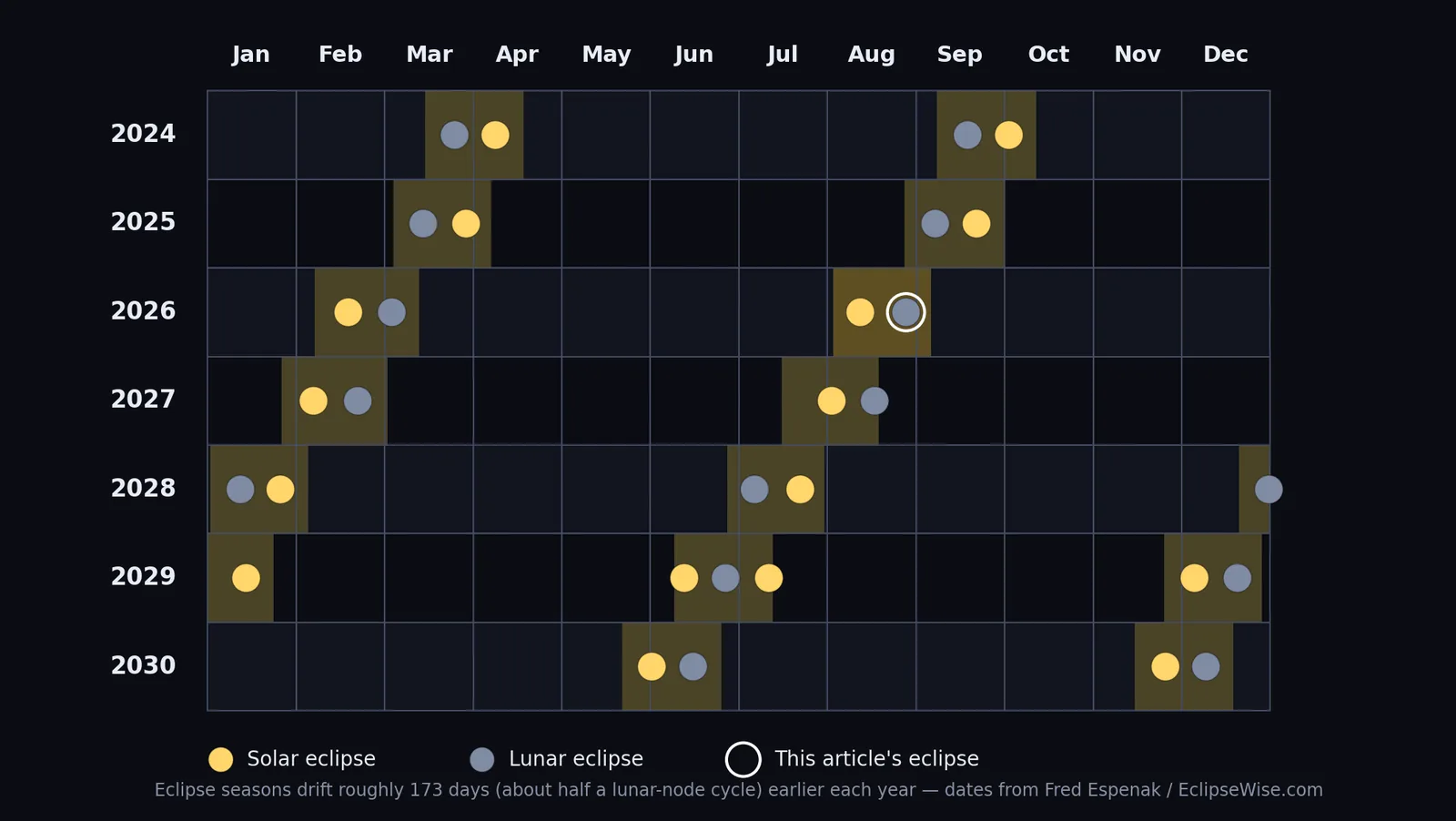
Eclipses aren’t spread evenly through the year — they cluster into eclipse seasons, roughly 31 to 37 days long (avg. 34), that recur about every 173 days (just under six months) as the Moon’s tilted orbit brings its nodes back in line with the Sun. Every eclipse season produces at least two eclipses (one solar, one lunar, in either order) and occasionally three. That structure sets the floor and ceiling for how many eclipses a calendar year can have: a minimum of four (two solar, two lunar) most years, with five, six, or rarely, even seven possible — the last seven-eclipse year was 1982, the next is 2038.
This eclipse is in the latter half of 2026’s second eclipse season: a total solar eclipse crossed the Northern Hemisphere just two weeks earlier, on August 12. Same season, same underlying alignment, two very different-looking results depending on whether it’s the Sun or the Moon doing the disappearing act. By the time we get to the next New Moon in September, we’ll be outside this window (so no eclipse).
Observing the Eclipse
Timing
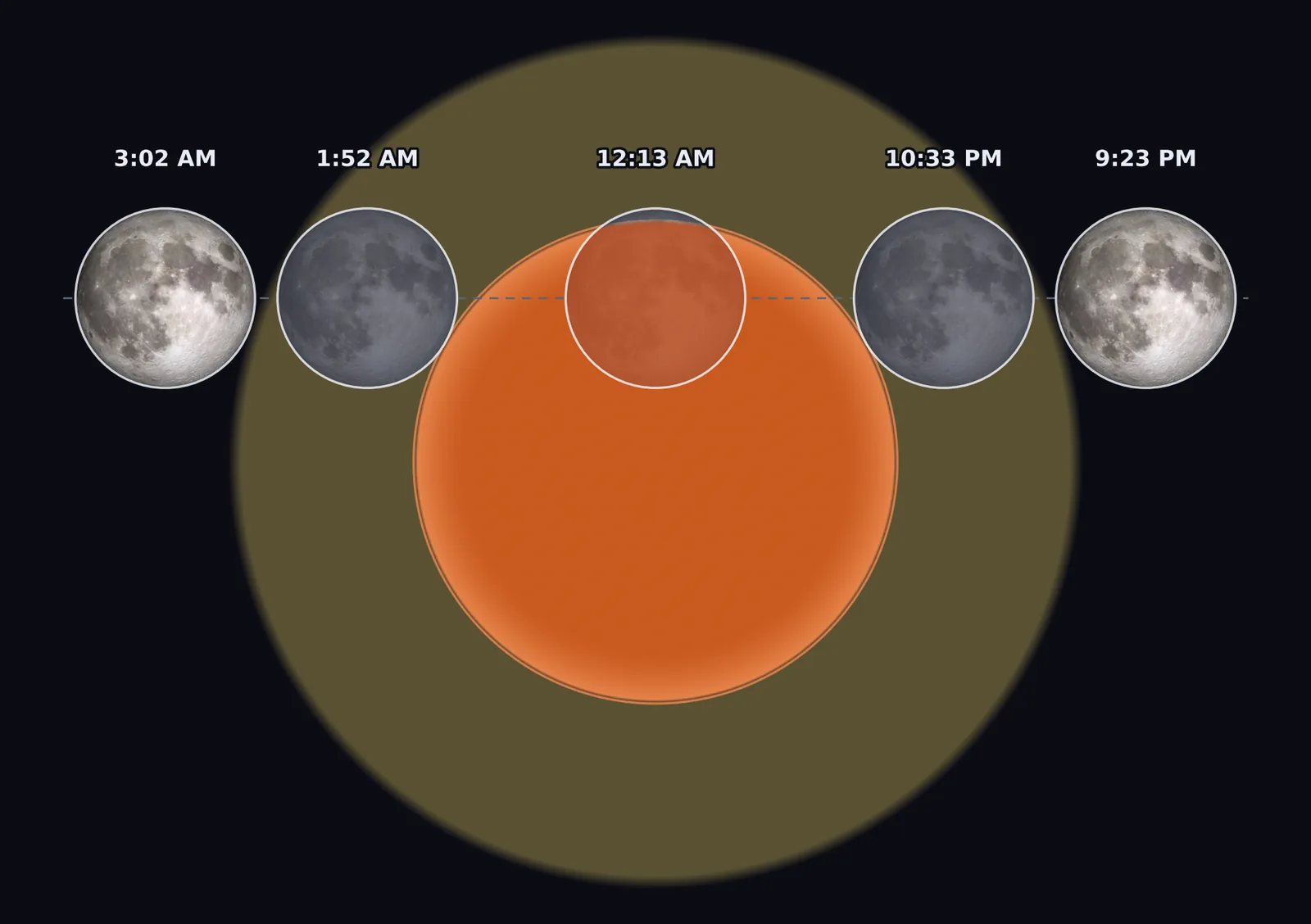
All times below are Eastern Daylight Time, corrected to Fred Espenak’s EclipseWise.com predictions for this eclipse (his figures are the ones NASA’s own eclipse pages defer to):
| Time (EDT) | Event | Moon’s position from North Adams |
|---|---|---|
| 9:23 PM, Aug. 27 | Penumbral phase begins | ~19° alt, southeast |
| 10:33 PM, Aug. 27 | Umbral (partial) phase begins | ~28° alt, southeast |
| 12:13 AM, Aug. 28 | Maximum eclipse (93–96% covered) | ~36° alt, south |
| 1:52 AM, Aug. 28 | Umbral (partial) phase ends | ~36° alt, south-southwest |
| 3:02 AM, Aug. 28 | Penumbral phase ends | ~31° alt, southwest |
The Moon never gets anywhere near the horizon during this eclipse from our latitude. No hilltop or clear-horizon spot required; a reasonably open view to the south/southeast is enough.
Observing Visually
The full event — first penumbral shading to last — runs 5 hours 39 minutes, but the part worth losing sleep over is the 3-hour-19-minute umbral phase in the middle, when the darkening is unmistakable to the naked eye. The penumbral phase on either side of that is real but subtle: in the 15–20 minutes before the Moon touches the umbra, watch the edge of the Moon that will enter the shadow first for a faint gray-brown softening — it’s easy to miss if you’re not already looking for it, and easy to see in hindsight once the obvious darkening starts.
As the eclipse deepens toward maximum, watch the full Moon’s usual glare fade enough for fainter stars to reappear near it — the eclipsed Moon this month sits in Aquarius, in a comparatively faint part of the sky it normally washes out completely.
Binoculars, Telescopes, and Smart Scopes
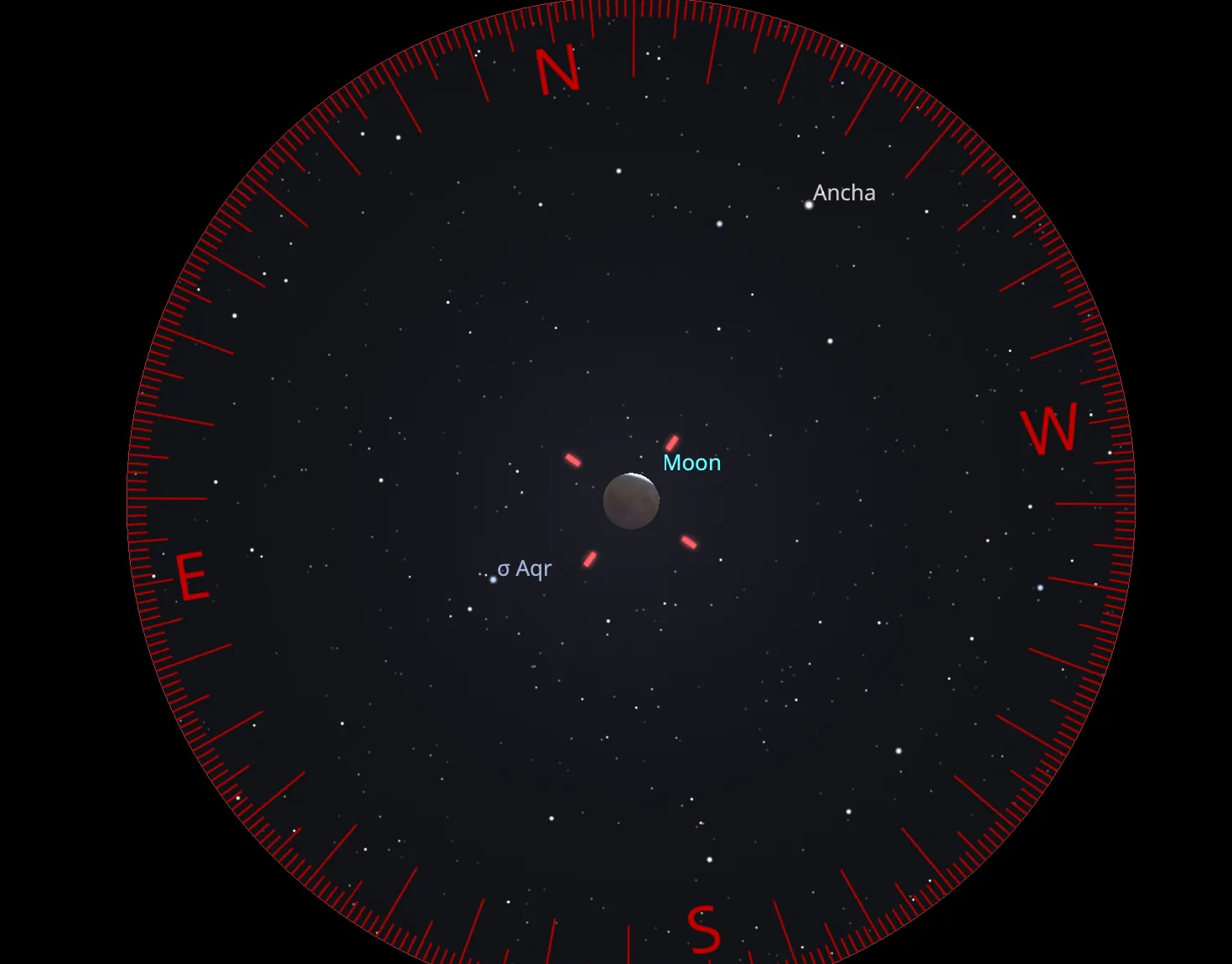
None of this needs equipment, but each step up adds something different. Binoculars pull in the eclipse’s color more vividly than the naked eye and frame the whole Moon comfortably in one low-power view — good for watching the reddening deepen and the surrounding stars reappear as the glare fades. A small telescope adds something neither the naked eye nor binoculars can: at low-to-moderate power, you can watch the umbra’s edge visibly creep across individual craters and highlands over the course of a few minutes, rather than just noticing sometime later that the Moon looks different now.
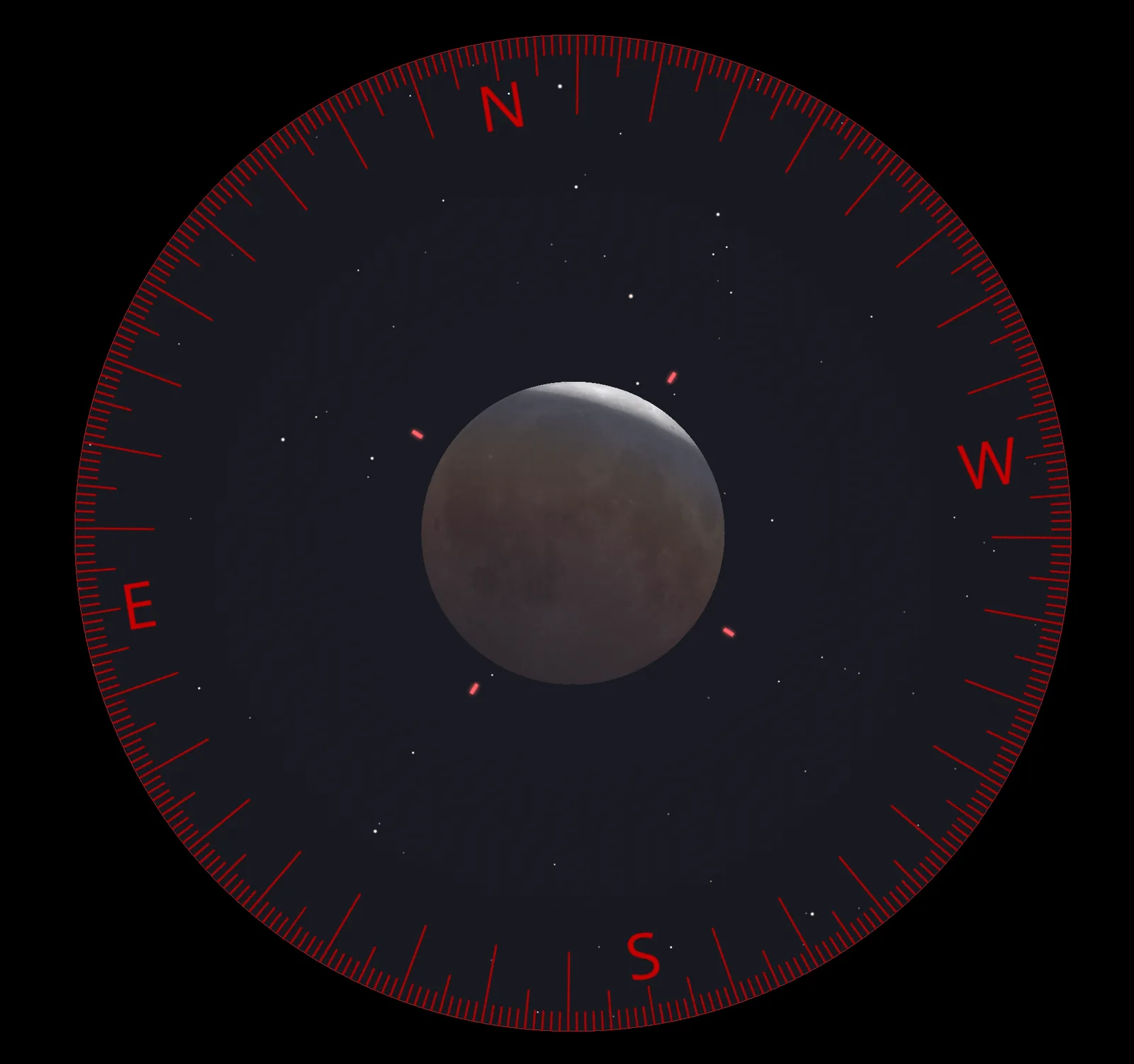
Smart scopes can shoot it too, but turn off aggressive auto-stretch or live-stacking for this one — a single reasonably-exposed frame preserves the reddening far better than a stack that’s fighting to brighten a dimming, moving target.
No Equipment Required
This is about as low a technical barrier as astronomy gets: no telescope, no drive to a dark sky, no special timing beyond being outside and looking up. Just a Moon, a shadow, and however long you want to stand there and watch one slide into the other.
That’s worth sitting with for a second. Nearly 96% of the Moon disappearing into a deep red-orange glow is one of the more dramatic things the sky does, and it asks nothing of you beyond showing up — no equipment to buy, no technique to learn, nothing standing between you and the same experience people have been having since long before anyone understood why the Moon does this. If tonight is your first real astronomical “event,” this is a good one to start on.
If you want to mark the calendar for next time: the next total lunar eclipse fully visible from North Adams isn’t until June 26, 2029 — and it’s worth the wait. At 1 hour 41 minutes of totality, it’s set to be the longest, darkest total lunar eclipse of the entire 21st century. This August’s eclipse isn’t a placeholder for that one, though. It’s its own real event, happening this month, and it doesn’t need a telescope, a road trip, or three more years to be worth watching.