
Introduction
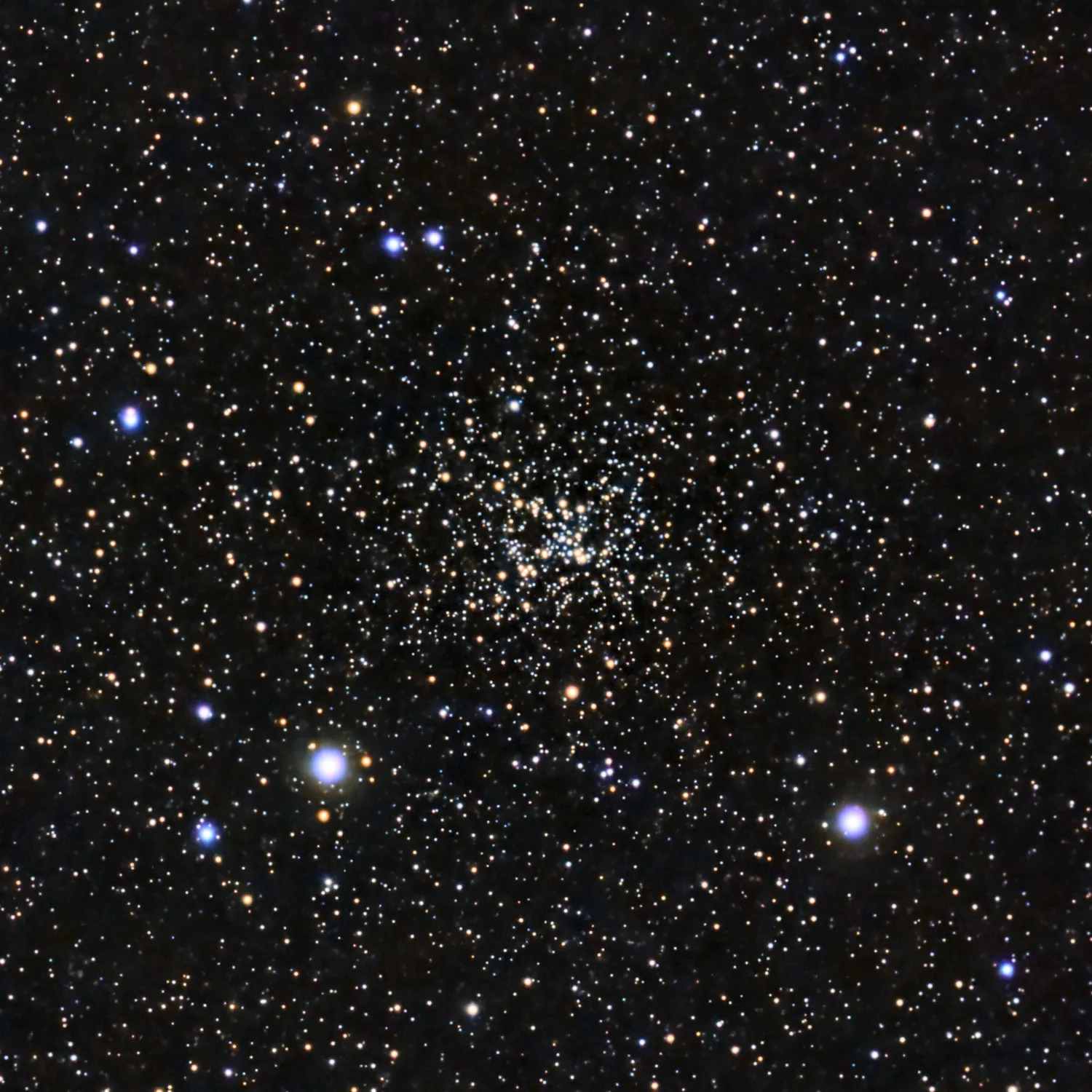
NGC 6819 doesn’t look like much through a small telescope – a faint, compact haze in Cygnus that takes some aperture to resolve into anything interesting. But between 2009 and 2013, this unremarkable-looking cluster sat in the unblinking gaze of the Kepler space telescope for four straight years, and what came out of that data turned it into one of the most useful star clusters in the galaxy for understanding how stars actually age.
Four years of uninterrupted starlight on a cluster this size turns up a lot: a direct, measured number for how much mass a star loses on its way to becoming a giant, a working census of the cluster’s pulsators and eclipsing binaries, and – tucked in among all of it – one star whose mass still doesn’t add up, more than a decade after anyone first noticed.
Discovery

An Old Cluster in Kepler’s Unblinking Eye
Stars, like bells, ring. Not literally – but the gas inside a star sloshes and resonates in patterns driven by convection and pressure waves, and those internal oscillations show up as tiny, rhythmic flickers in a star’s brightness. Measuring those flickers precisely enough to learn something is called asteroseismology, and it requires exactly what most stars never get: a telescope staring at the same spot, without interruption, for a long time.
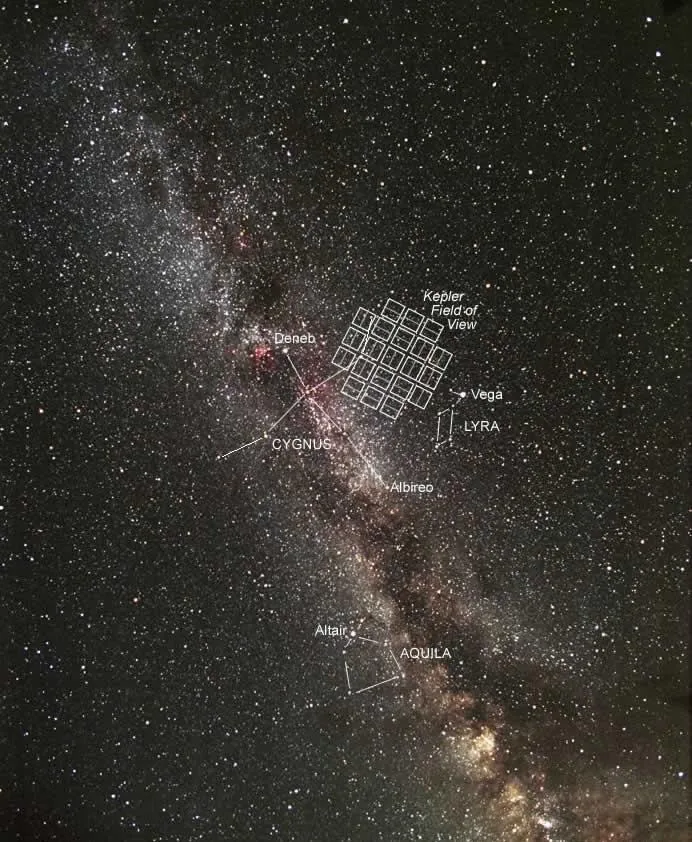
That comparison produced a genuinely useful result. Stars on their way up the red giant branch came out slightly heavier, on average, than stars that had already passed through the “red clump” phase further along in their evolution – about 1.61 solar masses versus 1.64. That’s not surprising in itself; stars shed mass as they age. What was valuable is that this gave astronomers a direct, measured number for how much a Sun-like star actually loses on its way through the red giant branch, checked against independent cluster-based estimates rather than theory alone. It’s the kind of unglamorous, foundational measurement that quietly makes better models possible.
That’s the headline result. It’s far from the only thing four years of nonstop data turned up.
Everything Else Kepler Found
NGC 6819’s real value was volume: thousands of stars in the field, monitored continuously, with nothing to interrupt the record. That’s enough to catalog a cluster’s oddities, not just its averages.
Several of the cluster’s blue stragglers – stars that sit above the main-sequence turnoff, looking younger than the rest of the cluster has any right to be – turned out to pulsate, and a 2023 study caught it on camera: rapid flickering in some, slower rippling in others. Blue stragglers are already a minor puzzle on their own – the leading explanations are mass transfer from a companion or an outright stellar collision – and having their pulsations on record gives astronomers another way to test which story holds up for each one.
The same photometry turned up a working population of eclipsing binaries – pairs of stars orbiting closely enough that each one blocks the other’s light on a predictable schedule. At least seven confirmed contact binaries – pairs so close they’re touching, sharing a single stretched envelope between them – were identified within the cluster’s boundaries, on top of a broader haul of pulsating, spotted, and rotating stars turned up across the field.
Meanwhile, a completely different technique produced an independent check on the cluster’s age. Hubble Space Telescope imaging traced NGC 6819’s white dwarfs down to the faint end of their cooling sequence – essentially timing how long these stellar embers have been cooling off – and came back with an age of 2.25 ± 0.20 billion years (Bedin et al. 2015), matching the 2.25 ± 0.30 billion years derived separately from the main-sequence turnoff. Two different clocks, built on completely different physics, agreeing this closely is itself a quiet confirmation that the models are on the right track.
One Star That Still Doesn’t Fit
Not everything added up cleanly. One of the cluster’s red giants, catalogued as KIC 4937011, came back from the asteroseismology measurements at just 0.71 solar masses – nearly a full solar mass lighter than the cluster’s other red-clump stars, which average around 1.64. A star of such low mass shouldn’t reach this evolutionary stage for roughly another 26 billion years – longer than the universe has existed. The leading explanation, from a 2024 study (Matteuzzi et al.), is a wrecked companion: a smaller star got pulled inside KIC 4937011’s outer layers and was destroyed there, and the resulting drag stripped away roughly a solar mass of the giant’s own envelope in the process. It isn’t fully settled – the same study flags real open questions about the star’s exact history – but it’s a reminder that even in a cluster where every star’s age should be a known quantity, one star can still turn up with a past that doesn’t match its neighbors.
Finding and Observing NGC 6819
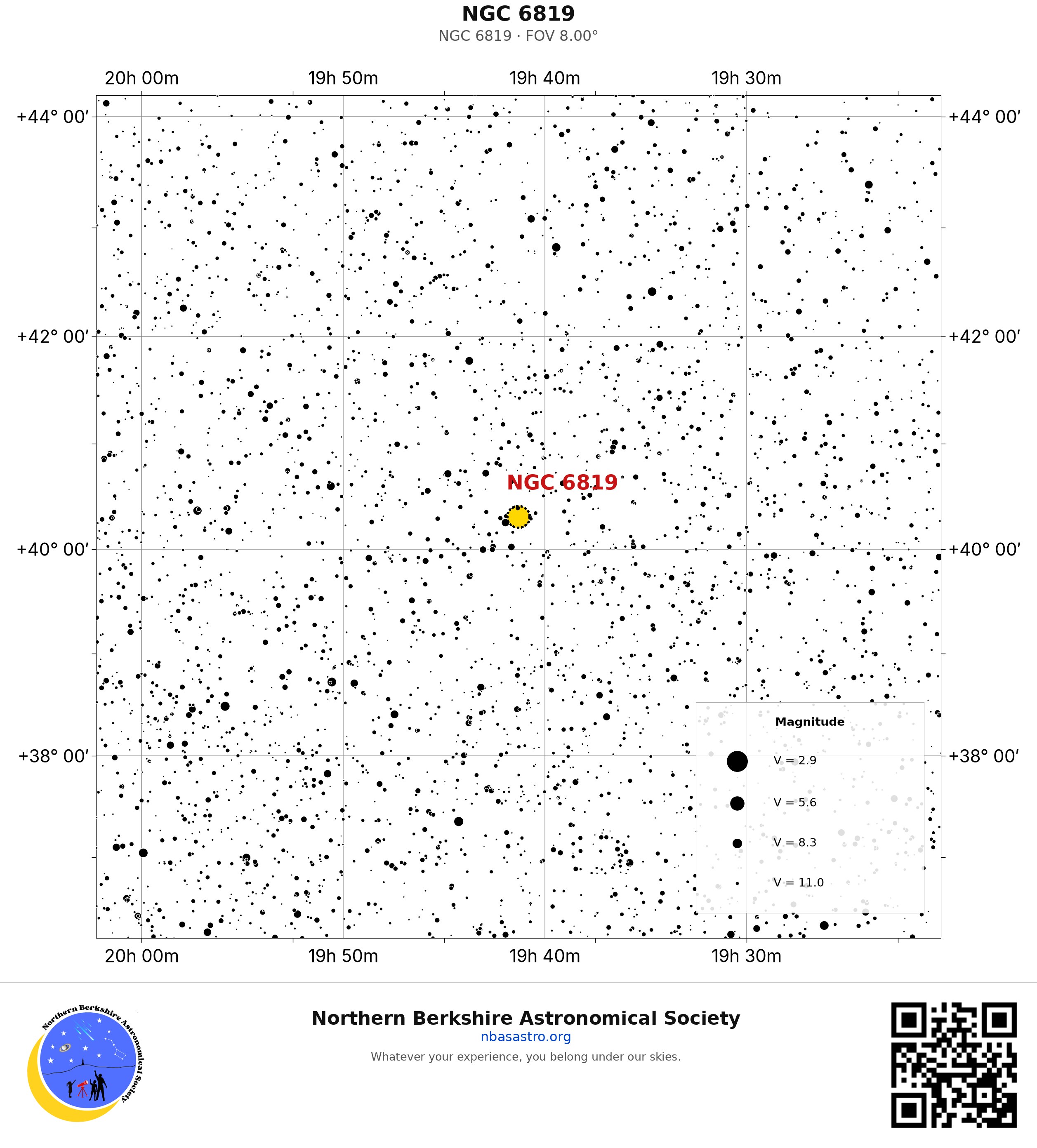
NGC 6819 sits in Cygnus, roughly 8° west-southwest of Sadr (γ Cygni) and about 2° from the open cluster M29 – both useful jumping-off points if you’re star-hopping. It rides high overhead from mid-northern latitudes on late-summer and early-fall evenings, which makes timing easy even if the object itself isn’t.
Be honest with your expectations here. At magnitude 7.3 it sounds like it should be an easy target, but that number is deceptive: the cluster is old, compact, and made up of stars that are individually faint and closely packed, so small scopes mostly show a soft, unresolved glow rather than a field of stars. An 8-10 inch telescope starts to break it apart; 12-14 inches under a dark sky will resolve two or three dozen stars and start to reveal the loose, fox-head-shaped pattern that gave the cluster its informal nickname. This isn’t one of the quick, obvious showpiece clusters – it rewards aperture and a little patience more than most.
Cygnus sits in the thick of the summer Milky Way, so NGC 6819 has to compete with an unusually dense field of background stars – more clutter than most clusters face. In practice it holds up well: even a short smart-scope exposure, like the one at the top of this article, pulls the cluster out as a distinct, recognizable clump rather than just more stars in a crowded field.
Whatever you’re using to look at it, it’s worth remembering what you’re actually looking at: the same 2.4-billion-year-old collection of stars that Kepler watched, unblinking, for four years – stars whose masses, pulsations, and eclipses are now on record in more detail than almost any other cluster in the sky, including one star in there whose past still doesn’t quite add up.