
Introduction
As we get to know the sky, we take the 88 constellations pretty much for granted — but fewer than half come from ancient mythology, and there wasn’t an official list at all until the International Astronomical Union fixed one in 1922. It had to: two centuries of competing star atlases had piled up well over a hundred rival “constellations” (Bode’s 1801 Uranographia alone depicts over 100), most of them built from stars Ptolemy had left “unformed” in the Almagest, or added by mapmakers filling gaps once European navigators started charting southern skies. The habit of using those leftover stars to flatter the powerful is almost as old as the gaps themselves — Ptolemy himself describes Antinous, raised into the sky by the Emperor Hadrian, right there in the Almagest.
The ten constellations below are the concentrated version of that habit: a roughly hundred-year run, 1678 to 1789, when astronomers wanting a rebuilt observatory, a royal appointment, or just goodwill built a scepter, a sword, an oak tree, or a monogram out of unclaimed stars and dedicated it to whoever might notice. None of it was subtle, and none of it survived the IAU’s 1922 cut — except Scutum, which made it through for reasons that have nothing to do with why it was drawn in the first place.
Robur Carolinum
Charles’s Oak — Edmond Halley, 1678 (published 1679), honoring King Charles II of England. Absorbed into Carina.
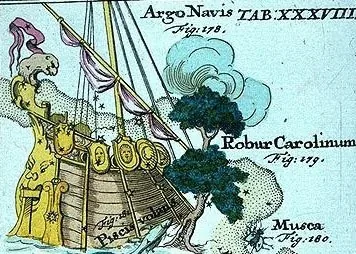
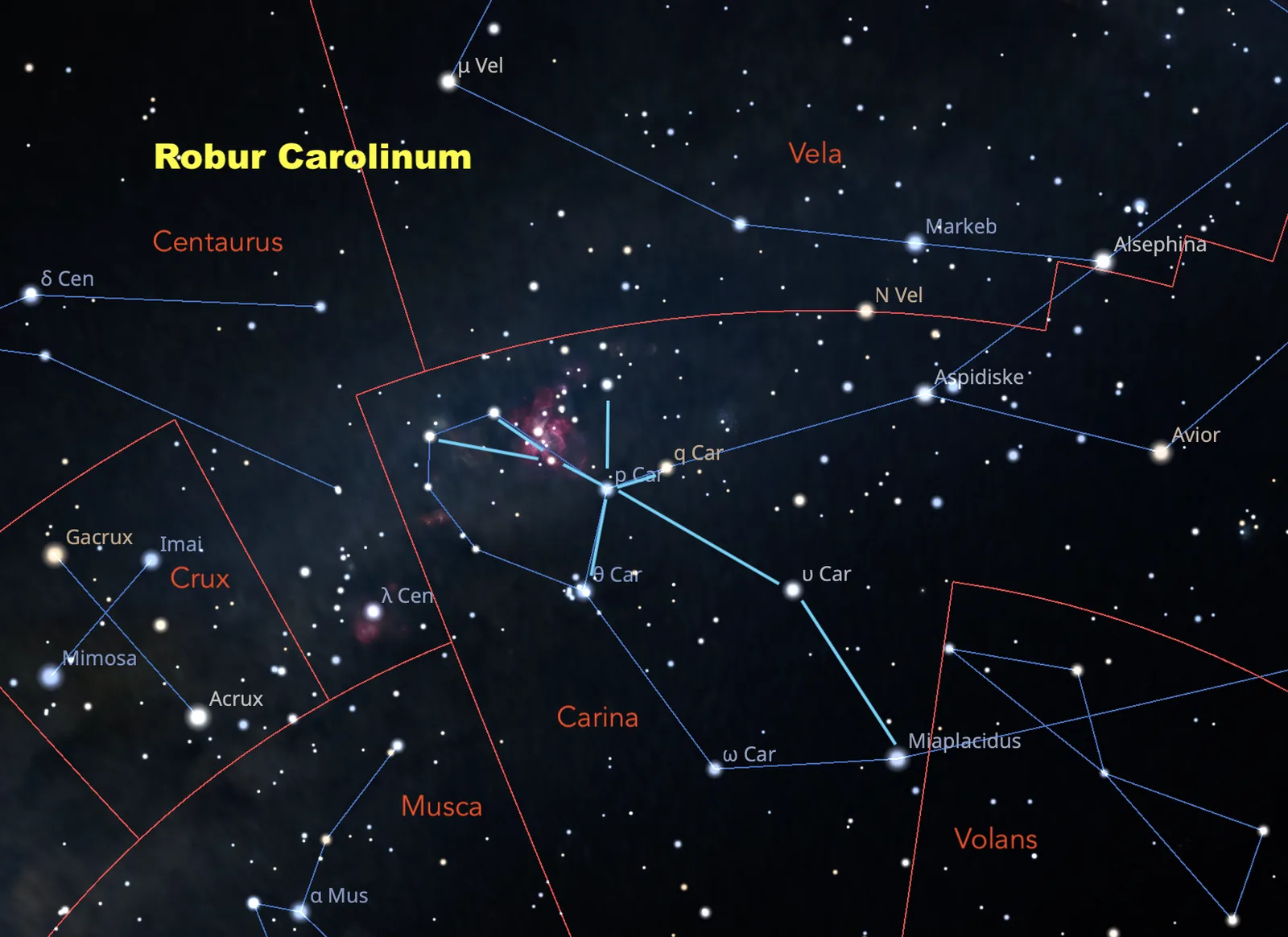
Edmond Halley invented this one in 1678, fresh off a two-year expedition to the island of St Helena to catalog the southern sky — the same trip that produced his Catalogus Stellarum Australium (1679), where Robur Carolinum first appeared in print. He built it from stars carved out of Argo Navis, the enormous ship constellation that would later be broken up permanently by Lacaille. The oak commemorated the real tree at Boscobel House in which Charles II hid after his defeat at the Battle of Worcester in 1651, during his escape from Oliver Cromwell’s forces.
The brightest star, in the tree’s roots, is the second-magnitude star now called Beta Carinae — Miaplacidus, magnitude 1.7. Halley’s fourth-listed star, among the branches, turned out to be Eta Carinae, the famous eruptive variable; his catalog is the first known record of it, though nobody at the time knew that’s what they were looking at.
Halley called it a “perpetual memory” of the king. It lasted about seventy-five years. Lacaille, remapping the southern sky far more rigorously in the 1750s, disapproved of Halley carving up Argo for nationalistic reasons and left the oak out. Most astronomers followed Lacaille’s lead — except Johann Bode, who kept it in his 1801 Uranographia as “Robur Caroli II.” Even that couldn’t save it long-term.
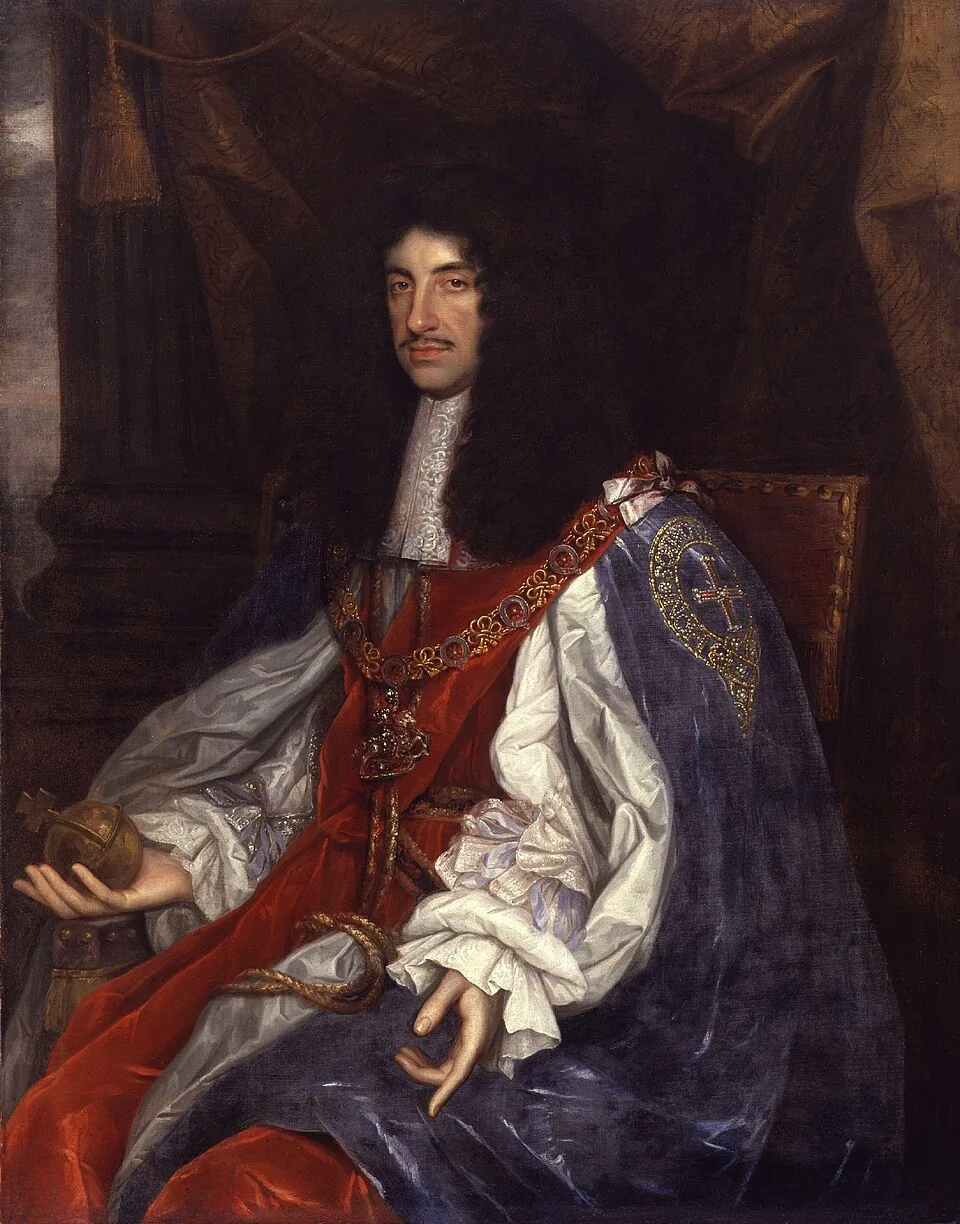
The astronomer: Edmond Halley (1656–1742) is best known today for the comet, but at 22 he was already sailing to the South Atlantic to fill in the gaps in the era’s star catalogs — nobody had systematically mapped the far-southern sky before.
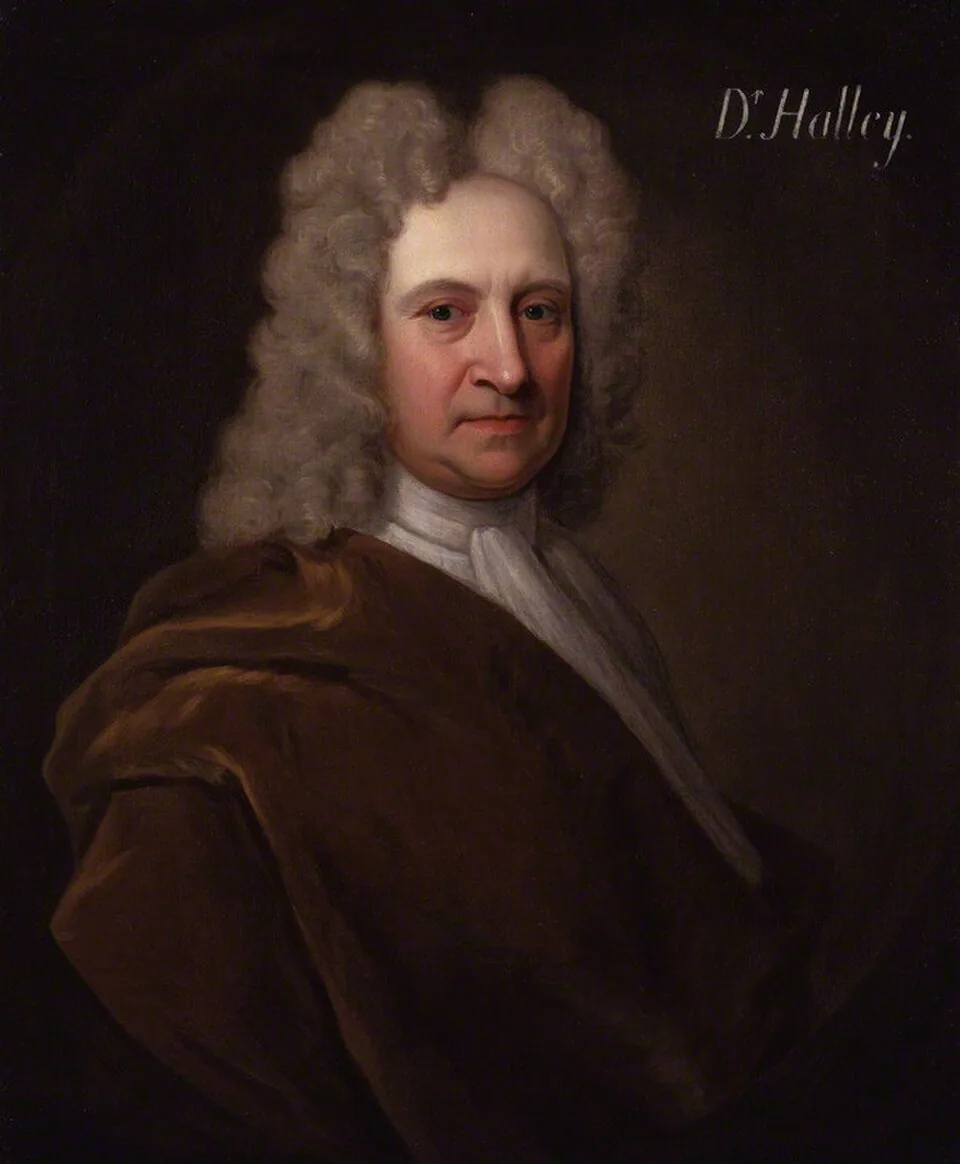
The honoree: Charles II (1630–1685) spent a day hiding in the Boscobel oak before escaping to exile in France; the tree became a Restoration-era symbol strong enough that Halley was still using it as a tribute nearly three decades after Charles took the throne.
Sceptrum (et Manus Iustitiae)
The Scepter (and Hand of Justice) — Augustin Royer, 1679, honoring King Louis XIV of France. Absorbed into Lacerta.
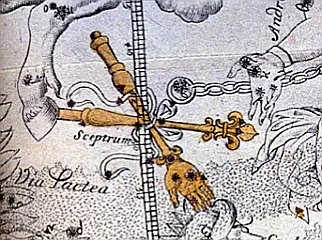
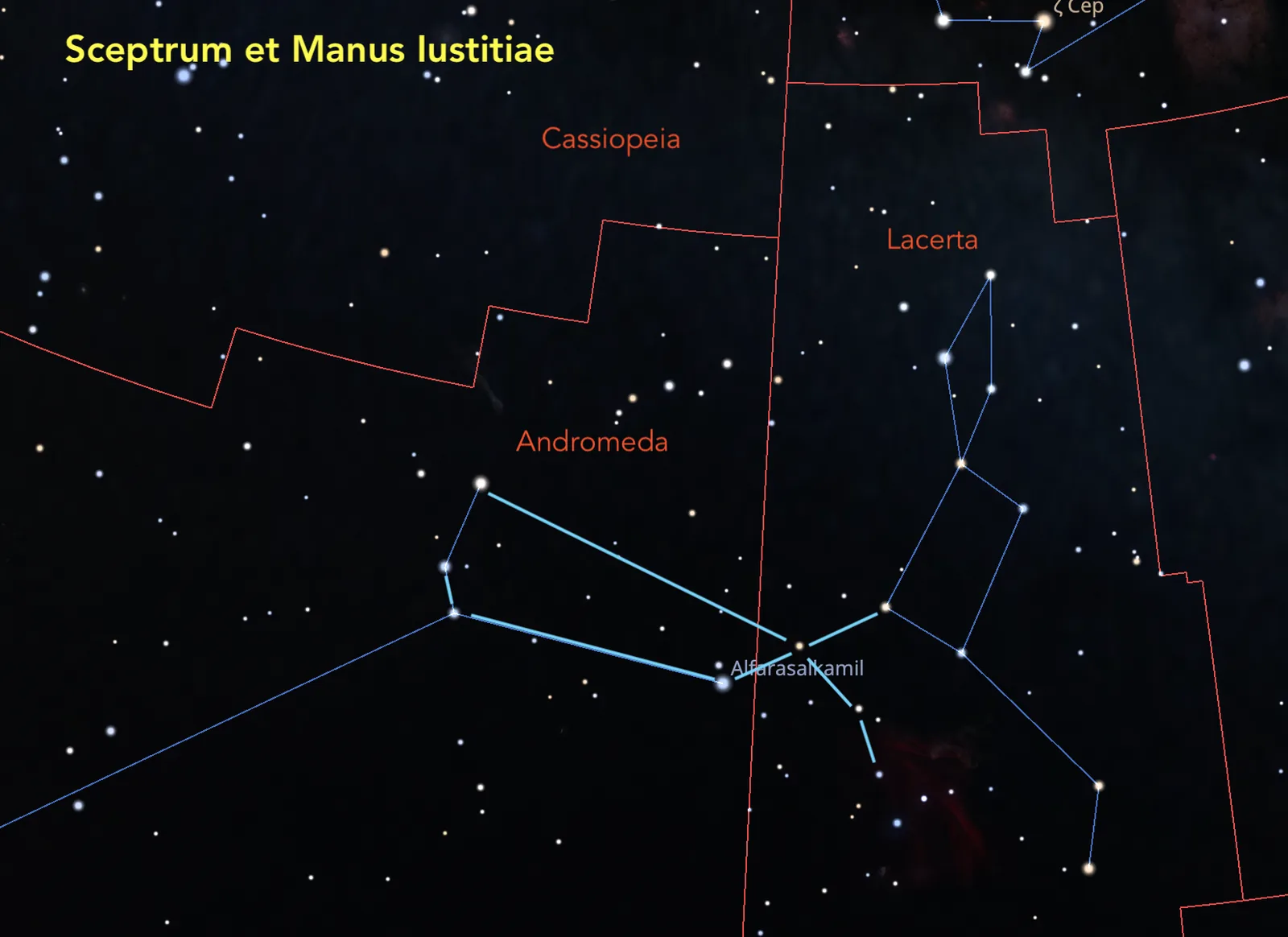
One correction before anything else: the elaborate Latin name usually attached to this constellation — Sceptrum et Manus Iustitiæ — was never used by Royer himself. Ridpath traces it to Julius Staal’s 1988 book New Patterns in the Sky; Royer’s own 1679 catalog and chart simply call it Sceptrum, though his introductory notes describe it in both Latin and French as representing the French royal scepter and the ceremonial Hand of Justice.
Royer, a French architect and astronomer about whom almost nothing else is known — even Ridpath lists his life dates as unknown — published it on a chart in his Cartes du Ciel réduites en quatre tables (1679), listing seventeen component stars of 4th to 6th magnitude. He noted, not at all subtly, that the constellation “passes through the zenith of the residence of our great monarch and the capital of his States” — directly over Paris and Versailles. It didn’t help: Sceptrum never caught on, and within a few years the same patch of sky was claimed by Hevelius’s Lacerta, which is what absorbed it.
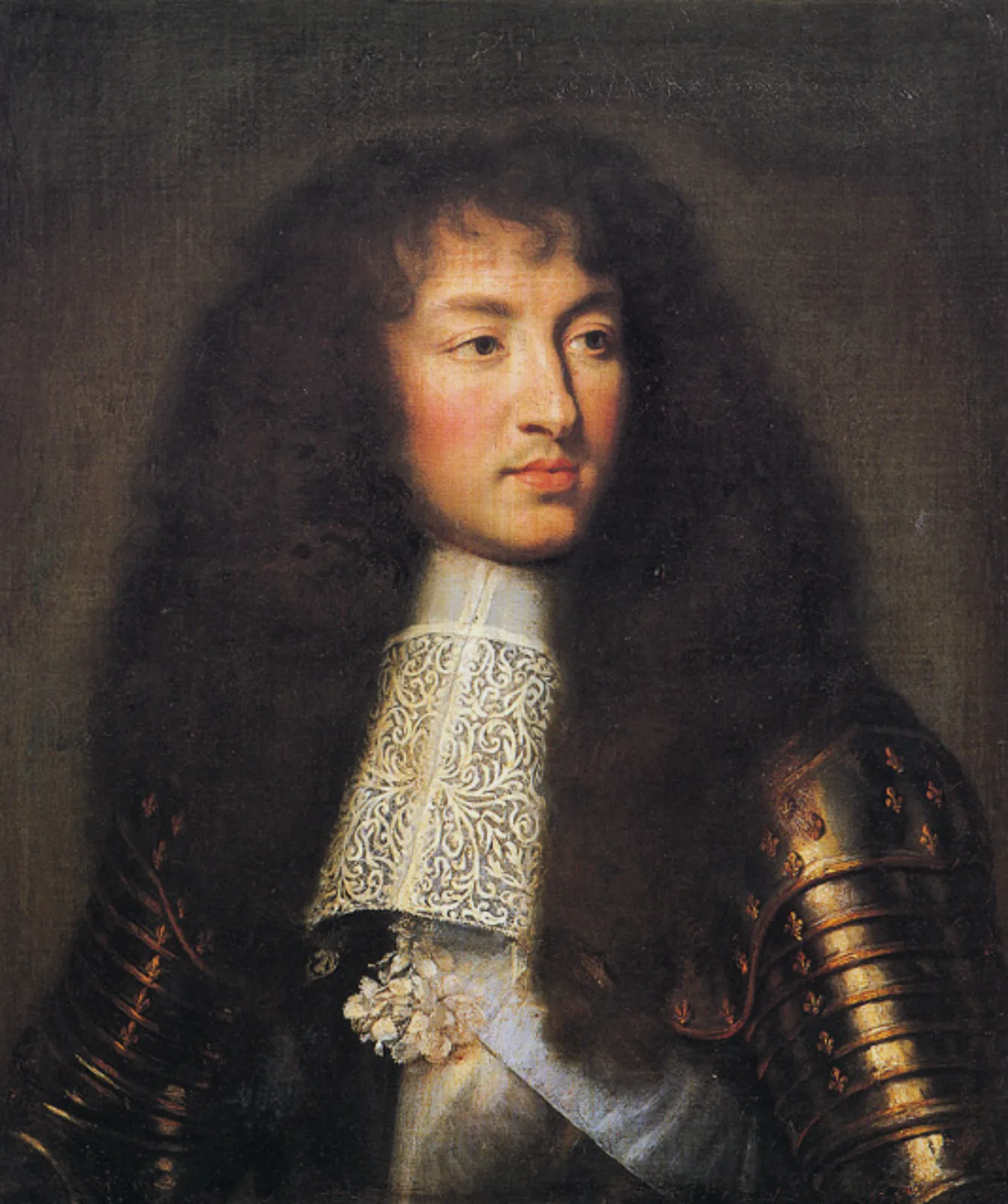
The astronomer: Augustin Royer — dates unknown, occupation architect, one known constellation to his name.
The honoree: Louis XIV (1638–1715), the Sun King, needs no introduction — but it’s worth noting Royer’s Sceptrum arrived at the height of Louis’s power, the same decade construction finished at Versailles.
Gladii Electorales Saxonici
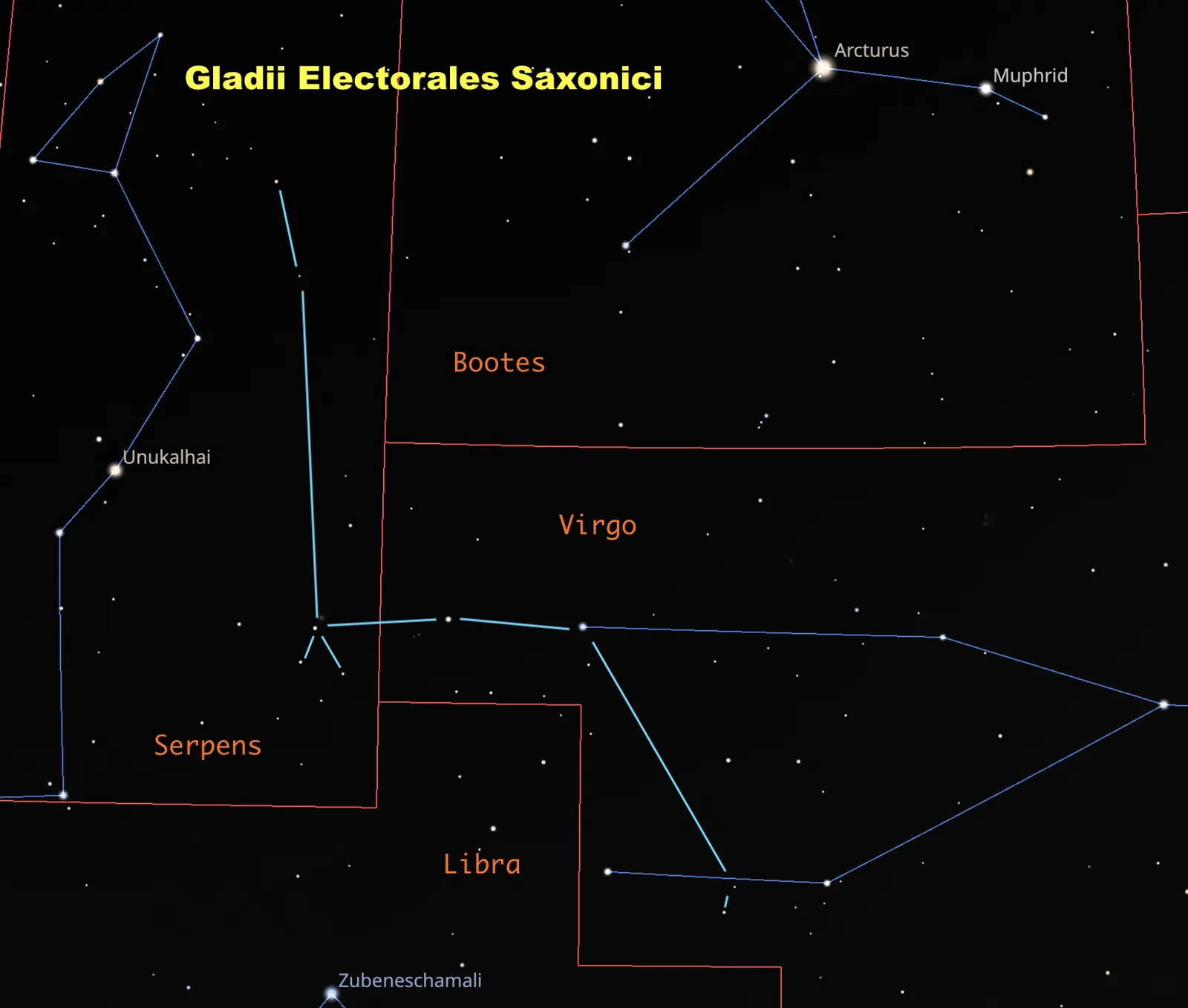
The Saxon Electoral Swords — Gottfried Kirch, 1684, seeking the patronage of Johann Georg III, Elector of Saxony. Absorbed into Virgo and Serpens, right at the Boötes border.
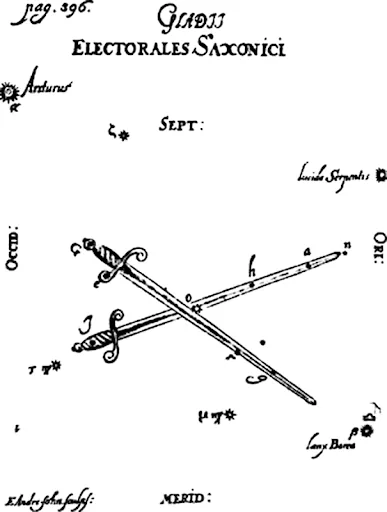
German astronomer Gottfried Kirch introduced this constellation — a pair of crossed ceremonial swords — in 1684 as a fairly transparent bid for patronage. He hoped to win the favor of Johann Georg III, Elector of Saxony, by giving him a piece of the sky.
The star pattern consists of nine stars between magnitudes 3.7 and 5.2, bounded by Arcturus, Unuk al Hai, Zubeneschamali, Mu Virginis, and Tau Virginis. Finding this location is easy. Making Gladii Electorales Saxonici out of its stars is not — its brightest member is the unremarkable star we now call 109 Virginis.
Kirch’s chart appeared in the same August 1684 issue of Acta Eruditorum — the leading scientific journal of the day — as Johannes Hevelius’s own political invention, Scutum Sobiescianum. Two astronomers, in the same journal issue, independently trying the same trick on two different patrons.
This is the first of three constellations Kirch invented in his career — the other two, Pomum Imperiale and Sceptrum Brandenburgicum, follow next — and all three were political flattery pieces; he never attempted anything mythological or descriptive, unlike his contemporaries. Hevelius introduced 10 constellations, of which 7 survive today (Canes Venatici, Lacerta, Leo Minor, Lynx, Scutum, Sextans, Vulpecula); only Cerberus, Mons Maenalus, and Triangulum Minus were dropped. Bode is a different case again: his Uranographia depicts over 100 constellations, but nearly all of that is other people’s work, revived or renamed rather than invented — Bode himself only originated four, and none of those survived either. Kirch, by contrast, went 3 for 3 on royal flattery, and 0 for 3 on the IAU’s final list.
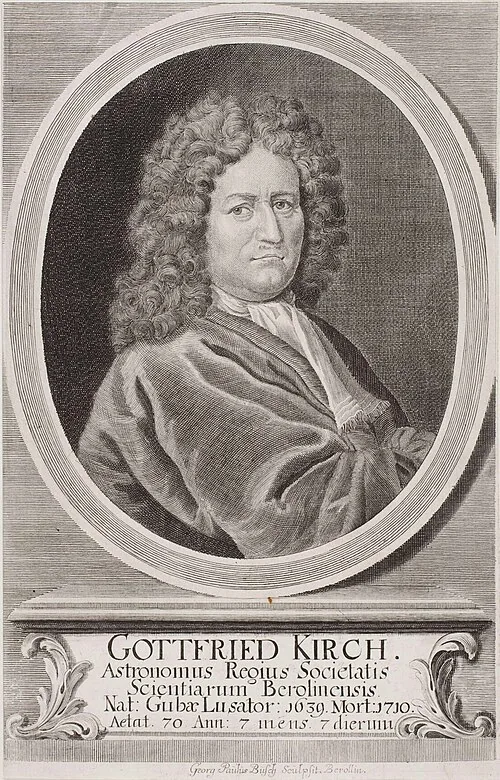
The astronomer: Gottfried Kirch (1639–1710) went on to become the first director of the Berlin Observatory and the Prussian/Brandenburg royal astronomer, appointed in 1700 by Frederick III — the same elector he was still courting with Sceptrum Brandenburgicum.
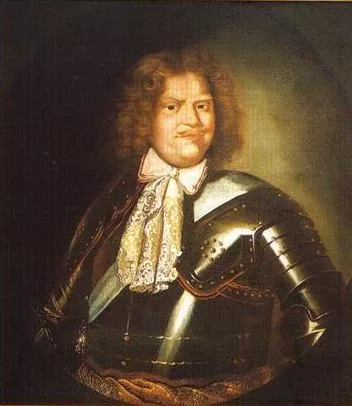
The honoree: Johann Georg III, Elector of Saxony (1647–1691) — a military-minded elector who would go on to command Saxon troops at the Battle of Vienna in 1683, the year before Kirch’s tribute.
Pomum Imperiale
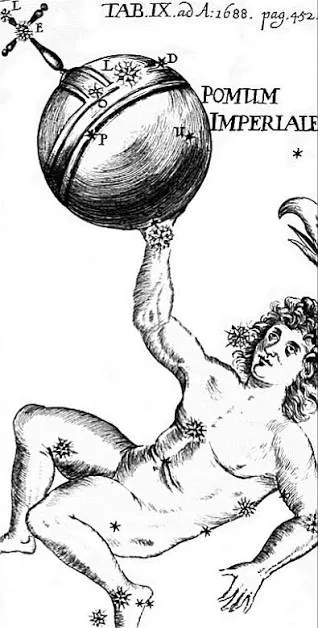
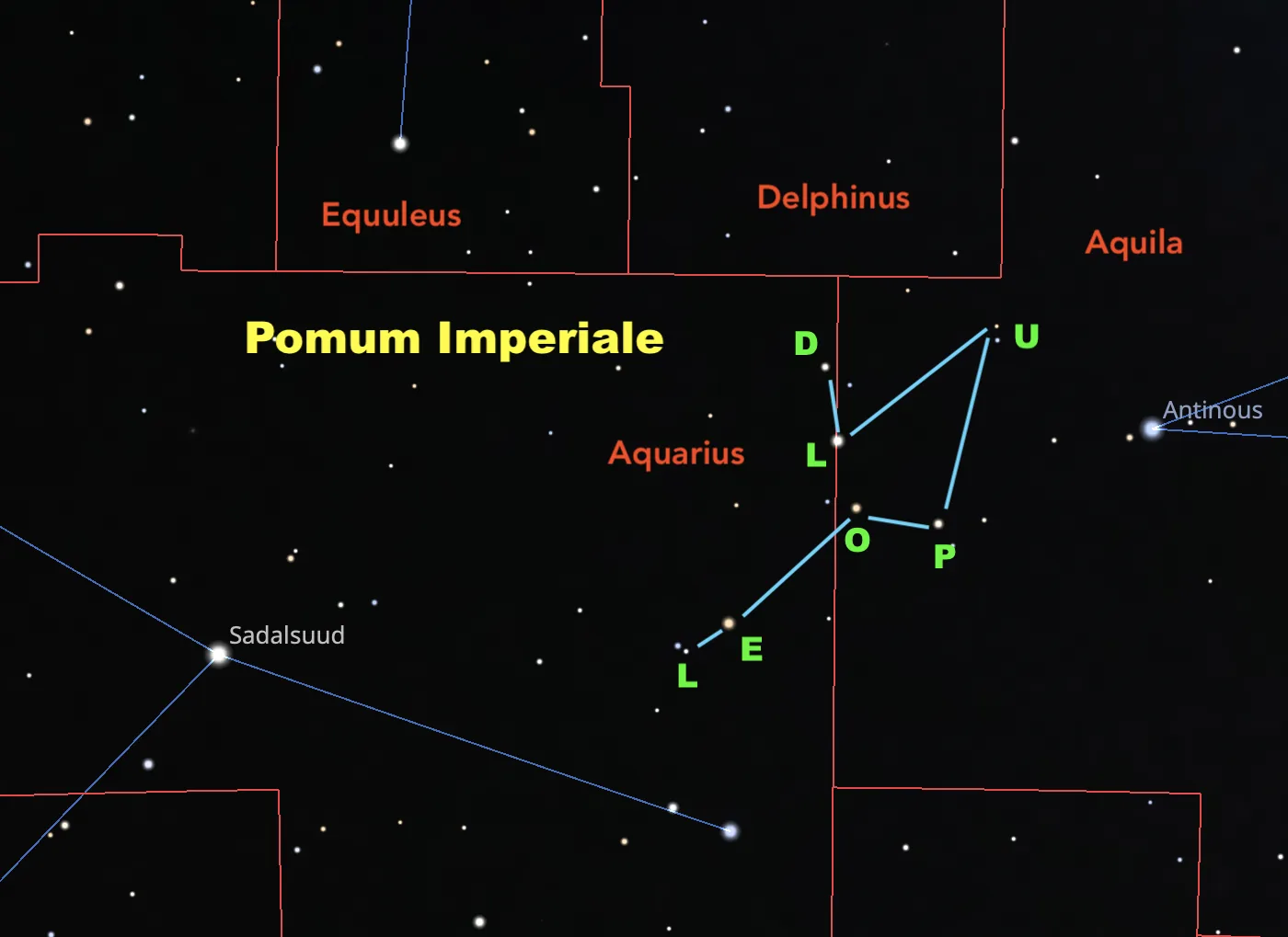
The Imperial Orb — Gottfried Kirch, 1688, honoring Leopold I, Holy Roman Emperor. Straddled the Aquarius/Aquila border; never revived, effectively extinct since publication.
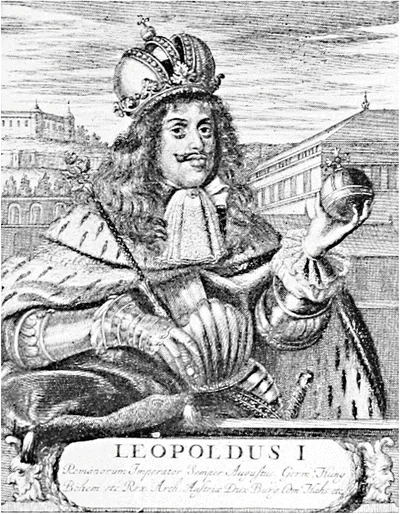
Kirch’s second political constellation, published four years after Gladii Electorales Saxonici, aimed higher: the Holy Roman Emperor himself, Leopold I. The imperial orb — a globe topped with a cross, standard regalia at Holy Roman coronations — sat on the border between Aquarius and Aquila, held aloft by a figure on the constellation Antinous. Antinous is itself an ancient forerunner of this whole practice: Emperor Hadrian raised it into the sky around the time Ptolemy was compiling the Almagest, to commemorate his own deified companion, drowned in the Nile in AD 130 — a genuinely different motive than anything else in this piece (nobody was currying favor with a living patron), but the same underlying impulse. It outlasted every constellation here, staying in general use into the 19th century before finally being reabsorbed into Aquila; in 2024 the IAU named its brightest star, Theta Aquilae, “Antinous.”
Seven stars, positioned around the orb, spell out the emperor’s name. Ridpath calls it “universally ignored” in its own time — nobody, including Bode, ever bothered reviving it. It’s as close to a constellation that never really existed outside one publication as this list gets.
The astronomer: Gottfried Kirch — see Gladii Electorales Saxonici above.
The honoree: Leopold I (1640–1705), Holy Roman Emperor for nearly 47 years — one of the longest reigns in the empire’s history, spanning the Great Turkish War and the outset of the War of the Spanish Succession.
Sceptrum Brandenburgicum
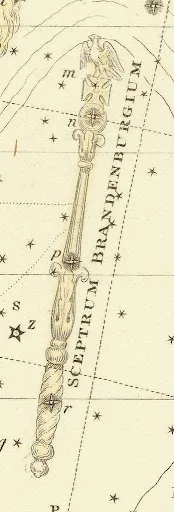
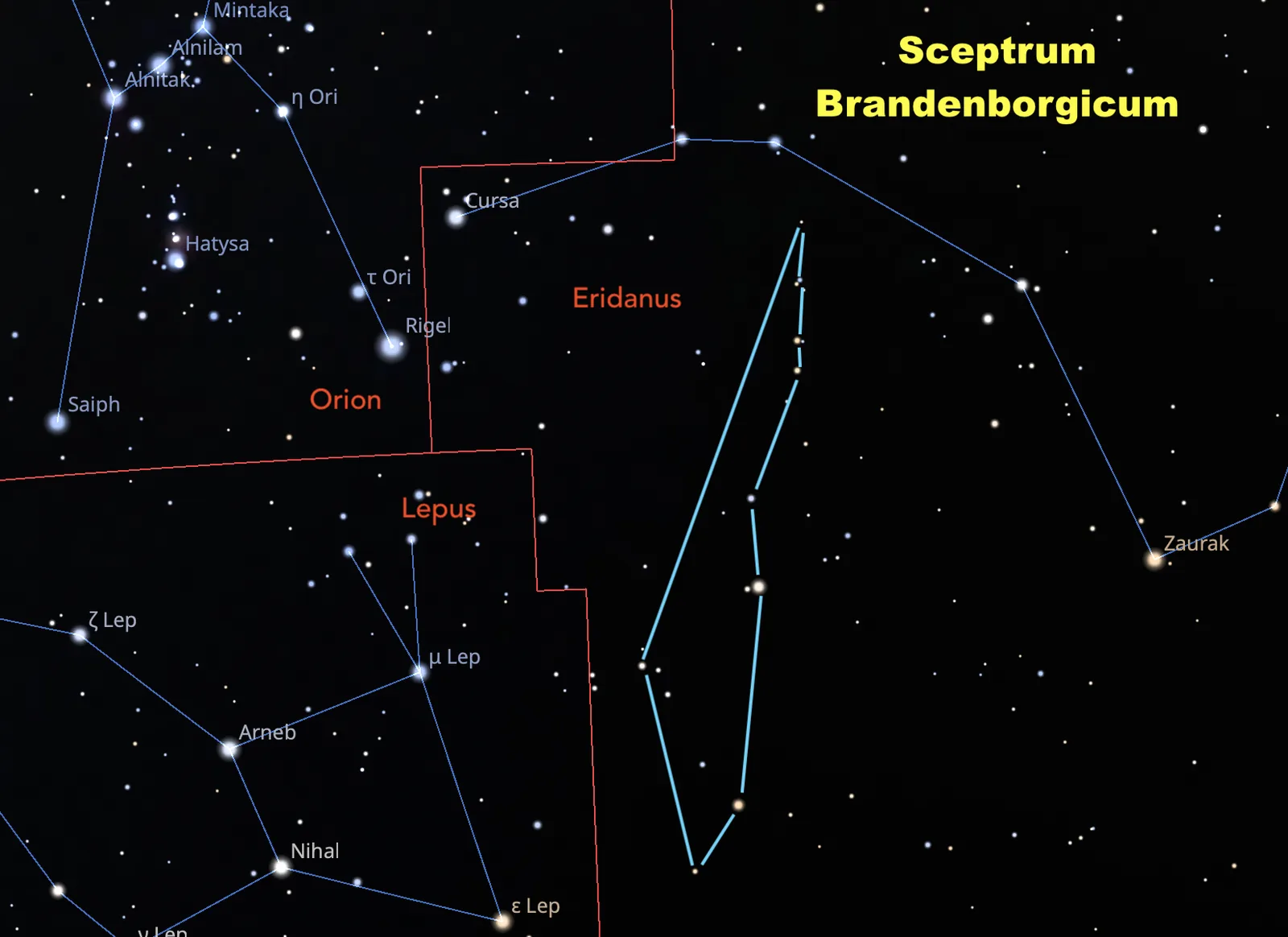
The Scepter of Brandenburg — Gottfried Kirch, 1688, honoring Frederick III, Elector of Brandenburg. Absorbed into Eridanus.
Kirch’s third and, unlike Pomum Imperiale, most successful bid for patronage. This one was a small, faint constellation near Eridanus and Lepus, built around five stars — but it worked. In 1700, Frederick III appointed Kirch astronomer to the newly founded Brandenburg Society of Sciences and made him the first director of its Berlin observatory. Whether or not the constellation itself was decisive, the tribute and the appointment line up.
Unlike Pomum Imperiale, this one had staying power on paper even after it stopped being taken seriously as a real constellation: Bode kept reviving it, including it in both his 1782 star atlas and the 1801 Uranographia.
The astronomer: Gottfried Kirch — see Gladii Electorales Saxonici above. This is the entry in the trilogy where the patronage bid actually paid off.
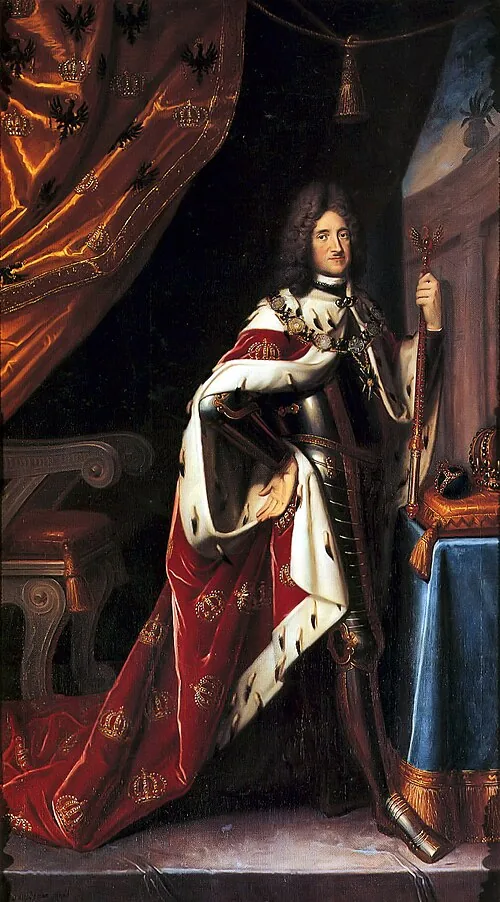
The honoree: Frederick III, Elector of Brandenburg (1657–1713) — who in 1701 crowned himself Frederick I, first King in Prussia.
Taurus Poniatovii
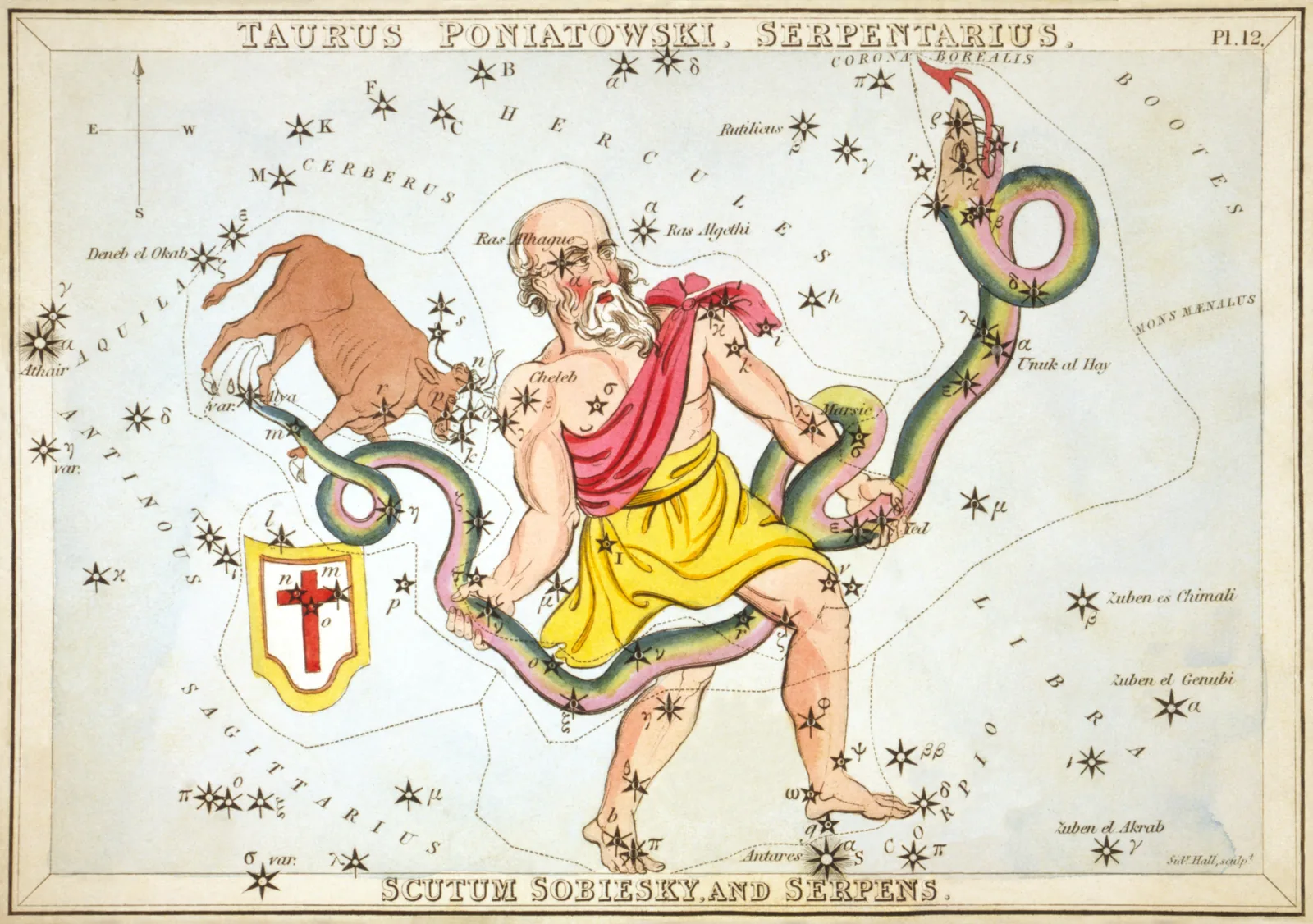
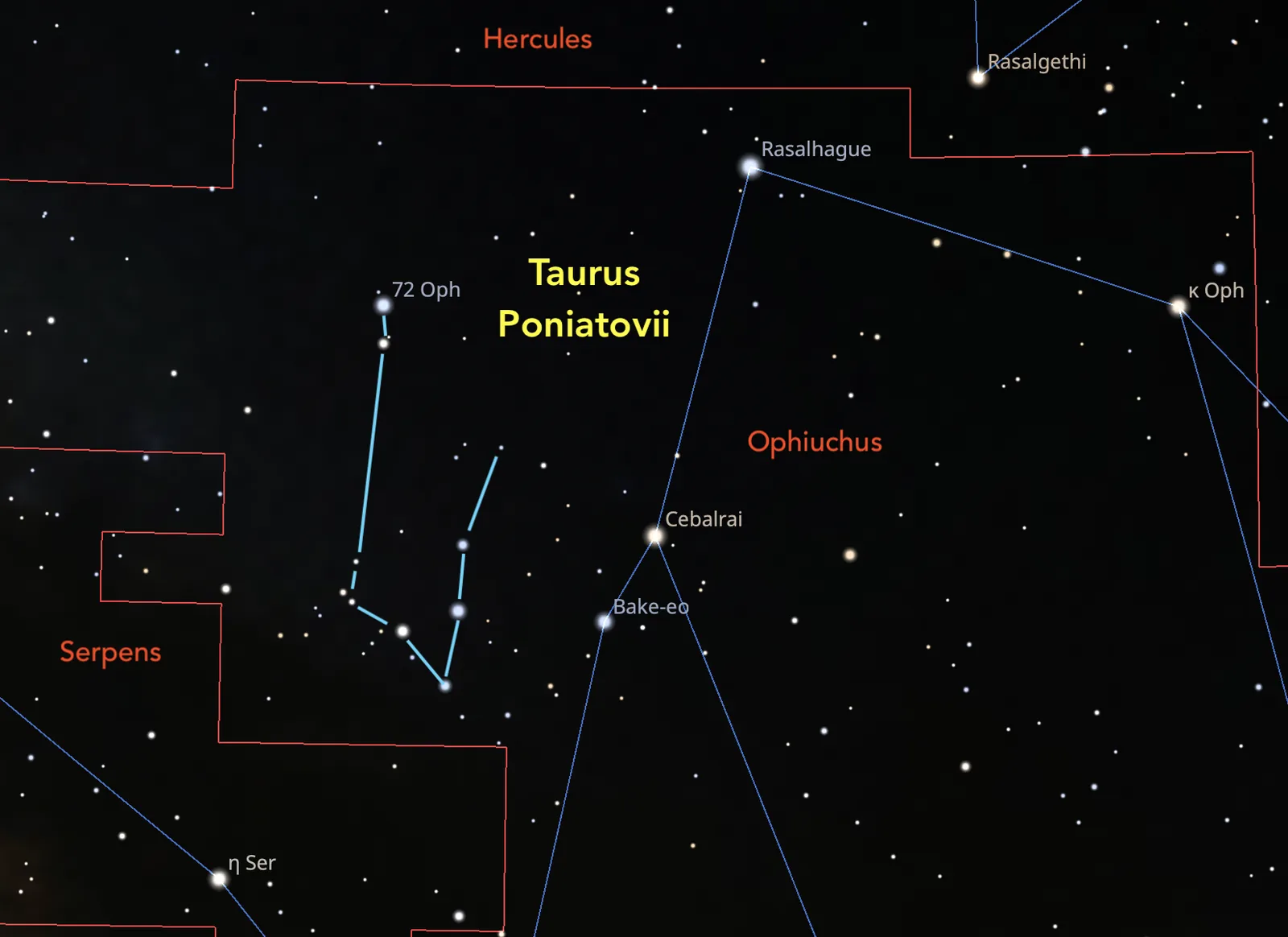
Poniatowski’s Bull — Marcin Poczobut, 1777, honoring King Stanisław August Poniatowski of Poland and Lithuania. Absorbed into Ophiuchus and Serpens Cauda.
A near-century gap separates this constellation from the Kirch pieces above — the fad went quiet for decades before picking back up in the 1770s and 80s. Marcin Poczobut, director of the Royal Observatory at Vilnius, built this one in 1777 to honor his king, Stanisław August Poniatowski — a noted patron of the arts and sciences whose family coat of arms actually featured a bull, giving Poczobut a built-in visual hook.

The bull’s face was a V-shaped group of stars wedged between Ophiuchus’s shoulder and the tail of Serpens — five of them had been listed by Ptolemy himself, nearly two thousand years earlier, as “unformed” stars not belonging to any constellation. They’re now known as 66, 67, 68, 70, and 72 Ophiuchi. Poczobut noticed the group resembled the Hyades, the cluster that forms the face of the real Taurus, and built the rest of the bull’s body from fainter stars around it.
The best trivia in this entire piece lives here: Poczobut had no way of knowing it, but his short-lived bull contained Barnard’s Star — the second-closest star system to the Sun, 5.9 light-years away — sitting in the bull’s head near present-day 66 Ophiuchi. E. E. Barnard wouldn’t discover its enormous proper motion until 1916, well after the constellation itself had been forgotten.
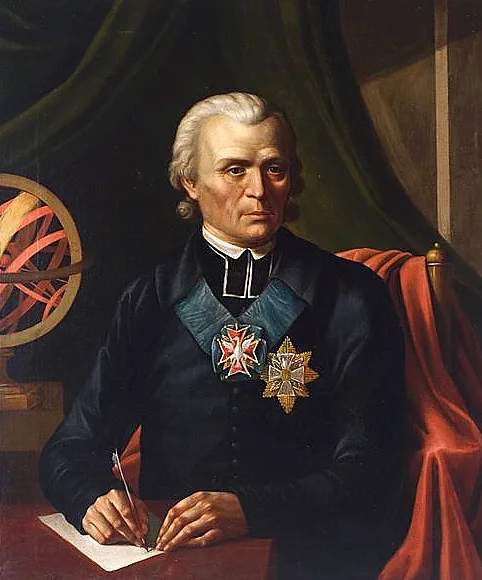
The astronomer: Marcin Poczobut (1728–1810), a Lithuanian-Polish Jesuit astronomer who directed the Vilnius observatory for decades.
The honoree: Stanisław August Poniatowski (1732–1798), the last King of Poland, a significant patron of the Polish Enlightenment.
Leo Palatinus
The Palatine Lion — Karl Joseph König, 1785, honoring Count Palatine Charles Theodore and Countess Palatine Elizabeth Auguste. Never widely adopted, and comparatively obscure even among this group.
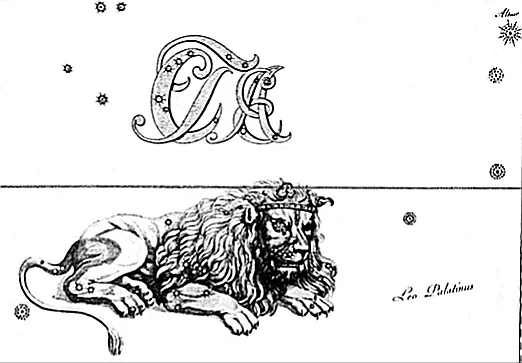
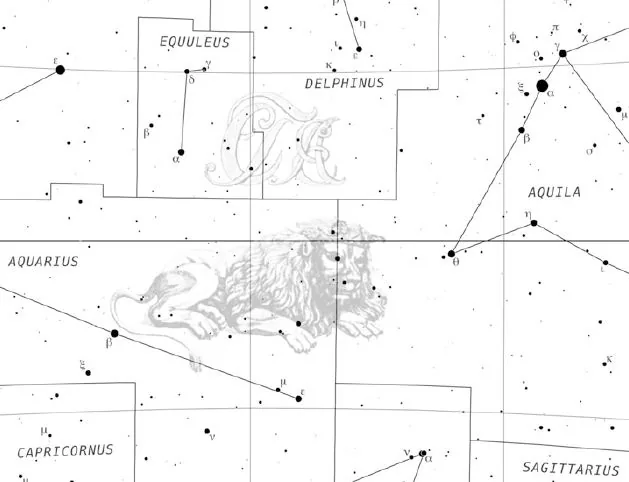
This one isn’t in Ridpath’s Star Tales obsolete-constellation chapter and doesn’t seem to have circulated much even in its own time. Karl Joseph König, working at the Mannheim observatory, split the honor across two disconnected star groups in 1785: a small crowned lion in northwestern Aquarius, and a separate monogram reading “CTEA” near Equuleus, standing for Charles Theodore and Elizabeth Auguste.
Unlike most of the entries here, this one appears never to have been picked up by a later atlas-maker — no Bode revival, no alternate depiction. What’s shown above is very likely the only image of it that was ever published.
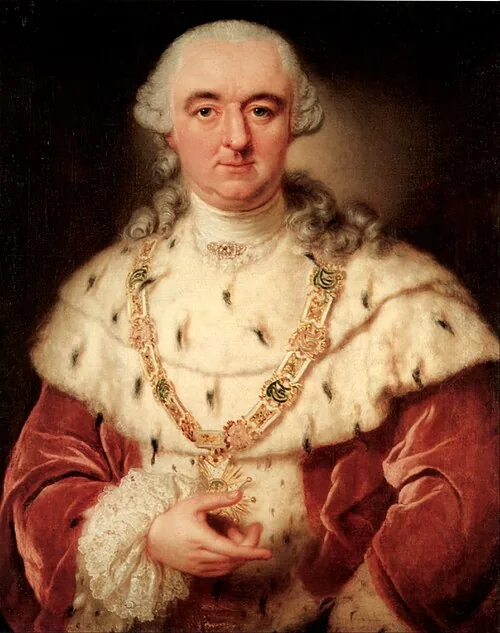
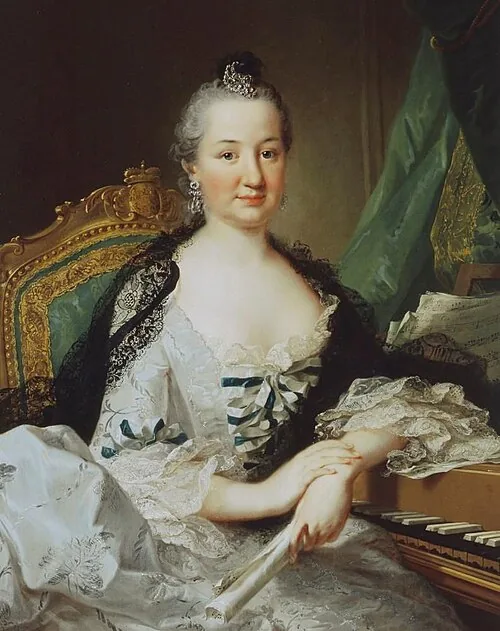
The astronomer: Karl Joseph König — comparatively obscure figure associated with the Mannheim observatory; biographical detail is thin.
The honorees: Charles Theodore, Elector Palatine (1724–1799) and his second wife, Countess Palatine Elizabeth Auguste — a rare case in this list of a constellation honoring a couple rather than a single monarch.
Honores Friderici (Gloria Frederici)
The Honors of Frederick — Johann Bode, 1787, honoring Frederick the Great of Prussia, who had died the year before. Absorbed into Andromeda, with stars also borrowed from Cassiopeia, Cepheus, and Pegasus.
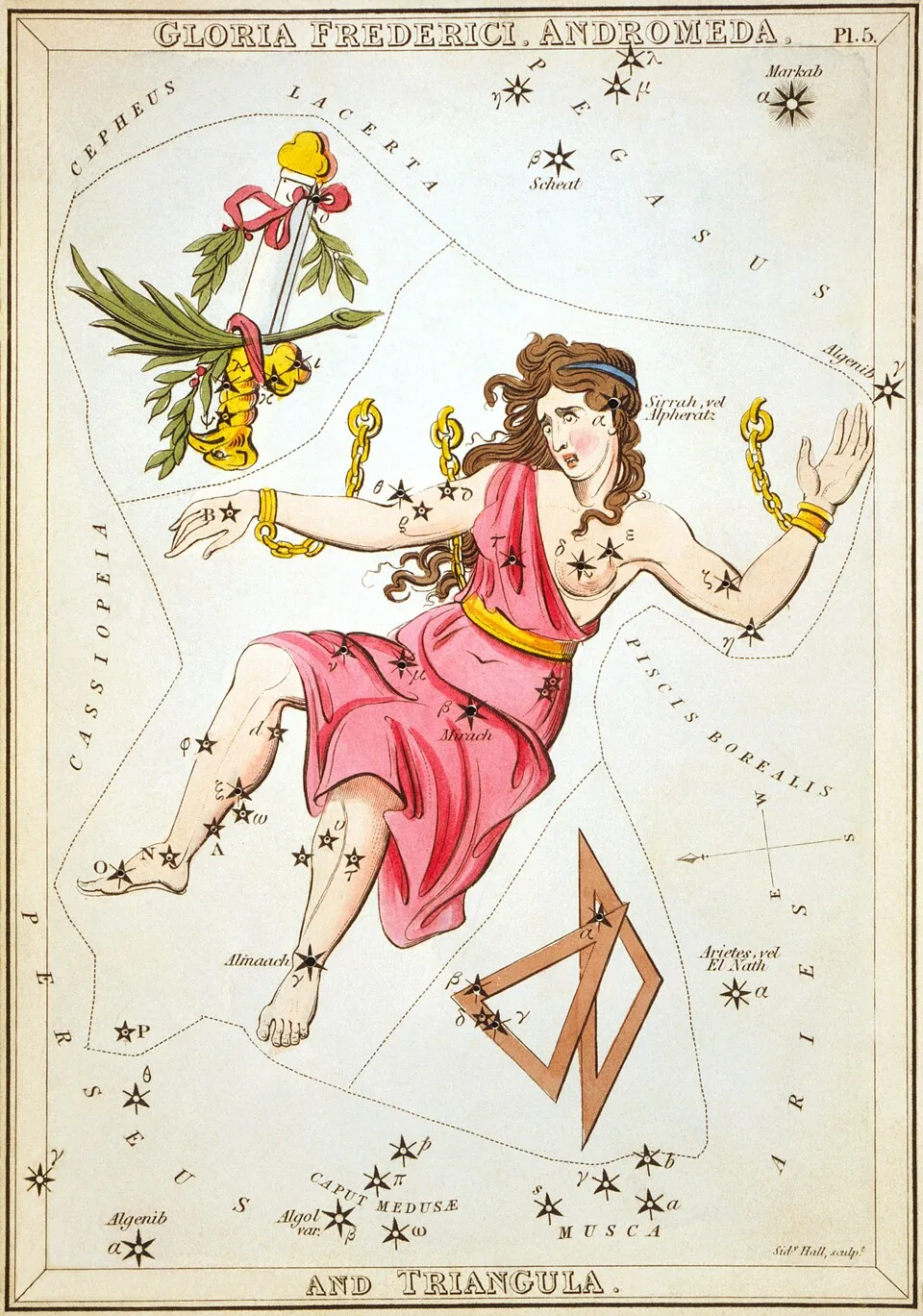
Unlike most of the entries here, this one is Bode’s own invention rather than a revival. He introduced it in 1787 to commemorate Frederick the Great of Prussia, first announcing it in his own Astronomisches Jahrbuch before formally Latinizing the name to Honores Friderici in his 1801 Uranographia. Other atlas-makers used variant names — Gloria Frederici (Alexander Jamieson) and Gloria Frederica (Elijah Burritt) — which is the naming variant that survives in the Urania’s Mirror card depicted above.
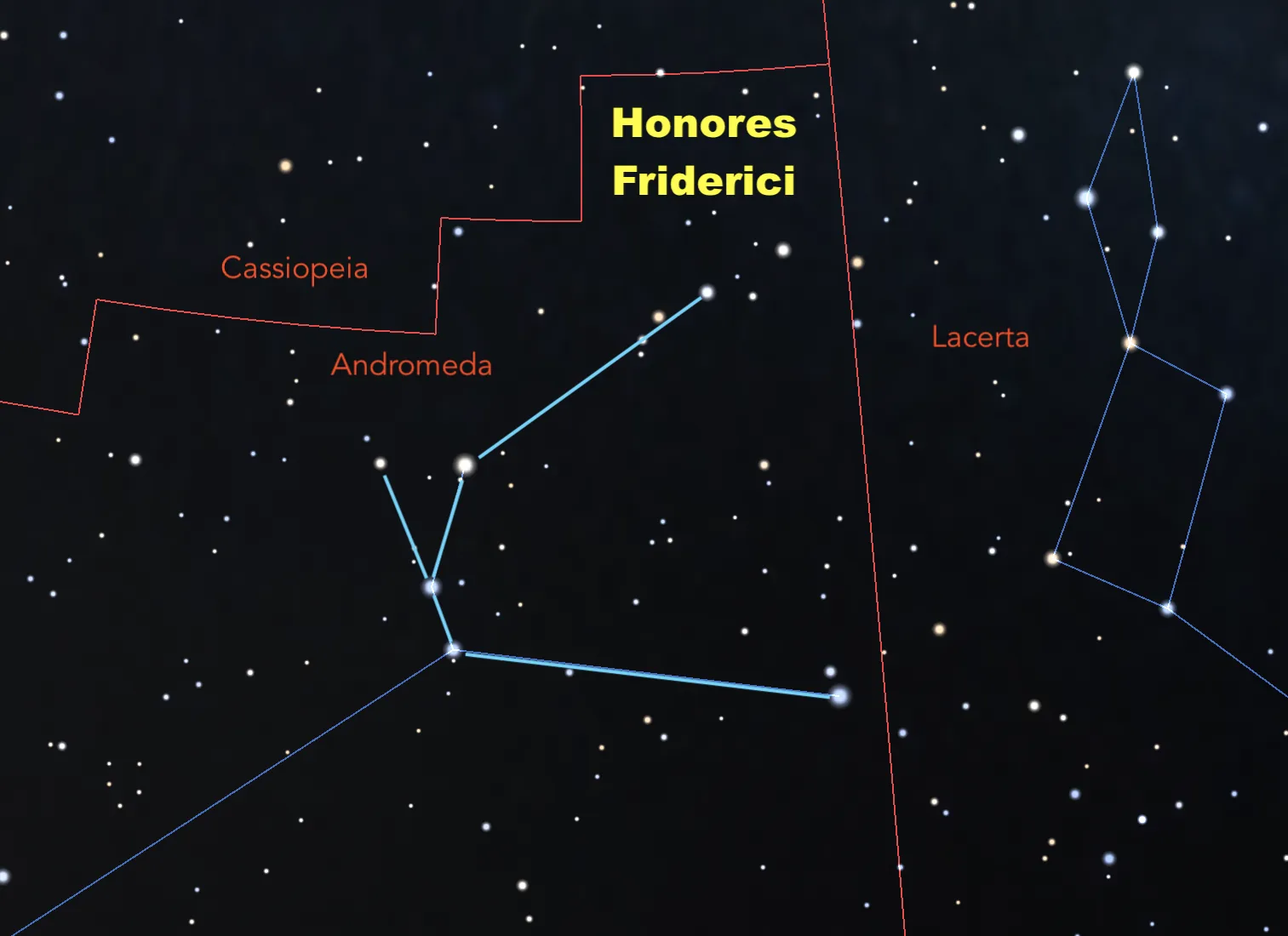
The figure combined a ceremonial sword wrapped in laurel, a quill pen, an olive branch, and a crown — sword for Frederick as a military hero, pen for his writing and patronage of philosophy, olive branch for peace. Most of its stars are now part of Andromeda; its brightest members are the modern Omicron, Lambda, and Kappa Andromedae, all 4th magnitude. In 2025 the IAU formally named the star 7 Andromedae “Honores,” because it falls in the feather of the constellation’s quill pen — the same kind of afterlife Antinous’s brightest star got a year earlier.
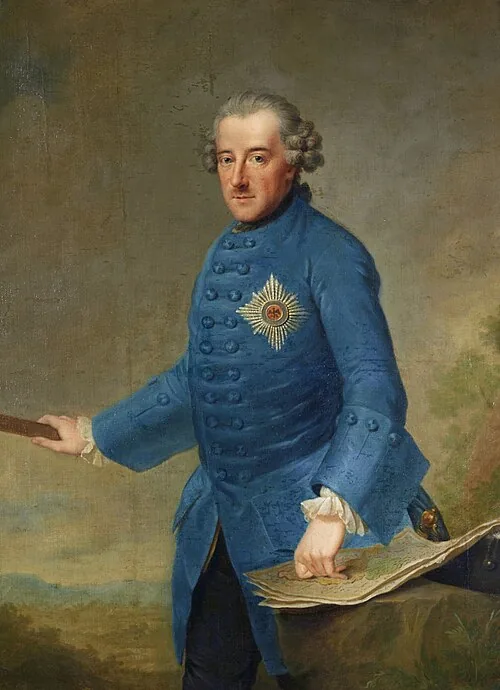
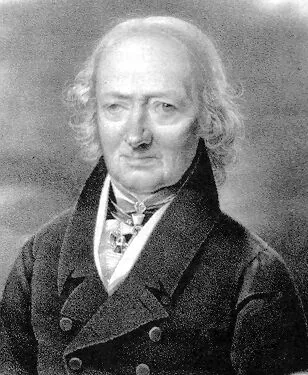
The astronomer: Johann Elert Bode (1747–1826), director of the Berlin Observatory — one of only four constellations he actually originated himself, as opposed to the 100-plus his Uranographia merely depicts (see Gladii Electorales Saxonici above for the tally).
The honoree: Frederick II (“the Great”) of Prussia (1712–1786) — one of the most consequential rulers of 18th-century Europe, a patron of the Enlightenment as well as a career military commander. Not to be confused with Frederick III/I above, his grandfather.
Psalterium Georgii (Harpa Georgii)
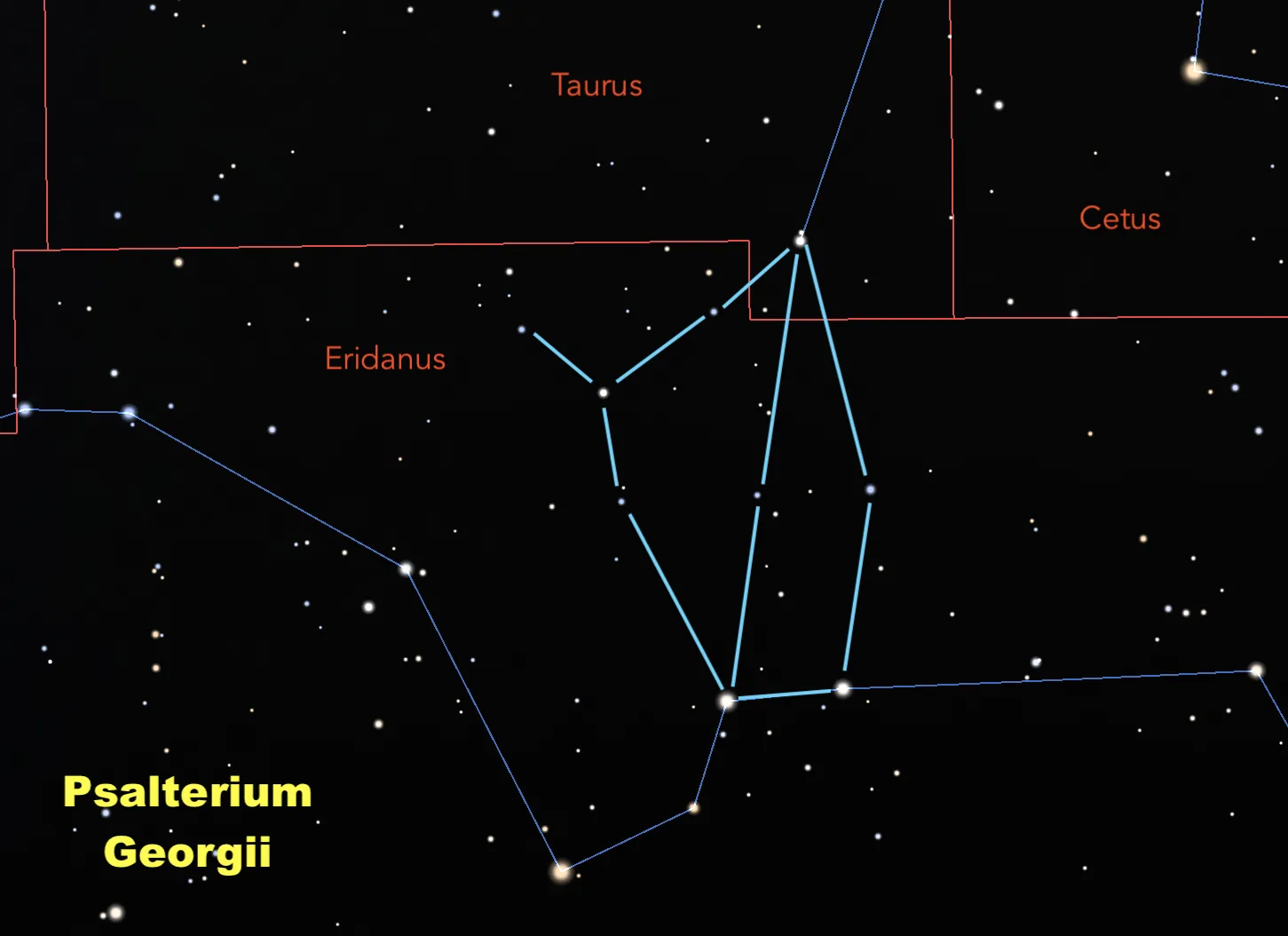
George’s Harp — Maximilian Hell, 1789, honoring King George III of Great Britain. Absorbed into Taurus and Eridanus.
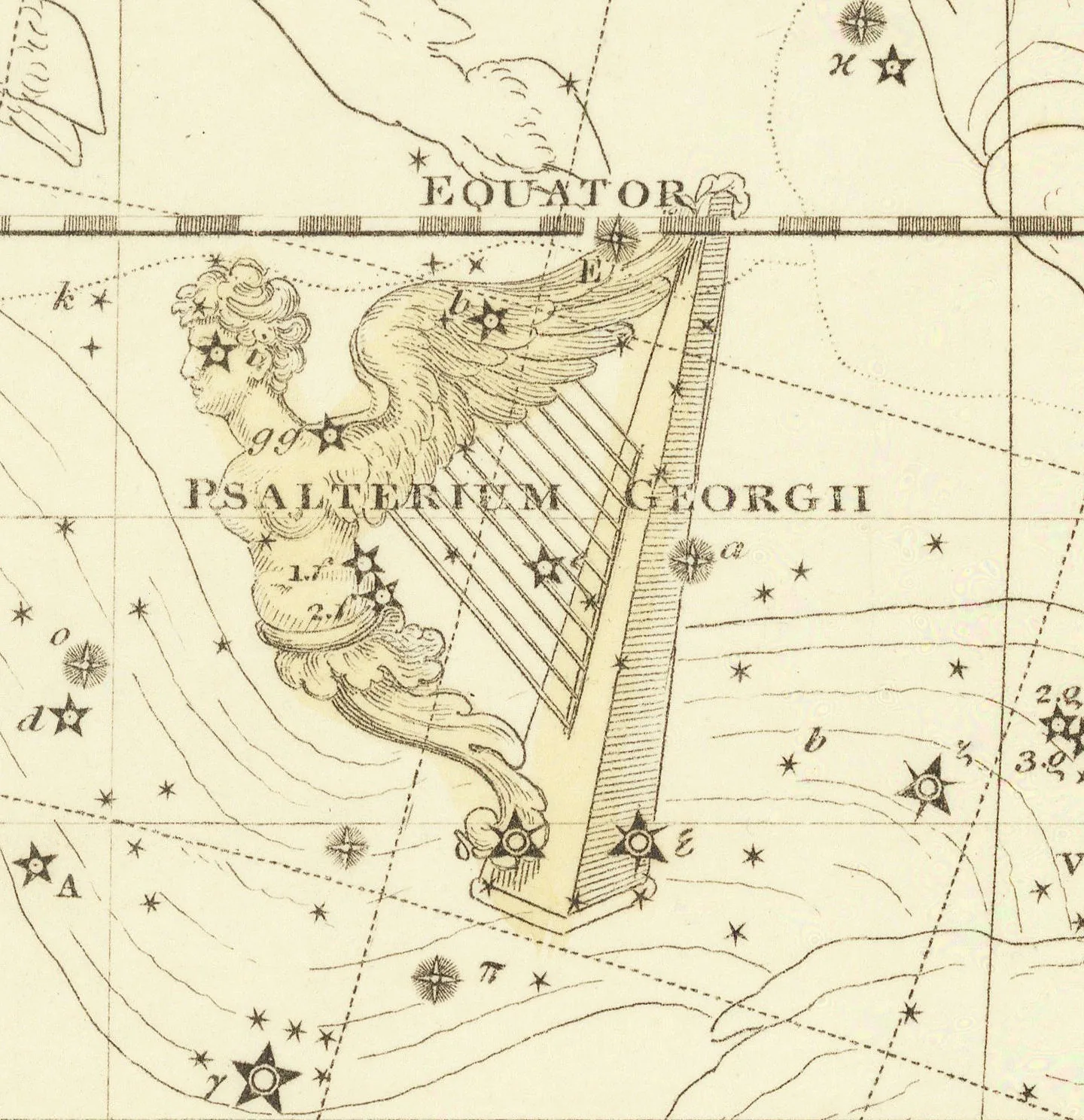
Maximilian Hell, the Hungarian-born director of the Vienna Observatory, introduced this one in 1789 under the name Psalterium Georgianum — George’s Psaltery, a psaltery being an ancient ten-stringed harp. It honored King George III, patron of William Herschel, who had discovered Uranus in 1781. Hell published it alongside two companion constellations he also invented to commemorate Herschel’s telescopes.
Bode adopted Hell’s constellation for his 1801 Uranographia but simplified the name to Harpa Georgii and redrew it as a more conventional harp. That was the version that became best-known before it faded out over the following decades. The harp’s brightest star — Gamma in Hell’s version, “E” in Bode’s — is the present-day 10 Tauri, magnitude 4.3, sitting almost exactly on the celestial equator.
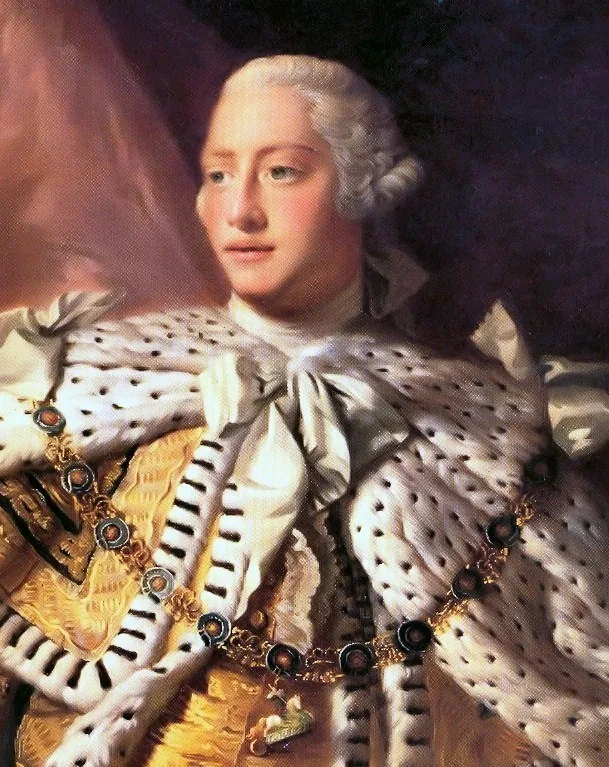
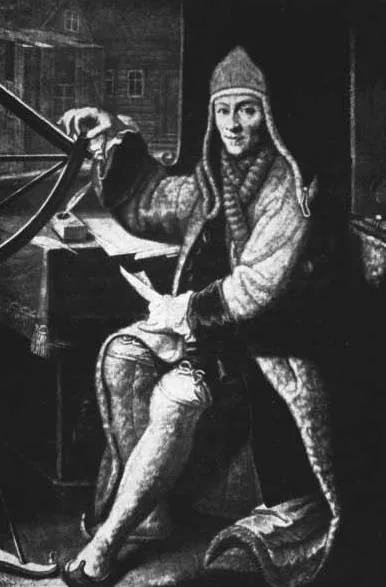
The astronomer: Maximilian Hell (1720–1792), a Jesuit astronomer who directed the Vienna Observatory and later led an expedition to observe the 1769 transit of Venus from northern Norway.
The honoree: King George III (1738–1820) — patron of William Herschel and, by extension, of the discovery that made this whole tribute possible in the first place.
Scutum Sobieski
Sobieski’s Shield — Johannes Hevelius, 1684 (chart published in Acta Eruditorum, August 1684; formally issued in the atlas Firmamentum Sobiescianum, 1690), honoring King John III Sobieski of Poland. The one survivor: still an official IAU constellation today, as plain Scutum.
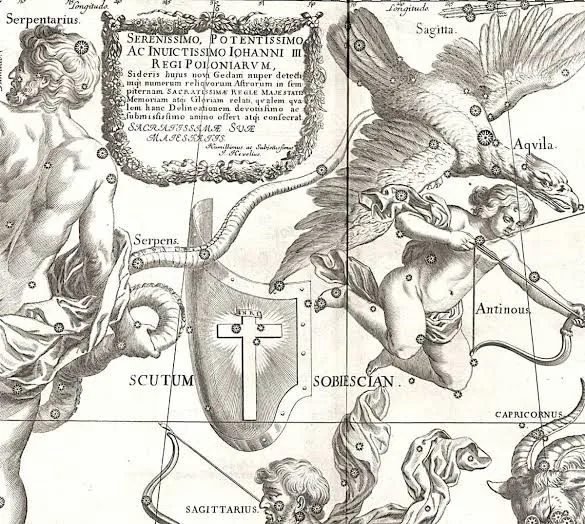
The fifth-smallest constellation in the sky, and the only politically-motivated one from this era still officially recognized. Hevelius introduced it as Scutum Sobiescianum — Sobieski’s Shield — to honor King John III Sobieski, who had personally helped fund the rebuilding of Hevelius’s rooftop observatory after a catastrophic fire in 1679 destroyed his instruments and most of three houses. Hevelius’s own description explicitly cited Halley’s six-years-earlier Robur Carolinum as precedent.
Even so, Scutum nearly didn’t make it. John Flamsteed, Britain’s first Astronomer Royal, ignored it entirely in his 1725 catalog and 1729 atlas, folding its stars into Aquila instead. Bode reinstated it in 1801 as Scutum Sobiesii. Francis Baily dropped it again from his 1845 British Association Catalogue. It was the American astronomer Benjamin Gould who settled the argument, including it as plain Scutum in his 1879 Uranometria Argentina and assigning it Greek letters for the first time — the detail that actually mattered.
Scutum sits in a bright stretch of the Milky Way between Aquila and Sagittarius. None of its stars are brighter than 4th magnitude and none are named, but it holds the Wild Duck Cluster (M11), whose fan-like shape gives the cluster its name.
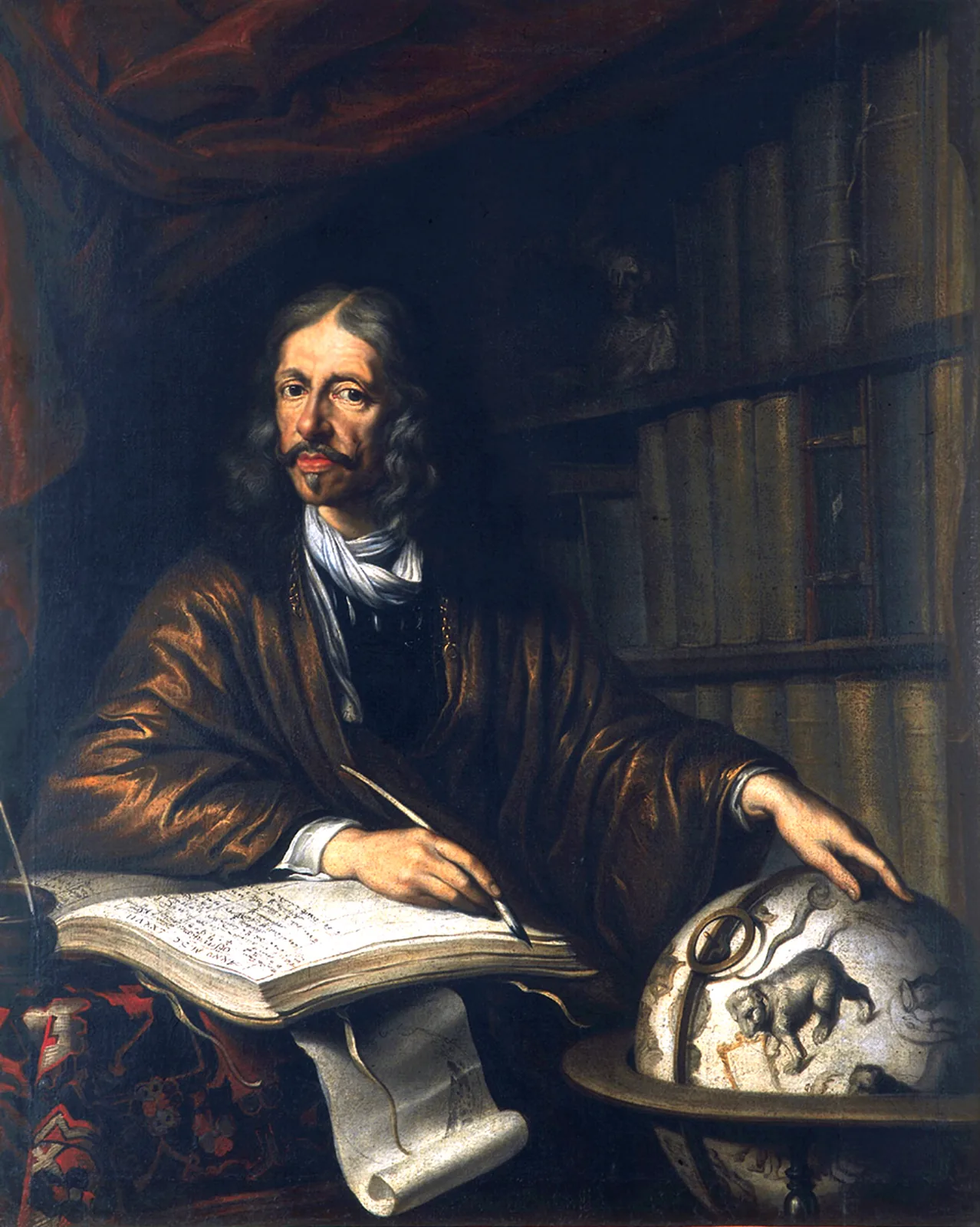
The astronomer: Johannes Hevelius (1611–1687), the last great naked-eye astronomer of the pre-telescopic-catalog era, ran a private observatory in Danzig (Gdańsk) that was, for a time, the finest in Europe — until the 1679 fire.
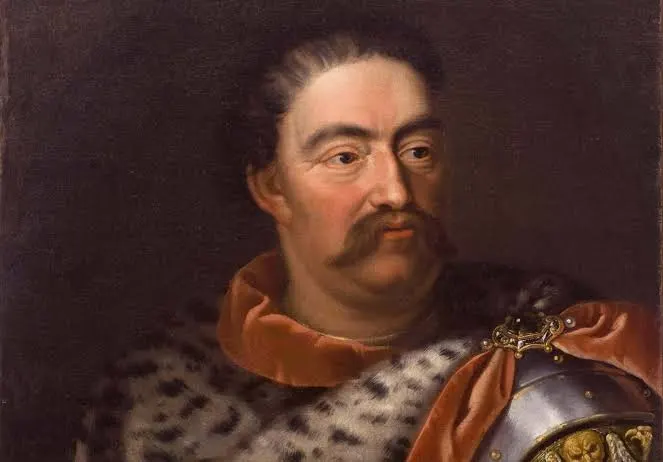
The honoree: King John III Sobieski (1629–1696), best remembered for commanding the relief of Vienna from Ottoman siege in 1683 — the year before Hevelius’s tribute.

Rediscovering the Former Constellations
Every constellation in this piece (except for Scutum) disappeared the same quiet way: nobody voted them out, they just stopped getting redrawn. Each generation of mapmakers had less reason to bother with a dead king’s sword or a forgotten elector’s scepter, until eventually none did.
At the same time, they haven’t really vanished, either; their stars are still exactly where they always were, just wearing different names now. Every entry above includes a modern starmap showing precisely where each one landed, and despite being made of dim stars, most are perfectly reachable with binoculars from an ordinary suburban backyard. Tracing out Kirch’s scepter in the bend of Eridanus, or Poczobut’s bull hiding in Ophiuchus, or the two disconnected pieces of König’s lion, is a genuinely fun way to become even more acquainted with the sky beyond the modern 88 constellations. There are a few dozen other “ex”-constellations that we’ll explore in future Historical Perspectives articles in the coming months.