
Introduction
“Pluto is actually an easy target for these scopes (and we’ll get to it later in the summer),” this space promised back in May, when a fainter, harder pair of dwarf planets – Haumea and Makemake – took center stage. It’s Pluto’s turn now.
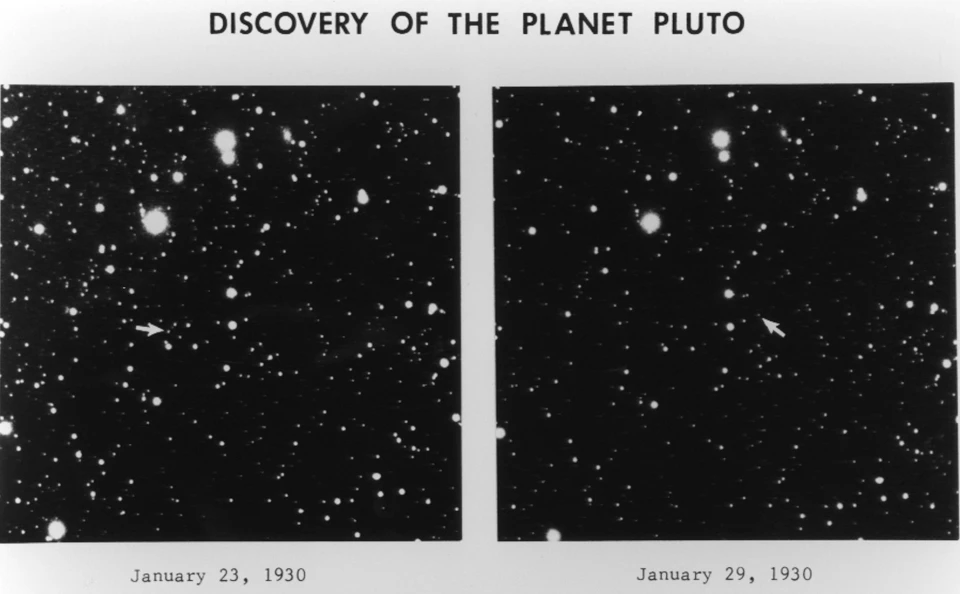
At magnitude ~14.5, Pluto isn’t the faintest thing a smart scope can reach – Haumea and Makemake, at magnitude 17, are harder targets by that measure. What makes Pluto’s challenge different is that you’re not hunting for a disk, a color, or any hint of structure. You’re hunting for motion. Take two exposures of the same star field a few nights apart, blink-compare them, and the one dot that shifted position is Pluto. That’s the entire technique – and it’s the same one used to find Pluto in the first place, by hand, in 1930.
Discovery

Percival Lowell spent the last decade of his life chasing a planet he never found. Convinced that unexplained irregularities in the orbits of Uranus and Neptune pointed to an unseen “Planet X” beyond them, he began a dedicated search from his observatory in Flagstaff, Arizona in 1906. He died in 1916 without success, and the search lapsed for over a decade.
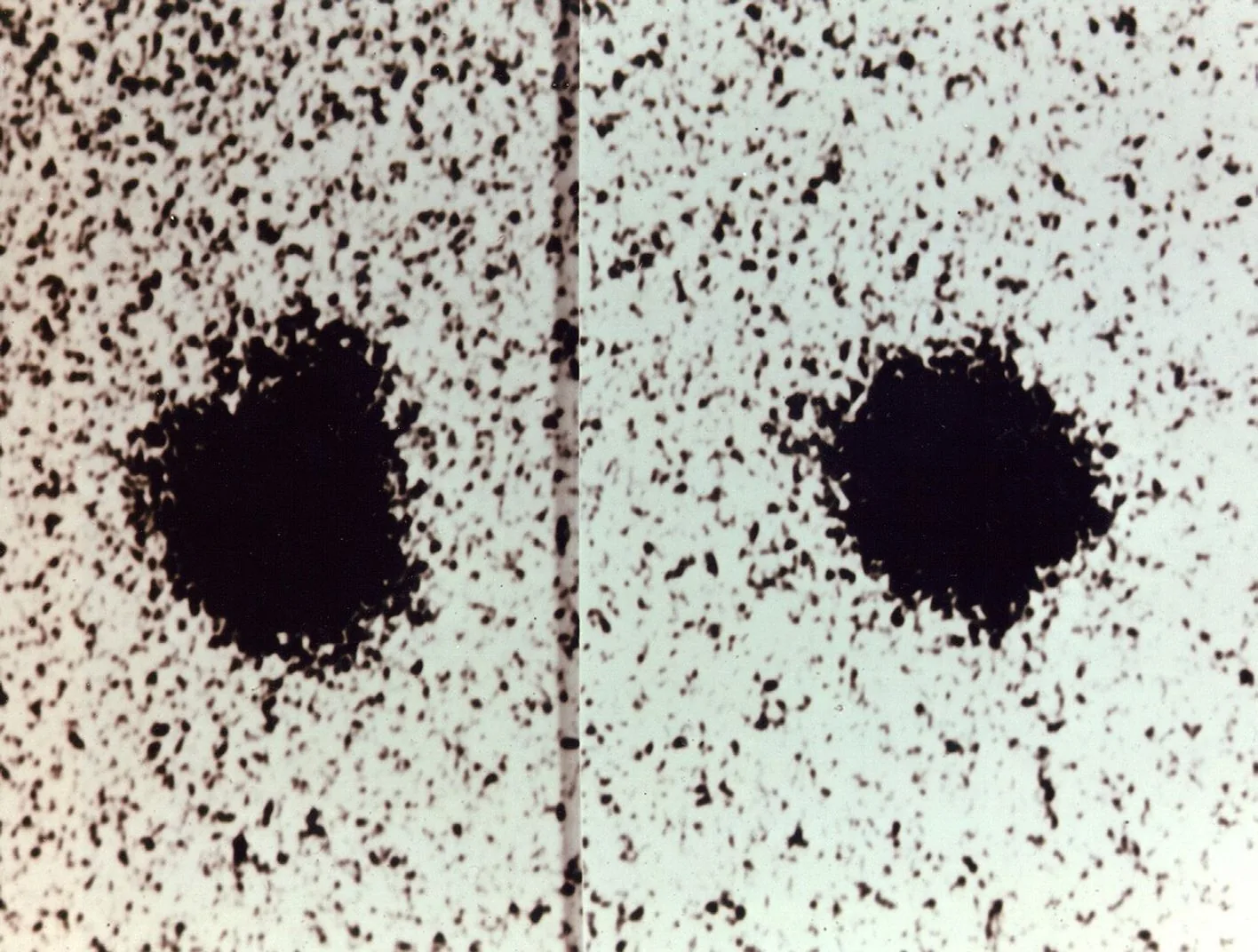
It resumed in 1929, when Lowell Observatory hired a 22-year-old Kansas farmer named Clyde Tombaugh. Tombaugh had no formal astronomy training – he’d built his own telescopes from farm equipment and mail-order lenses – but he had exactly the patience the job demanded: photographing the same regions of sky nights apart, then comparing each pair of plates star by star in a blink comparator, watching for anything that jumped between frames instead of holding still. Stars don’t move on that timescale. Something closer does.
On February 18, 1930, comparing plates taken January 23 and 29, Tombaugh found it. Lowell Observatory announced the discovery on March 13, 1930 – Percival Lowell’s birthday, and the anniversary of Uranus’s discovery 149 years earlier.
(On a personal note: I did my graduate work at New Mexico State Univ., founded by Clyde Tombaugh, and was privileged to have him attend my doctoral defense!)
The “Problem” of Pluto

It wasn’t, and the mismatch was obvious almost immediately: Pluto was far too faint to be a giant planet at that distance, which meant it had to be far too small to cause the irregularities that started the search. Estimates of its actual mass stayed rough for decades, because there was no way to weigh it precisely without something orbiting it to time.
So what caused Uranus’s apparent wobble in the first place? Nothing – it was a fluke of imprecise data, not a hidden planet. Neptune’s mass – the figure astronomers used to calculate exactly how hard Neptune’s gravity tugs on Uranus – was slightly overestimated. When Voyager 2 flew past Neptune in 1989, the way the flyby bent the spacecraft’s trajectory let astronomers measure Neptune’s mass directly, far more precisely than any telescope observation could, and revised it downward by about half a percent – roughly the mass of Mars. Recalculate Neptune’s pull on Uranus with the corrected mass, and the residual wobble vanishes entirely. There was never a Planet X. Lowell spent a decade hunting a ghost created by a slightly wrong number – and the search for that ghost turned up something real anyway.
The Largest Dwarf Planet
Pluto was reclassified as a dwarf planet by the IAU in 2006, a decision that still generates arguments at star parties. This isn’t the place to relitigate it – whatever you call it, Pluto is one of the more interesting objects in the outer solar system, and the label doesn’t change what’s actually out there.
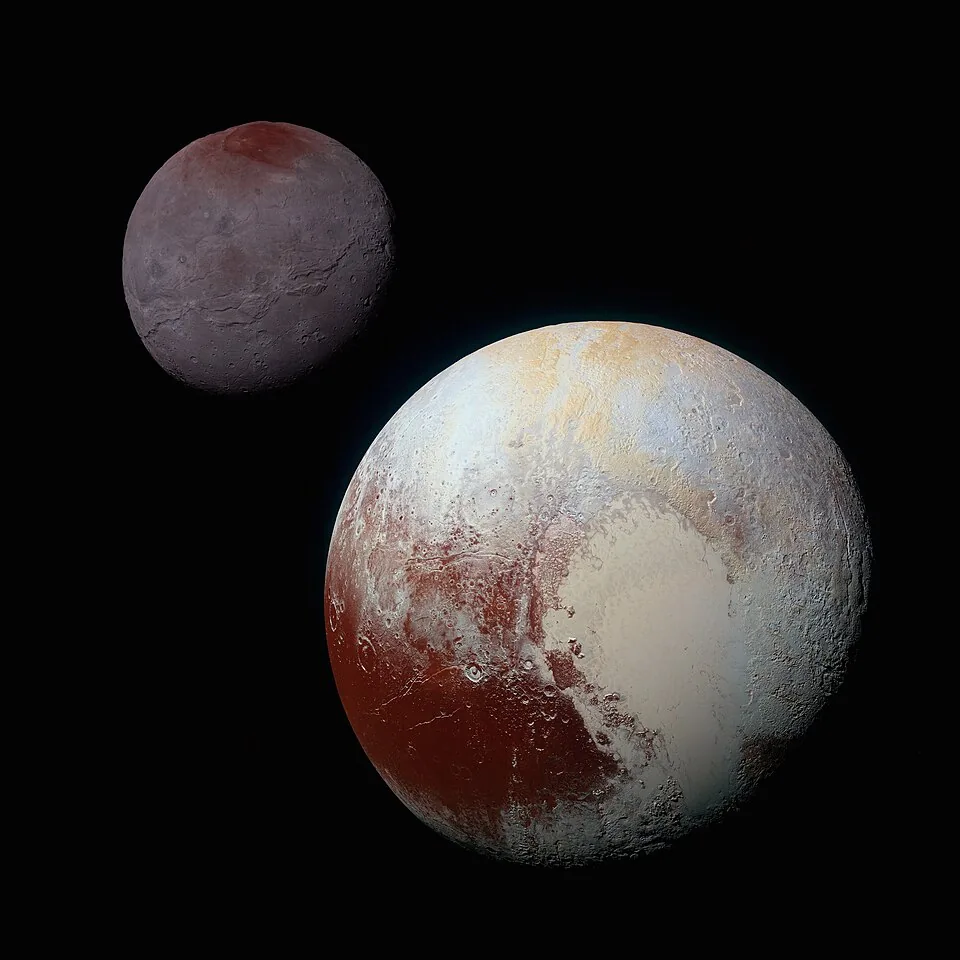
What’s out there is smaller than most people expect: about 2,377 km across, smaller than Earth’s own Moon. Its largest moon, Charon, is roughly half that diameter – big enough relative to Pluto that the two don’t orbit a point inside Pluto the way the Moon orbits inside Earth’s sphere of influence. They orbit a shared point of balance in the empty space between them, locked face-to-face, each showing the other the same hemisphere forever. It’s less “planet and moon” than “double world.”
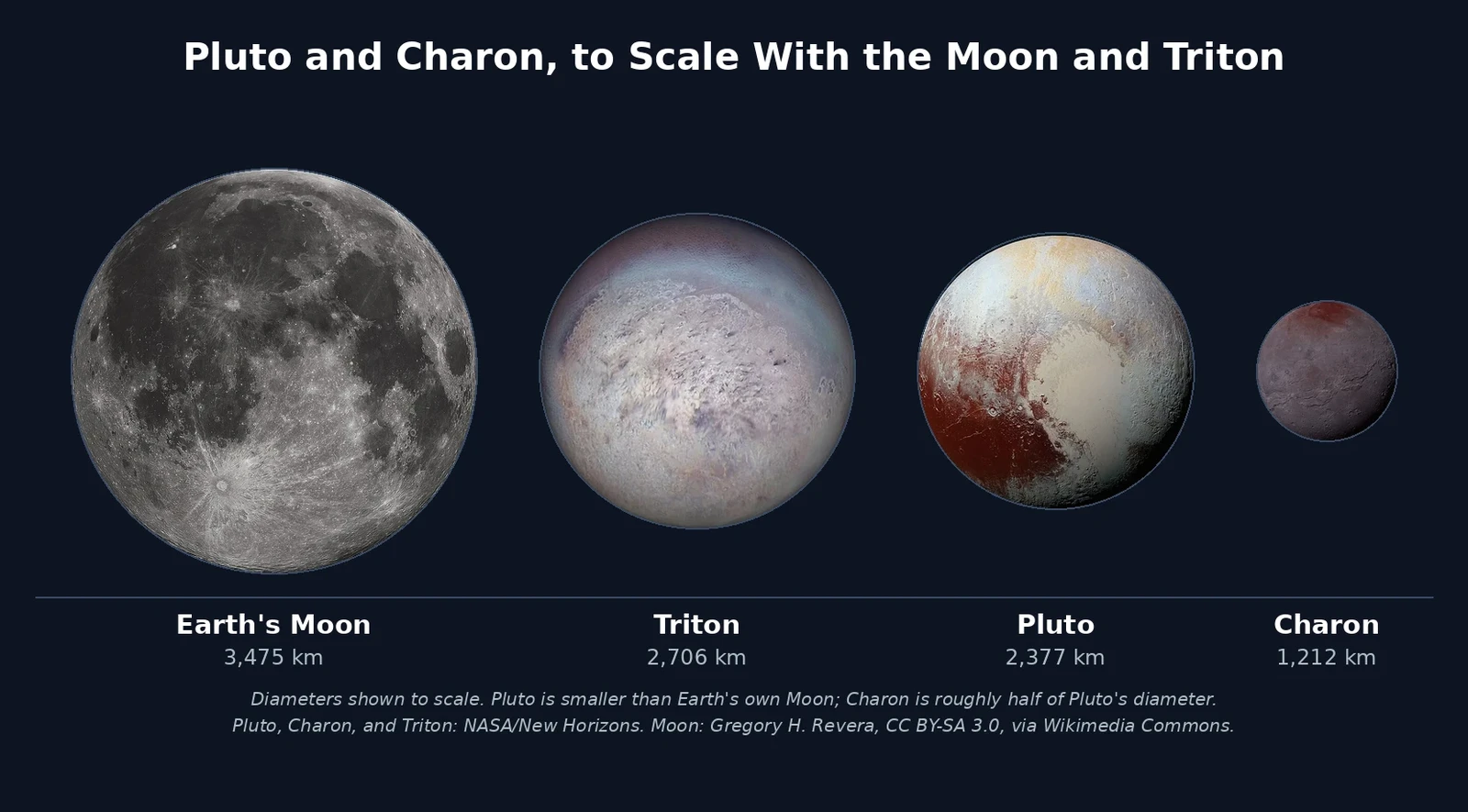
Neptune’s moon Triton, shown above for scale, is a useful comparison: similar size, similar likely composition, and – unlike every other large moon in the solar system – orbiting Neptune backwards, opposite the planet’s own rotation. That retrograde orbit is the giveaway that Triton wasn’t born alongside Neptune at all. It’s almost certainly a captured world, pulled in from the same Kuiper Belt population Pluto belongs to – a preview of what Pluto itself might look like if it ever wandered too close to a giant planet.
NASA’s New Horizons spacecraft flew past Pluto on July 14, 2015, after a nine-year journey, and turned it from a fuzzy dot into an actual world. The heart-shaped plain visible in the image above is Tombaugh Regio, named for Pluto’s discoverer – its western lobe, Sputnik Planitia, is a nitrogen-ice glacier several kilometers thick with no impact craters at all, meaning its surface is actively resurfacing itself and is likely younger than 10 million years old. Nearby, water-ice mountains – Norgay Montes, named for Tenzing Norgay of the first Everest summit – rise over 11,000 feet, comparable to the Rockies, made of ice rigid enough to hold that shape at Pluto’s temperatures. Pluto turned out to have a thin, hazy, multi-layered nitrogen atmosphere, and there are hints, still debated, of a liquid water ocean under all of it. Charon got its own surprise: a dark red north polar cap, nicknamed Mordor Macula, built up from gases that escape Pluto’s atmosphere and freeze onto Charon’s pole before sunlight cooks them into reddish organic compounds. None of that was knowable in 1930. All of it was sitting there the whole time.
Observing Pluto
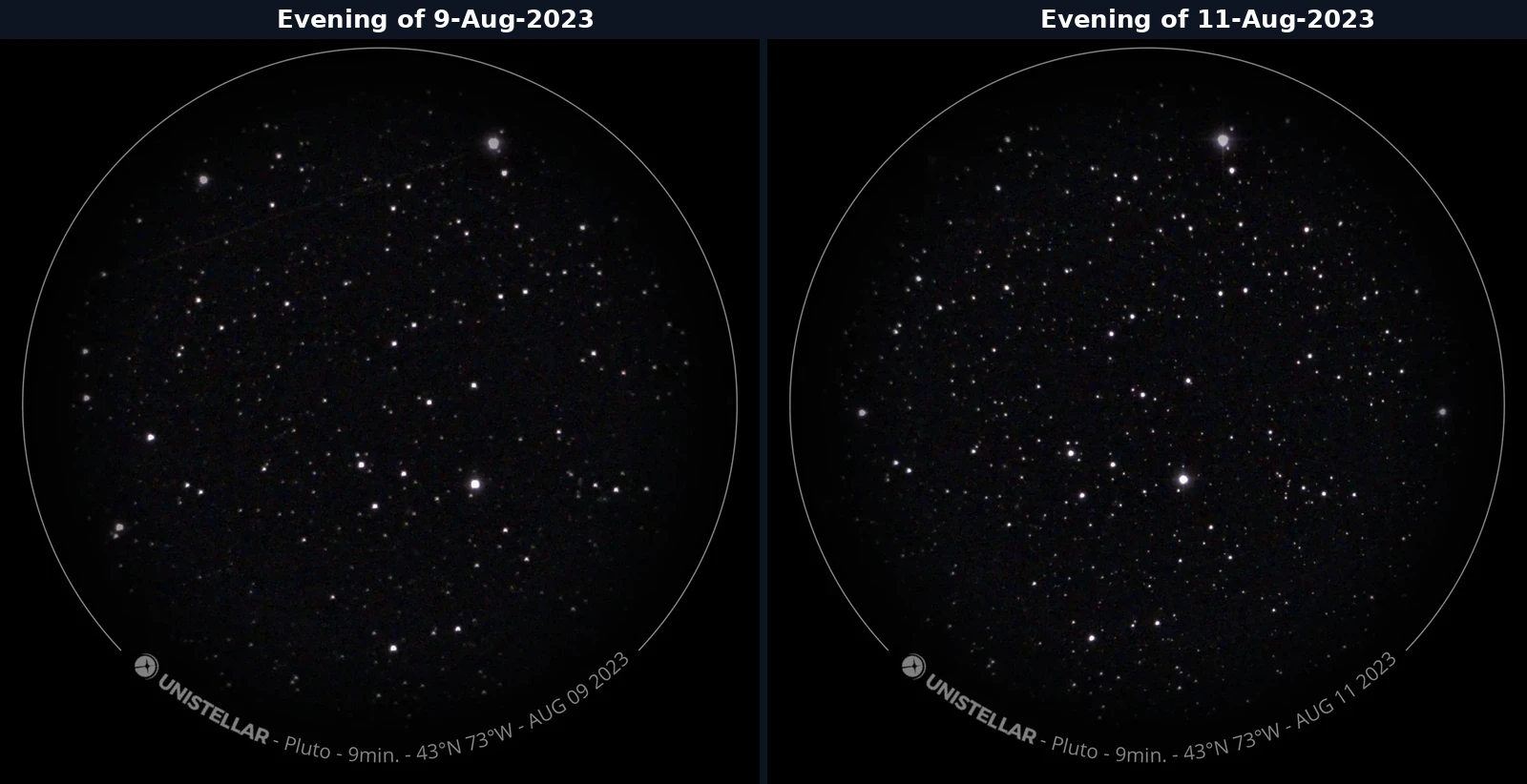
Mimicking the Blink Method
You don’t have to take a series of images if you already know where to look, though it’s worth doing at least once – it’s the same exercise Tombaugh ran by hand, just compressed from weeks of plate-blinking into an evening of smart-scope integration. At magnitude 14-15, Pluto is within range of every smart scope currently on the market, and it doesn’t require hours-long exposure times: the pair above is 9 minutes each on an eQuinox2. Scaling roughly for aperture, expect around 30 minutes on a Seestar S50, and closer to 80 minutes on the smaller S30.
Go to Pluto’s coordinates on your smart scope app – eQuinox2 users, that’s the “Move” section’s crosshairs button; Seestar users, create a custom object and enter the RA/Dec directly – and integrate for the times above. Then repeat the same field a few nights (or a couple of weeks) later. Pluto moves slowly this far out – only about 2-3 arcminutes over five days in the table below – but that’s still easily detectable against a fixed star field once you blink the two images.
Two things make this window a slightly awkward one, worth knowing going in. First, Pluto sits at declination -23.6°, well south of the celestial equator, so it’s not up above the horizon for very long from mid-northern latitudes – plan for a shorter window each night than you’re used to. Second, Pluto actually reached opposition – its closest, brightest, best-placed point for the year – on July 27, 2026, just before this window opens. You’re catching it a bit past its yearly peak rather than at it, which is why its solar elongation keeps dropping across the table below. It’s still well-placed for evening observing through the whole window; it just won’t get any better than it already was a month earlier.
Ephemeris Predictions
Positions below are from NASA Horizons, geocentric, at 0h UT for each date. The full output – including azimuth/elevation, airmass, and lunar sky brightness for every five-day step – is available as a plain text file if you want more than the table below.
Since Pluto is past opposition and getting closer to the Sun in the sky as the window goes on, meridian transit – when it’s highest and best-placed for the night – creeps about four minutes earlier each night. That’s included below as local Eastern Daylight Time.
| Date (0h UT) | R.A. | Dec. | Mag. | Dist. (AU) | Meridian (EDT) |
|---|---|---|---|---|---|
| 2026-Aug-27 | 20 26 25.83 | -23 36 41.4 | 14.49 | 34.71 | 10:59 PM |
| 2026-Sep-01 | 20 26 02.00 | -23 38 05.8 | 14.50 | 34.76 | 10:39 PM |
| 2026-Sep-06 | 20 25 39.92 | -23 39 21.5 | 14.51 | 34.82 | 10:19 PM |
| 2026-Sep-11 | 20 25 19.82 | -23 40 27.8 | 14.52 | 34.88 | 9:59 PM |
| 2026-Sep-16 | 20 25 01.92 | -23 41 24.1 | 14.53 | 34.95 | 9:39 PM |
| 2026-Sep-21 | 20 24 46.38 | -23 42 10.2 | 14.53 | 35.02 | 9:19 PM |
| 2026-Sep-26 | 20 24 33.36 | -23 42 46.1 | 14.54 | 35.09 | 8:59 PM |
| 2026-Oct-01 | 20 24 23.01 | -23 43 11.5 | 14.55 | 35.17 | 8:39 PM |
| 2026-Oct-06 | 20 24 15.43 | -23 43 26.2 | 14.56 | 35.25 | 8:19 PM |
| 2026-Oct-11 | 20 24 10.73 | -23 43 30.1 | 14.56 | 35.34 | 8:00 PM |
| 2026-Oct-16 | 20 24 08.99 | -23 43 23.4 | 14.57 | 35.43 | 7:36 PM |
| 2026-Oct-21 | 20 24 10.27 | -23 43 06.3 | 14.58 | 35.52 | 7:16 PM |
| 2026-Oct-26 | 20 24 14.59 | -23 42 38.8 | 14.58 | 35.60 | 6:57 PM |
| 2026-Oct-31 | 20 24 21.92 | -23 42 01.3 | 14.59 | 35.69 | 6:37 PM |
Meridian times are computed for the club’s own observing latitude and longitude (42.58°N, 73.17°W) and stay in EDT throughout this window – Daylight Time doesn’t end until November 1. Note that a couple of these transit times land in the evening before the UT date in the first column; that’s just the UTC/local date boundary crossing at night, not an error.
Pluto sits right on the Sagittarius/Capricornus border for this entire window – consistent with its slow drift into Capricornus in recent years. Check the position against Stellarium or your planetarium app of choice before each session, but treat the table above as the more current word: Stellarium’s built-in orbital elements aren’t always the freshest.